
1. Introduction
Chronic meningitis refers to a clinical syndrome caused by several etiologies, including infectious (Mycoses, Bacteria, Mycobacterium, Parasites.) autoimmune, neoplastic, and other group diseases. Neuropsychologic signs and symptoms, including decreased level and content of consciousness, focal neurologic deficits and meningeal irritation for more than 3 - 4 weeks with sustained abnormal cerebrospinal fluid cerebrospinal fluid (CSF) present this syndrome. Fungal infections have recently shown increased incidence in immunocompromised patients, and brucellosis should be noticed based on epidemiology (1). In spite of clinical impact and improvement in diagnostic tools, chronic meningitis remains a diagnostic challenge in clinical practice. Owing to non-specific clinical manifestations and paraclinical findings, it is difficult to distinguish different etiologies, resulting in delayed diagnosis especially when more than one disease is responsible.
Brucellosis is most commonly seen in the Mediterranean countries, the Balkans, the Persian Gulf, the Middle East, and Central and South America (2). Brucella melitensis is the most invasive species and can involve any part of nervous system as acute, subacute and chronic course (3). Laboratory confirmation is necessary by culture, serology, or molecular tests. Automated blood culture systems are more often positive than conventional cultures for sterile body fluids including CSF. Serum agglutination test (SAT or Wright test) is usually recognized as the reference technique and ELISA is less specific. Molecular tests with high sensitivity and specificity provide early recognition (4).
Aspergillus meningitis is rare with nonspecific clinical presentation. The most common Aspergillus species causing invasive infection is A. fumigatus, followed A. flavus, A. terreus, and, less common A. niger. However, less common species that are often identified by molecular means have increasingly been reported to cause invasive infection. Most species initially appear as small, fluffy white colonies on culture plates within 48 hours from a normally sterile site, such as a needle biopsy or CSF, although blood cultures are rarely positive (5).
A. terreus has colony beige to cinnamon buff color with Columnar; biseriate; globose; small 2 - 2.5 μm conidia and globose accessory conidia along hyphae. It is increasingly detected as resistant to amphotericin B and more susceptible to newer azoles. Aspergillus niger has initially white colony, rapidly turning black with yellow reverse, microscopically radiate; biseriate; globose, black, with very rough conidia 4 - 5 μm. It is uncommon in invasive infections but causing superficial agent of otic disease and colonization (6).
Antibody detection is of limited utility because immunosuppressed hosts fail to mount an antibody response even with invasive infection. Detection of galactomannan (GM) by enzyme immunoassay (EIA) has contributed substantially to the diagnosis of invasive aspergillosis with controversy in optimal cut-offs (0.5 - 0.7). Other potential markers also include the nonspecific fungal marker β-d-glucan (BDG) (7). Polymerase chain reaction (PCR) is now accepted as an early diagnostic marker for IA, which may be more sensitive than other methods (6). The new metagenomic next-generation sequencing (mNGS) is a fast, unbiased, culture-free approach that can increase the pathogen species detection rate, such as fungi, helping clinicians improve the accuracy of clinical diagnosis and take therapeutic action as quickly as possible (8).
In this report, we present a case of co-infection of Aspergillus and Brucella chronic meningitis in a construction worker with no history of immune deficiency.
2. Case Presentation
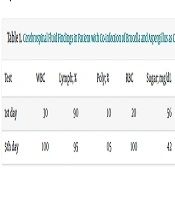
The patient is a 36-year-old Afghan man, who lived in Iran in a village near Tehran for 20 years as a construction worker. He had headaches, dizziness, nausea, vomiting, and weight loss since a month ago and behavior disorder, lethargy, restlessness, confusion, delirium, ataxia, and arthralgia from one week before admission. He had no focal neurological deficits, nuchal rigidity, or Kernig’s and Brudzinski’s signs. Both pupils were midsize and reactive to light. Fundoscopy showed no uveitis and retinopathy. The cranial and peripheral nerve exams were normal. Chest, abdomen, musculoskeletal, and scrotum exams was all normal. The brain CT scan was normal. MRI presented small nonspecific white matter hyperintensity signals on T2-weighted and fluid attenuated inversion recovery (FLAIR). Unidentified bright objects were also observed in the frontal lobe. Chest CT scan, abdominopelvic ultrasonography was all normal. Cerebrospinal fluid analysis showed lymphocytic pleocytosis, low sugar, and increased protein (Table 1). Treatment with ceftriaxone, vancomycin, and acyclovir was started. Complete blood count, rheumatologic, renal, liver, thyroid, inflammatory, and toxicologic tests were normal. Biochemistry tests were normal other than resolving hyponatremia. The patient evaluation was continued with the impression of chronic meningitis. Serum VDRL, galactomannan (GM) antigen, and β-d-glucan (BDG) tests were negative. Brucella serology was reported positive in serum as Wright: 1/160, Coombs Wright: 1/160, 2ME:1/80 and in CSF as Wright:1/80, Coombs Wright:1/160 and 2ME1/40. No pathogen was obtained through microbial culture. Aspergillus PCR was negative for A. fumigatus and A. flavus but a positive PCR which could not differentiate A. niger from A. terreus, was detected in CSF by PCR, regarding A. terreus is inherently resistant to amphotericin B. The mNGS test was not available to further differentiation.
The treatment was changed to ceftriaxone, doxycycline, rifampin, and intravenous voriconazole. There was a rise in serum creatinine level, which normalized by discontinuation of vancomycin. After one week, the level of consciousness content slightly decreased, and a new Brain CT scan showed mild ventriculomegaly; dexamethasone was added, and he had clinical improvement with complete orientation after two days.
At the end of two weeks of treatment, the patient's symptoms improved. Due to financial problems treatment continued as oral doxycycline and rifampin, plus ceftriaxone and voriconazole in the form of outpatient parenteral antibiotic therapy (OPAT) from the third week. For one month there was no neurologic sequelae or drug side effects, but after that time (6 weeks of treatment) he moved to his country without informing anyone or coming to the hospital.
Table 1.
Cerebrospinal Fluid Findings in Patient with Co-infection of Brucella and Aspergillus as Chronic Meningitis
| Test | WBC | Lymph; % | Poly; % | RBC | Sugar; mg/dL | Protein; mg/dL |
|---|---|---|---|---|---|---|
| 1st day | 30 | 90 | 10 | 20 | 56 | 418 |
| 5th day | 100 | 95 | 05 | 100 | 42 | 305 |
3. Discussion
Chronic meningitis is meningeal inflammation with signs and symptoms for at least 4 weeks without relief, including headache, lethargy, mental status changes, and fever with sustained abnormal CSF. It has many infectious and non-infectious etiologies to be considered as a challenging diagnostic entity and needs more complex diagnostic tests and treatments based on etiology (1).
New pathogens have been added to infectious etiologies, and molecular analysis provides important help to detect them. New mNGS provides identification of pathogens without the bias of a predetermined result (8).
Considering two etiologies may cause signs and symptoms, all clinical and paraclinical evaluations should be completed based on epidemiology and patient immune status.
Neurobrucellosis is common in endemic countries and is in the first diagnoses of chronic meningitis including in Iran. It involves every part of the central and peripheral nervous system, such as isolated meningitis, encephalitis, myelitis, peripheral neuritis and psychologic disorders, or any combinations of these syndromes. It is diagnosed by serology and culture. In brucella meningitis, CSF changes include mononuclear pleocytosis, high protein, and hypoglycorrhachia (9). Paraclinical confirmation is necessary by culture, serology, or molecular tests (6).
A case of Brucella and VZV co-infection in a 56-year-old woman with low consciousness, seizures, fever, and mood disorders has been reported. The brain CT revealed no pathological lesions, but MR showed non-specific plaques in the periventricular white matter. VZV was detected by molecular tests in CSF. The blood culture and the Wright test revealed the presence of Brucella spp (10).
Karsen has presented a meningitis case with Brucella and Mycobacterium co-infection. Patient was a 19-years-old stockbreeder who had severe headache, fever, vomiting, meningeal irritation symptoms, confusion and diplopia. STA test for brucellosis was positive at 1/80 titer in CSF and at 1/640 titer in serum with negative growth of Brucella spp. There was no clinical improvement. Repeated CSF smear yielded acid-fast bacteria. Tuberculosis meningitis was confirmed with the growth of M. tuberculosis on the 14th day of cultivation (BACTEC) of the CSF sample (11). A case of hydrocephalus due to brucella meningitis has been reported as our case (12). Coinfection of Brucellae and Aspergillus in meninges has not been reported.
Cerebral aspergillosis has the highest mortality of invasive aspergillosis syndromes; the incidence of cerebral aspergillosis is low and can’t be easily determined because the diagnosis is often unsuspected, and it appears in patients with persistent immunosuppression and disseminated disease. Concomitant pulmonary infection is usually present in some patients. Isolated cerebral aspergillosis can occur in intravenous drug abusers or immunocompetent patients (13). Aspergillus has 250 species in 8 subgenera that are subdivided into a total of 27 sections and species complexes. Different probes are used for the detection and differentiation of Aspergillus spp. based on the detection of markers within the gene of Aspergillus and newly mNGS (8).
A. terreus is an emerging uncommon opportunistic pathogen, a common soil-related isolate, causing fatal disseminated infections in immunocompromised patients. Identification of A. terreus is increasingly important because of its resistance to antifungals, including amphotericin B, but improved susceptibility with newer azoles (14). Its presentations are low and described in case reports. A case of fungal meningitis caused by A. terreus in an immunocompetent patient with nasal and sinus polypectomy. He developed headache, fever, fits, loss of consciousness one week after surgery. Computed tomographic (CT) images showed pansinusitis, hydrocephaly, left lower lobe consolidation with right upper lobe linear atelectasis and mild ground glass density patches. Abnormal CSF culture was positive for Aspergillus (BACTEC) and mNGS showed high degree of similarity (above 99.7%) to A. terreus reference sequences. He had hydrocephaly as our case (15). Syndromes as endogenic endophthalmitis, post acupuncture spondylodiscitis with A. terreus, and other presentations has been reported (16, 17).
Aspergillus niger is found in soil, on plants, in food and condiments such as pepper, and is used in the chemical industry for a variety of applications, while being a possible pathogen to humans. The role of A. niger in invasive infection is less well proved, because of its low virulence, perhaps due to its large conidia, which cannot easily reach deep into lung parenchyma. It is a common colonizer and causes superficial infections, such as otitis externa (6).
Simmonds reported a 68-year-old woman with a background of hypertension, stroke and rheumatoid arthritis treating with methotrexate presented with a 4-week history of gradual deterioration and increasing confusion with new onset right-sided weakness. Her initial CT scan revealed a rim enhancing mass lesion with surrounding edema in the left parietal lobe for which she underwent CT scan-guided biopsy. Microbiology culture of the 2 biopsy samples yielded A. niger. She was started on the antifungal agent voriconazole then posaconazole, with recovery (18).
Another case of a 67-year-old previously immunocompetent female who was treated with corticosteroids for COVID-19 one-month prior was admitted for altered mental status (AMS). Subsequent imaging and biopsy demonstrated invasive CNS A. niger. This report draws attention to the detrimental immunosuppressive effects of corticosteroid therapy in COVID-19 (19).
Our patient was an immunocompetent construction worker without any immunosuppressive drug use.
Signs and symptoms of chronic meningitis and CSF changes in infectious and noninfectious etiologies are similar, non-specific, and overlap with each other. So, evaluation should be complete to find combined diseases. In endemic areas, infection with two pathogens at the same time should not be ignored, and physicians should use a variety of methods to augment the detection rate of the pathogen.
This case has four points of importance: (1) Brucella meningitis is common, and this patient is the first case of Brucella and Aspergillus co-infection in meninges; (2) A. niger or A. terreus meningitis alone is rare, and this patient is the first co-infection of A. niger or A. terreus and Brucella in meninges; (3) all possible infectious and non-infectious diseases should be evaluated for rapid diagnosis and prevention of neurological complications, and various pathogens should be considered based on the patient’s immune status and endemicity; (4) identification of pathogenic fungal species is important for using effective drugs, contemplating antifungal sensitivity.
3.1. Conclusions
In chronic meningitis, it is important to investigate all possible infectious etiologies agents (Bacterium, Fungi, …) and other non-infectious diseases to confirm rapid diagnosis and prevent neurological complications. Consideration of various pathogen should also involve the patient’s immune status and endemicity.