
1. Background
One of the most important and evolving topics in pediatric cardiology is the fetal heart (1). The possibility of high-quality and detailed images of the anatomy of the heart became possible with the advancement of ultrasound technology (2) that enabled capturing images of the developing heart of the fetus with high resolution. Currently, congenital heart disease in babies and children is diagnosed using this method (3). On the other hand, fetal echocardiography between 18 - 22 weeks of pregnancy can detect congenital heart diseases (CHD) in fetus with a high sensitivity (2). Fetal echocardiography is a completely non-invasive and harmless diagnostic method, and the most suitable tool for diagnosing structural abnormalities of the heart including CHD and echogenic heart (1). The CHD is one of the most common congenital abnormalities in infants and children (4). Based on the results of the previous studies, 6 - 9 out of every 1000 live babies have CHD (5). As the heart defects are associated with significant complications and mortality in fetuses and infants, one of the most important measures during pregnancy is to diagnose fetal CHD before birth (6). Most CHDs can be detected in utero during the second or even late first trimester with a detection rate of 85 - 95% in specialized departments. One of the weak soft markers of CHD in newborns is the presence of an echogenic focus in the ventricular heart (4). The intracardial echogenic focus of the fetus (ICEF) is defined as a type of benign complication without clinical symptoms (7). Echogenic diagnosis is made with the observation of a bright spot in the heart muscle during the ultrasound examination of the fetus (8). The incidence of ICEF has been reported to be between 30 - 86 % (9). The most common place for the ICEF Index is the left ventricle of the fetus heart (7). Based on the results of previous studies and clinical experiences, the echogenic focus represents mineralization or small deposits of calcium in the heart muscle (9). Therefore, physiological changes during pregnancy are obvious for the adaptation of the mother and the nutritional needs of the fetus (8). Considering the conflicting results obtained in pathogenesis studies, the reported findings need further investigation.
The findings of a number of previous studies have shown that the presence of ICEF does not cause structural or functional problems in the heart (10-12). However, some other echocardiography studies of newborns have shown the continuation of the echogenic focus inside the heart and subsequent congenital diseases of newborns (7, 13). Additionally, some studies have shown that in 20 - 90% of cases, ICEF disappears inside the heart of newborns (14).
2. Objectives
Considering the contradiction between the results of previous studies, the present study was undertaken in pregnant women to explore the association between ICEF and CHD.
3. Methods
3.1. Study Design and Participants
The study population of the current Cohort study consisted of pregnant women whose fetuses were affected by intracardiac echogenic focus.
3.2. Data Collection
The pregnant women who were referred to Dr. Mohammad Kermanshah Hospital Clinic, Kermanshah, Iran, for fetal echocardiography during 2017 - 2023, and had definitive diagnosis of the echogenic center inside the fetal heart. Pregnant women were selected during 7 years. Echocardiography was performed by a Samsung Ws80 device, manufactured in South Korea in 2015, by a pediatric cardiologist.
Each pregnant woman was examined during 9 months of pregnancy between the 18th and 22nd week of their fetus. After delivery, their babies were followed up until the 36th day after birth.
3.3. Inclusion and Exclusion Criteria
Inclusion criteria were as follows: (1) The ultrasound anomaly scan was normal; (2) none of the other soft markers, such as echogenic intestine, were present; (3) the axis of the heart was normal; and (4) the four-chamber view of the heart was normal. The exclusion criteria included: (1) The parents had a history of CHD; (2) kidney function and calcium levels were not normal; (3) an echogenic focus scan had not been performed between weeks 18 and 22; (4) control echocardiography was not performed after birth until the 36th day; and (5) the mother’s kidney function was abnormal.
3.4. Data Collection Tool
The data collection tool in the present study was a researcher-made checklist. The checklist includes the mother’s demographic information such as weight (kg), height (cm), Body Mass Index (BMI), mother’s age (years), delivery age (years), and pregnancy information including: Mother’s turn of pregnancy (number), abortion history (number), age of fetal examination (weeks), location of echogenic focus of the fetal heart (right, left, both), and delivery data time of newborn cardiac examination after birth (days), gender of the newborn (boy, girl), type of delivery (natural, cesarean), and congenital heart disease of the newborn (yes/no).
3.5. Statistical Analysis
Data analysis was performed after data collection and entry into STATA software version 17. To describe quantitative data, central indicators (mean, standard deviation) and to describe qualitative variables, frequency (percentage) were reported.
4. Results
Among the 926 women studied, 100 pregnant women whose fetuses had fetal heart echogenic foci during pregnancy and met the study criteria were selected using the using the census method. The minimum age of pregnancy was 16 years and the maximum age was 46 years. Overall, the average age of the included subjects was 32.1 ± 9.1 years. Based on the descriptive results, the average BMI was 30.9 ± 5.3. On average, the fetus was examined at 19.2 ± 1.2 weeks and the newborn at 38.2 ± 1.9 days for the echogenic state of the heart (Table 1).
Table 1.
Descriptive Information Related to Quantitative Variables Studied (N = 100)
| Variables | Range | Mean ± SD |
|---|---|---|
| Age (y) | 16 - 46 | 32.1 ± 9.1 |
| Weight (kg) | 60 - 116 | 81.3 ± 13.1 |
| Height (cm) | 153 - 178 | 162.5 ± 5.9 |
| BMI | 22 - 45 | 30.9 ± 5.3 |
| Time of fetal cardiac echogenic examination (wk) | 18 - 22 | 19.2 ± 1.2 |
| Time of echogenic examination after birth (d) | 36 - 41 | 38.2 ± 1.9 |
Abbreviation: BMI, Body Mass Index.
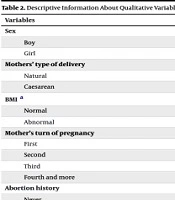
The results showed that 54.0% (n = 54) of the examined infants were boys and the rest were girls. Also, 28.0% of women (n = 28) experienced their first pregnancy and 20.0% (n = 20) had at least their fourth pregnancy. The findings indicated that 46.0% (n = 46) of the echogenic focus of the fetal heart was observed on the right side, 29.0% (n = 29) on the left side, and 25.0% (n = 25) on both sides. Therefore, 28.0% (n = 28) of the women had a history of one abortion and 7% (n = 7) had a history of two abortions. Additionally, 86% (n = 86) of women gave birth naturally and the rest were delivered by cesarean section. None of the examined infants who had an echogenic heart center during the fetal period had congenital heart disease after birth until the 36th day. Additionally, after 36-day postnatal follow-up, their cardiac echogenic focus disappeared (Table 2).
Table 2.
Descriptive Information About Qualitative Variables Studied (N = 100)
| Variables | No. (%) |
|---|---|
| Sex | |
| Boy | 54 (54.0) |
| Girl | 46 (46.0) |
| Mothers’ type of delivery | |
| Natural | 86 (86.0) |
| Caesarean | 14 (14.0) |
| BMI a | |
| Normal | 11 (11.0) |
| Abnormal | 89 (89.0) |
| Mother’s turn of pregnancy | |
| First | 28 (28.0) |
| Second | 29 (29.0) |
| Third | 23 (23.0) |
| Fourth and more | 20 (20.0) |
| Abortion history | |
| Never | 65 (65.0) |
| 1 | 28 (28.0) |
| ≥ 2 | 7 (7.0) |
| Congenital heart disease | |
| Yes | 0 (00.0) |
| No | 100 (100.0) |
| Location of echogenic focus | |
| Left | 29 (29.0) |
| Right | 46 (46.0) |
| Both | 25 (25.0) |
| Time of examination after birth (d) | |
| < 5 | 31 (31.0) |
| 5 - 10 | 69 (69.0) |
Abbreviation: BMI, Body Mass Index.
a Normal Body Mass Index is 18.5 - 24.9. Abnormal was considered less than 18.5 and more than 24.9.
5. Discussion
The results of the present study showed that there was no association between ICEF and CHD. Also, after follow-up, the ICEF in infants disappeared. The results of studies by Huang et al. (10), Buyukkurt et al. (11), and Wrede et al. (12) showed that no abnormal cardiac structures were detected in subjects with ICEF. Additionally, the echogenic focus created in the fetus decreased or even disappeared as the week of pregnancy progressed. However, the results of the studies by Shakoor et al. (13) and Chiu et al. (7) showed a high prevalence of congenital heart disease defects in ICEF. Conflicting reports on the association of ICEF with CHD may be due to sample size or predefined inclusion and exclusion criteria in different studies. Therefore, according to the results of the current study, it is suggested that the echogenic focus be considered as a finding of low importance and without serious consequences in infants.
The results of the present study showed that the most common location for the formation of ICEF is the right ventricle of the fetus. However, studies by Wang et al. (15), Chiu et al. (7), Philip et al. (16), and Vahedian et al. (2) reported the most common site of formation of ICEF in the left ventricle of the fetus. Therefore, based on the results of the previous studies, cardiac echogenic focus has been observed mostly in the left ventricle. On the other hand, according to the results of previous studies, the appearance of echogenic focus in different organs of the fetus often indicates pathological findings or related diseases during prenatal ultrasound examination. Multiple echogenic foci or diffused echogenic foci in the fetal heart, especially when the right ventricle is involved, has been linked with other pathologies and may be a sign of poor prognosis (14).
The most important finding in this study was that none of the examined infants with an echogenic heart center during the fetal period showed signs of CHD on echocardiography up to the 36th day following birth. Additionally, the cardiac echogenic focus disappeared after the 36-day follow-up. Given these observations, the presence of multiple echogenic foci appears to be a poor prognostic marker for CHD, particularly when the fetal right ventricle is involved.
One of the limitations of the present study was the lack of examination of serum calcium level of pregnant mothers. Based on the results of previous studies, a direct and strong association between serum calcium levels and echogenicity exists. Therefore, it is suggested to investigate the relationship between serum calcium levels and echogenicity and its related factors in future studies.