
1. Background
Diabetes mellitus (DM) is a disorder of carbohydrate metabolism that is characterized by persistent hyperglycemia due to impaired insulin secretion, increased peripheral insulin resistance, or both (1). Diabetes mellitus is associated with numerous complications, including microvascular, macrovascular, and neurological disorders (2). Among these, diabetic foot ulcer (DFU) is a severe complication often coexisting with peripheral neuropathy and peripheral arterial disease (PAD), leading to infection, hospitalization, and lower limb amputation (3-5).
Peripheral arterial disease impairs wound healing in approximately 50% of affected individuals, exacerbating DFU severity (4). Peripheral arterial disease is reported in 50 - 61% of patients with DFU, and its presence increases the risk of non-healing ulcers, severe infection, and amputation (6, 7). Ischemia due to arterial occlusion may exacerbate tissue loss and complicate wound healing (8). Investigations on the impact of glycated hemoglobin (HbA1C) on DFU outcomes have produced mixed results; some studies demonstrated no correlation between poor glycemic control and DFU severity (9, 10). In a study of 99 patients, HbA1C did not influence recovery rates but was significantly associated with recovery duration (11). Another study demonstrated that higher levels of HbA1C were associated with an increased risk of amputations and progressive tissue loss (12). Chronic kidney disease, Systemic inflammation, functional hematinic deficiencies, erythropoietin resistance and reduced red cell survival may cause anemia in diabetic patients (13). A recent systematic review and meta-analysis demonstrated a prevalence of 49.5% in patients with mild to moderate DFU, compared with 73% in those with severe DFU (14). In another study involving 323 patients, anemia of chronic disease secondary to DFU was identified as the predominant etiology of anemia in this population (15). Overall, these studies indicated a strong association between anemia and DFU severity and suggest that anemia is linked to poorer clinical outcomes in affected patients (14, 15).
2. Objectives
The burden of DM, DFU, and diabetic foot infections (DFIs) has been rising rapidly in Iran, including in Isfahan, where diabetes prevalence is among the highest in the country (16, 17). Despite the high clinical and economic impact of DFU, local data on the determinants of ulcer severity, particularly the roles of arterial occlusion, HbA1C, and hemoglobin (Hb) remain limited. Understanding these associations in our regional population is essential for early risk stratification, optimizing management strategies, and reducing amputation rates. This study aimed to investigate the relationships between arterial occlusion, HbA1C, Hb levels, age, and sex and the severity of DFUs among hospitalized patients in Isfahan, Iran.
3. Methods
This cross-sectional study was conducted at Alzahra Hospital, Isfahan, Iran. The study population consisted of 205 patients with DFU who were admitted to Alzahra Hospital between March 2021 and March 2023. A data collection form was developed to record variables including age, sex, arterial occlusion, HbA1C, Hb, and DFU severity.
Diabetic foot ulcer severity was assessed according to the IDSA classification (18), as documented in medical records by a physician. Ulcers were categorized into three groups: Mild, moderate, and severe.
Arterial occlusion status in the lower limbs was determined by reviewing arterial Doppler ultrasonography reports available in the patients’ medical records. The patients had undergone arterial Doppler ultrasonography during hospitalization.
Glycated hemoglobin and Hb values were extracted from medical records; most HbA1C measurements were performed at hospital admission using standard laboratory procedures. Demographic variables (age and sex) were also recorded. Intervening factors such as smoking status, blood pressure, comorbidities, and medications were not controlled in this retrospective study and are acknowledged as potential confounders. Data were entered into a standardized checklist and subsequently analyzed using SPSS version 26 (IBM Corp., Armonk, NY, USA). Descriptive statistics were reported and inferential analysis were performed using one-way analysis of variance (ANOVA), chi-square test, and multiple ordinal logistic regression. We note that the number of patients in the severe DFU group was relatively small, which may affect the statistical power and interpretation of results for this subgroup. A two-tailed P-value < 0.05 was considered statistically significant.
The study protocol was approved by the Ethics Committee of Isfahan University of Medical Sciences (approval number: IR.MUI.MED.REC.1402.378). The study involved retrospective review of medical records without direct patient contact. All data were anonymized and handled confidentially. No financial compensation was received from any individuals or organizations, and there was no conflict of interest.
4. Results
A total of 205 patients were included, of whom 141 (68.8%) were male, with a mean age of 59.5 ± 11.1 years. Diabetic foot ulcer severity was mild in 32.2%, moderate in 56.6%, and severe in 11.2% of patients. Of the 184 patients assessed by arterial Doppler ultrasonography, 65.2% had arterial occlusion.
Normality tests for non-categorical variables across the different DFU severity groups indicated that the P-values for both skewness and kurtosis were above the 0.05 threshold in all cases, suggesting no significant deviation from normal distribution which supports the use of parametric statistical methods in subsequent analyses (Table 1).
Table 1.
Skewness and Kurtosis Tests for Normality (Joint Test)
| DFU | Obs | Pr (skewness) | Pr (Kurtosis) | Adj Chi2(2) | Prob > Chi2 |
|---|---|---|---|---|---|
| Mild | |||||
| HbA1C | 26 | 0.8034 | 0.1371 | 2.51 | 0.2858 |
| Age | 66 | 0.4482 | 0.7946 | 0.66 | 0.7195 |
| Hb | 66 | 0.7638 | 0.9034 | 0.11 | 0.9488 |
| Moderate | |||||
| HbA1C | 59 | 0.3281 | 0.0761 | 4.23 | 0.1204 |
| Age | 116 | 0.9643 | 0.6108 | 0.26 | 0.8777 |
| Hb | 113 | 0.1442 | 0.2939 | 3.31 | 0.1910 |
| Severe | |||||
| HbA1C | 9 | 0.2451 | 0.5571 | 2.00 | 0.3680 |
| Age | 23 | 0.9540 | 0.0500 | 4.09 | 0.1296 |
| Hb | 23 | 0.4837 | 0.8028 | 0.58 | 0.7487 |
Abbreviations: DFU, diabetic foot ulcer; Hb, hemoglobin; HbA1C, glycated hemoglobin.
Table 2 demonstrates the characteristics of included population based on the severity of DFU. The mean age did not significantly differ among the groups (P = 0.3448). The mean HbA1C levels differed significantly within the three groups (P < 0.05). Hb levels differed significantly across the severity groups (P < 0.05). The mild group had the highest mean Hb (11.2 ± 1.8 g/dL), followed by the moderate group (10.2 ± 2.1 g/dL) and the severe group (8.8 ± 1.8 g/dL). No significant difference was found in the sex distribution between groups (P = 0.556). The presence of arterial occlusion was significantly more common in patients with moderate (71.0%) and severe (80.0%) DFU compared to the mild group (49.1%) (P < 0.05).
Table 2.
Patients’ Characteristics Based on Severity of Diabetic Foot Ulcer
| DFU | Mild (1) | Moderate (2) | Severe (3) | Test; P-Value |
|---|---|---|---|---|
| Age | F(2,202) = 1.1; P = 0.3448 | |||
| n | 66 | 116 | 23 | |
| Mean ± SD | 59.4 ± 10.2 | 58.9 ± 11.4 | 62.7 ± 12.3 | |
| Min-max | 34 - 80 | 32 - 92 | 42 - 84 | |
| HbA1C | F(2,91) = 4.4; P < 0.05; P (1,2) a < 0.05 | |||
| n | 26 | 59 | 9 | |
| Mean ± SD | 8.4 ± 2.1 | 10.1 ± 2.4 | 9.8 ± 2.5 | |
| Min - max | 5.2 - 12.4 | 5.8 - 15.3 | 5.8 - 12.4 | |
| Hb | F(2,199) = 14.6; P < 0.05; P (1,2)a < 0.05; P (1,3)a < 0.05; P (2,3)a < 0.05 | |||
| n | 66 | 113 | 23 | |
| Mean ± SD | 11.2 ± 1.8 | 10.2 ± 2.1 | 8.8 ± 1.8 | |
| Min - max | 7.1 - 16.4 | 5.5 - 15.5 | 6 - 12.9 | |
| Sex; No. (%) | Chi2(2) = 1.17; P = .556 | |||
| Female | 18 (27.3) | 37 (31.9) | 9 (39.1) | |
| Male | 48 (72.7) | 79 (68.1) | 14 (60.9) | |
| Arterial occlusion; No. (%) | Chi2(2) = 10.0; P < 0.05 | |||
| Yes | 28 (49.1) | 76 (71.0) | 16 (80.0) | |
| No | 29 (50.9) | 31 (29.0) | 4 (20.0) |
Abbreviations: DFU, diabetic foot ulcer; Hb, hemoglobin; HbA1C, glycated hemoglobin.
a Post-hoc Bonferroni test.
According to Table 3, ordinal logistic regression analyses were employed to evaluate the association between characteristics and DFU severity. In the univariate ordinal logistic regression, higher HbA1C levels were significantly associated with increased odds of more severe DFU (OR = 1.25; 95% CI: 1.04 - 1.49; P < 0.05), while higher Hb levels were protective, with lower odds of DFU (OR = 0.69; 95% Cl: 0.60 - 0.80; P < 0.05). The presence of arterial occlusion was also significantly linked with increased risk of DFU (OR = 2.64; 95% CI: 1.43 - 4.89; P < 0.05).
Table 3.
Association of Some Characteristics on Severity of Diabetic Foot Ulcer Using Ordinal Logistic Regression
| DFU | Univariate Ordinal Logistic Regression | Multiple Ordinal Logistic Regression | ||
|---|---|---|---|---|
| OR (95% CI) | P-Value | OR (95% CI) | P-Value | |
| Age | 1.01 (0.98 - 1.03) | 0.478 | 1.005 (0.96 - 1.05) | 0.8 |
| HbA1C | 1.25 (1.04 - 1.49) | < 0.05 | 1.44 (1.16 - 1.77) | < 0.05 |
| Hb | 0.69 (0.60 - 0.80) | < 0.05 | 0.68 (0.52 - 0.88) | < 0.05 |
| Arterial occlusion (yes) | 2.64 (1.43 - 4.89) | < 0.05 | 3.47 (1.26 - 9.58) | < 0.05 |
| Sex (male) | 1.37 (0.76 - 2.45) | 0.295 | 2.35 (0.77 - 7.16) | 0.13 |
Abbreviations: DFU, diabetic foot ulcer; Hb, hemoglobin; OR, odds ratio; CI, confidence interval; HbA1C, glycated hemoglobin.
In the multiple ordinal logistic regression model, HbA1C remained associated with DFU severity, with each 1% increase in HbA1C corresponding 44% higher odds of being in a more severe DFU category (OR = 1.44; 95% CI: 1.16 - 1.77; P < 0.05). Higher Hb levels were significantly associated with lower DFU severity, with each 1g/dL increase in Hb linked to 32% lower odds of more severe DFU (OR = 0.68; 95% Cl: 0.52 - 0.88; P < 0.05). In addition, patients with arterial occlusion had 3.47 times higher odds of more severe DFU compared to those without arterial occlusion (OR = 3.47; 95% Cl: 1.26 - 9.58; P < 0.05) (Table 3).
5. Discussion
In the present study, we found that arterial occlusion was strongly associated with DFU severity. Elevated HbA1C was also associated with increased severity, while Hb levels showed an inverse relationship with DFU severity. Age and sex were not significantly associated with DFU severity in any analysis.
The robust association between arterial occlusion and DFU severity observed in our study aligns with existing literature. Several studies have documented a correlation between PAD and an increased risk of non-healing ulcers, infection, and major limb amputation (7) The prevalence of PAD in patients with DFU is reported to range from 50% to 61% (6, 7), and our findings indicate a prevalence of 65.2% for arterial occlusion. Another study showed that patients with PAD have approximately threefold higher odds of developing DFUs compared to individuals without PAD (19). Our study identified a significant association between arterial occlusion and the severity of DFUs, with an odds ratio of 3.47. This finding highlights the potential importance of arterial occlusion in relation to DFU severity.
Regarding HbA1C levels, a recent research by Arnold et al. (20) demonstrated that poor glycemic control and high HbA1C levels are major risk factors for both microvascular and macrovascular complications in diabetes. Dogan (21) reported a significant association between higher levels of HbA1C levels and the formation of deeper and larger wounds, while Fesseha et al. (10) found no association between baseline HbA1C and wound healing. In our study, patients in the moderate group exhibited significantly higher HbA1c levels compared with those in the mild group; however, the severe group did not differ significantly from the other groups. The limited sample size of the severe group may account for this lack of statistical significance. Overall, using multiple ordinal logistic regression, we observed that each 1% increase in HbA1c was associated with 44% higher odds of more severe DFUs. This association is consistent with the proposed effects of hyperglycemia on immune function, delayed wound healing, and increased susceptibility to infection (22).
Hb levels were significantly lower in patients with more severe DFUs. A study of 323 patients demonstrated chronic disease secondary to DFU as the leading cause of anemia in DFU patients (15). Impaired nutrient and oxygen delivery to the ulcer site may compromise tissue repair and delay wound healing (23). Thus, previous studies suggest that severe DFU may exacerbate anemia, and anemia, in turn, may contribute to worsening DFU, potentially creating a vicious cycle (Figure 1) (14, 15).
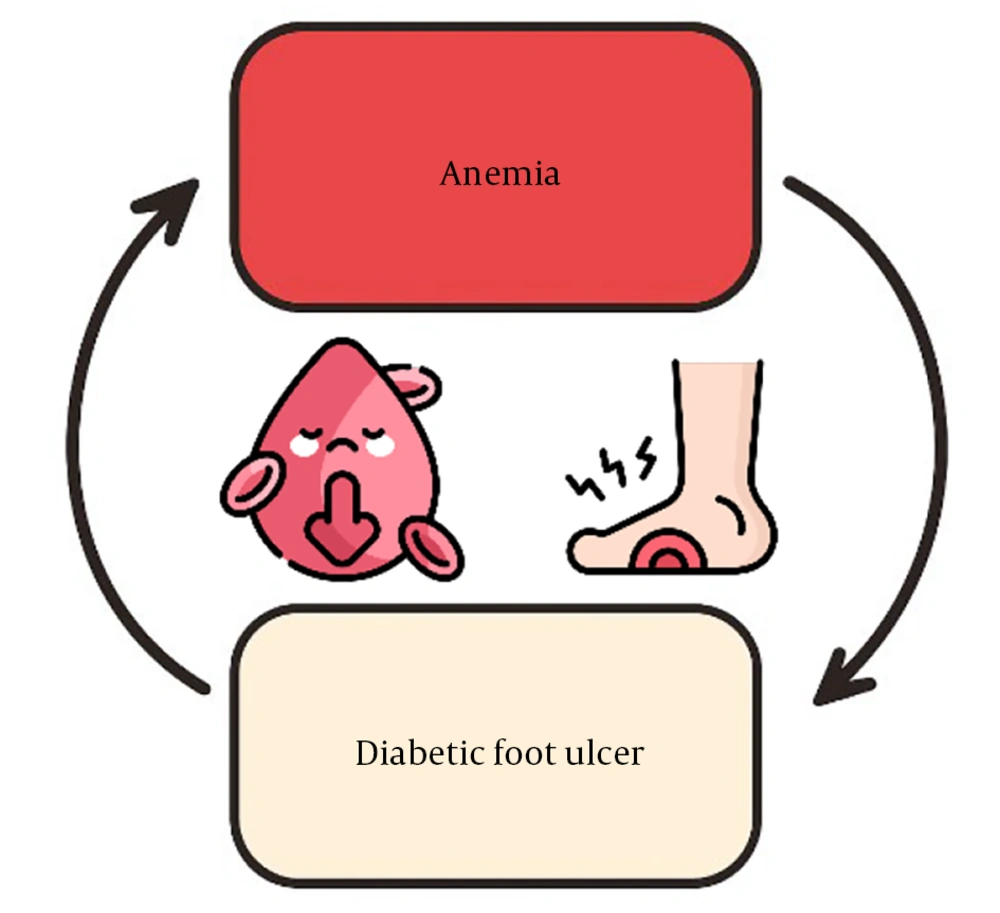
Figure 1.
Vicious cycle between anemia and diabetic foot ulcer (DFU)
The mean of age of our study population was 59.54 ± 11.13 years, with approximately 80% of participants over 50 years of age. Despite this, no significant relationship between age and DFU severity was observed. Syauta et al. (24) similarly found no significant association between age and DFU severity. Conversely, some studies have reported an association between age and occurrence of DFUs (25, 26) and another research suggested that wound healing may be more difficult in older patients with DFU (27). Similarly, sex was not significantly associated with DFU severity in our cohort, despite the predominance of men (68.8%) in the sample and reports from some other studies suggesting worse ulcer outcomes in men (28). The absence of a significant association between age or sex and DFU may result from study limitations, including relatively sample size and the specific population included. Another potential explanation is that age and sex may be related to the occurrence of DFUs, but not to their severity.
In our country, several studies have investigated the predictors and risk factors of DFU complications. A case-control study conducted in Zahedan, Iran, found that male sex, older age, and higher HbA1C levels were significantly associated with both the incidence and severity of DFU (29). In contrast, a cohort study from Ahvaz, Iran, reported that male sex was a significant risk factor for DFU progression, whereas HbA1C was not a significant predictor (30). These inconsistencies among studies highlight the necessity of conducting region-specific research to better understand local risk factors and patterns of DFU.
The present study has several limitations. Its cross-sectional design limits the ability to draw causal inferences. Incomplete HbA1c data may also have reduced the precision of our estimates. Additionally, the number of patients with severe DFU was relatively small, which may have limited the statistical power to detect differences in this subgroup and should be considered when interpreting the results. Because the study was conducted in a single tertiary care center, the findings may not be fully generalizable to broader or more diverse populations. Additionally, cultural factors such as healthcare access, lifestyle, and patient awareness may influence ulcer severity and outcomes, which should be considered when generalizing the findings. Future prospective studies with larger and more balanced sample sizes across DFU severity categories, multi-center recruitment, and standardized HbA1c assessment are needed to better elucidate these associations.
In conclusion, arterial occlusion, poor glycemic control (high HbA1c), and anemia are key factors associated with DFU severity. These results underscore the importance of comprehensive assessment and management of vascular health, glycemia, and Hb levels to prevent progression of DFUs.