
1. Background
Livestock manure, particularly from cattle and sheep, represents a significant source of organic waste in agricultural systems worldwide. Improper disposal of these wastes can lead to serious environmental challenges (1). Composting has emerged as an environmentally sustainable and cost-effective method for stabilizing animal manure, converting it into a nutrient-rich organic amendment suitable for agricultural use. Through microbial degradation under controlled aerobic conditions, composting not only reduces the volume and pathogenic load of manure but also enhances its nutrient availability and humification degree, contributing to soil fertility and plant growth (2). Animal manure directly influences composting dynamics and compost quality. Co-composting these wastes can balance nutrient ratios and optimize microbial activity (2). Moreover, recent concerns about the presence of emerging contaminants in animal manure highlight the necessity of monitoring their fate during composting. Understanding how these contaminants transform or degrade within the composting matrix is essential for ensuring the environmental safety and agricultural applicability of the final compost product (3). Therefore, assessing the quality of compost derived from cattle and sheep manure is crucial not only for evaluating its agronomic potential but also for minimizing ecological risks associated with waste recycling. Such research provides valuable insights into sustainable livestock waste management practices that align with the principles of the circular economy and environmental protection goals (4).
2. Objectives
The main objective of this study was to provide a health policy brief for relevant stakeholders and health authorities in Iran, emphasizing the critical importance of effective animal manure management, its conversion into compost, and rigorous, continuous monitoring of the composting process to minimize environmental pollution. In this study, the effect of different ratios of biochar and cow-to-chicken manure on the removal efficiency of organic and inorganic pollutants present in animal manure during composting in a chamber was investigated.
3. Methods
In this experimental study, all chemicals and reagents were obtained from Merck (Germany) through Projek Chemie and Asia Pahoehoeh companies. A composting study was conducted using 12 treatments that combined different cattle-to-poultry manure ratios (1:3, 1:1, and 3:1) and Kohbanan biochar (5%, 10%, and 15%) in a factorial design for 60 days. One treatment without biochar was studied as a control. A bioreactor with an effective volume of 60 L was designed for intermittent aeration and mechanical mixing. Aeration was performed three times daily for 20 minutes each time in the first days of the process and continued until the thermophilic phase by an aeration pump (China, Aqua, AP-9805). A mechanical mixer was used to mix the reactor contents daily. The initial C/N ratio and moisture content were adjusted to approximately 25:1 and 60%, respectively. The physical-chemical properties were analyzed to evaluate the performance of the process. Nitrogen and carbon were determined using the Kjeldahl (HACH, USA) (5) and furnace combustion methods (6), respectively. The concentrations of zinc, chromium, and copper (7) were determined by atomic absorption chromatography (Perkin Elmer, Germany). All experiments were performed in triplicate. Data were analyzed using SPSS 20 at a significance level of 0.05. The normality of the data was checked using the Kolmogorov-Smirnov test. The ANOVA test was used to determine the differences in pollutant removal efficiency among the various treatments.
4. Results and Discussion
This study investigated the effects of biochar addition (0 - 15% v/v) and different cattle-to-poultry manure ratios (CM/PM) on compost quality, pollutant removal, and microplastic (MP) dynamics during composting. The results demonstrated that biochar substantially enhanced compost maturity, nutrient stabilization, and contaminant reduction compared with control treatments. Total organic carbon (TOC) initially increased with higher biochar levels, ranging from 40% in 5% biochar treatments to 42.32% in 15% biochar treatments (Figure 1). During composting, TOC decreased significantly (P = 0.001) across all treatments, with reduction efficiencies between 35% and 51%, confirming active organic matter degradation. Biochar had a significant effect on TOC dynamics, while the CM/PM ratio was not statistically influential. Control treatments consistently showed lower TOC reduction, highlighting the stimulatory role of biochar in microbial decomposition.
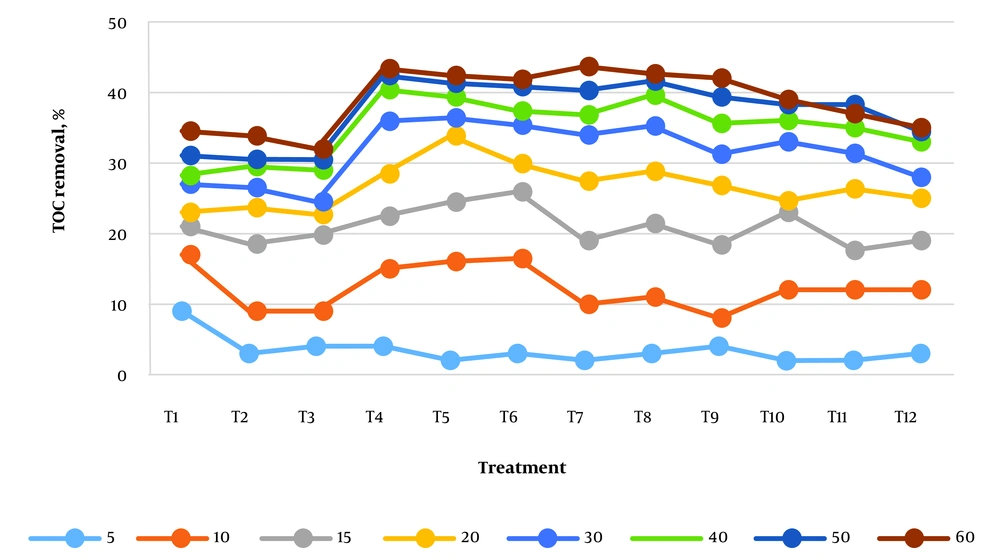
Figure 1.
Total organic carbon removal in different treatments in the current study
Humic substance formation was notably enhanced by biochar addition (8). Humic acid (HA), humification index (HI), humus ratio (HR), and degree of polymerization (DP) all increased significantly (P = 0.0001), whereas fulvic acid (FA) decreased. The HA/FA ratio was highest in treatments containing 10% - 15% biochar, indicating advanced humification and compost stabilization (8). In contrast, the CM/PM ratio had little effect on humic composition (Figure 2).
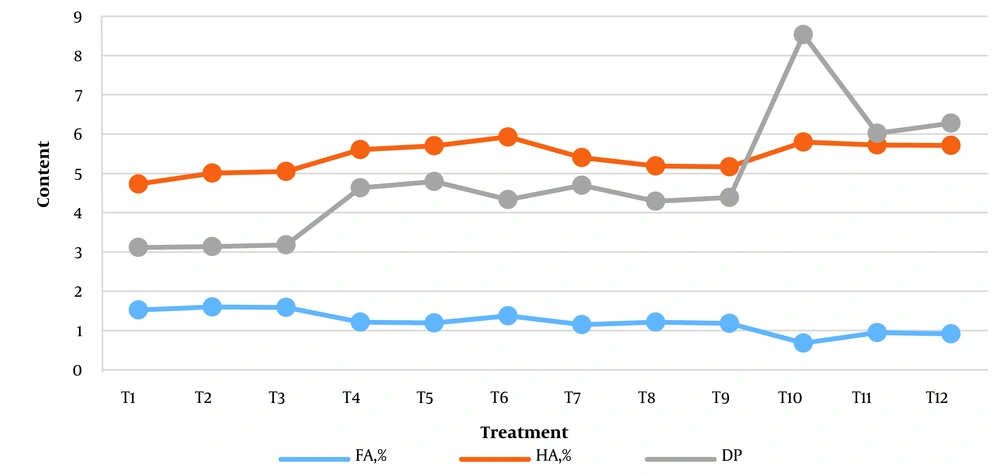
Figure 2.
Humification level in different treatments in the current study
The carbon-to-nitrogen (C/N) ratio declined progressively over time and with increasing biochar content, reaching 10 - 20 in mature compost, consistent with standard maturity indicators. The most pronounced reduction occurred in 5% biochar treatments, decreasing from approximately 66 to 21, signifying improved nitrogen retention and organic matter transformation. Heavy metal (Zn, Cu, Cr) concentrations decreased markedly (P = 0.0001) during composting, with mean removal efficiencies of 87.26%, 49.20%, and 26.22%, respectively (Figure 3). Final concentrations were below Iranian and U.S. EPA limits (9), confirming the safety of the final compost.
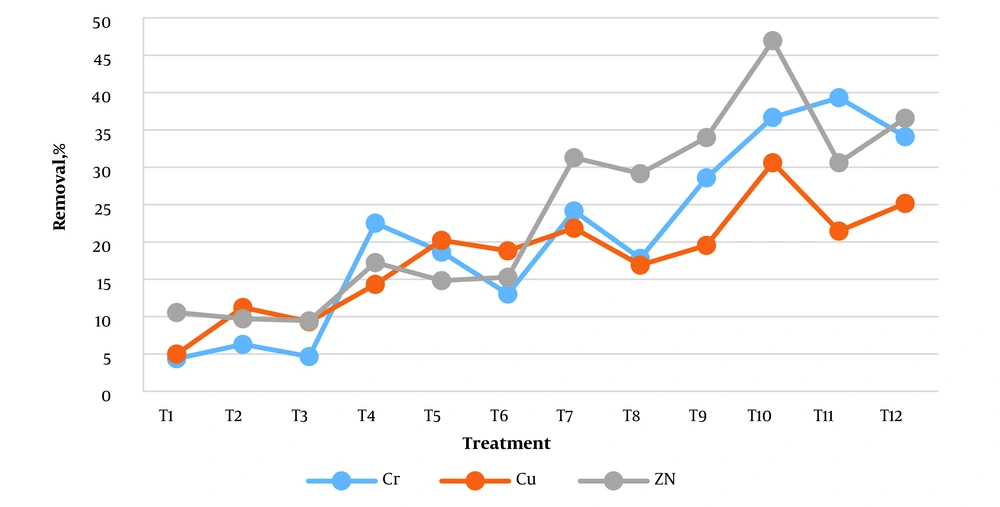
Figure 3.
Heavy metal removal in different treatments in the current study
Microplastic assessment revealed MPs in 66.7% of initial and 58.3% of mature composts. Fiber-shaped white polypropylene particles predominated. Although MP abundance decreased, the reduction was not statistically significant (P = 0.12), while polymer diversity declined after composting. Overall, biochar-amended composting effectively improved compost quality, enhanced nutrient availability and heavy metal reduction, and partially mitigated microplastic contamination, offering a sustainable approach for animal waste management and environmental protection.
5. Conclusion
Composting of animal manure is an effective and sustainable method for recycling organic matter and improving soil fertility. In this study, the composting process conducted using an in-vessel bioreactor converted livestock waste into stable compost, resulting in increased nutrient content, enhanced cation exchange capacity, improved soil structure, porosity, and water-holding capacity, as well as reduced pollutants such as heavy metals. The resulting compost not only improves soil productivity and crop performance but also provides significant economic benefits to farmers by reducing the need for chemical fertilizers and overall production costs. Furthermore, this approach prevents environmental contamination caused by the direct disposal of animal manure and plays a vital role in promoting sustainable agriculture and advancing the circular bioeconomy. Ultimately, it is emphasized that policymakers and farm managers should facilitate the implementation of compost production systems alongside livestock operations and other agricultural farms using such methods. This strategy would not only provide substantial economic benefits but also effectively prevent environmental pollution, thereby supporting sustainable waste management and eco-friendly agricultural development.