
1. Background
Stroke has received universal consideration due to its significant mortality, extremely high morbidity, and huge economic burden (1, 2). It is one of the leading causes of death globally (3) and is associated with brain dysfunction caused by impaired blood flow to the brain, whether by occlusion in ischemic or by a rupture in hemorrhagic stroke. Ischemic strokes make up nearly 80% of strokes (4). Brain ischemic condition leads to increased release of pro-inflammatory cytokines and chemokines by microglial cells, which in turn causes secondary damage to the ischemic brain tissue. Activated glial cells not only secrete inflammatory cytokines but also, produce neurotoxic mediators such as nitric oxide and superoxide which further damage neurons (5-7).
The standard intervention for ischemic stroke is recombinant tissue plasminogen activator (rt-PA) or alteplase which reduces the neuronal damage by increasing reperfusion (8). It dissolves blood clots by increasing the level of fibrinolysin (9). It has been demonstrated that intravenous thrombolysis with rt-PA significantly improves functional outcomes after an ischemic stroke up to 4.5 hours after the onset of symptoms (10-12). Administration of rt-PA as early as possible leads to better outcomes in functional recovery. Therefore, the main focus of the health system is decreasing stroke onset to needle time through population-based education and improving emergency medical services (13). Simultaneously, expanding the time window of rt-PA administration from 3 to 4.5 hours and more has been done (14). Although, delayed administration of rt-PA resulted in less functional recovery and more risky side effects (15-17).
Infusing intravenous rt-PA within three hours of the beginning of symptoms enhances the likelihood of functional independence at three months (18, 19). When the medication is taken during the first 90 minutes of a symptom's onset, the benefit is time-dependent and significantly stronger (19, 20). Although the benefit is less significant for individuals treated between 3 to 4.5 hours, rt-PA is still advantageous in this longer time frame (17-19). Delayed rt-PA treatment can cause hyperperfusion, leading to extracellular matrix deterioration by elevating MMP-2 and MMP-9 levels, disrupting blood-brain-barrier (BBB) and hemorrhagic transformation (15, 16). Enhancement of the effect of rt-PA among patients who received the drug in a longer time frame by simultaneous use of other medications is an alternative.
The effect of combination therapy on recovery from stroke has been reported (21). Combination therapy can induce pharmacological advantages like an enlarged therapeutic window, lower doses, and fewer unwanted side effects (22). If patients received delayed rt-PA, combining an agent with rt-PA may expand its therapeutic window, effectively reduces its side effects, and improves the outcomes of treatment (21). One of the candidates for such a purpose is resveratrol (23).
Resveratrol (trans-3,5,4′-trihydroxystilbene) is a phytoalexin and a natural polyphenol that has been reported to have multiple biological advantages such as neuroprotection, anti-inflammatory, anti-oxidative, anti-apoptotic, anti-diabetic, anti-viral, anti-cancer, and anti-aging effects (24, 25). Several studies indicated the protective effect of resveratrol against an animal model of cerebral ischemic injury (26-30). Besides animal studies, few clinical trials have focused on the neuroprotective and treatment effects of resveratrol in human ischemic stroke. The combination of rt-PA and resveratrol improved NIHSS scores and regulated plasma concentration of MMP-2 and MMP-9 after 24 hours, especially in the delayed rt-PA group (23). Additionally, treatment with a daily dose of resveratrol for one year significantly reduced risk factors linked to secondary stroke recurrence (31). Despite the positive findings, controversies were revealed and a recent study didn’t indicate any significant difference in functional recovery among ischemic stroke patients between the resveratrol and placebo groups (32). Therefore, the present study aimed to investigate the effect of resveratrol on functional outcomes after ischemic stroke, focusing on patients with delayed administration of rt-PA. This is the first study that focuses on the effect of rt-PA and resveratrol on long-term recovery after ischemic stroke.
2. Methods
2.1. Study Design and Participants
This study was a double-blind clinical trial (trial registration number: IRCT20191020045162N1) and was registered on 2020-03-12. All patients with ischemic stroke who were admitted to Imam Reza university hospital, Kermanshah, Iran between 2019-11-11 to 2021-01-09 and received rt-PA 3 to 4:30 hours after stroke onset were considered to be involved in the study. Sixty consecutive upcoming patients were recruited based on exclusion and inclusion criteria. Diagnosis of ischemic stroke was confirmed by clinical examination and brain computed tomography (CT) scan which was done by an expert neurologist. Patients aged between 18 to 90 years who signed the informed consent were included. Patients were excluded if they were admitted to the hospital after 4:30 hours of stroke onset, had a history of grape seed allergy, were pregnant, or encountered cerebral hemorrhage. The time of the onset was determined by interviewing patients and/or any accessible witnesses. The patient was also excluded if the onset time could not be exactly determined. In addition, patients with intolerant oral enteral feeding within 12 hours after rt-PA administration were also excluded. Patients were asked whether they had eaten any natural foods such as grapes, peanuts, berries, and rhubarb containing resveratrol within 48 hours before the onset of stroke for removal. Patients who had any contraindication for rt-PA administration based on guidelines were excluded (8).
2.2. Resveratrol and Placebo Capsule Preparation
Resveratrol powder was purchased from Rahesh Darou Company, Iran, Tehran, and formulated in capsule form at the School of Pharmacy, Kermanshah University of Medical Sciences. Solubility test and FTIR spectrum were used to check the purity of the material. Each capsule contained 150 mg of resveratrol. Placebo capsules contained excipients (Avicel and Magnesium stearate) and lactulose. Resveratrol and placebo preparations were identical in terms of shape, weight, and color. Patients received 450 mg/day in three divided doses. Both patients and physicians were blinded to the intervention. Both groups received 90 capsules of either resveratrol or placebo of the same size and shape. Capsules were labeled with A or B for resveratrol and placebo, respectively. The selected dose of resveratrol, its bioavailability, and safety was obtained based on Sergides, C., et al study (33).
2.3. Procedures
During the study period (2019-11-11 to 2021-01-09), sixty patients who met the inclusion and exclusion criteria were randomly allocated to resveratrol and placebo groups using the block randomization method to guarantee that both studied groups have equal size. For the enrolled patients (n=60), we generated fifteen block sizes of 4. Then, besides block randomization, each generated random sequence was written on a separate card and placed in non-transparent blocks. For example, block number 1 with sequence AABB randomizes 4 participants in the study groups. They were also used based on numerical orders allocated to each block.
To hide the treatment as a first-level blinding, both interventions (resveratrol and placebo) were prepared as the same shape/size capsules. Drugs were repackaged in envelopes marked with A and B, and each patient received the desired treatment depending on the code.
Both groups received all routine stroke standard care according to the guidelines including emergency brain imaging as soon as arrival at the hospital before any specific treatment, determining blood glucose level before therapy, rt-PA administration as quickly as possible in eligible patients, airway support, ventilatory assistance, supplemental oxygen if necessary, monitoring and correcting of hypotension, hypovolemia, or hypertension, antipyretic medications if temperature was higher than 38ºC, blood glucose level regulation, and post-rt-PA treatment (8). They received 0.90 mg/kg rt-PA (Boehringer Ingelheim, Germany) from 3 to 4:30 hours after stroke onset. Ten percent of the dose was injected as a bolus, followed by continuous infusion of the remaining 90% over one hour.
In addition to the ordinary medication and care, they also received three daily doses of 150 mg of either resveratrol or placebo within 12 hours after receiving rt-PA for 30 days. The study was a double-blind clinical trial and all patients and investigators were blinded to the intervention and placebo groups. A methodologist who was blinded to the study performed the permuted block randomization and shared the data with the related department's receptionist who was not aware of the studied treatments. In the final step, the patients were assigned to the related studied group by receiving a code from the receptionist. All outcomes were measured by an examiner who was completely blinded to both groups and medications. We used the CONSORT reporting guidelines (34).
2.4. Outcome Measurements
Functional outcomes were evaluated before and after treatment at several time points. Patients were evaluated by NIHSS when they arrived at the hospital before rt-PA intervention, 24 hours after administration of rt-PA, and on the day of discharge (35). Modified Rankin Scale (MRS) was performed on the discharge day and 3 and 6 months later. MRS is a commonly used scale with high validity and reliability for the measurement of disabilities and dependency in daily activities after stroke (36). Barthel Index was measured for all participants 3 and 6 months after the stroke. BI is a reliable scale for the measurement of performance in daily activities (37). The evaluations were performed by examiners who were completely blinded to the groups and medications. In addition, participants and their families were instructed to report any side effects. Also, examiners were trained to search for any side effects in all evaluation steps.
2.5. Statistical Analysis
Data were analyzed by Statistical Package for Social Science (SPSS) software version 22 (SPSS V.22.) using independent sample t-test and chi-square for comparison of the demographic and baseline data between groups. The effect of the intervention on outcomes during the time was analyzed by repeated measures analysis using the intention-to-treat (ITT) analysis. Considering the mean and the standard deviation of NIHSS in treatment and placebo groups (3.21 and 4.05 in resveratrol and placebo group), 95% confidence level, and the power of 80%, the minimum required sample size was calculated to be at least 20 subjects in each group.
2.6. Ethical Consideration
The study was approved by the ethical committee of Kermanshah University of Medical Sciences (Ethical Code: IR.KUMS.REC.1398.718) on 2019-10-20. All ethical considerations for participants were performed. Written informed consent was obtained from all patients or their legal guardians. All patients received the drug for free. They were evaluated and treated for any drug side effects for free. Moreover, patients could exit the study if they decided to.
3. Results
3.1. Demographic and Baseline Measurements
Nineteen participants (9 females Age: 62 ± 12 years) in the resveratrol and 21 participants (7 females; Age: 61 ± 12 years) in the placebo group finally completed the study (Figure 1). Five patients in each group were expired and the rate of mortality did not significantly differ between the two groups (P = 0.65). There were no significant differences between groups in demographic characteristics, blood pressure, and mortality rate (Table 1). No side effects were reported in both resveratrol or placebo groups.
Table 1.
Demographic Characteristics, Mortality Rate, and Baseline Blood Pressure Measurements Among Groups of Patients with Ischemic Stroke a
| Variables | Resveratrol (n = 19) | Placebo (n = 21) | Statistical Value | P-Value |
|---|---|---|---|---|
| Gender | ||||
| Male | 10 (52.6) | 14 (66.7) | X2 = 0.81 | 0.28 |
| Female | 9 (47.4) | 7 (33.3) | ||
| Mortality | 5 (26.3) | 5 (23.8) | X2 = 0.18 | 0.65 |
| Age (y) | 62 ± 12 | 61 ± 12 | t = -0.37 | 0.70 |
| Systolic Blood Pressure | 148 ± 23 | 148 ± 29 | t = 0.04 | 0.96 |
| Diastolic Blood Pressure | 88 ± 10 | 85 ± 12 | t = -0.99 | 0.32 |
a Values are presented as No. (%) or mean ± standard deviation unless otherwise indicated.
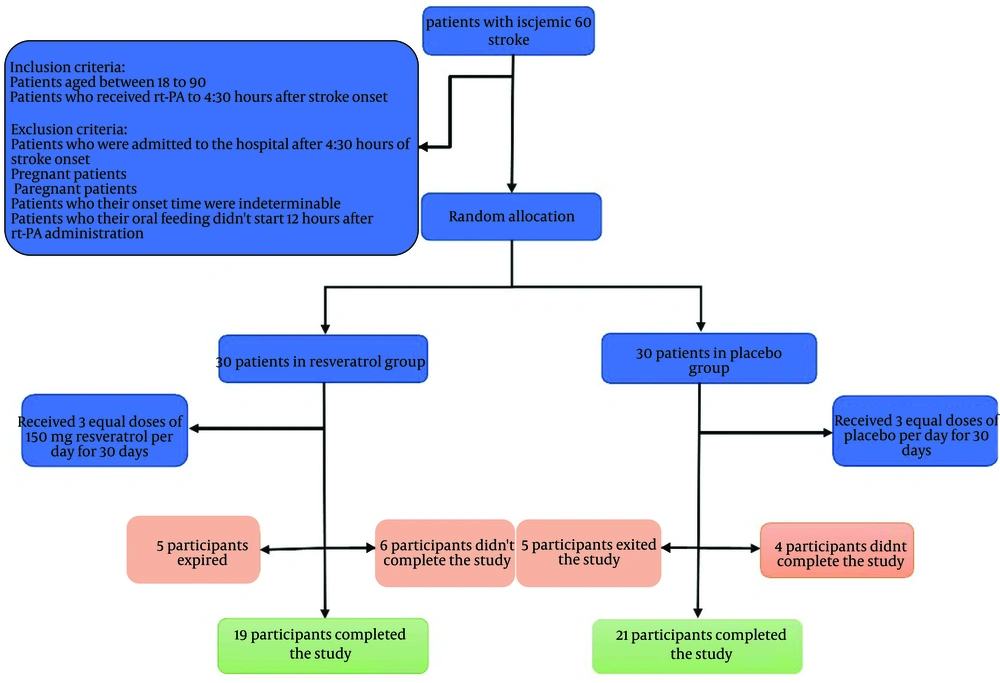
Figure 1.
Flowchart of patient selection and randomization
3.2. National Institute of Health Stroke Scale Outcomes
Table 2 indicates the mean and standard deviation of outcomes in the study groups at different times. There is a significant decrease in the NIHSS over time in both groups based on repeated measure analysis (Table 3).
Although the NIHSS score was significantly decreased in both groups over time (Table 3 and Figure 2), which means functional recovery was improved and stroke severity declined, there was no significant therapeutic effect of resveratrol on NIHSS outcomes compared to placebo (F = 0.00, P interaction = 0.99) (Table 3).
Table 2.
Comparison of Outcome Measures Between Groups During the Time a
| Variables | Before rt-PA | 24 Hours After rt-PA | Discharge | 3 Months After Stroke | 6 Months After Stroke |
|---|---|---|---|---|---|
| NIHSS | |||||
| Resveratrol | 13.00 ± 6.57 | 10.47 ± 5.89 | 8.42 ± 6.36 | ||
| Placebo | 12.95 ± 6.61 | 10.95 ± 6.99 | 7.95 ± 7.23 | ||
| MRS | |||||
| Resveratrol | 2.77 ± 1.74 | 2.15 ± 1.99 | 1.54 ± 1.66 | ||
| Placebo | 1.61 ± 1.50 | 2.00 ± 2.16 | 1.92 ± 2.17 | ||
| Barthel Index | |||||
| Resveratrol | 74.23 ± 23.87 | 81.53 ± 21.44 | |||
| Placebo | 75.76 ± 30.54 | 76.15 ± 31.23 |
a Values are presented as mean ± standard deviation.
Table 3.
Results of Repeated Measures of ANOVA of the Studied Outcomes in Patients with Ischemic Stroke
| Variables | Outcomes | ||
|---|---|---|---|
| P-Value | F | Eta Squared | |
| NIHSS | |||
| Group | 0.70 | 0.27 | 0.007 |
| Time | 0.001 | 27.65 | 0.42 |
| Group × time | 0.99 | 0.00 | 0.00 |
| MRS | |||
| Group | 0.65 | 0.20 | 0.008 |
| Time | 0.17 | 1.81 | 0.07 |
| Group × time | 0.02 | 4.78 | 0.16 |
| Barthel Index | |||
| Group | 0.85 | 0.03 | 0.001 |
| Time | 0.02 | 5.41 | 0.18 |
| Group × time | 0.04 | 4.38 | 0.15 |
Abbreviations: ANOVA, analysis of variance; NIHSS, National Institute of Health Stroke Scale; MRS, Modified Rankin Scale.
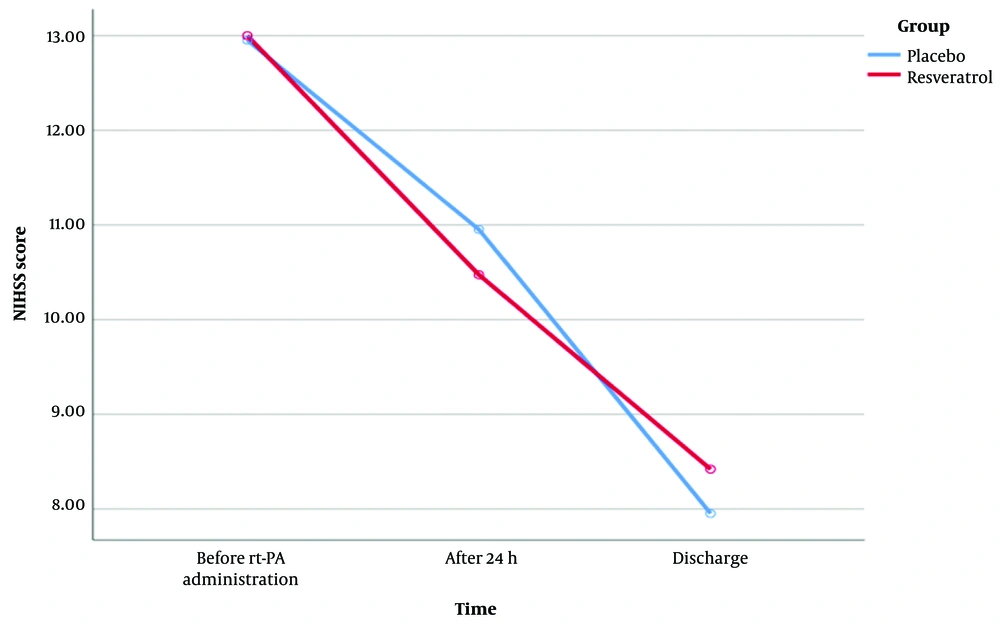
Figure 2.
Changes in National Institute of Health Stroke Scale score over time in patients with ischemic stroke
3.3. Modified Rankin Scale
MRS score was measured when patients were discharged as well as 3 and 6 months after the stroke. Neither time nor the intervention had any significant effects on the MRS score, but a significant therapeutic effect of the intervention over time was observed (F = 4.58, P interaction = 0.02) (Table 3, Figure 3).
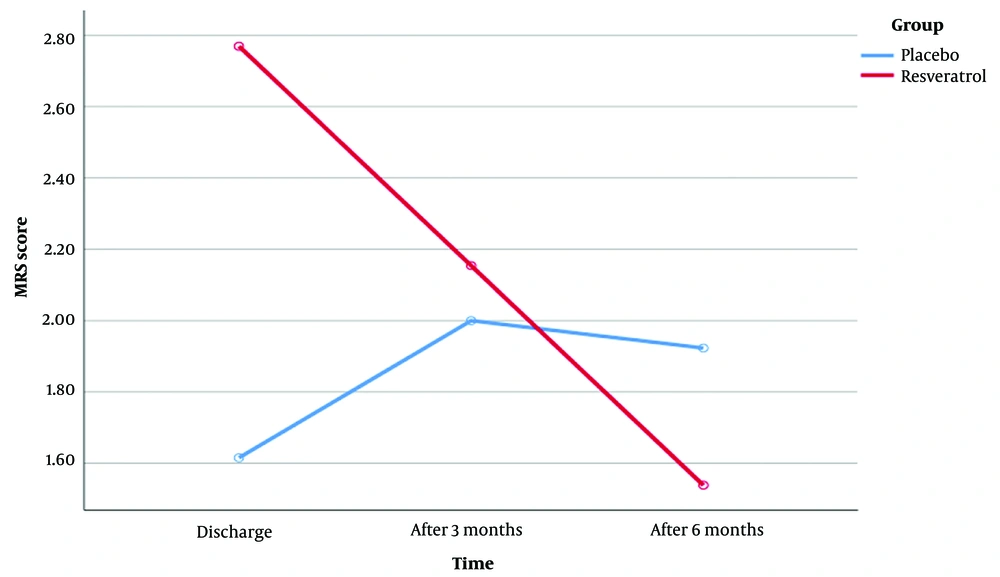
Figure 3.
Changes in Modified Rankin Scale scores over time in patients with ischemic stroke
3.4. Barthel Index
The Barthel index score was increased over time in both groups and the effect of the time was also significant (P = 0.02; F = 5.41), indicating a substantial trend of recovery during time. The effect of intervention during time was significant, and the Barthel index score was increased over time in the resveratrol group compared to the placebo indicating a higher functional recovery in the resveratrol group (F = 4.38, P interaction = 0.04) (Table 3) (Figure 4).
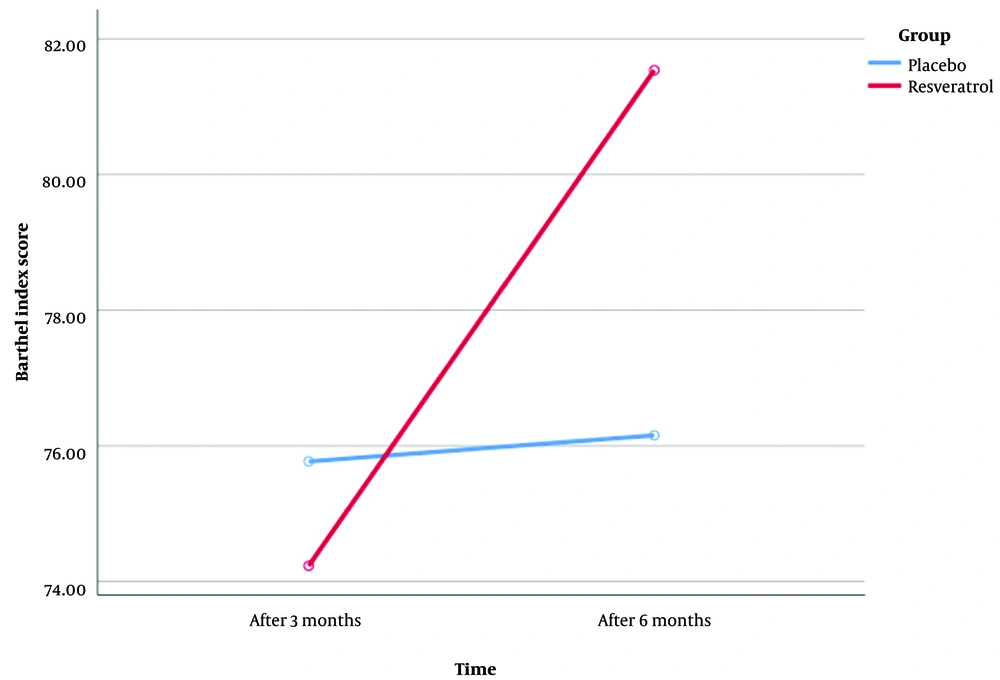
Figure 4.
Barthel Index changes over time in patients with ischemic stroke
4. Discussion
Ischemic stroke still remains a significant threat to human life and health (1). The standard treatment for ischemic stroke is rt-PA (9), but it has a narrow therapeutic window, making it less beneficial for patients treated after 3 to 4.5 hours of stroke onset (17). The primary goal of this study was to investigate the effect of resveratrol on short- and long-term functional outcomes after stroke in patients who received delayed rt-PA (3 to 4.5 hours after stroke). Results indicated no effect of resveratrol on immediate and early outcomes measured by NIHSS. But when late recovery outcomes were considered, based on MRS and Barthel index, a significant effect of resveratrol over time was observed compared to placebo. Based on the result, resveratrol led to significantly higher late recovery outcomes compared to placebo.
In contrast to the present finding, Chen et al reported significantly improved NIHSS scores 24 hours after treatment among patients who received a combination of delayed rt-PA treatment and resveratrol compared with those who received placebo (23). The difference may result from the sample size, the dose and the time of resveratrol administration, and the statistical methods they used compared to the present study. The administration of resveratrol was started 12 hours after rt-PA administration, but Chen et al administered resveratrol and rt-PA together 120 to 240 minutes after the stroke (23).
When long-term functional outcomes were considered, resveratrol significantly improved MRS and Barthel index during the 3- and 6-month follow-up. A recent study failed to reveal any significant therapeutic effect of resveratrol on short- and long-term functional recovery among a group of stroke patients who were not eligible for rt-PA administration because of contraindications or narrow therapeutic time windows. Authors reported that 500 mg daily intake of resveratrol for 30 days in patients with middle cerebral artery stroke, did not improve NIHSS after 24 hours as well as MRS and Barthel index scores after 3 months (32). The difference may arise from co-administration and the combined effects of rt-PA and resveratrol on stroke recovery in the present study.
Several mechanisms have been recognized to explain the protective effect of resveratrol against ischemic stroke. Resveratrol induces differentiation and growth of neurons and prevents neural apoptotic death by activating silent information regulator-1 (SIRT-1), which in turn deacetylates and restrains P53 as a transcription factor which leads to apoptosis and cell-cycle arrest (38). In addition, resveratrol deactivates M1 microglia cells by downgrading the CD147/MMP-9 axis. M1 microglia cells produce cytokines and chemokines that induce secondary brain damage following ischemic stroke (7, 39, 40). Chen et al indicated a resveratrol-induced reduction in plasma levels of both matrix metalloproteinase (MMP)-2 and MMP-9 and a positive correlation between MMPs decline and improvement of NIHSS scores (23). Another clinical trial study revealed a significant dose-dependent reduction in secondary stroke recurrence risk factors following treatment with a daily dose of resveratrol for one year. Risk factors included high systolic and diastolic blood pressures, body mass index, cholesterol, LDL, HDL, triglycerides, and blood glucose (31). In addition, animal studies confirmed the therapeutic effect of resveratrol on recovery from ischemic stroke and revealed the mechanisms of this effect. Animal model studies indicated that resveratrol significantly decreases ischemia/reperfusion injury partly by inhibiting the NLRP3 inflammasome activation via stimulating Sirt1-dependant autophagy and activation of JAK2/STAT3/PI3K/AKT/mTOR pathway (26, 27). On the other hand, pretreatment with resveratrol may partially mediate the Sonic Hedgehog signaling pathway and upgrade neuro-restoration after ischemic injury (41). Intravenous administration of resveratrol (0.1 and 1 µg/kg) on mice models after one hour of middle cerebral artery occlusion (MCAO) decreased infarct volume and increased functional recovery (28). Another mice-model investigation revealed that treatment with resveratrol decreased ischemic brain injury, neurological deficits, and stroke-induced peripheral inflammation (29). Also, resveratrol reduced the downstream inflammatory cascade and enhanced brain recovery followed by hypoxic-ischemia insult in neonate mice (30).
Based on the result of the present study and findings of previously published articles, resveratrol can be a potential candidate to improve rt-PA-induced recovery after ischemic stroke either by prevention of hyperperfusion and subsequent extracellular matrix deterioration after rt-PA administration or neuroprotective effects from neurobiological mechanisms. Further clinical trials with higher sample sizes which investigate both short- and long-term recovery and use different doses of resveratrol are needed to approve the clinical application of resveratrol in the setting of acute ischemic stroke.
The results of the present study should be considered based on some limitations. Due to mortality, insufficient collaboration of patients, and ethical considerations, the sample size was not larger. The present study did not use more precise motor, linguistic, and cognitive tests for detecting stroke recovery trends. It seems that without such a detailed examination, some fine aspects of recovery from stroke may be ignored. Also, no biomarkers were considered during the study period to estimate and compare the efficacy of resveratrol to that of placebo. In addition, recovery after 6 months from stroke was not investigated in the present study. On the other hand, there was a delay between rt-PA and resveratrol administration that may decrease the combination effects.
5. Conclusion
This study showed that using resveratrol during the acute phase of ischemic stroke in patients who received delayed rt-PA could be beneficial in improving patients’ functional outcomes as revealed by decreasing MRS and increasing Barthel index after three and six months since the start of treatment. Resveratrol didn’t significantly improve short-term recovery measured 24 hours after intervention and on the day of the discharge, mainly on the seventh day after rt-PA administration.