
1. Background
Before the COVID-19 virus spread, students were part of a less active society, according to several studies. Then, their level of inactivity, psychomotor and physical health problems increased during the pandemic (1-3). Playing is a solution that can greatly enhance the improvement of such children's problems. Children in the play display a range of moral and behavioral traits, including the desire to command or obey, being aloof or aggressive, and having friendly or hostile feelings. Children can communicate with their environment and develop positive cognitive processes through playing (4). Research has shown that behavioral interventions and play therapy can enhance certain psychological and metacognitive variables needed for children's daily life behaviors (5).
Mindfulness, emotion regulation, and executive function are important metacognitive variables that should be considered. Mindfulness, for instance, is a fundamental human ability to be fully present in the moment, to be aware of what is happening, and to refrain from reacting impulsively to emotions (6). The brain's executive function is another cognitive variable that can be improved through play. Regular aerobic exercise can enhance executive functions and boost children's attention (7). Emotion regulation, on the other hand, is the capacity to manage emotional experiences in a socially acceptable and adaptable manner. It can involve delaying spontaneous reactions when necessary (8). Emotion regulation can also be described as the inherent processes that oversee, assess, and adjust emotional responses. It encompasses initiating, restraining, or adjusting a person's emotional state or behavior in each situation.
Every day, children are continuously exposed to various potentially irritating stimuli. Inappropriate, extreme, or uncontrolled emotional reactions to such stimuli can hinder proper functioning of society. In general, many studies have shown the effects of various plays on the improvement and development of cognitive and metacognitive skills (9, 10). For example, Rahman Gholhaki et al. showed that Spark movement games can improve neuropsychological indicators and movement performance of children with developmental coordination disorders (5). In this regard, Dedehban and Afshani demonstrated the effectiveness of play therapy on the symptoms of depression and anxiety. On the other hand, there are emerging mental and movement games that may have an important effect on children's cognitive and metacognitive processes, but research studies have not been done on them yet (11). For example, cup stacking and domino games are cognitive and perceptual-movement activities. It is essential to explore the influence of these games on metacognitive factors. The cup stacking game is a growing sport that involves arranging and collecting special cups according to instructions. Cup stacking has a high level of excitement due to its speed and has attracted fans of different ages, including those with physical and mental disabilities (12, 13). Cup stacking is an excellent way to enhance concentration, nerve, and muscle coordination, strengthen hand-eye coordination, and engage both brain hemispheres simultaneously by using both hands. Studies have shown that individuals who can multitask tend to be more emotionally independent, determined, adept at handling situations, and skilled at problem-solving without giving up. Therefore, cup stacking is a multidimensional sport that not only enhances physical abilities like eye-hand coordination, speed, and concentration but also boosts self-confidence, teamwork, and sportsmanship. This game not only entertains children but also helps them steer clear of excessive screen time. According to the global cup stacking site, participating in this sport can result in benefits such as improved physical fitness, self-esteem, increased self-confidence, communication skills, and hand-eye coordination. Research has indicated that playing the cup stacking game can offer numerous advantages, including enhanced reading and frontal lobe function, improved math skills, better utilization of the left hemisphere of the brain, and enhanced spatial visualization (14).
The domino game is another movement activity with both subtle movements and cognitive dimensions. Dominoes is a great intellectual sport that allows the creation of structures that follow the laws of physics by stacking rectangular pieces. This game is suitable for all age groups. Dominoes are known to influence the development of mental, artistic, and motor skills. The purpose of domino is to stimulate and strengthen the power of imagination, develop artistic creativity, improve the ability to interpret signs and symbols, and enhance the capabilities of design mechanisms (15). Dominoes can be utilized to improve various basic geometric and mathematical skills, increase accuracy and concentration, coordinate between mind and members, foster participation, and create healthy and exciting scientific competition. Additionally, dominoes helps to flourish the power of initiative and innovation, learn the basics of visual arts, and strengthen and nurture the nine intelligences (15, 16).
2. Objectives
Children's behavior inside the home indicates that playing digital games and engaging in social networks are more prevalent than studying and physical activity. This inactive lifestyle pattern causes children to gain weight and develop related diseases (3, 17). It is crucial to offer solutions and strategies that enable children to engage in physical activities at home, especially in apartment living settings. Playing games at home using simple equipment can motivate children to participate in various daily physical activities. These activities can help prevent physical diseases, promote vitality at home, enhance physical strength, improve cognitive-motor abilities and physiological conditions, and reduce psychological distress. Additionally, with the closure of schools and sports clubs due to the coronavirus pandemic, online sports activities were organized. The lack of research in this area highlights the importance of exploring the effectiveness of online movement game training. Therefore, the primary aim of this study was to examine the impact of two types of perceptual-motor and cognitive games (cup stacking and dominoes) on children's metacognitive processes, such as mindfulness, emotional regulation, and executive functioning. Furthermore, the influence of online education on these games has been rarely studied. Hence, the secondary objective of this study was to assess the effect of online game training on metacognitive processes.
3. Methods
3.1. Subjects
The research was conducted as an experimental pre and post-test design with a control group. The statistical population included girls aged 10 - 12 years in classes 5th and 6th at Rasa Girls' Primary School in the 8th district of Tehran. The study's subject number was determined using the G*Power 3.1 program. The analysis revealed a minimum of 15 samples with a 0.05 margin of error, 0.95 power, and 0.15 effect size. Therefore, 54 female students who were randomly selected were divided into 3 equal groups, with 18 students in each group, cup stacking, domino, and control groups.
3.2. Apparatus and Task
3.2.1. Behavior Rating Inventory of Executive Function (Brief)
This questionnaire consists of two indicators of behavioral and cognitive regulation, with sub-components respectively (inhibition, attention transfer, emotion control) and (initiation, working memory, strategic planning, organization, and monitoring) (18). Abdolmohamadi et al. (19) showed that the average Cronbach's alpha for 8 subscales was between 0.68 and 0.86. The test-retest correlation was also 0.72 to 0.84.
3.2.2. Adolescent and Adult Mindfulness Scale (AAMS)
3.2.3. Emotion Regulation Questionnaire
This questionnaire was compiled by Gross. This questionnaire contains 10 items with two general emotion regulation strategies, i.e., reappraisal and suppression. Gross has reported an internal consistency coefficient of 0.73 and a retest coefficient of 0.69 for both strategies. Lotfi et al. (22) validated this questionnaire in primary school students.
3.3. Procedure
First, the participants completed pre-test questionnaires. Then, the experimental groups attended classes through the Adobe Connect application. Parents were instructed that their children should not engage in any other motor or cognitive games during the research period. The research protocol was 12 training sessions, 2 sessions per week for 45 minutes. In each session, training was given to the cup stacking group and the domino group. Before the class, a video was prepared to fully explain these games and were given to the children. Children also practiced simultaneously with the coach. The training protocol of each group is presented in Appendices 1 and 2 (see Supplementary File). At the end of the sessions, the subjects completed the research questionnaires again. Parents of all participants completed and signed the personal consent form to participate in the research.
3.4. Data Analysis
One-way multivariate analysis of covariance (MANCOVA) was used to compare the research groups in the pre-test and post-test (P ≤ 0.5). First, the assumptions of this test were verified, and pre-test scores were included as covariates. Research data were analyzed using SPSS 24 software.
4. Results
The results of data analysis showed the average age of the control group (n = 18, M = 11.06 ± 0.63), domino group (n = 18, mean age = 10.33 ± 0.48) and the cup stacking group was (n = 18, mean age = 11.33 ± 0.48). The results of the Shapiro-Wilk test indicated that all research variables and their subscales follow a normal distribution.
4.1. Comparing Domino and Control Groups
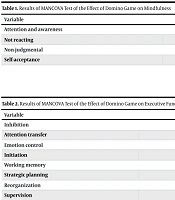
The results showed that the main effect of the group in the subscales of mindfulness was significant (P ≤ 0.05). Online domino training had a significant effect on the subscales of attention, not reacting, and non-judgment (F (4, 27) = 2.16, P = 0.1, Wilks' Λ = 0.75, partial η2 = 0.24) (Table 1).
Table 1.
Results of MANCOVA Test of the Effect of Domino Game on Mindfulness
| Variable | Mean of Squares | F-Value | P-Value |
|---|---|---|---|
| Attention and awareness | 226.01 | 6.88 | 0.01 |
| Not reacting | 16.62 | 3.93 | 0.05 |
| Non-judgmental | 40.94 | 4.69 | 0.03 |
| Self-acceptance | 0.62 | 0.10 | 0.75 |
The main effect of the group on the subscales of cognitive-emotional regulation (the reappraisal strategy) was significant (F (2, 31) = 6.45, P = 0.005, Wilks' Λ = 0.70, partial η2 = 0.29). In other words, online domino training had a significant effect only on children's reappraisal strategy subscale (mean of squares =587.38, F (2, 31) = 10.50, P = 0.003)
The main effect of group was significant in some subscales of executive function (F (8, 19) = 4.76, P = 0.03, Wilks' Λ = 0.68, partial η2 = 0.31). Online domino training had a significant impact on attention transfer, emotion control, and strategic planning subscales (Table 2).
Table 2.
Results of MANCOVA Test of the Effect of Domino Game on Executive Functions
| Variable | Mean of Squares | F-Value | P-Value |
|---|---|---|---|
| Inhibition | 17.43 | 1.37 | 0.27 |
| Attention transfer | 41.67 | 3.87 | 0.03 |
| Emotion control | 33.43 | 3.42 | 0.02 |
| Initiation | 0.44 | 0.09 | 0.27 |
| Working memory | 0.03 | 0.002 | 0.30 |
| Strategic planning | 94.11 | 4.07 | 0.02 |
| Reorganization | 5.49 | 0.80 | 0.43 |
| Supervision | 0.66 | 0.10 | 0.52 |
4.2. Comparing cup Stacking and Control Groups
The main effect of the group was significant in the subscales of mindfulness (F (4, 27) = 1.45, P = 0.24, Wilks' Λ = 0.82, partial η2 = 0.17). Online training for cup stacking had a notable impact on the attention and awareness subscales (Mean of squares =140.007, F (4, 27) = 5.07, P = 0.03).
The main effect of the group was significant in a cognitive-emotional regulation subscale (F (2, 31) = 17.40, P = 0.001, Wilks' Λ = 0.47, partial η2 = 0.52). Online cup stacking game had a significant impact only on children's reappraisal strategy subscale (Mean of squares =1283.76, F (2, 31) = 23.18, P = 0.001).
The results showed that the effect of the online cup stacking game on the executive function was not significant (F (8, 19) = 1.45, P = 0.23, Wilks' Λ = 0.62, partial η2 = 0.38).
4.3. Comparing Domino and cup Stacking Groups
The results of Wilks’ lambda test to compare the cup stacking and domino games on mindfulness showed that there was no significant difference between the effects of these two games [F (4, 27) = 0.311, P = 0.86, Wilks' Λ = .95, partial η2 = 0.04].
The results showed a significant difference between two games on cognitive emotion regulation. [F (2, 31) = 8.26, P = 0.001, Wilks' Λ = 0.65, partial η2 = 0.34]. The results of the LSD post-test indicated that the cup stacking was significantly better than the domino group in the reappraisal strategy (P = 0.001).
The results of Wilks’ lambda test comparing the cup stacking and domino games on executive function revealed a significant difference. [F (8, 19) = 3.29, P = 0.04, Wilks' Λ = 0.72, partial η2 = 0.27]. The LSD post-test results revealed that the domino was significantly better than the cup-stacking group in attention transfer, emotion control, and strategic planning (P < 0.05).
5. Discussion
The purpose of this research was to investigate the effect of online training of competitive games (dominoes and cup stacking) on mindfulness, emotions regulation and executive function of children's brains.
5.1. Mindfulness
The results showed that online training for cup stacking and domino games had a significant effect on the attention and awareness subscales of mindfulness compared to the control group. These results are consistent with findings from previous studies (23-28). These studies indicate that all types of play therapy skills significantly and positively improve attention, which is consistent with the findings of present study. Playing dominoes and cup stacking are effective ways to improve attention and mindfulness. Its enjoyment engages the child's senses and concentration, which in turn increases attention. Children must be attentive, purposeful, and willing to overcome challenges without judging the results of their work. According to the current research, only playing the domino game had an impact on non-judgmental aspects. It is possible that the child had already seen how the domino structure would end up because they had built it many times before. However, in the event of cup stacking, incorrect arrangement and collection of cups could lead to different outcomes. To solve this problem, children should focus on the moments of the game. Children should concentrate on playing games instead of focusing on past exercise results or future game outcomes (15, 16). It was found that online domino and cup stacking could improve children's mindfulness (albeit only in a few of its subscales). In contrast, the effects of cup-stacking and domino games were not significantly different. Perhaps the similarity in cognitive load between the two games contributed to their lack of distinction.
5.2. Cognitive Regulation of Emotion
The present study demonstrates that learning cup stacking and domino online significantly impacts the reappraisal strategy subscale of emotion regulation in children, compared to a control group. The mean of reappraisal for the cup-stacking group was significantly higher than that for the domino group. These results are consistent with those of the previous studies (29, 30). The conclusion is that play is a meaningful way to enhance fundamental learning capacities, reality testing, and self-regulation for all children. For children in need of psychological development, it can serve as a source of joy and a self-correcting mechanism. During childhood, it is feasible to acquire any cognitive skill. Self-regulation abilities are vital for both early childhood education and sustained academic achievement (31). Starting at the age of 10, this process becomes internalized, and cognitive strategies play a crucial role in adjusting and regulating emotions. The age range of 11 to 13 years, which is the focus of the current research, is deemed critical for the cultivation and enhancement of emotional regulation skills (32). Online activities such as domino and cup stacking training have demonstrated that emotional regulation can be influenced, providing benefits that can be leveraged during epidemics.
The findings that the domino game improved the reappraisal may be explained by the fact that the cognitive load of the domino game is high, and its plans are specific. Therefore, if you do not proceed according to the plan, the structure is not completed correctly. Additionally, the excitement of dominoes is linked to the correct arrangement, which results in a beautiful fall and enhances the appearance of structures. The complete collapse of the structure is more certain if the structure is arranged correctly. Moreover, physical effort is great in domino games, and research has shown that physical activity helps people regulate their emotions more effectively (32). In addition, time was not relevant for stacking dominoes. From the initial stage to the final stage, errors may occur owing to the time pressure (12-16, 33, 34). On the other hands, cup stacking involves special instructions, and speed and timing factors play a role in cup stacking these two factors may cause excitement, stress, and reduced control. Time and excitement, as well as hand physical activity in the cup-stacking game, may have led to a significant effect on the reappraisal of emotion regulation. Cup stacking is a more organized and regular sport than a domino. Compared to dominoes, record-keeping and its more competitive mode regarding time may have resulted in a more significant impact on the reappraisal subscale.
5.3. Executive Functions of the Brain
Finally, the results of the research showed that an online domino game training course had a significant effect on some subscales of children's brain executive functions (attention transfer, emotional control, and strategic planning) compared to the control group. In addition, an online training course for the cup-stacking game did not have a significant effect on the executive functions. The findings showed that domino game is more effective than cup stacking. These results are consistent with those of the previous studies (14, 35-38). This shows that some games are effective in improving the metacognitive and behavioral aspects of executive functions in children. Studies have shown that game training influences executive functioning. It seems that cognitively engaging exercises have a stronger effect on children's executive function than unappealing activities (37). Dominos are a form of engaging in cognitive training. In the current study, playing domino games enhanced the brain's executive functions. Research indicates that children who participate in various activities, combining physical and cognitive exercises, can improve their executive function, even with minimal physical activity (38). In this regard, research has shown that a physical activity program can enhance the executive function of the brain in elementary school children (39). Domino is a game that is both physically and cognitively stimulating, with a recreational essence. Recreational games with enjoyable objectives have been proposed to be beneficial in this context (37). In conclusion, online domino training has been proven to enhance metacognitive functions of the brain's executive functions.
5.4. Conclusions
According to current research, training the domino and cup stacking impact on mindfulness and emotion regulation. However, only the domino game affects the brain’ executive function. Therefore, cognitive challenges, even with minimal physical activity, can still have a beneficial effect on metacognitive variables. To maintain the effectiveness of these methods, they must be used continuously, and their complexity and difficulty should gradually increase to facilitate progress and improvement (39). It is recommended that these games be included in children's entertainment and played during their free time. Child educators, psychologists, parents, and officials must ensure that play is a crucial part of a child's life, as it provides a natural and indirect means of acquiring important skills through entertainment (13). Parents should remember that they should give their children opportunities to work freely and creatively to develop their talents properly. Another objective was to examine the effectiveness of online games teaching on metacognitive variables. The COVID-19 pandemic and quarantine resulted in children being denied face-to-face education. Officials decided to replace face-to-face training with virtual training on the Internet. Although the results of face-to-face training have been confirmed in many studies, it is necessary to use online training during the quarantine period. The results of the present study confirmed that non-attendance education can also influence some of the metacognitive processes of children, and this effectiveness is possible far from the risks of infectious diseases and in the safe environment of the home.
The current research had some limitations, including the lack of strict control over students' attention during online sessions, the absence of control over the number of exercises completed at home, and the inability to regulate the motivation and sleep patterns of children at night. Furthermore, low internet speeds were also a limiting factor.
It is suggested that future research should be conducted in the field of investigating other cognitive games and combining them with movement games to compare the effects of different games on children's cognitive and metacognitive processes.