
1. Background
Visual impairment is one of the health problems found in all countries, but is more prevalent in developing countries. According to estimates from the World Health Organization (WHO), 285 million people all over the world are visually impaired, of them 39 million are blind and 246 million are visually-impaired, with 28% of in the age group of 15 - 49 years old (1). The International Paralympic Committee (IPC) classifies visual impairment athletes based on their visual acuity into three classes, with “B” representing ‘blind’: B1 (visual acuity lower than LogMAR 2.60), B2 (visual acuity ranging from LogMAR 1.50 to 2.60 (inclusive) and/or visual field constricted to a diameter of less than 10 degrees), and B3 (visual acuity ranging from LogMAR 1.40 to 1.0 (inclusive) and/or visual field constricted to a diameter of less than 40 degrees) (2, 3).
Vision provides 80% of human perception (4). Therefore, visual losses can cause major movement problems. Motor disorders could be associated with the prevalence of musculoskeletal pain (5). Also, defective basic movement patterns could affect the athlete’s performance and put him/her at risk of injury (6).
Studies on blind and low-vision people have shown that the blind than low-vision individuals and the low-vision people than normal people have a weaker movement function. Houwen et al. (7) stated that children with visual impairment performed with lower motor skill scores in comparison with their sighted peers. However, motor skills in blind individuals play a critical role in cognitive, emotional, and social functioning as well as quality of life (7, 8), and the vision impairment following stroke and chronic fatigue syndrome may cause the most of the problems in different aspects of life (7). Loss of vision causes a considerable impact up on daily function (9).
Even those who exercise with this disability are also at risk of various musculoskeletal injuries. In this regard, Magno e Silva et al. (10) showed that the injury rate among swimmers with vision impairment were 64%, of which injuries 80% were caused by overuse and the 20% were acute injuries. The injuries prevalence among track and field athletes with vision impairment is 74%, of which 82% were due to overuse and 18% were acute injuries (11). The high rate of injuries in blind athletes could be a reason for poor motor skills and the importance of the fact that the quality of performing an activity is more important than quantity of activity. In this regard, it was emphasized to monitor the motor system from childhood to old age periodically (12).
The first step for improving functional movements and reestablishing corrective strategies in individuals with low vision is to identify movement constraints. Functional movement screen (FMS) is one of the best tools for examining the motor competence that was introduced by Cook (13). This test evaluates the quality of seven functional movements fast, non-invasive, and easily, in terms of the movement symmetry in the lower and upper extremity , pain, and limited range of motion, impaired proprioception, posture control, and core stability (13). Scores zero, one, two, or three are assigned to each movement, which respectively represent pain, inability to perform movement, performing movement with compensatory movements, and perfect movement pattern (13). Each of these activities challenges various aspects of movement and, finally, the score obtained from all of these movements represents the quality of the person's functional movements (13). It has been shown in some sports a score of ≤ 14 in this test increases the risk of injury (14). In some health centers, the test score is used to assess the effect of therapeutic interventions on movement patterns or to identify movement constraints in different societies (15, 16).
In the last decade, the attention has been paid to the issues and challenges of individuals with visual impairments but less attention has been paid to the quality of their motor skills. Carrying out FMS test on athletes with low vision helps sport coaches and physical therapists identify athletes who are at risk of injury and take into account the necessary prevention strategies. Therefore, in order to know the movement pattern of athletes with visual impairments, the present research was aimed to describe and compare the total score of the FMS test and its components in the B1, B2, and B3 groups in female athletes with low vision.
2. Methods
2.1. Subjects
This is a descriptive study, which lasted for 6 months during the years 2016 - 2017. The statistical population of the present study was Iranian female athletes with visual impairments who exercised at least three days per week. Based on G*Power software version 3.1.9.6 (Düsseldorf, Germany) ver. 3.1.9.2 (17) at the significance level of α = 0.05, the statistical power of P = 80%, and the effect size of 0.4 for one-way ANOVA, 73 participants were selected. Therefore, among athletes who attended the national championship in 2016 and 73 participants who had the inclusion criteria were selected. Twenty-nine players were classified as B1 (visual acuity lower than LogMAR 2.60), thirty-four players as B2 (visual acuity ranging from LogMAR 1.50 to 2.60 and/or visual field constricted to a diameter of less than 10 degrees), and ten players as B3 (visual acuity ranging from LogMAR 1.40 to 1.0 and/or visual field constricted to a diameter of less than 40 degrees). Participants were informed of all stages of the study prior to any measurement. Then, the medical assessment questionnaire and consent letter were completed by the participants with the help of mentors. Participants who had a surgery history, injury history such as fracture, dislocation, rupture of a tendon or ligament over the last 6 months or taking drugs that have an effect on movement function, were excluded from the study. The present study was approved by Ethics Committee of Sport Sciences Research Institute of Iran with the code of IR.SSRC.REC.1403.011 and was in accordance with the Declaration of Helsinki.
2.2. Apparatus and Task
Height and weight were measured first by using a height gauge and seca scale. Then, the length of the palm and tibia was measured using a caliper and according to the International Society for the Advancement of Kinanthropometry (ISAK) standard (18). This information was used to normalize the scores in the shoulder mobility (SM), hurdle step (HS), and in line lunge (ILL) movements.
2.3. Procedure
The participants adjusted his/her posture by touching the FMS kit before starting each movement, and the movement started and was repeated three times after receiving clear explanations from the researcher. Movements were filmed from both side and front angles and then scored at the end; the best score of three repetitions was recorded as a final score in the score record sheet. The movements were assigned a score between 0 and 3 based on performance quality, with scores zero, one, two, and three indicating the presence of pain during the movement pattern or the detection test for that movement, the inability to carry out the movement pattern, the performing the movement pattern with compensatory movements, and the perfect implementation of the movement pattern, respectively. The following movements were repeated for left and right sides of the body: Hurdle step, in line lunge, shoulder mobility, active straight leg raise, and rotary stability. Therefore, the final score of these movements was determined by the lower score between the left and right sides of the body and the total score was also calculated by summing up the total score of all the movements.
The obstacle height in hurdle step movement and the distance between the legs in line lunge movement was set based on the tibia length (13, 19). In the shoulder mobility, the scores were determined based on the closest distance between the fists. If the distance between two fists was less than or equal to one palm length, more than 1 to 1.5 times of the palm length, and more than 1.5 times of the palm length, the scores 3, 2, and 1 was recorded respectively (13, 19).
2.4. Data Analysis
The research variables included the total score of the FMS and its separate movements were described based on mean, standard deviation, and 95% confidence interval. The normal distribution of data was confirmed using the Shapiro-Wilk test (B1: P = 0.332; B2: P = 0.321; B3: P = 0.766). One-way ANOVA was used to compare the total FMS score in B1, B2, and B3 groups. Since each movement was scored on a scale of 0 - 3 points, the nonparametric Kruskal-Wallis test was used to compare seven FMS movement patterns in all groups. The Mann–Whitney U test was also used to make pairwise comparisons in case of achieving a significant result in the Kruskal-Wallis test for each variable. All statistical methods were performed using SPSS ver. 22.
3. Results
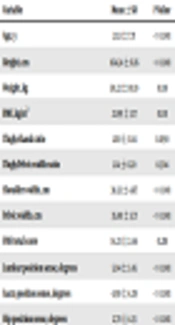
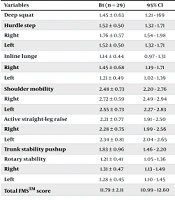
Table 1 shows the anthropometric characteristics of participants. Three groups of B1, B2 and B3 were homogeneous in terms of height and weight (P < 0.05). The mean ± standard deviation of the total FMS score for the female athletes with low vision in B1, B2, and B3 groups was 11.79 ± 2.11, 12.50 ± 2.92, 13.10 ± 2.76 , respectively (Table 2). Overall, the best and weakest performances were related to shoulder mobility and rotary stability movements, respectively. Pain was reported only in trunk stability push-up movement in B2 and B1 groups. Table 3 shows the frequencies (percentages) of different scores for each movement stratified by group. One-way ANOVA showed no significant difference between the groups in terms of the total FMS score (F (2, 70) = 1.118, P = 0.33).
Table 1.
Descriptive Characteristics of the Participants a
| Variables | B1 (n = 29) | 95% CI | B2 (n = 34) | 95% CI | B3 (n = 10) | 95% CI | Total (n = 73) | 95% CI |
|---|---|---|---|---|---|---|---|---|
| Age (y) | 26.52 ± 9.39 | 22.94 - 30.09 | 20.50 ± 6.51 b | 18.23 - 22.77 | 19.50 ± 4.76 b | 16.09 - 22.91 | 22.75 ± 8.31 | 21.03 - 24.81 |
| Height (cm) | 158.8 ± 5.96 | 156.32 - 161.04 | 159.03 ± 6.11 | 156.82 - 161.23 | 160.05 ± 8.94 | 153.65 - 166.44 | 159.04 ± 6.43 | 157.49 - 160.58 |
| Weight (kg) | 60.31 ± 12.09 | 55.62 - 65.00 | 60.38 ± 13.24 | 55.60 - 65.16 | 62.74 ± 17.20 | 50.43 - 75.04 | 60.69 ± 13.24 | 57.53 - 63.85 |
| Body mass index (kg/m2) | 23.59 ± 4.24 | 21.91 - 25.27 | 23.72 ± 4.27 | 22.17 - 25.26 | 24.36 ± 5.61 | 20.35 - 28.38 | 23.76 ± 4.41 | 22.70 - 24.82 |
aValues are expressed as mean ± SD.
bSignificantly different compared with B1 group (P < 0.05).
Table 2.
Individual and Total Score on the FMSTM Stratified by Group a
| Variables | B1 (n = 29) | 95% CI | B2 (n = 34) | 95% CI | B3 (n = 10) | 95% CI | Total (n = 73) | 95% CI |
|---|---|---|---|---|---|---|---|---|
| Deep squat | 1.45 ± 0.63 | 1.21 - 169 | 1.41 ± 0.55 | 1.22 - 1.61 | 1.50 ± 0.70 | 0.99 - 2.01 | 1.44 ± 0.60 | 1.30 - 1.58 |
| Hurdle step | 1.52 ± 0.50 | 1.32 - 1.71 | 1.79 ± 0.64 | 1.57 - 2.02 | 1.80 ± 0.42 | 1.50 - 2.10 | 1.68 ± 0.57 | 1.55 - 1.82 |
| Right | 1.76 ± 0.57 | 1.54 - 1.98 | 1.94 ± 0.64 | 1.71 - 2.17 | 2.10 ± 0.56 | 1.69 - 2.51 | 1.89 ± 0.61 | 1.75 - 2.03 |
| Left | 1.52 ± 0.50 | 1.32 - 1.71 | 1.82 ± 0.67 | 1.59 - 2.06 | 2.00 ± 0.66 | 1.52 - 2.48 | 1.73 ± 0.62 | 1.58 - 1.87 |
| Inline lunge | 1.14 ± 0.44 | 0.97 - 1.31 | 1.53 ± 0.66 b | 1.30 - 1.76 | 1.60 ± 0.84 | 1.00 - 2.20 | 1.38 ± 0.63 | 1.23 - 1.53 |
| Right | 1.45 ± 0.68 | 1.19 - 1.71 | 1.68 ± 0.72 | 1.42 - 1.93 | 1.90 ± 0.87 | 1.27 - 2.53 | 1.62 ± 0.73 | 1.44 - 1.79 |
| Left | 1.21 ± 0.49 | 1.02 - 1.39 | 1.62 ± 0.69 b | 1.37 - 1.86 | 1.60 ± 0.84 | 1.00 - 2.20 | 1.45 ± 0.66 | 1.30 - 1.61 |
| Shoulder mobility | 2.48 ± 0.73 | 2.20 - 2.76 | 2.41 ± 0.70 | 2.17 - 2.66 | 2.30 ± 0.67 | 1.82 - 2.78 | 2.42 ± 0.70 | 2.26 - 2.59 |
| Right | 2.72 ± 0.59 | 2.49 - 2.94 | 2.61 ± 0.60 | 2.40 - 2.82 | 2.90 ± 0.31 | 2.67 - 3.12 | 2.69 ± 0.56 | 2.56 - 2.83 |
| Left | 2.55 ± 0.73 | 2.27 - 2.83 | 2.55 ± 0.66 | 2.32 - 2.78 | 2.30 ± 0.67 | 1.81 - 2.78 | 2.52 ± 0.68 | 2.36 - 2.68 |
| Active straight-leg raise | 2.21 ± 0.77 | 1.91 - 2.50 | 1.94 ± 0.81 | 1.66-2.23 | 2.30 ± 0.82 | 1.71 - 2.89 | 2.10 ± 0.80 | 1.91 - 2.28 |
| Right | 2.28 ± 0.75 | 1.99 - 2.56 | 2.00 ± 0.81 | 1.72 - 2.28 | 2.30 ± 0.82 | 1.71 - 2.89 | 2.15 ± 0.79 | 1.97 - 2.34 |
| Left | 2.34 ± 0.81 | 2.04 - 2.65 | 2.21 ± 0.77 | 1.94 - 2.47 | 2.40 ± 0.69 | 1.90 - 2.90 | 2.29 ± 0.77 | 2.11 - 2.47 |
| Trunk stability pushup | 1.83 ± 0.96 | 1.46 - 2.20 | 2.06 ± 0.77 | 1.79 - 2.33 | 2.30 ± 0.67 | 1.82 - 2.78 | 2.00 ± 0.85 | 1.80 - 2.20 |
| Rotary stability | 1.21 ± 0.41 | 1.05 - 1.36 | 1.35 ± 0.48 | 1.18 - 1.52 | 1.30 ± 0.48 | 0.95 - 1.65 | 1.29 ± 0.45 | 1.18 - 1.39 |
| Right | 1.31 ± 0.47 | 1.13 - 1.49 | 1.44 ± 0.50 | 1.27 - 1.62 | 1.30 ± 0.48 | 0.95 - 1.65 | 1.37 ± 0.48 | 1.26 - 1.48 |
| Left | 1.28 ± 0.45 | 1.10 - 1.45 | 1.44 ± 0.50 | 1.27 - 1.62 | 1.40 ± 0.51 | 1.03 - 1.77 | 1.37 ± 0.48 | 1.26 - 1.48 |
| Total FMSTM score | 11.79 ± 2.11 | 10.99 - 12.60 | 12.50 ± 2.92 | 11.48 - 13.52 | 13.10 ± 2.76 | 11.12 - 15.08 | 12.30 ± 2.61 | 11.69 - 12.91 |
aValues are expressed as mean ± SD. Total FMSTM score: Sum of the seven individual test items in the functional movement screen.
bSignificantly different compared with B1 group (P < 0.016).
Table 3
. Frequencies (Percentages) of Different Scores for Each Movement Stratified by Group
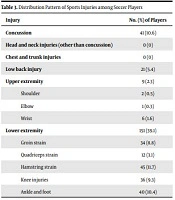
| S core | DS | HS | ILL | SM | ASLR | TSPU | RS | ||||||||||||||
|---|---|---|---|---|---|---|---|---|---|---|---|---|---|---|---|---|---|---|---|---|---|
| B1 | B2 | B3 | B1 | B2 | B3 | B1 | B2 | B3 | B1 | B2 | B3 | B1 | B2 | B3 | B1 | B2 | B3 | B1 | B2 | B3 | |
| 0 | - | - | - | - | - | - | - | - | - | - | - | - | - | - | - | 4 (13.8) | 2 (5.9) | - | - | - | - |
| 1 | 18 (62.1) | 21 (61.8) | 6 (60.0) | 14 (48.3) | 11 (32.4) | 2 (20.0) | 26 (89.7) | 19 (55.9) | 6 (60.0) | 4 (13.8) | 4 (11.8) | 1 (10.0) | 6 (20.7) | 12 (35.3) | 2 (20.0) | 4 (13.8) | 3 (8.8) | 1 (10.0) | 23 (79.3) | 22 (64.7) | 7 (70.0) |
| 2 | 9 (31.0) | 12 (35.3) | 3 (30.0) | 15 (51.7) | 19 (55.9) | 8 (80.0) | 2 (6.9) | 12 (35.3) | 2 (20.0) | 7 (24.1) | 12 (35.3) | 5 (50.0) | 11 (37.9) | 12 (35.3) | 3 (30.0) | 14 (48.3) | 20 (58.8) | 5 (50.0) | 6 (20.7) | 12 (35.3) | 3 (30.0) |
| 3 | 2 (6.9) | 1 (2.9) | 1 (10.0) | - | 4 (11.8) | - | 1 (3.4) | 3 (8.8) | 2 (20.0) | 18 (62.1) | 18 (52.9) | 4 (40.0) | 12 (41.4) | 10 (29.4) | 5 (50.0) | 7 (24.1) | 9 (26.5) | 4 (40.0) | - | - | - |
Abbreviations: DS, deep squat; HS, hurdle step; ILL, inline lunge; SM, shoulder mobility; ASLR, active straight-leg raise; TSPU, trunk stability pushup; RS, rotary stability.
The results of Kruskal-Wallis test revealed no significant differences between the three groups in deep squat (χ2 = 0.60, P = 0.970), hurdle step (χ2 = 3.797, P = 0.150), shoulder mobility (χ2 = 0.580, P = 0.748), active straight-leg raise (χ2 = 2.450, P = 0.294), trunk stability pushup (χ2 = 2.065, P = 0.356), and rotary stability movements (χ2 = 1.615, P = 0.446), but there was a significant difference between the groups only in the inline lunge movement (χ2 = 8.444, P = 0.015). The Mann-Whitney U test showed a significant difference between B1 and B2 groups in the inline lunge score (U = 329.500, P = 0.004), however, there was not a significant difference between B1 and B3 groups (U = 101, P = 0.034) and B2 and B3 groups (U = 168, P = 0.950). Table 3 also shows the distribution of scores 0, 1, 2, and 3 for the separate FMS movements in the blind and low-vision female athletes.
4. Discussion and Conclusions
The present study was aimed to describe and compare the total score of FMS and its components in the B1, B2, and B3 groups of female athletes with low vision. The total FMS score in B1, B2, and B3 groups was 11.79 ± 2.11, 12.50 ± 2.92, 13.10 ± 2.76, respectively. The FMS score also declined with a decrease in the visual strength, so that the absolute blind group got the lowest score. These differences were not statistically significant among three groups. Examination of the ability to perform separated FMS movements in the three groups also showed that the best and weakest performance were respectively related to shoulder mobility and inline lunge in B1 group; shoulder mobility and rotatory stability in B2 and B3 groups. There was also no significant difference between the three groups in separated FMS movements, and B2 Group scored better than Group B1 only in the inline lunge movement.
The movement performance of athletes with low vision in this study was lower in comparison with the sighted people in previous studies. Similarly, Houwen et al. (7) showed children with vision impairment are weaker in motor skills than sighted children. Also, the FMS score of the participants in the present study is lower than sighted non-athletic and athletic individuals in previous studies. Similarly, Fox et al. (20) reviewed the FMS score in male Gaelic field sports. They showed that the overall score of players was 15.56 ± 1.45 (elite group: 15.8 ± 1.58 vs. sub-elite group: 15.34 ± 1.31 was no significant difference between groups). The FMS score for healthy distance runners was reported 13.13 ± 1.8 (21). Perry and Koehle (16) reported the mean FMS scores for women and men were 14.5 ± 2.8 and 14 ± 2.8, respectively in middle-aged adults.
The superiority of the sighted people to the individuals with low vision may be due to the ability of the sighted individuals to imitate the movements through observation and correct them by identifying the errors; while the individuals with low vision may suffer from movement problems and their movement function has decreased due to the vision impairment.
According to the findings of this research and other researches, the total FMS score is different in various groups, including (athlete and non-athlete), age groups (adolescent, middle-aged and old age), and genders (male and female), sighted and blind groups. Therefore, a reference point cannot be used to understand the movement pattern, identify and prevent injuries in all individuals. Therefore, it is imperative that coaches of who work with visually impaired athletes use FMS tests as a valid tool and measure the performance level of their athletes along with medical tests in order to assess motor skills and prevent sports injuries and thus identify the individuals at risk and take steps to improve their capabilities (22, 23).
The findings of the present study also revealed that there was no significant difference between B1, B2, and B3 groups in their movement function. Therefore, the movement strategy is developed with vision impairment and it would not affect the movement pattern as it becomes more severe. These results were not consistent with the findings of Haibach et al. (24) study. They compared the ability to perform gross motor skills, which included six motor skills and six skills of object control in B1, B2, and B3 groups and showed that the severity of vision impairment significantly affected on all the skills. The B1 group displayed a weaker performance than the other two groups in almost all skills, and the performance of the B2 and B3 groups was not similar in three skills include running, capturing, and throwing. The difference in the results of this study with the findings of the present study may be due to the movement experience of the participants. The participants of the present study were athletes; therefore, it was likely that movement experience in athletes had neutralized the effect of blindness on the movement function of the blind, and requires further studies in this regard. On the other hand, motor skills were outcome-oriented in the Haibach et al. (24) research, while the movements were determined based on performance quality in the present research. The quality of the exercises requires the whole-body neuromuscular coordination and outcome-based scores are assigned based on the amount of covered distance and the number and timing of the movement, regardless of the quality of the movements. Therefore, it seems that the effect of blindness acuity on motor skills was different depending on the aim of the movements and their scoring procedure.
We acknowledge that there are some limitations to this study. First, the number of participants in group B3 was not similar to other groups. Second, the prevalence, severity, and risk of sports injuries were not measured. Third, physical performance and its relationship with FMS score were not investigated.
The present study was aimed to describe and compare the functional movement screening test in B1, B2, and B3 groups of female athletes with low vision. In this study, the total FMS score and its movements were reported separately in female athletes with low vision and it was shown that the quality of functional movements decrease with an increase in the blindness acuity, but this was not statistically significant. Therefore, coaches are recommended to include FMSTM in the programs for screening, pre-participation, and assessments of athletes with visual impairments to improve functional movements and establish corrective strategies to identify movement constraints.