
1. Background
Visual skills have been repeatedly emphasized as one of the most influential factors in athletic performance (1-3). The visuomotor skills constitute a dynamic interaction between the perception of sensory stimuli and motor behavior (4). The fact that a skilled perception precedes a highly-efficient performance has arisen from the observed difference between the expert and novice athletes (5). As one of the most popular sports, soccer attracts around 265 million players and over 1 billion audiences globally each year (6, 7).
Ophthalmologic evaluation of professional athletes has demonstrated superior visual abilities in elite athletes compared to novice professionals (8, 9). However, contact sport athletes with low visual skills seem to be at increased risk for encountering an incoming collision and subsequent injury (10). Visual performance is rarely assessed thoroughly by sport medicine professionals, and most of the time, a brief physical examination with the Snellen chart is sufficient (1). In a professional sports setting, highly efficacious visual skills are required for an athlete to scan the visual information at different levels and depths, switch between near and far-distance stimuli, discriminate the peripheral stimuli in the visual field and ultimately execute an appropriate eye-limb coordination response. While an athlete with a visual impairment might be at an increased risk of sports injury, highly skilled visual performance may be an essential factor in trauma prevention and athletic performance (11, 12).
Studies regarding the association of visual impairments and sports injuries in soccer league players are limited. This issue is important because some of these sports injuries are preventable. In addition, some sports injuries cause eye problems, which might be neglected in professional athletes and later lay the ground for further injuries (13).
2. Objectives
Our study aimed to determine if there is any relationship between the professional soccer league players' visual skills and sports injuries and scrutinize any potential correlation between the type of visual impairment and the type of injury.
3. Methods
3.1. Study Design
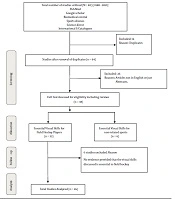
Through a prospective cohort study among professional soccer league teams, which was conducted between September 2017 and October 2018, a total of 386 soccer players were recruited for a complete ophthalmologic examination including visual acuity, field of vision, and color discrimination during the pre-competition medical assessment at Iran’s football medical assessment and rehabilitation center (IFMARC) in Tehran, Iran. Each player was followed for about one year till the end of the season. The study's outcome was the occurrence of injuries and their association with visual impairments. The Iran University of Medical Sciences' institutional ethical review board approved the study protocol under the ethical code number 211. All the participants were aware of the scope of these examinations, and their data were kept confidential.
3.2. Participants
All soccer players active in a professional soccer league team were eligible to enter the study. Based on the examination, the players received a report if any eye impairment correction was applicable. While the players were not obligated to correct the reported visual impairments, the player or their team physicians had to report any correction. The players who reported to have corrected their eye impairments before and during the season were excluded from the study, as we could not reexamine these players to see the level of correction and consider their new examination. Players with a documented ocular condition that was not evaluated during our eye examination were also excluded from our study to eradicate the effect of other eye impairments on soccer injuries.
3.3. Ophthalmologic Examination
Following a brief history of ophthalmic conditions, the participants underwent a static visual acuity test for distance and near vision through an externally illuminated Snellen chart at 10 meter and 40 cm distances, respectively. A more detailed eye examination was performed by dilating the pupil with a 1.0% tropicamide drop to confirm the initial diagnosis in case of any abnormality. Heine CE Streak retinoscope at a working distance of 50 cm was used for a dry retinoscopy. For cycloplegic refraction, a 1.0% cyclopentolate drop was used in some instances to obtain the best-corrected vision under subjective refraction. Clement Clarke RAF near point rule also measured the near point of convergence and accommodation. Color vision of all the players was tested by 38-plate edition ISHIHARA color plates.
3.4. Injury Record
All injuries were recorded daily in an online injury record service by the team physicians. The online form was created based on “the consensus statement on injury definitions and data collection procedures in studies of football (soccer) injuries," which was published in the British Journal of Sports Medicine 2006 (14). All physicians were trained before the season to use the online recording system. This online system recorded the type of injury, area of injury, time of injury, its extent, and the outcome of injury for the player.
3.5. Statistical Analysis
Data were analyzed with the statistical package for social sciences (SPSS for Windows, version 17, Chicago, Inc.). The possible relationship between an abnormal ophthalmologic examination result, position in the field, age, and the sports injury incident was investigated by binary logistic regression. All the continuous variables are presented as mean ± standard deviation (SD) and the categorical variables as number (%). Logistic regression analysis was performed to control confounding factors. A statistical significance was obtained at a P-value < 0.05.
4. Results
4.1. Overall Characteristics of Players and Vision Assessment
A total of 386 male soccer players in four different playing positions were recruited from 16 national league teams. The age of study participants ranged from 17 to 40 years, with an average of 25 ± 4.6 years. Playing positions included 50 goalkeepers (13%), 123 defenders (31.9%), 148 midfielders (38.3%) and 65 forwards (16.8%). Most participants were younger than 25 years old and played as a midfielder (Table 1).
Table 1.
Primary Characteristics of Study Participants a
| Features | Values |
|---|---|
| Age group (y) | |
| 17 - 25 | 222 (57.5) |
| 25 - 30 | 113 (29.3) |
| 30 - 35 | 45 (11.7) |
| 35 - 40 | 6 (1.6) |
| Playing position | |
| Goalkeeper | 50 (13) |
| Defender | 123 (31.9) |
| Midfielder | 148 (38.3) |
| Striker | 65 (16.8) |
a Values are expressed as No. (%) unless otherwise indicated.
The results of the visual assessment in study participants are presented in Table 2. As it is shown, myopia is the most common refractive error in both eyes, with 252 cases (65.3%) on the right and 238 cases (61.7%) on the left eye. The mean ± SD sum of both eyes' refractive errors was 1.03 (0.93) with a range of 0 to 5 diopters. Mean ± SD pupillary distance was 64.41 ± 3.37 mm with a range of 47 mm to 75 mm. In total, eight players (2.1%) showed defects in the visual field. On the other hand, color blindness was detected in 14 participants (3.8%), of which green/blue/red color blindness was the most common (5 cases, 1.3%).
Table 2.
Distribution Pattern of Visual Assessment Results a
| Visual Parameters | Values |
|---|---|
| Color vision blindness | 14 (3.6) |
| Yellow | 1 (0.3) |
| Brown | 3 (0.8) |
| Green | 1 (0.3) |
| Green/blue/red | 5 (1.3) |
| Yellow/green | 1 (0.3) |
| Brown/green | 2 (0.5) |
| Brown/green/blue/red | 1 (0.3) |
| Eye field of vision defect | 16 (4.1) |
| Right eye visual acuity | |
| Myopia | 252 (65.3) |
| Hypermetropia | 77 (19.9) |
| Left eye visual acuity | |
| Myopia | 238 (61.7) |
| Hypermetropia | 88 (22.8) |
| Pupillary distance (47 - 75 mm) | 64.3 ± 4.7 |
a Values are expressed as No. (%) unless otherwise indicated.
4.2. Type of Injuries
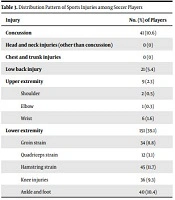
Nine players (2.3%) suffered from upper extremity injuries, which had led to at least one day of absence from training or match. Lower extremity injuries with at least one-day absence from training or match occurred in 151 players (39.1%).
Table 3 describes the distribution pattern for all types of injuries among soccer players. As presented, hamstring injuries, concussions, and ankle injuries are the most common injuries on both sides (Table 3).
Table 3.
Distribution Pattern of Sports Injuries among Soccer Players
| Injury | No. (%) of Players |
|---|---|
| Concussion | 41 (10.6) |
| Head and neck injuries (other than concussion) | 0 (0) |
| Chest and trunk injuries | 0 (0) |
| Low back injury | 21 (5.4) |
| Upper extremity | 9 (2.3) |
| Shoulder | 2 (0.5) |
| Elbow | 1 (0.3) |
| Wrist | 6 (1.6) |
| Lower extremity | 151 (39.1) |
| Groin strain | 34 (8.8) |
| Quadriceps strain | 12 (3.1) |
| Hamstring strain | 45 (11.7) |
| Knee injuries | 36 (9.3) |
| Ankle and foot | 40 (10.4) |
4.3. Risk Factors for Concussion
A logistic regression model showed that concussion incidence is higher in players with visual field defects (P-value < 0.005). Analysis of other visual impairments showed no significant relationship with concussion (Table 4).
Table 4.
Analysis of Risk Factor Variables for Upper Extremity and Low Back Injuries from Binary Logistic Regression a
| Variable | Concussion | Upper Extremity | Low Back | |||||||||
|---|---|---|---|---|---|---|---|---|---|---|---|---|
| OR | P-Value | Total | Shoulder | Elbow | Wrist | OR | P-Value | |||||
| OR | P-Value | OR | P-Value | OR | P-Value | OR | P-Value | |||||
| Age (y) | 1.36 | 0.98 | 0.91 | 0.31 | 0.89 | 0.55 | 0.15 | 0.99 | 0.92 | 0.45 | 0.98 | 0.71 |
| Playing post | ||||||||||||
| Goalkeeper | 1.00 | 0.99 | 2.64 | 0.28 | > 100 | 0.99 | > 100 | 0.97 | 1.23 | 0.83 | 0.58 | 0.46 |
| Defender | 0.98 | 0.94 | 0.26 | 0.27 | 1.06 | 0.99 | 7 | 0.99 | 0.25 | 0.27 | 0.37 | 0.12 |
| Midfielder | 2 | 0.99 | 0.37 | 0.34 | > 100 | 0.99 | 0 | 0.98 | 0.17 | 0.16 | 0.45 | 0.17 |
| Forward (reference) | 1 | 1 | 1 | 1 | 1 | 1 | ||||||
| Abnormality in vision field | 0.86 | 0.048* | 0 | 0.99 | 0 | 0.99 | > 100 | 0.99 | 0 | 0.99 | 0 | 0.99 |
| Sum of refractive error | 0.93 | 0.64 | 1.03 | 0.92 | 0.43 | 0.54 | 0 | 0.94 | 1.45 | 0.34 | 0.97 | 0.92 |
| Pupillary distance | 1.86 | 1.02 | 0.93 | 0.48 | 0.91 | 0.62 | 0 | 0.95 | 0.93 | 0.61 | 1.04 | 0.52 |
Abbreviation: OR, odds ratio.
a * P-value < 0.05 is significant.
4.4. Risk Factors for Upper Extremity Injuries
Analysis of risk factors showed no associate variable for upper extremity injuries (Table 4).
4.5. Risk Factors for Low Back Injuries
Analysis of risk factors showed no significant association for low back injuries (Table 4).
4.6. Risk Factors for Lower Extremity Injuries
A logistic regression model showed that the odds of quadriceps injury are 1.92 times greater (P-value: 0.005) for one diopter of increase in both eyes' sum of refractive errors. The odds of ankle injury are 0.91 times lower (P-value: 0.048) for one year increase in age based on the logistic regression model. Analysis of other risk factors showed no significant association for lower extremity injuries (Table 5).
Table 5.
Analysis of Risk Factor Variables for Lower Limb Extremity from Binary Logistic Regression a
| Variable | Lower Extremity | |||||||||||
|---|---|---|---|---|---|---|---|---|---|---|---|---|
| Total | Groin | Quadriceps | Hamstring | Knee | Ankle | |||||||
| OR | P-Value | OR | P-Value | OR | P-Value | OR | P-Value | OR | P-Value | OR | P-Value | |
| Age (y) | 0.99 | 0.76 | 0.97 | 0.49 | 1.04 | 0.55 | 1.03 | 0.31 | 1 | 0.81 | 0.91 | 0.048* |
| Playing post | ||||||||||||
| Goalkeeper | 0.36 | 0.28 | 0 | 0.99 | 0 | 0.99 | 0.79 | 0.76 | 0.56 | 0.36 | 1.2 | 0.829 |
| Defender | 1.00 | 0.98 | 0.75 | 0.58 | 0.81 | 0.79 | 1.62 | 0.37 | 0.6 | 0.29 | 2.39 | 0.19 |
| Midfielder | 1.35 | 0.33 | 0.86 | 0.76 | 0.46 | 0.34 | 1.88 | 0.23 | 0.53 | 0.19 | 3 | 0.08 |
| Forward (reference) | 1 | 1 | 1 | 1 | ||||||||
| Abnormality in vision field | 0.20 | 0.14 | 1.51 | 0.7 | 0 | 0.99 | 0 | 0.99 | 0 | 0.99 | 0 | 0.99 |
| Sum of refractive error | 0.93 | 0.56 | 0.91 | 0.68 | 1.92 | 0.005* | 0.9 | 0.57 | 0.83 | 0.4 | 0.79 | 0.27 |
| Pupillary distance | 0.98 | 0.66 | 1.1 | 0.09 | 0.96 | 0.69 | 0.97 | 0.57 | 0.94 | 0.28 | 1 | 0.99 |
Abbreviation: OR, odds ratio.
a * P-value < 0.05 is significant.
5. Discussion
In this study, we found that there was no significant relationship between abnormal visual skills and the incidence of low back and upper extremity injuries among soccer players. However, a logistic regression model showed that the odds of quadriceps injury is 1.92 times higher for one diopter increase in the sum of refractive error of both eyes. There is also an increased risk of concussion in players who have visual field defects.
Humans' movement relies on a dynamic interaction between sensory stimuli, information processing in the central nervous system, and ultimate motor response (4). That being said, visual stimuli provide a backbone for initial development and further modification of motor behavior (15, 16). Any impairment in the above mechanism would potentially impact the motor response. While this can be dramatically sensed in an athletic setting, visual impairment may result from a sport-related incident (17). On the other hand, numerous studies have demonstrated a significant difference in visual skills between professional and non-professional sports players (8, 18), and impaired visual skills have been shown to affect professional competence negatively to a great extent (19).
In an analysis of 939 athletes, Beckerman et al. showed that 29% of these athletes had visual symptoms, and 28% had visual acuity of less than 20/25, while 25% of those athletes had never had a complete eye examination (20). Such reports underscore the importance and necessity of a complete visual evaluation for professional athletes.
Overall, our results showed that some visual impairments could put players at higher risk for some sport-related injuries. To be more precise, it was found out that the chance of quadriceps injury is 1.92 times higher (P-value: 0.005) for a one diopter increase in the sum of refractive errors, and also concussion incidence increases with visual field defects.
According to our results, low visual acuity and visual field defects contributed to the occurrence of sports injuries among professional soccer players. Schmidt et al. investigated the odds of sustaining moderate and severe head impacts in 37 high school football (soccer) players with high and low visual performance (1). The study revealed that better visual performance does not necessarily reduce the odds of higher magnitude head concussion. It was shown that visual performance did not significantly impact higher magnitude head concussions, and establishing visual training programs in athletes with poor visual skills is not clinically relevant. Of course, it should be noted that this study has been conducted at a school level with a low sample size, while our study was performed at the national level among professional soccer players of the premier league. Moreover, the mentioned study only focused on head injuries and avoided commenting on any potential relationship between visual skills and limb injuries, in contrast to our study.
On the other hand, a recent study by Clark et al. suggested that a lack of eye discipline during headers can be a possible mechanism for increased concussion rates in female soccer players (21). It was shown that most girls close their eyes while heading in soccer, and lack of precise vision can cause higher rates of concussion among girls (21). Although we did not include female soccer players in our study, somehow, we can consider visual field defects equal to lack of precise vision; both of them lead to a lack of visual awareness, which raises the risk for concussion.
We found out that ankle injuries decrease with each year's increase in players' age. Talking of age, previous studies have shown a higher probability of developing collision in young strikers compared to older players (10, 22). This higher rate of sports injuries in the younger age group of football (soccer) players might be attributed to the fact that young players are more involved in high-risk maneuvers than their older colleagues.
High performance in soccer requires noticing a wide variety of visual stimuli depending on the player's position. A tight end demands different visual skills than a quarterback, and even the visual requirements of a given position may vary throughout the league's different matches and even between seasons. Nevertheless, the national soccer competition is a demanding set of athletic tasks requiring visual skills more excellent than that posed by novice players (23). There is a vast difference between the relationship of visual skills and sports injuries regarding professional or amateur players. With this in mind, it is noteworthy to emphasize the potential variation in required visual skills in different populations, the pattern of sports injuries, and the beneficial interventions to reduce these injuries' incidence rate. Our study aimed to provide a concept on the existing relationship between abnormal visual skills and sports injuries exclusively in national soccer league players. The findings of this research can pave the way for future studies on different populations of soccer players and remind the importance of full eye examination by sport medicine professionals, regardless of the initial visual complaint by the athletes or lack of an obvious impairment in professional performance.
5.1. Limitations
Although our study is one of the few available publications on the role of visual skills in sustaining sports injuries among national soccer league players, it poses limitations that should be considered before extrapolating its results to the next level. First, our study population constituted a heterogeneous soccer player group with different cultural, social, and economic backgrounds. Although it is not feasible to compare the study endpoints between different teams, a subgroup analysis based on age and playing positions has scrutinized the potential impact of young age in sustaining a sports injury. On the other hand, data regarding our participants' previous history of ophthalmologic health status and any ophthalmologic intervention to correct the visual impairment was lacking. This could be an essential issue to consider when altering visual skills, and the benefits of a correctional intervention are sought to be investigated. No relationship between eye field impairments and concussion was found in our study, and our sample size was relatively small for defining such a relationship. Future cohort studies with larger sample sizes are required to address this relationship and the effect of correctional interventions in improving visual skills and subsequent changes in the incidence rate of sports injuries in a homogenous but still large group of professional soccer players.
5.2. Conclusion
Visual performance can be a contributor to sports injuries in national soccer league players. Hypermetropia and visual field defects are significantly associated with a quadriceps injury and concussion in soccer players, respectively. However, future studies are required to determine the potential benefits of a correctional intervention for soccer players' impaired visual skills in reducing the incidence of sports injuries during national league competitions.