Journal of Motor Control and Learning
An International Journal of Movement Science
Implicit or Explicit Body Awareness: which is more Efficient for Professional Athletes? Application of Embodied Cognition in Sport Science
Authors

Abstract
Objective: Investigating factors that affect the performance of professional athletes has always been one of the important fields of sports science.
One of the important questions in this regard is whether athletes are better to be self-aware while performing physical movements or, conversely, this self-awareness as an interfering factor will lead to a decline in their performance.
Methods: In the present study, an attempt has been made to examine this issue with an interdisciplinary view based on the physical cognition approach, especially with the application of two models of Dreyfuss (2007) and the meshed architecture (Christensen, Sutton and McIlewin 2016; Gllagher, 2020).
Results: According to the first model, self-awareness will interfere with the performance of skillful movements, and in the opposite model, the performance of movements requires awareness of self, body and position.
Conclusion: Both approaches seem to rightly point to different aspects of awareness in performing movements; although awareness of the current situation is essential for performing movements, overt body awareness interferes with learning and performing movements and can have adverse psychological consequences for athletes in the long run.
Highlights
Copyright
© 2021, Journal of Motor Control and Learning. This open-access article is available under the Creative Commons Attribution-NonCommercial 4.0 (CC BY-NC 4.0) International License (https://creativecommons.org/licenses/by-nc/4.0/), which allows for the copying and redistribution of the material only for noncommercial purposes, provided that the original work is properly cited.
Similar Articles
The Effect of Mental and Physical Training on Meta Cognitive Beliefs and Sports Performance of Elite Karate Athletes
Akbari Niaz Abadi S, Azimkhani A, Aminzadeh R. The Effect of Mental and Physical Training on Meta Cognitive Beliefs and Sports Performance of Elite Karate Athletes. J Motor Control Learn. 2023;5(2):e144167. doi: https://doi.org/10.61186/ijmcl.5.2.35
The comparison impact of Metacognitive Therapy-Based Group Intervention and Group Acceptance-Based Behavioral Therapy on Psychophysiological Signs of Professional Soccer Players in the U-19 League in Tehran
Alavizadeh SM, Sobhi Gharamaleki N, Mami S, Mohammadzadeh J, Ahmadi V. The comparison impact of Metacognitive Therapy-Based Group Intervention and Group Acceptance-Based Behavioral Therapy on Psychophysiological Signs of Professional Soccer Players in the U-19 League in Tehran. Zahedan J Res Med Sci. 2020;22(2):e92514. doi: https://doi.org/10.5812/zjrms.92514
The Relationship between Cognitive Styles, Attention and Performance of Shooting Skill
Bahrami A, Moradi J, Rasouli P. The Relationship between Cognitive Styles, Attention and Performance of Shooting Skill. J Motor Control Learn. 2024;2(3):e146521. doi: https://doi.org/10.29252/ijmcl.2.3.23
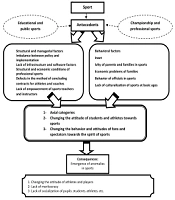
Paradigm Model of Emergence Typology of Anomalies and Corruption in Sport Hierarchical Levels in Iran with Emphasis on Human Resources
Razavi SMH, Alavi SH, Loghmani M. Paradigm Model of Emergence Typology of Anomalies and Corruption in Sport Hierarchical Levels in Iran with Emphasis on Human Resources. Asian J Sports Med. 2023;14(1):e118533. doi: https://doi.org/10.5812/asjsm-118533
Investigating Sport Attributional Style, Sport Self-Efficacy, and Creativity in Elite Team Athletes
Zoljanahi E, Mohammadi-Nezhad M, Sadeghpour Gilde B, Taheri HR. Investigating Sport Attributional Style, Sport Self-Efficacy, and Creativity in Elite Team Athletes. Iran J Psychiatry Behav Sci. 2018;12(3):e7860. doi: https://doi.org/10.5812/ijpbs.7860
- Scopus by DOI: 0
Last Update: 1 month ago
- Scopus by Title: 0
Last Update: 1 month ago
- Scopus by Title (Ref): 1
Last Update: 1 month ago
- CrossRef: 0
Last Update: 1 week ago
- OpenAlex: 2
Last Update: 11 hours ago
- OpenCitations: 0
Last Update: 4 days ago