1. Background
Multiple sclerosis (MS) is a chronic, complex disease of the central nervous system that has attracted increasing attention because of its progressive nature and profound effects on physical and psychological health (1). Beyond its neurological manifestations, MS significantly affects psychological functioning, including personality structure and mental organization (2). Several studies have reported that individuals with MS often exhibit altered personality profiles compared with healthy populations, including increased neuroticism and reduced extraversion, conscientiousness, and agreeableness; these traits are associated with greater mood disturbances and psychological symptoms in this population (3). Research in early MS cohorts has also found significant associations between core personality traits and anxiety or depression, suggesting a link between personality features and emotional adaptation (4). Personality, a fundamental component of human psychology, may undergo considerable change when individuals confront chronic illness (5). Therefore, examining personality organization in individuals with MS may provide valuable insight into psychological adaptation and inform the development of more effective therapeutic interventions (5).
Multiple sclerosis is an autoimmune disease characterized by demyelination in the central nervous system, leading to diverse neurological impairments and unpredictable relapses (6). Owing to its fluctuating and uncertain course, MS imposes substantial psychological burdens, including stress, anxiety, depression, and disturbances in self-concept and identity (6). In this context, personality organization, which refers to the integrated structure of psychological functioning encompassing identity, defense mechanisms, and reality testing, may be disrupted, thereby contributing to emotional instability and maladaptive coping (7). According to Kernberg's model of personality organization, chronic stressors and internalized conflicts may weaken ego integration, intensify primitive defenses, and destabilize self-perception.
Individuals with MS frequently face psychological challenges such as hopelessness, anxiety, reduced self-esteem, and difficulties maintaining interpersonal relationships (8). These challenges not only reduce psychological well-being but also diminish social participation and overall quality of life (9). Cultural and social contexts may also influence personality organization. In a diverse metropolitan area such as Tehran, sociocultural and economic pressures may shape how individuals interpret their illness and cope with its consequences (10). Thus, studying individuals with MS within their specific cultural context may reveal distinct patterns of psychological adjustment and inform culturally sensitive interventions (11).
Qualitative research methods are valuable for elucidating the depth and complexity of patients' lived experiences. Unlike quantitative approaches, qualitative inquiry allows an interpretive and comprehensive exploration of the emotional and cognitive processes underlying personality organization (12). The present study adopted a qualitative framework to explore the multidimensional psychological consequences of MS, focusing particularly on alterations in personality organization that influence adaptation, coping, and self-concept.
The literature indicates that disturbances in reality testing, reliance on primitive defense mechanisms such as denial, projection, and splitting, and identity confusion are among the psychological difficulties reported in individuals with MS (13, 14). These features may exacerbate emotional distress, impair interpersonal functioning, and hinder treatment adherence (15). Moreover, social and cultural pressures in Tehran, such as role changes, economic instability, and limited social support, may further aggravate these challenges, underscoring the need for comprehensive psychological care (16).
In summary, the interaction between chronic neurological impairment and personality structure in individuals with MS represents a relatively neglected but important area of study. Understanding these dynamics is essential for developing integrative therapeutic strategies that enhance psychological resilience and quality of life (17).
2. Objectives
This study aimed to provide an in-depth, culturally grounded exploration of personality organization among individuals with multiple sclerosis living in Tehran and to identify its dimensions, components, and indicators, with particular attention to psychological mechanisms, including reality testing, primitive defense mechanisms, and identity confusion.
3. Methods
This qualitative study used a two-phase design, comprising a meta-synthesis and the Delphi technique, to explore and refine dimensions of personality organization in individuals with MS.
3.1. Study Samples
The study included two distinct samples: a meta-synthesis sample of published studies and a Delphi expert panel.
Meta-synthesis sample: The meta-synthesis included 18 eligible peer-reviewed articles addressing personality functioning or related psychological constructs in individuals with MS. Studies were purposively selected based on conceptual relevance and methodological quality. Studies lacking adequate conceptual alignment or methodological rigor were excluded.
The inclusion criteria were as follows: 1) studies examining personality organization or related psychological constructs in individuals with MS; 2) qualitative, quantitative, or mixed-method designs; 3) publication in English or Persian; 4) full-text availability; and 5) no predefined conceptual framework, although Kernberg's theory of personality organization guided the analysis. No date restrictions were applied, and studies published through January 2024 were considered.
The exclusion criteria included duplicate publications, conference abstracts without full text, and studies that did not directly address personality-related constructs in MS populations.
A systematic search was conducted on January 10, 2024, in PubMed, Scopus, Web of Science, PsycINFO, SID, IranDoc, Magiran, Noormags, Civilica, Google Scholar, ScienceDirect, and Wiley Online Library. Title/abstract and full-text screening were performed independently by 2 reviewers, with disagreements resolved through discussion or consultation with a third reviewer. Methodological quality was assessed using the appropriate Joanna Briggs Institute Critical Appraisal Checklist for each study design.
Delphi expert panel: The Delphi panel comprised 15 experts, including clinical psychologists, neuropsychologists, and clinicians and researchers specializing in MS. Eligibility required an advanced academic degree and at least 5 years of clinical or academic experience relevant to MS and personality research. Experts were recruited through purposive sampling and participated voluntarily in all Delphi rounds (Table 1).
Table 1.
Demographic and Professional Characteristics of the Delphi Expert Panel a
| Characteristic | No. (%) |
|---|---|
| Age (y) | |
| Under 45 | 2 (13.3) |
| 45 - 50 | 3 (20.0) |
| 51 - 55 | 6 (40.0) |
| Over 55 | 4 (26.7) |
| Relevant work experience (y) | |
| Under 10 | 3 (20.0) |
| 10 - 20 | 8 (53.3) |
| Over 20 | 4 (26.7) |
| Gender | |
| Male | 8 (53.3) |
| Female | 7 (46.7) |
| Expert type | |
| Theoretical | 6 (40.0) |
| Practical | 9 (60.0) |
| Field of study | |
| Clinical psychology | 4 (26.7) |
| Health psychology | 8 (53.3) |
| Neurology | 3 (20.0) |
a Percentages are based on the total Delphi expert panel (N = 15).
3.2. Procedure
Relevant psychological constructs related to personality organization in individuals with MS were extracted, coded, and synthesized using iterative thematic analysis.
A 2-round Delphi method was implemented. Experts evaluated the extracted components and rated their importance. In Round 1, experts rated preidentified components derived from the meta-synthesis using a structured Delphi worksheet. An open-ended section allowed experts to propose additional components. Consensus was defined as ≥ 80% agreement among experts and was reached through iterative feedback. Informed consent was obtained, and confidentiality and anonymity were maintained.
3.3. Data Analysis
Thematic analysis was performed using MAXQDA Analytics Pro 2018. For the Delphi phase, IBM SPSS Statistics 23 was used. Kendall's coefficient of concordance (W) was calculated to assess agreement among experts across Delphi rounds. A statistically significant W (P < 0.05) with a value > 0.70 was considered indicative of strong consensus. For individual components, consensus was defined as ≥ 80% agreement among experts. Components that did not reach this threshold in a given round were excluded from subsequent rounds. Descriptive statistics were used to summarize consensus levels across the Delphi rounds.
4. Results
The thematic analysis identified six primary dimensions of personality organization among individuals with MS in Tehran. Delphi ratings indicated stable expert agreement across rounds.
4.1. Identified Dimensions of Personality Organization
Six core dimensions emerged: personality traits, coping styles, psychological quality of life, reality testing, primitive defenses, and identity confusion. Each dimension comprised multiple components (Table 2).
Table 2.
Summary of Identified Dimensions, Components, and Representative Indicators
| Dimensions and Components | Representative Indicators |
|---|---|
| Personality traits | |
| Neuroticism | Stress sensitivity, anxiety, emotional reactivity |
| Extraversion | Social energy, emotional expression, positive affect |
| Conscientiousness | Responsibility, persistence, goal orientation |
| Coping styles | |
| Active coping | Problem-solving, planning, seeking support |
| Emotional coping | Emotion expression, stress regulation |
| Spiritual coping | Meaning-making, prayer/meditation, acceptance |
| Psychological quality of life | |
| Mental health | Emotional balance, hope, low anxiety |
| Social health | Support systems, family engagement, social participation |
| Physical health | Energy level, daily functioning, sleep quality |
| Reality testing | |
| Reality-imagination differentiation | Symptom appraisal, acceptance of illness |
| Social understanding | Interpersonal role recognition, support use |
| Cognitive adaptability | Flexible thinking, cognitive regulation |
| Primitive defenses | |
| Denial | Symptom minimization, treatment avoidance |
| Projection | Externalization, blaming others |
| Splitting | Black-and-white thinking, emotional shifts |
| Identity confusion | |
| Identity incoherence | Role instability, disrupted self-concept |
| Negative self-image | Low self-esteem, hopelessness |
| Identity reconstruction | Acceptance, positive reframing, capability focus |
Personality traits included neuroticism, extraversion, and conscientiousness. Coping styles were classified as active, emotional, and spiritual strategies. Psychological quality of life encompassed mental, social, and physical well-being. Reality testing involved differentiating internal experiences from external experiences, social understanding, and cognitive adaptability. Primitive defenses were characterized by denial, projection, and splitting. Identity confusion reflected an incoherent self-concept, negative self-evaluation, and efforts toward identity reconstruction.
4.2. Frequency of Thematic Codes
The analysis demonstrated relatively balanced theme frequencies across categories. The most frequently coded content concerned social factors, support, and patients, indicating a central emphasis on interpersonal functioning and support systems.
Primitive defenses and neurotic features appeared consistently across sources. Codes related to active coping, hope, and identity rebuilding also appeared frequently, suggesting compensatory psychological processes.
4.3. Expert Consensus
Consensus was strongest for neuroticism, social support, denial, and cognitive flexibility. Based on analyses addressing the main research question, the final research model derived from the identified factors is schematically illustrated in Figure 1.
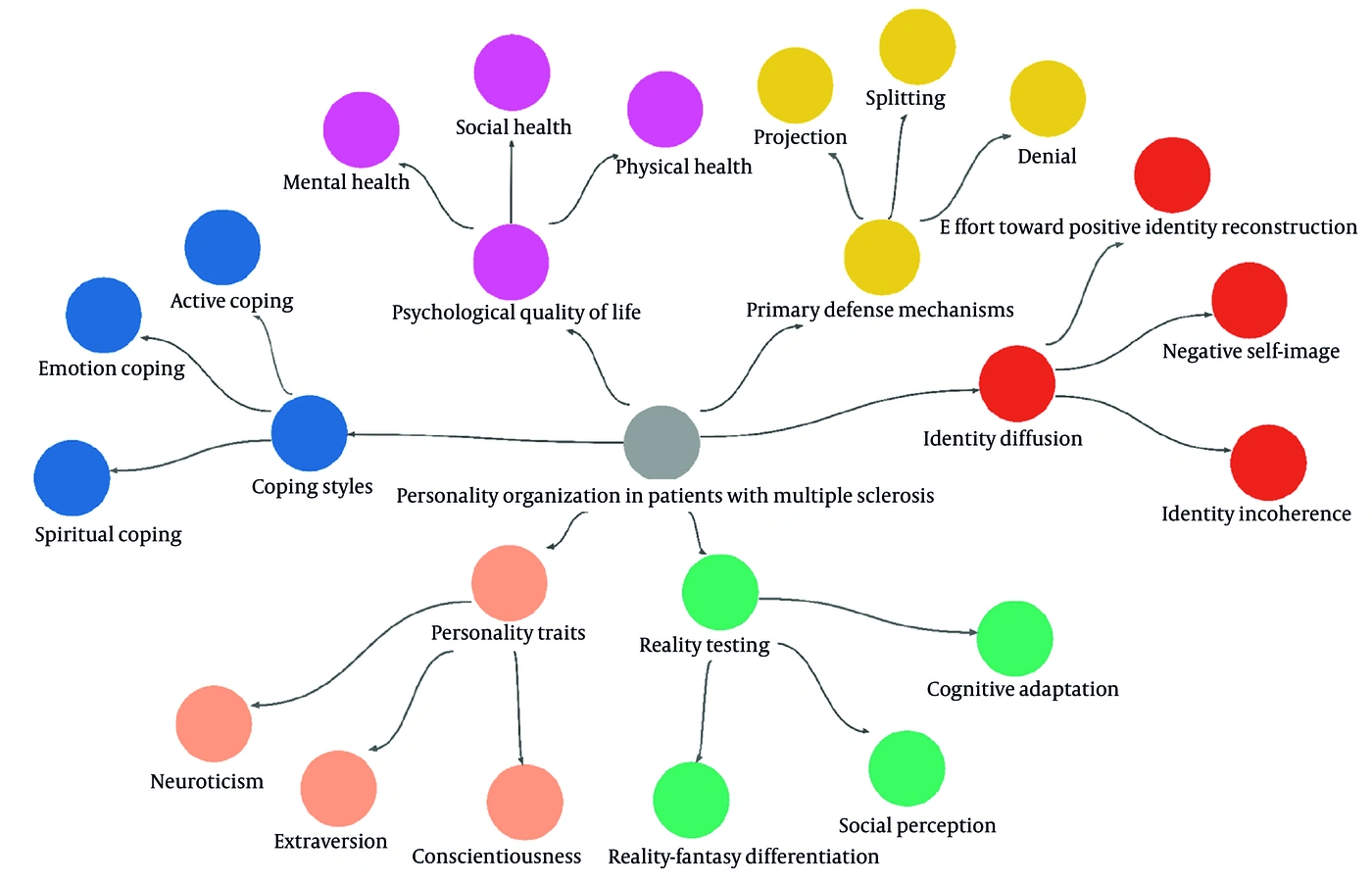
Figure 1.
Final model of personality organization in patients with multiple sclerosis in Tehran
5. Discussion
The present study identified six fundamental dimensions of personality organization among individuals with MS in Tehran: personality traits, coping styles, psychological quality of life, reality testing, primitive defenses, and identity confusion. These findings highlight the complex emotional, cognitive, and identity-related challenges experienced by individuals with MS and support the view that chronic neurodegenerative conditions may substantially affect psychological structure and functioning (9, 15, 18, 19).
Consistent with Kernberg's psychoanalytic model, the findings indicated reliance on primitive psychological defenses such as denial, projection, and splitting, which may function as emotional survival strategies as individuals cope with a chronic and unpredictable illness (20, 21). The elevated neurotic tendencies and emotional sensitivity observed in the current findings align with research showing increased vulnerability to stress, negative emotions, and cognitive dysregulation among individuals with MS (15, 22, 23, 24). In addition, many patients appeared to engage actively in identity reconstruction, supporting recent evidence that identity disruption and challenges to self-coherence play a central role in MS (25, 26).
Cultural context also appeared to shape psychological experiences. Frequent references to "social" and "support" suggest that interpersonal connectedness and family support are important resilience factors among Iranian patients, consistent with findings in Middle Eastern MS populations (22, 27). The prominence of spiritual coping further reinforces the importance of culturally informed coping mechanisms and meaning-making processes in chronic illness trajectories (19, 28).
The study also demonstrated that adaptive coping, including active problem-solving and spiritual regulation, co-occurred with maladaptive defenses. This balance may reflect patients' efforts to maintain psychological stability while navigating functional limitations, fluctuating symptoms, and uncertainty about disease progression (9, 23). Expert Delphi consensus further indicated that neuroticism, social support, denial, and cognitive flexibility are core psychological markers in MS populations.
Consistent with previous work, the findings suggest that MS affects not only emotional stability but also reality-testing capacities and cognitive adjustment, emphasizing the interplay between neurological pathology and psychological functioning (9, 15). Given the multidimensional nature of the observed personality disruptions, interventions should incorporate emotion regulation, cognitive rehabilitation, identity-strengthening strategies, and culturally relevant support systems.
Overall, this study extends the literature by integrating psychodynamic personality theory with chronic illness research and provides a comprehensive model that highlights both psychological vulnerabilities and adaptive capacities among individuals with MS.
5.1. Conclusions
In conclusion, individuals with MS exhibit a distinct pattern of personality organization characterized by heightened emotional reactivity, reliance on primitive defenses, fluctuating identity patterns, and substantial reliance on social and spiritual coping mechanisms. These findings underscore the need for holistic, culturally sensitive psychological interventions that target emotional processing, self-organization, and adaptive coping strategies. Future research should examine longitudinal changes in personality dynamics throughout disease progression and evaluate targeted psychotherapeutic approaches to strengthen identity coherence and emotional resilience in MS populations.
5.2. Study Limitations
This study has several limitations that should be considered when interpreting the findings. First, the qualitative design and reliance on expert consensus limit the generalizability of the results to broader MS populations. Second, the Delphi expert sample was relatively small and selected through purposive sampling, which may not fully capture the diversity of professional perspectives. In addition, data collection was conducted within a limited time frame and focused on patients from a single metropolitan area, Tehran, potentially restricting the applicability of the findings to other cultural or geographic contexts. Finally, variations in disease severity, treatment status, and individual psychosocial conditions at the time of data collection may have influenced the identified patterns of personality organization.
5.3. Suggestions for Future Research
Future studies should address these limitations by using longitudinal and mixed-method designs to examine changes in personality organization across different stages of MS. Expanding samples to include patients from diverse cultural, social, and geographic backgrounds may improve the generalizability of the findings. The use of standardized quantitative measures alongside qualitative approaches could further validate the identified personality dimensions. Future research should also explore the effects of disease severity, treatment modalities, social support, and cultural factors on personality organization and evaluate targeted psychotherapeutic interventions aimed at strengthening identity coherence and emotional resilience in individuals with MS.