
1. Background
Vertical jumping is a skill used in various sports and is commonly employed as a test of lower-limb strength, which may provide insight into the effects of training programs (1). Vertical jump performance and the ability to generate the power required at takeoff depend on multiple factors, including the contribution of slow- and fast-twitch muscle fibers, activation of lower-limb muscles, and coordinated transfer of joint power from proximal to distal segments (2). Therefore, vertical jump performance is determined by both motor patterns and the mechanical output of the neuromuscular system (3). One of the primary objectives in vertical jumping is to achieve maximal vertical velocity at takeoff because the height reached by the body's center of mass is directly influenced by body position and vertical velocity at the instant of takeoff (4). Several studies have shown that a considerable proportion of the variance in vertical jump performance can be explained by kinematic characteristics (5). Moreover, a positive relationship has been reported between the maximum knee flexion angle and jump height. One factor that appears to influence motor performance, particularly during jumping skills, is attentional cueing; research has demonstrated that jumpers tend to focus their attention on specific skill-related cues during movement execution (6). Thus, the direction of attentional focus can have immediate effects on skill performance (7, 8, 9).
Research in this area has emphasized that adopting an external focus of attention is more effective than an internal focus of attention for enhancing motor performance and learning (6, 10). An external focus directs attention to the effects and outcomes of movement on the environment, whereas an internal focus directs attention to one's own body movements (10). For example, when a jumper focuses on knee-joint extension, this represents an internal focus because attention is directed toward the movement pattern. In contrast, directing attention to the floor surface during jumping reflects an external focus because it emphasizes the effect of the movement (10). Supporting the superiority of an external focus, McNevin et al. proposed the constrained action hypothesis, which suggests that attempts to consciously control movement through an internal focus constrain the motor system and interfere with automatic control processes. In contrast, shifting attention away from the movement itself and toward its effects allows the system to engage more fully in automatic processing, thereby facilitating motor performance (11).
Numerous studies indicate that the type of attentional focus adopted by an athlete during jumping is an important factor that can influence jump distance and the underlying kinematic variables contributing to performance. Most of this research has highlighted the superiority of external over internal focus (6, 12-14). For example, studies examining the effect of attentional instructions on knee kinematics during jumping and landing have demonstrated that external-focus instructions, compared with internal-focus instructions, lead to more optimal kinematics and better landing technique. This, in turn, may reduce the risk of knee injury during jumping (15-18). Although the benefits of external focus over internal focus have been consistently documented (6, 10, 18, 19), another line of research has shown that increasing the distance of the external focus can further enhance performance. Specifically, directing attention toward movement effects located farther from the body results in improved execution and learning (20). For example, Coker demonstrated that, among adolescent participants, focusing on the arms rather than the legs resulted in significantly greater long-jump distances (13). Similar findings have been reported by other researchers (14, 21).
Recent studies have also examined the role of distance in internal focus and found that focusing on the legs may have more detrimental effects on standing long-jump performance than focusing on the arms (22). In other words, all forms of internal focus may impair performance compared with control conditions, but directing attention to the legs may have an even greater detrimental effect than directing attention to the arms (22). Although the superiority of external focus over various forms of internal focus has been demonstrated across different motor skills (23), there are situations in which directing attention to specific external components of a skill is not feasible (24). In this context, Becker et al. introduced another type of attentional focus, namely holistic focus (6, 24, 25). Holistic focus refers to a state in which irrelevant stimuli are inhibited while attention to relevant stimuli is enhanced. This type of focus can be applied to both performance execution and learning (26). Current studies have considered holistic focus as an alternative to either control conditions (no attentional instructions) or an external focus. However, its advantage has not been consistently observed across all situations and skill levels (6, 24, 27). For example, Saemi et al. did not report an advantage of holistic focus in either skilled or novice child swimmers (6). Therefore, given the novelty of this attentional instruction, further studies are needed to investigate its efficacy and compare it with an external focus. Moreover, to the best of the researchers' knowledge, few studies have compared holistic focus with various forms of distal or proximal external focus or with distal or proximal internal focus.
The investigation of kinematic variables when comparing different types of external, internal, and holistic attentional instructions has also been limited. For instance, Saemi et al. compared external, internal, and holistic focus during the standing long jump and showed that holistic focus was similar to external focus, with both being superior to internal focus and the control condition. However, they found no differences in kinematic variables, such as maximum knee extension, among the attentional instructions (6). Therefore, additional studies are needed to achieve a more comprehensive understanding of the effects of various attentional instructions on the execution and kinematics of jumping skills.
Another environmental factor influencing motor-skill execution is the prevailing climate during practice sessions. Depending on the emphasis placed by the coach, this climate can be categorized as competitive or non-competitive. Several studies have examined competitive training environments and their effects on psychological variables, performance, and motor learning. Triplett's study is often considered the first to investigate the effect of competition on athletic performance; cyclists performed better when training alongside other cyclists (28). According to the competitive model described by Gill and Williams (29), in a competitive environment, an individual's performance is typically evaluated and compared against specified standards in the presence of one or more people who are aware of those standards. Among the environmental factors influencing performance, encouragement and motivation play particularly important roles because they elicit higher levels of arousal. Gill identified task importance and the presence of rewards as key elements that create competition (29). The presence of another individual as a competitor has been reported to improve sprint performance but not jumping performance. However, only a limited number of studies have compared the effects of attentional-focus instructions under competitive and non-competitive conditions, which inherently involve different levels of arousal, on motor performance and movement kinematics.
2. Objectives
Accordingly, the present study was designed to address the following questions: Do different types of attentional-focus instructions, including near and far internal focus, near and far external focus, and holistic focus, influence vertical jump performance and kinematics (ie, maximal knee flexion)? Furthermore, does the effect of attentional-focus instructions on vertical jump height and kinematics differ between competitive and non-competitive conditions?
3. Methods
3.1. Participants
The sample consisted of 30 participants. This number was determined using G*Power software (version 3.1.9.2) with a statistical power of 0.80, an effect size of 0.25, a confidence interval of 0.05, and repeated-measures ANOVA with within-subject interaction as the statistical test. The minimum required sample size was calculated as 24; however, a larger sample was included to increase the reliability of the results. Accordingly, 30 undergraduate students (all female; mean age = 21 ± 3.5 years; mean weight = 57 ± 7.1 kg; mean height = 163 ± 1.63 cm) voluntarily participated via convenience sampling.
The inclusion criteria were physical health, no history of surgery, absence of knee osteoarthritis, and no musculoskeletal injuries or disorders. The exclusion criteria included incorrect vertical jump technique, sustaining an injury, or a lack of motivation to perform jumps during the experiment. The research protocol was prepared in accordance with the Declaration of Helsinki and was approved by the Research Ethics Committee of the Department of Motor Behavior and Sport Psychology at the university. Data were collected between January and February 2025 at the Motor Behavior and Exercise Physiology Laboratory within the Faculty of Sport Sciences at Shahid Chamran University of Ahvaz.
3.2. Apparatus and Task
3.2.1. Digital Vertical Jump Measurement Device
A digital vertical jump measurement device was used to assess maximum lower-limb power. Participants stood next to the device according to standardized procedures and performed a vertical jump. Muscular power was then calculated based on jump height, measured in inches or centimeters. The test is commonly applied in sports such as volleyball and basketball, in which jumping ability and muscular power are critical. In the present study, maximum vertical jump height, in centimeters, was used as the dependent variable to evaluate jump performance.
3.2.2. Kinematic Measurement Instrument
A commercial inertial measurement unit (IMU)-based motion analysis system (IMU Motion Capture Setup V2.0.7; BSN 1 - 15; software: B2.0.1.0) was used to record kinematic variables related to the participants' knee joints. Specifically, to measure the maximum knee flexion angle before takeoff, 1 sensor was placed on the trunk in the frontal plane as a reference, 2 sensors were placed on the thighs at the mid-segment in the sagittal plane, and 2 sensors were attached to the shanks at the mid-segment in the sagittal plane, for a total of 5 sensors. The sensors were positioned such that the X-axis was parallel to the ground and the Y-axis was perpendicular to the ground (Figure 1).
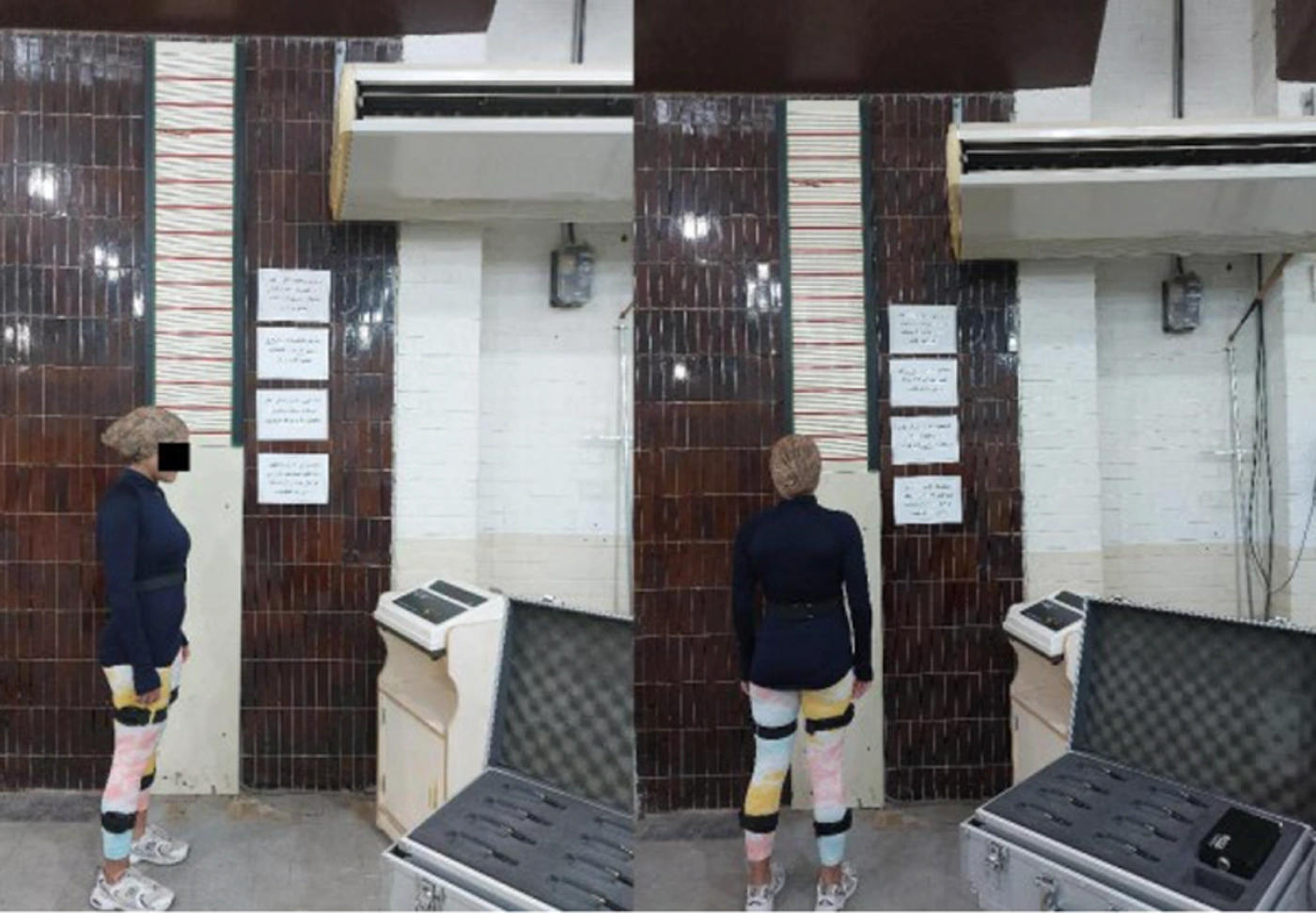
Figure 1.
Illustration of sensor placement on the human body
For each jump, data from the 5 sensors were recorded simultaneously using B2.0.1.0 software installed on a laptop. After completion of all trials (10 jumps), the mean maximum knee flexion angle for each condition was calculated and exported to an Excel file. This system has previously been used to measure kinematic variables (6, 30). Maximum knee flexion angle was defined as the greatest degree of knee flexion observed before takeoff (13).
3.3. Procedure
Before testing, all participants completed an informed consent form. None of the participants were aware of the purpose of the study. Each participant was instructed to focus according to the attentional instruction provided before each jump. After receiving a brief explanation of the procedures, all participants performed a 5-minute warm-up that included stretching exercises followed by jumping movements.
Next, 5 sensors were attached to each participant's body to record the kinematic variables. Participants then performed vertical jumps from a standing position, beginning with knee flexion and following the given instructions. Each participant performed a total of 10 vertical jumps, with 1 jump per experimental condition (2 motivational conditions × 5 attentional-focus conditions). The motivational conditions consisted of competitive and non-competitive settings, whereas the attentional-focus conditions comprised internal-near, internal-far, external-near, external-far, and holistic strategies (Figure 2).
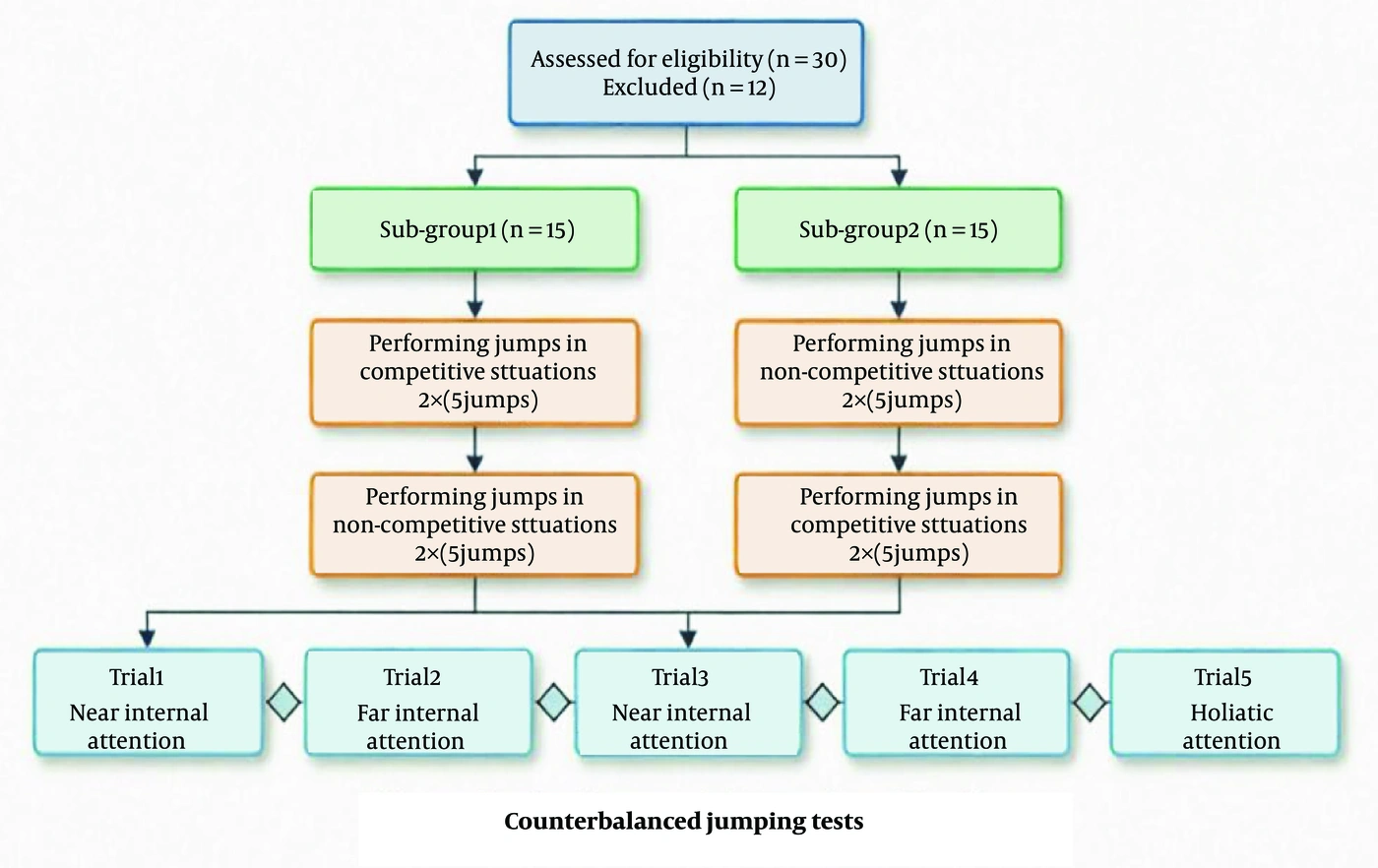
Figure 2.
Experimental protocol
3.3.1. Attentional Instructions and Experimental Conditions
In both competitive and non-competitive settings, participants performed their jumps under 5 attentional-instruction conditions: internal-near focus, internal-far focus, external-near focus, external-far focus, and holistic focus.
Internal-near focus: Participants were instructed, "As you attempt to jump with maximal effort, mentally focus on the extension movement of your knees during the jump."
Internal-far focus: Participants were instructed, "As you attempt to jump with maximal effort, mentally focus on the extension movement of your toes during the jump."
External-near focus: Participants were instructed, "As you attempt to jump with maximal effort, mentally focus on the point located on the wall at a distance of 1 meter above your standing height."
External-far focus: Participants were instructed, "As you attempt to jump with maximal effort, mentally focus on the point located at the top of the jump measurement board" (10).
Holistic focus: Participants were instructed, "As you attempt to jump with maximal effort, mentally focus on the smoothness and fluidity of your entire movement."
In the non-competitive condition, participants performed their jumps individually without receiving feedback about others' results. In the competitive condition, jumps were performed in pairs in a contest-like setting, with participants aware of their opponents' results. To mitigate neuromuscular fatigue and ensure maximal effort, each condition was performed as a single trial, with a mandatory 2-minute rest interval between jumps. The sequence of conditions was fully counterbalanced to control for order effects. In the competitive condition, participants were matched into dyads based on baseline jump performance to ensure competitive parity and minimize variance in perceived task difficulty. A prize was awarded to the winner. Prizes included a cash award of 200,000 Tomans per individual in the pair-based competitions and a sports bag for the overall winner, determined by comparing mean vertical jump records. Participants were also informed that, after the final assessment of performance data, top performers might be invited to join the university's physical fitness training team. To assess the perceived intensity of the competitive stimulus, participants were asked, "To what extent do the prize and achievement of the competition motivate you to jump higher?" Responses were recorded on a visual analog scale from 0% to 100%.
To control for order effects, the attentional-instruction conditions were counterbalanced across participants (14). After each jump, participants answered 2 questions: 1) "In this trial, did you focus your attention according to the given instructions?" and 2) "What percentage of the time did you focus on the given instructions?"
Analysis of the participants' mean responses to the self-report measures indicated that all participants achieved a mean score exceeding 80% for adherence to the attentional instructions, suggesting that they consistently maintained focus on the assigned task demands across trials. One participant was excluded because of failure to comply with these instructions and was subsequently replaced.
3.4. Data Analysis
Descriptive statistics, including means, standard deviations, and frequencies, were calculated. The Shapiro-Wilk test was used to assess normality. Both maximum knee flexion and vertical jump height were normally distributed. Therefore, vertical jump and knee flexion data were analyzed using two-way repeated-measures ANOVA to examine the main effects of competition and attentional focus and their interaction. When necessary, Bonferroni post hoc tests were applied. When Mauchly's test of sphericity indicated a violation of the sphericity assumption, the Greenhouse-Geisser correction was applied.
All analyses were performed at a significance level of P < 0.05 using SPSS version 23. Intraclass correlation coefficients (ICCs) were calculated for both dependent variables, yielding values of 0.92 for jump height and 0.88 for maximum knee flexion angle, indicating good measurement reliability.
4. Results
4.1. Vertical Jump Height
The 2 (competition) × 5 (attentional-focus condition) two-way repeated-measures ANOVA revealed a significant main effect of competition on vertical jump height, F(1, 29) = 18.854, P < 0.0001, η2 = 0.394. Specifically, jump height was significantly greater under competitive conditions (M = 36.522 ± 7.988 cm) than under non-competitive conditions (M = 33.389 ± 6.943 cm).
A significant main effect of attentional-focus condition was also observed, F(2.74, 79.71) = 3.297, P = 0.03, η2 = 0.264, indicating significant differences in jump height among the attentional-focus conditions. Mean jump heights for the internal-near, internal-far, external-near, external-far, and holistic focus conditions were 32.762 ± 8.553 cm, 33.941 ± 7.446 cm, 34.568 ± 8.742 cm, 36.333 ± 6.916 cm, and 37.174 ± 7.387 cm, respectively (Figure 3).
In addition, a significant competition × attentional-focus interaction was observed for vertical jump height, F(4, 116) = 4.500, P = 0.007, η2 = 0.409. Paired-samples t tests showed that jump height was significantly greater under competitive than non-competitive conditions for the internal-near (P = 0.001), internal-far (P = 0.001), external-far (P = 0.008), and holistic (P = 0.020) focus conditions. However, no significant difference between competitive and non-competitive conditions was observed for the external-near focus condition (P = 0.625) (Figure 3).
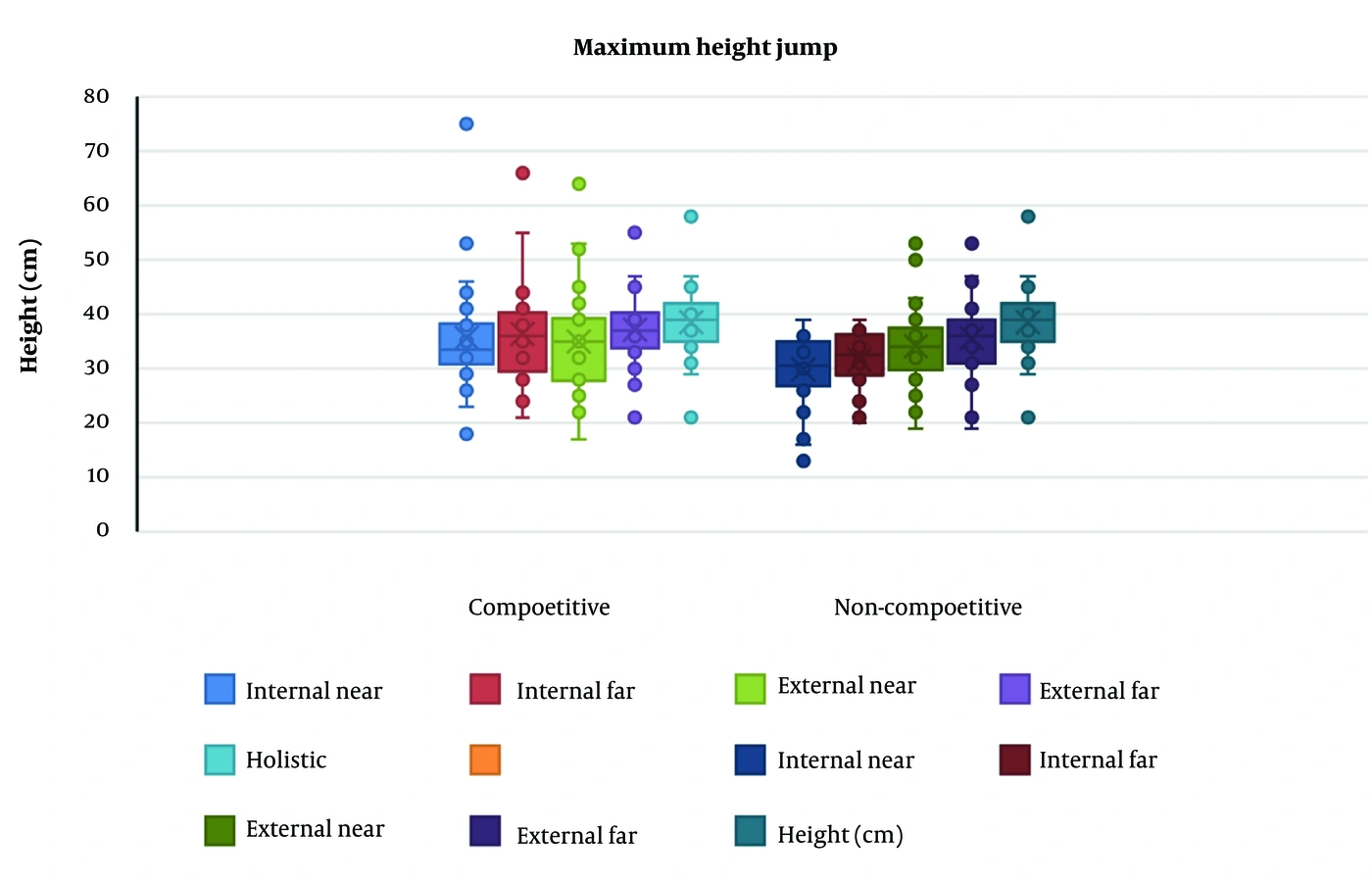
Figure 3.
Vertical jump height of participants across competitive and non-competitive conditions under five attentional focus instructions
4.2. Maximum Knee Flexion Angle
The 2 (competition) × 5 (attentional-focus conditions) two-way repeated-measures ANOVA for maximum knee flexion showed that the main effect of competition was not significant, F(1, 29) = 1.240, P = 0.275, η2 = 0.041. Similarly, no significant main effect of attentional-focus condition was observed, F(4, 116) = 2.217, P = 0.071, η2 = 0.071.
In addition, the competition × attentional-focus interaction effect on maximum knee flexion was not significant, F(4, 116) = 0.600, P = 0.663, η2 = 0.020 (Figure 4).
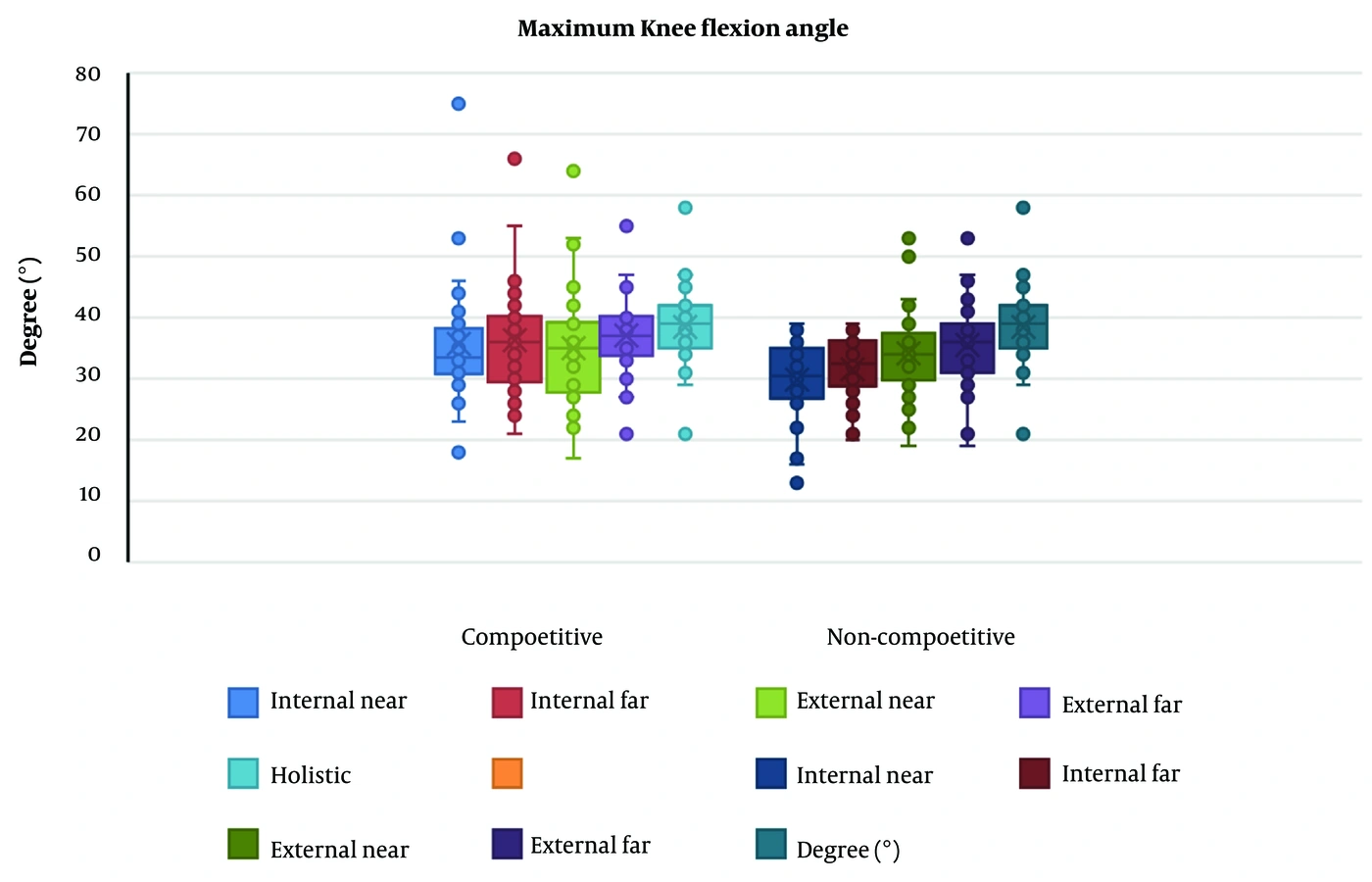
Figure 4.
Maximum knee flexion angle of participants in the competitive and non-competitive groups under five attentional conditions
5. Discussion
The present study examined whether attentional-focus instructions under competitive and non-competitive conditions influence vertical jump performance and movement kinematics. Accordingly, attentional-focus instructions at different distances (internal-near and internal-far; external-near and external-far; and holistic) were evaluated in relation to vertical jump performance and kinematics across competitive and non-competitive contexts.
Mean vertical jump height was greater under competitive conditions than under non-competitive conditions. In the non-competitive condition, the greatest jump height was observed with holistic-focus and external-far-focus instructions. However, under competitive conditions, no differences in vertical jump height were found among the attentional-focus instructions.
Given the high levels of compliance with attentional instructions reported by participants across all conditions (all above 80%), the observed differences among attentional conditions can reasonably be attributed to the attentional manipulations. These findings are consistent with previous research. For example, Saemi et al. reported that maximum knee flexion angle did not differ among external, internal, and holistic attentional-focus conditions (6). Similarly, Asadi et al. showed that participants in external-focus conditions, both near and far, achieved significantly greater jump distances than those in the control condition; however, no significant difference was observed between near and far external focus (14). The present data also showed that mean vertical jump height was greater under external-focus than under internal-focus conditions. Zhuravleva et al. demonstrated that, during vertical jumps on a force plate, jump height under external- and holistic-focus instructions was greater than under internal focus. However, they did not observe significant effects on any kinematic or kinetic dependent variables, including jump height, knee flexion, and hip flexion (27). Similarly, Saemi et al. reported that participants performed better under external and holistic focus than under internal focus in horizontal jump tasks (6). Regarding attentional-focus distance, Asadi et al. showed that skilled athletes performing horizontal jump tasks achieved superior performance under both external-far and external-near focus conditions compared with internal focus (14).
Vertical jump performance was also greater under competitive than under non-competitive conditions. In this study, competitive conditions were induced through rewards. Previous research has shown that coaches and athletes commonly use strategies such as rewards and punishment to maintain high levels of motivation for physical effort.
In sports, competition between individuals is recognized as an important factor in fostering motivation for improved performance. However, competition does not always enhance motivation and effort. Other factors, including task characteristics and individual traits, influence the competitive environment (31, 32). For cyclists, variables such as the number of participants, the quality of opponents, and the importance of the activity affect race speed and time to maximum effort (33-35). It appears that in tasks requiring physical fitness factors such as strength, speed, and endurance, including the task used in this study, increased arousal enhances performance. However, heightened arousal may diminish the influence of other instructions, such as directing attention to the body or the external environment.
Task goals, such as striving for task mastery versus striving to win, may also affect physical performance during competitive physical activities (35, 36). Individual competitive orientation, defined as the tendency to strive for success in competition (37), may influence the level of effort exerted in competitive settings. Individuals with higher competitive orientations are particularly motivated to exert greater effort against an opponent (31). Conversely, non-athletes or individuals with weak competitive orientations may be less inclined to engage in demanding physical competition, especially if the competition is perceived as highly challenging (3). This was not the case in the present study because the task was simple and low risk.
An intriguing finding was the interaction effect, specifically the lack of a significant difference between competitive and non-competitive conditions under the external-near focus instruction. This suggests that external-near focus may moderate the performance benefits typically induced by competition. Theoretically, this may be explained by attentional capacity and constraints. Although competition generally increases motivational arousal and performance, the external-near instruction may impose a highly localized and restrictive attentional demand. This narrow focus could limit the cognitive and motivational resources available for participants to translate competitive arousal into enhanced motor output. In other words, an intense focus on a proximal target might limit the individual's capacity to use the heightened physiological arousal characteristic of the competitive condition, thereby neutralizing the competitive advantage observed under other attentional conditions.
According to Apter's reversal theory, increased arousal enhances performance when it elicits enjoyment but impairs performance when it induces anxiety. In the present study, rewards generated enjoyment, whereas the absence of rewards did not produce anxiety. Thus, increased arousal may have promoted enjoyment, which in turn improved performance. Accordingly, the findings are consistent with reversal theory (38).
Although the present study showed superior performance under external and holistic focus compared with internal focus, the kinematic data showed no differences in maximum knee flexion angle before takeoff across attentional conditions. Nevertheless, previous studies have provided evidence that external focus leads to greater maximum knee flexion before takeoff than internal focus, which in turn contributes to increased jump distance or height (14).
In the present study, 30 novice participants performed vertical jumps under different attentional conditions, and maximum knee flexion angle before takeoff was recorded for each condition. In contrast, most related studies reporting significant differences in kinematic variables across attentional conditions included smaller samples. For example, Asadi's study involved 15 participants, and Gokeler et al.'s study involved 16 participants. Thus, one possible explanation for the differing findings may be the larger sample size in the present study. A larger sample may reduce the likelihood of false-positive findings; therefore, future studies with larger samples are recommended to provide more precise findings (12, 14).
Moreover, Gokeler et al.'s study was conducted in patients following anterior cruciate ligament (ACL) reconstruction, whereas the present study involved healthy adults. Another possible explanation for the discrepancy is the difference in jump tasks: Gokeler et al. examined a single-leg hop test, whereas the present study focused on vertical jumps. Future research should compare healthy participants and patients following ACL reconstruction under different attentional conditions while recording relevant kinematic variables (14).
Because this study focused on maximum knee flexion angle before jumping, the findings indicate that jump distance varied across attentional conditions without corresponding differences in knee flexion. One possible reason for the lack of differences in knee flexion is that only a single movement variable was measured, which may have limited the ability to detect variations in other joints. Therefore, future research should employ more complex kinematic analyses to examine movement differences across multiple joints and their effects on jump height. Future studies should also investigate the effects of attentional focus on inter-joint synergies, such as relationships among kinematic variables of the knee, ankle, and hip during vertical jumping.
5.1. Study Limitations
Several limitations warrant mention. First, although self-report scales were used to ensure attentional-focus compliance, consistent with established literature (6, 25), the absence of objective physiological markers (eg, heart rate) or standardized psychological scales (eg, CSAI-2) limits the ability to quantify the exact state of competitive arousal. According to reversal theory, the psychological response to competition is multifaceted; depending on individual personality traits, arousal may be experienced as either anxiety or excitement. Future research should incorporate multidimensional psychological and physiological assessments to better elucidate the mediators between competitive environments and motor performance. Second, although the sample size was sufficient for the primary performance analysis, the non-significant kinematic findings may be attributable to limited statistical power, particularly given the inherent noise and complexity of IMU-based measurements. Future studies with larger cohorts are recommended to detect more subtle biomechanical variations.
5.2. Conclusions
The findings demonstrated that attentional-focus instructions can influence vertical jump performance; however, this effect was primarily evident under non-competitive conditions. In competitive contexts, heightened arousal and motivation appear to drive individuals to exert maximum effort, thereby diminishing the impact of attentional-focus instructions on performance. This suggests that the effectiveness of attentional focus largely depends on environmental and psychological conditions.
Superior performance under external, particularly external-far, and holistic focus conditions provides further support for existing theories regarding the benefits of directing attention away from the body. The kinematic findings also indicate that improvements in performance are not necessarily accompanied by noticeable changes in a single variable, such as knee flexion angle, highlighting the need for more complex analyses of inter-joint interactions.
Accordingly, coaches and sport practitioners teaching and improving skills that require maximal force production, such as jumping in volleyball and basketball, should consider instructions that direct athletes' attention externally or holistically. Future research should use larger sample sizes, examine multi-joint kinematic variables, and compare different populations, such as healthy athletes and patients following ACL reconstruction, to provide a more comprehensive understanding of the role of attentional focus in motor performance.