
1. Background
Multiple sclerosis (MS) is an autoimmune disease originating from the central nervous system (CNS), which may be accompanied by various motor or sensory disorders and other defects (1). More than two million people suffer from MS worldwide (2). Research on MS in Iran suggests that the prevalence of this disease is increasing rapidly. This disease is vaguely more common in women and young people (3). Considering its chronic and recurrent nature, MS patients are usually susceptible to various mental and psychological disorders, including depression.
Depression, a mood disorder, refers to intense sadness or disability to experience joy and pleasure in life, with physical symptoms such as fatigue and low energy (4). A previous study revealed that depression is more common in young patients with MS than in other groups, while sex does not play a significant role in depression among these patients. It seems that MS patients with higher levels of education are more vulnerable to depression (5). Another study claimed that depressive symptoms are more common in MS patients due to underlying cognitive deficits (1).
The susceptibility of MS patients to mental and mood disorders, such as depression and anxiety, leads to some changes in their quality of life. The World Health Organization (WHO) defines the quality of life as people’s perceptions and assessments of their position in life and the value system in which they live; it also explains that people’s wishes and expectations in life widely influence their mental, social, and physical status (6). Research suggests that the quality of life of MS patients is low (7). Moreover, another study revealed that quality of life plays a crucial and mediating role in depression among MS patients (8).
Another important problem in MS patients is the level of perceived stress and coping mechanisms. Generally, stressful life events intensify MS, and negative, stressful events can predict MS relapse. On the other hand, positive stressful events reduce the severity of symptoms (9). According to previous studies, receiving social support can significantly prevent severe physical complications in MS patients (10). In this regard, a study reported that social support affected the quality of life of these patients and improved their coping with the disease. Besides, another study showed that increased positive social support reduced depression in MS patients (11).
Social support is related to a person’s personality style. It seems that patients who are classified into different groups regarding their personality styles show different behavioral patterns in dealing with different situations. The present study defined two personality styles: Sociotropy and autonomy. Generally, people with a sociotropic personality style need caring and seek approval from others. They try to please others and boost their self-esteem through other people’s affection and attention. Conversely, people with an autonomous personality style are purposeful individuals who seek independence. They are sensitive about their defeats and experience emotions such as doubt, self-criticism, and guilt (12). A study in Saudi Arabia indicated a very high rate of depression and anxiety among MS patients (13).
Although many studies have examined the effects of stressful events and social support on depression and quality of life, there is a lack of research on the effects of personality styles, especially sociotropy, and autonomy, on quality of life and depression. Obviously, the identification of personality styles in people with chronic diseases can help improve their coping strategies and treatment process. Nevertheless, most previous studies have not considered the personality styles of individuals, and there are only a few studies in this area. Given the influence of psychological factors on MS and the potential for MS to exacerbate psychological issues, it is important to investigate the impact of personality style, negative, stressful events, and social support on the quality of life and depression of sociotropic and autonomous MS patients in Iran. Despite the scarcity of research in this area, exploring these factors could shed light on future treatment and research directions.
2. Objectives
Therefore, this study aimed to determine the personal styles of MS patients and the effects of personality styles, negative, stressful events, and social support on the quality of life and depression in the sociotropic and autonomous groups. The present results could be useful for specialists and people providing services for MS patients.
3. Methods
This descriptive, analytical, cross-sectional study was performed using the regression analysis method. The statistical population consisted of all patients who were members of the Zahedan MS Society, Zahedan, Iran, in 2019. We used convenience sampling to select 101 patients (74 females and 27 males). Assuming that sociotropic and autonomic personality types each accounted for 50% of the samples, it was predicted that 50 out of 101 patients would belong to one of these groups. The study objectives were introduced and explained to the referred patients at the MS Association of Zahedan City. Those who met the inclusion criteria were selected as our study sample. As this study aimed to investigate the association of interpersonal support and negative, stressful events with quality of life and depression in MS patients and to propose a regression model for defining an independent quantitative variable, a minimum sample size of 12 was estimated. Twenty-five sociotropic and 25 autonomic patients (total = 50) were considered sufficient for the statistical analysis.
The inclusion criteria were willingness to participate in the study and having at least a middle school literacy education. Besides, the included patients had no other chronic diseases or psychiatric disorders. All patients completed the Personal Style Inventory (PSI), Beck’s Depression Inventory (BDI), Short-Form Health Survey (SF-36), Life Experiences Survey (LES), and Interpersonal Support Evaluation List (ISEL). Data were analyzed in SPSS version 24. Descriptive statistics, such as percentage, frequency, mean, and standard deviation (SD), were used for data analysis.
3.1. Measurement Tools
3.1.1. Personal Style Inventory
This inventory contains 48 items, including 24 measuring sociotropy and 24 measuring autonomy. The sociotropy personality style has three subfactors: (1) being worried about what others think, (2) dependence on others, and (3) pleasing others. Also, the autonomy personality style consists of three subfactors: (1) perfectionism/self-criticism, (2) the need for control, and (3) defensive separation. Cronbach’s alpha coefficients were measured to evaluate validity and reliability. The reliability of the scale was 0.84 (14, 15). The psychometric characteristics of this scale were assessed in the Iranian sample, showing that the internal stability of the scale of self-management and sociability is 0.71 and 0.73, respectively. Also, the reliabilities of self-governance and sociability were 0.76 and 0.79, respectively (16).
3.1.2. Beck’s Depression Inventory
This inventory consisted of 21 items. The scores ranged from 0 to 63, with scores of 0 - 14 indicating minimal depression, 14 - 20 indicating slight depression, 20 - 29 indicating moderate depression, and above 29 indicating severe depression. The validity of this tool was estimated at 0.85. It also had a significant positive correlation with other tools measuring mental health (17-19). In Iran, Cronbach’s alpha coefficient for this scale was reported to be 0.94 (20).
3.1.3. Short-Form Health Survey
This questionnaire consists of 35 items and eight scales. The scales include limitations in physical performance, usual role activities, social activities because of physical or emotional problems, physical pain, general mental health, vitality, and general health perceptions. The reliability of this tool was estimated at 0.77-0.90, and its validity was adequate; the correlation coefficients ranged from 0.58 to 0.95 (>0.40) (21-23).
3.1.4. Life Experiences Survey
This survey contains 60 items (57 valid items and three empty spaces for unlisted events) to examine the occurrence, severity, and positive or negative effects of life events in the last year. The reliability coefficients for the negative change score range from 0.56 to 0.88; this score is correlated with various dependent variables (24). In Iran, Cronbach’s alpha coefficient was measured to be 0.78 for the positive change score and 0.81 for the negative change score (25).
Interpersonal Support Evaluation List: This list contains 40 items to assess emotional and instrumental support. It surveys four major domains: Appraisal support, tangible support, self-esteem support, and belonging support. Its reliability was measured to be 0.83, and its correlation with another social support scale was moderate (26, 27).
4. Results
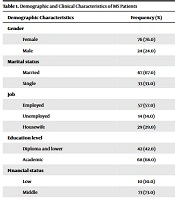
Among 101 participants examined in this study, 74 (73.3%) were female, and 27 (26.7%) were male. The mean age of the participants was 35.19 years (SD = 9.53). Based on the results, the personality style of 20 (19.8%) patients was sociotropic, while 26 (25.8%) patients had an autonomous personality style. The sociodemographic characteristics of the participants are summarized in Table 1.
Table 1.
Sociodemographic Characteristics of Participants (N = 101)
| Variables | No. (%) |
|---|---|
| Sex | |
| Male | 27 (73.3) |
| Female | 74 (26.7) |
| Marital status | |
| Single | 33 (32.7) |
| Married | 51 (50.5) |
| Divorced | 13 (12.8) |
| Widow | 4 (4) |
| Educational status | |
| Primary school | 22 (21.8) |
| High school diploma | 37 (36.6) |
| Postsecondary education | 42 (41.6) |
| Personality style | |
| Sociotropy | 20 (19.8) |
| Autonomy | 26 (25.8) |
| Usual | 48 (47.5) |
| Mixed | 7 (6.9) |
The variables in the sociotropy and autonomy groups are presented in Table 2. The results of stepwise regression analysis, shown in Table 3, revealed that 22% of the variance in quality of life (R2 = 0.22, P = 0.036) could be explained by negative, stressful events in the sociotropy group. Also, 33% of the variance in quality of life (R2 = 0.33, P = 0.008) could be explained by social support. Overall, social support and stressful events both explained 36% of the variance in quality of life in the sociotropy group (R2 = 0.36, P = 0.071), showing that social support in the face of negative, stressful events improved their quality of life.
Table 2.
Mean and Standard Deviation (SD) of Variables in Sociotropic and Autonomic Groups (N = 101)
| Variables | Mean ± SD | |
|---|---|---|
| Sociotropic Group | Autonomic Group | |
| Depression | 20.35 ± 11.38 | 21.42 ± 9.39 |
| Stressful events | 21.50 ± 11.37 | 20.50 ± 8.59 |
| Social support | 58.30 ± 31.38 | 67.92 ± 27.25 |
| Quality of life | 56.05 ± 13.08 | 56.53 ± 12.64 |
Table 3.
Specific and Common Role of Negative Stressful Events and Social Support in Quality of Life of Sociotropy Patients
| Predictors | β | SE | P-Value | Partial Correlation | R2 | ADJ R2 |
|---|---|---|---|---|---|---|
| Model 1 | 0.222 | 0.179 | ||||
| Negative stressful events | - 0.472 | 0.239 | 0.036 | - | ||
| Model 2 | 0.333 | 0.296 | ||||
| Social support | 0.577 | 0.079 | 0.008 | - | ||
| Model 3 | 0.362 | 0.287 | ||||
| Negative stressful events | - 0.207 | 0.273 | 0.395 | - 0.20 | ||
| Social support | 0.458 | 0.098 | 0.071 | 0.42 | ||
| F | (2,17) = 4.82 | |||||
| P-Value | 0.02 | |||||
Moreover, in the autonomy group, 22% of the variance in quality of life could be explained by negative, stressful events (R2 = 0.22, P = 0.014) (Table 4). There was no significant relationship between social support and quality of life (R2 = 0.06, P = 0.204). Social support and negative, stressful events both explained 23% of the variance in the quality of life of this group (R2 = 0.23, P = 0.55). Based on the results, the inclusion of social support as a moderating variable had no significant effects on improving the quality of life.
Table 4.
Specific and Common Role of Negative Stressful Events and Social Support in Quality of Life of Autonomy Patients
| Predictors | β | SE | P-Value | Partial Correlation | R2 | ADJ R2 |
|---|---|---|---|---|---|---|
| Model 1 | ||||||
| Negative stressful events | - 0.472 | 0.264 | 0.014 | - | 0.224 | 0.192 |
| Model 2 | ||||||
| Social support | 0.258 | 0.092 | 0.204 | - | 0.066 | 0.028 |
| Model 3 | 0.236 | 0.170 | ||||
| Negative stressful events | - 0.436 | 0.284 | 0.033 | 0.42 | ||
| Social support | 0.115 | 0.089 | 0.556 | 0.12 | ||
| F | (2,23) = 3.55 | |||||
| P-Value | 0.04 | |||||
Additionally, the results of stepwise regression analysis showed that in the sociotropy group, 33% of the variance in depression could be explained by the variance in negative, stressful events (R2 = 0.33, P = 0.007) (Table 5). Also, 60% of the variance in depression could be explained by social support alone (R2 = 0.60, P < 0.001). Overall, social support and negative, stressful events both explained 62% of the variance in depression (R2 = 0.62, P = 0.002), showing that social support plays a strong protective role against depression in this group of patients.
Table 5.
Specific and Common Role of Negative Stressful Events and Social Support in Depression in Sociotropy Patients
| Predictors | β | SE | P-Value | Partial Correlation | R2 | ADJ R2 |
|---|---|---|---|---|---|---|
| Model 1 | ||||||
| Negative stressful events | 0.581 | 0.192 | 0.007 | - | 0.33 | 0.30 |
| Model 2 | ||||||
| Social support | - 0.777 | 0.053 | < 0.001 | - | 0.60 | 0.58 |
| Model 3 | 0.62 | 0.58 | ||||
| Negative stressful events | 0.199 | 0.181 | 0.286 | 0.19 | ||
| Social support | - 0.662 | 0.065 | 0.002 | - 0.66 | ||
| F | (2,17) = 14.44 | |||||
| P-Value | < 0.001 | |||||
Moreover, regression analysis results showed that in the autonomy group, 10% of the variance in depression could be explained by variance in negative, stressful events (R2 = 0.10, P = 0.10) (Table 6). Also, 25% of the variance in depression could be explained by variance in social support alone (R2 = 0.25, P = 0.008). Social support and stressful events both explained 28% of the variance in depression (R2 = 0.28, P = 0.025), showing that social support could play a relatively protective role against depression in this group.
Table 6.
Specific and Common Role of Negative Stressful Events and Social Support in Depression in Autonomy Patients
| Predictors | β | SE | P-Value | Partial Correlation | R2 | ADJ R2 |
|---|---|---|---|---|---|---|
| Model 1 | ||||||
| Negative stressful events | 0.325 | 0.211 | 0.106 | - | 0.105 | 0.068 |
| Model 2 | ||||||
| Social support | - 0.506 | 0.061 | 0.008 | - | 0.256 | 0.225 |
| Model 3 | 0.285 | 0.222 | ||||
| Negative stressful events | 0.178 | 0.204 | 0.349 | 0.19 | ||
| Social support | - 0.448 | 0.064 | 0.025 | - 0.44 | ||
| F | (2,23) = 4.57 | |||||
| P-Value | 0.02 | |||||
5. Discussion
The current study aimed to determine the role of personal style, negative, stressful life events, and social support in predicting quality of life and depression in patients with MS. For this purpose, a total of 101 patients referred to Zahedan MS Society in Zahedan, Iran, were examined using the PSI, BDI, SF-36, ISEL, and LES scales. The results showed that in MS patients with a sociotropic personality style, social support could play a major role in improving their quality of life. In other words, when these patients are exposed to negative, stressful events, social support can play a moderating role in improving their quality of life, as they are enabled to cope with adverse situations. On the other hand, experiencing negative, stressful events without receiving social support reduces the quality of life of these patients. Overall, the present findings indicated the significant role of social support in this group of patients.
In this regard, Sin-Kau et al. showed that social support could help predict the psychological health of sociotropic individuals (28). Moreover, social support could reduce the level of depression in these people. In other words, when exposed to negative, stressful events, social support can protect against depression. Besides, negative, stressful events without social support could increase depression in this group. It is widely accepted that stressful life events are associated with the onset, exacerbation, and recurrence of depression. Nevertheless, only a minority of people who experience stressful life events also experience depression.
Researchers have investigated the risk factors for stress, such as personality traits and low social support (29). In patients with an autonomous personality, although social support does not play a vital role in their quality of life, it can slightly reduce depression. Although social support cannot play a moderating role in improving quality of life in the face of negative, stressful events, it can play a moderating role in reducing depression when exposed to such events. In this regard, Bakhshani showed that social support has a more significant moderating effect on sociotropic individuals than on the autonomous group (15).
Moreover, Nelson showed that one specific personality characteristic of autonomous people, i.e., the need to control, is a risk factor for chronic interpersonal stress. Besides, the sociotropic personality style is a risk factor for chronic stress, along with lower levels of self-adequacy and perceived interpersonal relationships (30). Generally, people with a sociotropic personality style are more concerned about social support and being accepted by others in their self-appraisal. In contrast, people with an autonomous personality style are more concerned about their independence, self-control, and self-appraisal (14, 31); these results align with our findings in patients with sociotropic and autonomous personality styles.
The distinctive attitudes and behaviors of sociotropic and autonomous people tend to increase their susceptibility to depression (31, 32). Depending on the self-schema in each personality style, life stressors can increase susceptibility to depression. Besides, personality traits can significantly influence one’s quality of life. They can affect people’s approach toward life circumstances or outcomes, influencing their quality of life either positively or negatively (32). Otani et al. showed that in both sociotropic and autonomous personality styles, stressful events increased people’s capabilities and susceptibility to depression (33), which is consistent with our findings. Moreover, Nikolaev and Vasileva in 2017 found that perceived social support for MS patients, based on typical emotional components and close social relations, was unstable for all personality styles; also, reduced social support and safety could be a major risk factor for depression (34).
Koelmel et al. found a significant relationship between social support, flexibility, and mental problems in MS patients (35). Furthermore, a study conducted by Shih revealed that sex significantly predicts interpersonal stress levels. Specifically, being female and having increased sociotropy were predictors of higher levels of interpersonal stress. This finding indicates interpersonal stress in women and suggests a relationship between sociotropy and the symptoms of depression (36). The present results are also consistent with previous findings, which showed that social support is important for MS patients experiencing negative, stressful events considering their personality styles; no study in the literature contradicted our findings.
We faced some limitations in this study, the most important of which was the limitation due to resources and time. Because of these limitations, we could not follow our variables in a sufficient population. Therefore, we could not control the demographic variables, and it is recommended for future studies to control the demographic variables and also to have a larger population. Also, since this study had a retrospective design, future prospective research is suggested.
5.1. Conclusions
Psychological problems are important consequences of chronic diseases. Therefore, our understanding of the patient’s personality style can effectively improve their problem-solving strategies and mental health problems. The present results also showed that social support could play a vital role in helping patients with a sociotropic personality style, while its impact was not as significant in the autonomous group.