Fulltext
The body of the article can be found in the PDF file.
Journal of Medical Education for Future Demands
Former Title: Journal of Medical Education | The Official Journal of School of Medical Education and Learning Technologies
Image Credit:J Med Edu
Authors
Background: In studies on validities of different methods for student assessment, each technique has been independently evaluated, but literature confirms the use of combination of different methods of assessment.Objectives: Searching for negative and positive aspects of assessment tools, and introducing the more preferable technique.Methods: In this descriptive-analytical research, 1372 medical students were tested using three types of questions; short-answer, multiple-choice, and true-false, so that the result of each method can be compared with those of the other two for each student. Nine classes from different curricula were randomly selected and in each of them, 30 questions for 10 selected topics (total 270), were distributed.Results: The students' score analysis after excluding questions with a discrimination index of less than 0.3, showed that the most valid assessment tool was the short-answer questions (r0.685). The kappa coefficients of the shortanswer method and the other two were in the "fair" range of agreement. The highest coefficient of contingency is between the multiple-choice and true-false questions (0.402). The percentage of correct answers is the lowest in short-answer questions (53%), and the highest in true-false questions (65%). The higher percentage of incorrect answers in multiple-choice (32%) compared with the true-false (26%) questions can be the result of the students being confronted with alternative choices in multiple-choice question, which apparently encourages them to chooseone without using the relevant knowledge.Conclusion: It is recommended to use short-answer and true-false questions as the main components of examination, instead of multiple-choice question alone, so that student's learning and recall would be tested and students would not be misled.
© 2004, Author(s). This open-access article is available under the Creative Commons Attribution 4.0 (CC BY 4.0) International License (https://creativecommons.org/licenses/by/4.0/), which allows for unrestricted use, distribution, and reproduction in any medium, provided that the original work is properly cited.
Kaveh Tabatabaee MS, Bahreyni Toosi MH, Derakhshan A, Khajeh Dalloee M, Gholami H. Analytic Assessment Of Multiple-Choice Tests. J Med Edu. 2003;2(2):e105008. doi: https://doi.org/10.22037/jme.v2i2.883
Pourmirza Kalhori R, Darabi F, Roshanpour F, Rezaei M. Analytic assessment of multiple choice questions (MCQ) of faculties' members' scholarship in Kermanshah University of Medical Sciences, 2010-2011. J Clin Res Paramed Sci. 2013;2(1):e82210. doi:
Ranganath R, Rajalaksmi C, Simon MA. Medical Students’ Perceptions of E-assessment: Multiple Choice Questions used as a Tool of Assessment for Preclinical Years. J Med Edu. 2017;16(1):e105563. doi: https://doi.org/10.22037/jme.v16i1.14842
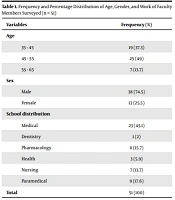
Shiani A, Ahmadi SM, Ramezani G, Darabi F, Zanganeh F, et al. The Role of Qualitative and Quantitative Feedback on Faculties’ Quality of Writing Multiple Choice Questions. Educ Res Med Sci. 2022;11(2):e119114. doi: https://doi.org/10.5812/erms-119114
Ghadermarzi M, Yazdani S, Poolad A, Bahram-Rezaei M. A Comparative Study between the Conventional MCQ Scores and MCQ with the CBA Scores at the Standardized Clinical Knowledge Exam for Clinical Medical Students. J Med Edu. 2015;14(1):e105419. doi: https://doi.org/10.22037/jme.v14i1.8027
Last Update: 3 weeks ago
Last Update: 3 weeks ago
Last Update: 3 weeks ago
Last Update: 6 days ago
Last Update: 8 hours ago
Last Update: 4 days ago