Fulltext
The body of the article can be found in the PDF file.
Journal of Medical Education for Future Demands
Former Title: Journal of Medical Education | The Official Journal of School of Medical Education and Learning Technologies
Image Credit:J Med Edu
Authors
Background and purpose: Partial knowledge is one of the main factors to be considered when dealing with the improvement of the administration of Multiple Choice Questions (MCQ) in testing. Various strategies have been proposed for this factor in the traditional testing environment. Therefore, this study proposed a Confidence Based Assessment (CBA) as a pertinent solution and aims at comparing the effect of the CBA Scoring system with that of the conventional scoring systems (with and without negative score estimation as penalty) on the students’ scores and estimating their partial knowledge on clinical studies.Methods: This comparative study was conducted using a standardized clinical knowledge exam for 117 clinical students. After two-step training, both the conventional MCQ and CBA examination was given in a single session simultaneously. The exam included 100 questions and the volunteers were requested to complete a questionnaire regarding their attitude and satisfaction on their first experience of the CBA after exam. A new confidence based marking system was selected for the scoring, which was a hybrid of the UCL and MUK2010 systems. The MCQ-Assistant, SPSS and Microsoft office Excel software were used for scoring and data analysis.Results: The mean age of the volunteers was 27.3±5.47, of whom 43.6% were men and 69.2% were senior medical students. Exam reliability was 0.977. The fit line of the MCQ scores without penalty estimation was R2=0.9816 and Intercept=18.125 or approximately.2 deviation in the low scores. The MCQ scoring with penalty had a fit line approximately parallel to the 45-degree line but on or above it and the CBA scoring fit line was nearer to the 45-degree line, parallel to it and a little below it. These two sets of scores had a significant p value0.037. The response percentage to the CBA is higher (p value=0.0001). The discrimination power of the MCQ and the CBA for the upper and lower 1/3 of the students was not significantly different (p value=0.34). The students’ satisfaction score was high and acceptable to the CBA system and expressed a positive perspective on this system for their examinations.Conclusions: The CBA method can increase the competencies of the MCQ exams. It was found to have a greater fairness assessment, was an effective examination, an authentic testing method, with precise estimation and higher constructs validity than the conventional MCQ exam. The CBA simulate the reflection for deeper learning among the students.
© 2015, Author(s). This open-access article is available under the Creative Commons Attribution 4.0 (CC BY 4.0) International License (https://creativecommons.org/licenses/by/4.0/), which allows for unrestricted use, distribution, and reproduction in any medium, provided that the original work is properly cited.
Rassaian N. A New Methodology For Comparison Of Three-Test Exam Techniques In Medical Students. J Med Edu. 2004;5(1):e105084. doi: https://doi.org/10.22037/jme.v5i1.814
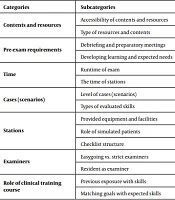
Faghihi A. The Influential Factors in the Performance of Medical Students in the Clinical Competency Exam: A Qualitative Study. Educ Res Med Sci. 2020;9(1):e104620. doi: https://doi.org/10.5812/erms.104620
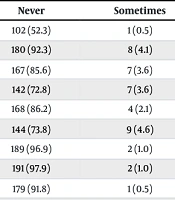
Rezaie L, Zobeiri M, Rezaei M, Ramezani G, Parvizi Fard AA, et al. Commonly Used Clinical Assessment Methods in Kermanshah University of Medical Sciences: A Five-Year Analysis 2014 - 2019. Educ Res Med Sci. 2025;14(2):e165309. doi: https://doi.org/10.5812/ermsj-165309
Haghdoost A, Esmaeili A. The Correlation between Medical Students’ Scores in their Physiopathology and Clinical Courses in Kerman University of Medical Sciences. J Med Edu. 2006;10(1):e105309. doi: https://doi.org/10.22037/jme.v10i1.703
Rahimi Z, Badiyepeymaiejahromi Z, Taghizadeganzadeh M. 360-Degree Evaluation of Nursing Students' Performance. Shiraz E-Med J. 2024;25(11):e148872. doi: https://doi.org/10.5812/semj-148872
Last Update: 1 week ago
Last Update: 1 week ago
Last Update: 1 week ago
Last Update: 6 days ago
Last Update: 9 hours ago
Last Update: 5 days ago