Fulltext
The body of the article can be found in the PDF file.
Journal of Medical Education for Future Demands
Former Title: Journal of Medical Education | The Official Journal of School of Medical Education and Learning Technologies
Image Credit:J Med Edu
Authors
Background and purpose: An open-book exam permits the examinees to consult some specific selected reference sources or materials while answering the exam questions. This study focused on the students' perspectives of open-book examinations in the histology/embryology courses, Zahedan University of Medical Sciences (ZUMS), Zahedan, Iran.Methods: The survey was conducted via a questionnaire after open-book examinations had been conducted in the histology and embryology courses, between 2009 and 2010. Of the 254 students who entered the new education system, 160 students were selected at random.Results: The results revealed that 72% of the students preferred the open-book type to the closed-book kind of examinations. Most of the students voiced that this type of examination was more suited to test high cognitive learning skills and solving real life situation problems, involving less stress while preparing for and taking the exam. They also mentioned that their marks in these examinations were not higher than those from the closed-book examinations. The overall satisfaction scores of the students of the biological sciences were significantly (p<0.001) higher than those of the medical sciences students (16.28±4.17 vs. 12.65±5.16); in the government run university students it was significantly (P<0.001) higher than in the international university students (14.93±4.53 vs. 10.24±5.08); the embryology course results were significantly (p<0.001) higher than the histology course (15.23 ± 4.07 vs. 12.79±5.4) and among the MD students it was significantly (p<0.001) lower than those of the BSc students (12±5.1 vs. 15.93±4.29). There was a positive correlation between the scores they acquired in their course and the overall satisfaction scores with the open-book type of examinations (r=0.46, p value=0.01).Conclusions: The finding of a positive response towards the open-book examination augurs well for extending such a type of examination to other subjects in our university.
© 2015, Author(s). This open-access article is available under the Creative Commons Attribution 4.0 (CC BY 4.0) International License (https://creativecommons.org/licenses/by/4.0/), which allows for unrestricted use, distribution, and reproduction in any medium, provided that the original work is properly cited.
Ranganath R, Rajalaksmi C, Simon MA. Medical Students’ Perceptions of E-assessment: Multiple Choice Questions used as a Tool of Assessment for Preclinical Years. J Med Edu. 2017;16(1):e105563. doi: https://doi.org/10.22037/jme.v16i1.14842
Roudbari M, Dadgar F. Effective factors on the results of the basic sciences examinations at Zahedan University of Medical Sciences. J Inflamm Dis. 2024;8(1):e155016. doi:
Ghaderi R. Medical Students' Attitudes towards Comprehensive and Basic Sciences Exam Questions in Birjand University of Medical Sciences. J Med Edu. 2015;14(2):e105429. doi: https://doi.org/10.22037/jme.v14i2.9235
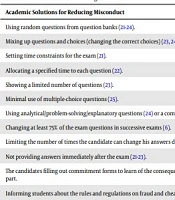
Heidarzadeh A, Zehtab Hashemi H, Parvasideh P, Hasan Larijani Z, Baghdadi P, et al. Opportunities and Challenges of Online Take-Home Exams in Medical Education. J Med Edu. 2021;20(1):e112512. doi: https://doi.org/10.5812/jme.112512
Golshani N, Mehraban B, Rashidi I, Salari N, Jalili C. Factors Affecting Anatomy Learning from the Viewpoints of Medical Students at Basic Sciences Stage. Educ Res Med Sci. 2018;7(2):e79407. doi: https://doi.org/10.5812/erms.79407
More by these authors
Last Update: 1 week ago
Last Update: 1 week ago
Last Update: 1 week ago
Last Update: 6 days ago
Last Update: 9 hours ago
Last Update: 5 days ago