Fulltext
The body of the article can be found in the PDF file.
Journal of Medical Education for Future Demands
Former Title: Journal of Medical Education | The Official Journal of School of Medical Education and Learning Technologies

Image Credit:J Med Edu
Authors
Background: Students’ perceptions of their learning environments influence their approaches to learning and the learning outcomes, and reflect a programme’s effectiveness. In Africa, literature on the learning environments of medical and health sciences education is scanty, and the issues impinging on effective education are not well documented. The objective of this study was to determine learners’ perceptions of the issues in the learning environment of undergraduate physiotherapy education at the University of Zambia.Methods: Undergraduate physiotherapy students in years 2 to 5 were stratified according to level of study and randomly sampled. They were provided written information about the study, and consenting students were allowed to complete the DREEM questionnaire unassisted. Completed questionnaires were rated using a recommended guideline and their responses analysed quantitatively. Global, subscale, and item mean scores were calculated, and Cronbach’s alpha was determined as a measure of data reliability and internal consistency. The study was approved by ethics committees of two universities.Results: Ninety-three students participated in the study. The response rate was 88.4 %. All classes rated the learning environment as ‘more positive than negative,’ with a mean global score of 123.2/200 (61.6 %). Scores within subscales (55.7–70.4 %) were comparable across the classes. Nine items scored below 2.0/4.0 indicating dissatisfaction. These included inadequate social support, teacher authoritarianism, and factual overload. Cronbach’s alpha for global scores was 0.896, and between 0.616 and 0.820 for subscale scores.Conclusion: Though total DREEM scores showed overall positive perception of the learning environment by the students, item analysis showed students’ dissatisfaction with several aspects. This analysis of undergraduate students’ perceptions of the Physiotherapy learning environment provided insight into the phenomena in the programme and adds to the literature on learning environments of Physiotherapy education in Africa.
© 2017, Author(s). This open-access article is available under the Creative Commons Attribution 4.0 (CC BY 4.0) International License (https://creativecommons.org/licenses/by/4.0/), which allows for unrestricted use, distribution, and reproduction in any medium, provided that the original work is properly cited.
Taheri M. Students' perceptions of learning environment in Guilan University of Medical Sciences. J Med Edu. 2009;13(4):e105414. doi: https://doi.org/10.22037/jme.v13i4.4524
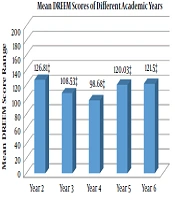
Atwa H, Alkhadragy R, Abdelaziz A. Medical Students' Perception of the Educational Environment in a Gender-Segregated Undergraduate Program. J Med Edu. 2020;19(3):e104934. doi: https://doi.org/10.5812/jme.104934

Rezaei F, Nikkerdar N, Hadian Zarkesh Moghadam Y. Assessing Medical and Dentistry Students' Perception of Learning Environment in Kermanshah University of Medical Sciences (2015-2016). Educ Res Med Sci. 2018;6(2):e79660. doi:

Eivazi M, Rezaei F, Shadravan H. Evaluation of Educational Environment of the School of Dentistry from the Perspective of Dental Students, Kermanshah University of Medical Sciences (2016). Educ Res Med Sci. 2018;6(2):e79659. doi:
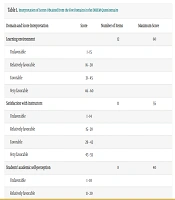
Tohidnia MR, Jalalvandi M. Determining the Educational Environment Status Using the DREEM Model at Kermanshah University of Medical Sciences. Educ Res Med Sci. 2026;15(1):e169576. doi: https://doi.org/10.69107/ermsj-169576
Last Update: 1 day ago
Last Update: 1 day ago
Last Update: 1 day ago
Last Update: 6 days ago
Last Update: 10 hours ago
Last Update: 4 days ago