
1. Background
The quality of medical education is recognized as a vital factor in training competent human resources and promoting community health. In this regard, the educational environment, as the collective perception of students regarding the psychosocial environment governing the learning process, plays a determining role in motivation, satisfaction, academic achievement, and attaining desired educational outcomes (1). A positive educational environment not only facilitates deep and meaningful learning but also leads to the development of professional skills, resilience, and a commitment to lifelong learning in medical students (2). However, assessing this multidimensional and qualitative phenomenon has always been challenging. In response to this need, the Dundee ready educational environment measure (DREEM) model has been developed as a standard, valid, and widely used tool for quantitatively measuring the educational environment in the health sciences domain (3, 4). This 50-item questionnaire assesses the educational environment in five key domains: Perception of the learning environment, perception of instructors, perception of one's own academic ability, perception of the educational atmosphere, and perception of social conditions. The ability to diagnose educational strengths and weaknesses and provide an objective picture of the learning environment has made the DREEM a popular tool for research and action aimed at improving educational quality (5). Numerous studies globally and nationally have used this model to evaluate educational environments in medicine, dentistry, nursing, and other health-related fields. Findings generally indicate that although the educational environment in many centers is assessed as "acceptable" or "relatively favorable," areas such as instructors' teaching methods, instructor-student communication, and emotional support have consistently been identified as needing improvement (6, 7). In Iran, research with this tool has also been conducted in various universities, mostly focused on a specific school or level, reporting diverse results from "semi-favorable" to "favorable" (8, 9). This diversity may be due to differences in cultural context, educational policies, facilities, and student expectations in different environments (10). Despite the abundance of these studies, there is a clear research gap regarding a comprehensive and integrated assessment of the educational environment at the entire Kermanshah University of Medical Sciences level. Most previous studies at this university have focused on a specific school or field. On the other hand, considering recent developments in the higher medical education system and the emphasis on student-centered and skill-based approaches, the need for periodic and systematic assessment of the educational environment to adapt to current standards and respond to the changing needs of students is felt more than ever (11, 12). Such an assessment can provide valuable data for administrators, planners, and instructors to design and implement targeted, evidence-based interventions to enhance educational quality. Furthermore, the educational environment is now recognized as a dynamic and multidimensional construct that not only influences students’ academic achievement but also plays a crucial role in their professional identity formation, motivation, well-being, and long-term engagement with the healthcare system (13). In medical universities, where students are exposed to high academic pressure and early clinical responsibilities, an unsupportive or poorly structured educational environment may contribute to stress, burnout, and reduced learning effectiveness (14).
2. Objectives
Systematic evaluation of students’ perceptions using validated instruments such as the DREEM is increasingly considered an essential component of educational quality assurance and institutional accreditation processes. This study aimed to comprehensively evaluate the educational environment at Kermanshah University of Medical Sciences from students’ perspectives using the DREEM model, in order to identify strengths, challenges, and areas requiring improvement across different domains of the educational environment.
3. Methods
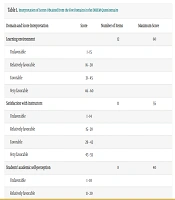
This descriptive-analytical study investigated the status of the educational environment at Kermanshah University of Medical Sciences using the standard modified DREEM questionnaire with the assistance of 418 students from 6 schools (medicine, dentistry, pharmacy, nursing and midwifery, health, and paramedical sciences). The sample size was calculated using Cochran's formula for an unknown population, considering a standard error of 0.05, a 95% confidence level, and approximate variance based on similar studies, resulting in a minimum sample size of 385. Considering the possibility of questionnaire attrition, 450 questionnaires were distributed, and ultimately 418 complete and analyzable questionnaires (response rate 92.9%) were collected. Sampling was done by a stratified random method from among students of all educational levels who gave informed and voluntary consent to participate in the study. Ethical approval for this study was obtained from the Ethics Committee under the ethics code IR.KUMS.REC.1395.710. The data collection tool was a questionnaire consisting of two parts: A section on students' demographic information collecting data on age, gender, marital status, educational level, school, field of study, GPA, and place of residence; and a second section with 50 specific items in a five-point Likert scale format across five domains: Learning environment, satisfaction with instructors, students' perception of their own academic ability, educational atmosphere, and students' social conditions. In scoring, the options "Strongly Agree" received 5 points, "Agree" 4, "No Opinion" 3, "Disagree" 2, and "Strongly Disagree" 1 point. The maximum total questionnaire score was calculated as 250. The total score and its interpretation based on the DREEM model are reported in Table 1. The face validity of the questionnaire was confirmed by 5 faculty members in Educational Sciences and Medical Education after incorporating their feedback on the clarity, relevance, and comprehensiveness of the items. Its reliability was also confirmed using a Cronbach's alpha coefficient of 0.75 calculated based on previous studies (15). After obtaining necessary permits and coordinating with the educational deputy of the schools, the purpose and importance of the research were explained orally to the students, and emphasis was placed on the confidentiality of information, voluntary participation, and the non-impact of results on their academic status. Questionnaires were completed and collected anonymously and voluntarily by the students. Data, after coding and entry into the computer, were analyzed using SPSS software version 26. Descriptive statistics including mean, standard deviation, and frequency were used to describe demographic variables and domain scores. Independent t-tests and one-way ANOVA were used for comparing means as appropriate, and Pearson's correlation test was used to examine significant relationships between the educational environment score and age groups, educational level, and GPA. The significance level for tests was considered as P < 0.05.
Table 1.
Interpretation of Scores Obtained from the Five Domains in the Dundee Ready Educational Environment Measure Questionnaire
| Domain and Score Interpretation | Score | Number of Items | Maximum Score |
|---|---|---|---|
| Learning environment | 12 | 60 | |
| Unfavorable | 1 - 15 | ||
| Relatively favorable | 16 - 30 | ||
| Favorable | 31 - 45 | ||
| Very favorable | 46 - 60 | ||
| Satisfaction with instructors | 11 | 55 | |
| Unfavorable | 1 - 14 | ||
| Relatively favorable | 15 - 28 | ||
| Favorable | 29 - 42 | ||
| Very favorable | 43 - 55 | ||
| Students' academic self-perception | 8 | 40 | |
| Unfavorable | 1 - 10 | ||
| Relatively favorable | 11 - 20 | ||
| Favorable | 21 - 30 | ||
| Very favorable | 31 - 40 | ||
| Educational atmosphere | 12 | 60 | |
| Unfavorable | 1 - 15 | ||
| Relatively favorable | 16 - 30 | ||
| Favorable | 31 - 45 | ||
| Very favorable | 46 - 60 | ||
| Social conditions | 7 | 35 | |
| Unfavorable | 1 - 9 | ||
| Relatively favorable | 10 - 18 | ||
| Favorable | 19 - 27 | ||
| Very favorable | 28 - 35 | ||
| Total educational environment score | 50 | 250 | |
| Unfavorable | 0 - 50 | ||
| Relatively favorable | 51 - 100 | ||
| Relatively favorable | 101 - 150 | ||
| Favorable | 151 - 200 | ||
| Very favorable | 201 - 250 |
4. Results
In the present study, out of 450 distributed questionnaires, 418 complete and analyzable questionnaires (response rate 92.9%) entered the analysis process. The mean age of the sample was 25 ± 3.11 years. 61.24% of students were female, and 72.97% were single (Table 2).
Table 2.
Frequency Distribution and Mean Total Educational Environment Score According to Demographic of Examples
| Variables and Category/Group | Frequency (Percentage) | Mean Total Educational Environment Score ± SD | P-Value |
| Gender | 0.667 | ||
| Male | 162 (38.76) | 145.53 ± 27.20 | |
| Female | 256 (61.24) | 148.17 ± 26.93 | |
| Age | 0.032 | ||
| 20 - 25 | 253 (63.57) | 149.86 ± 27.11 | |
| 26 - 30 | 87 (21.86) | 139.78 ± 25.19 | |
| 31 - 35 | 24 (6.03) | 146.08 ± 29.96 | |
| >35 | 34 (8.54) | 151.52 ± 26.36 | |
| Marital status | 0.495 | ||
| Single | 305 (72.97) | 148.14 ± 27.06 | |
| Married | 113 (27.03) | 144.46 ± 26.91 | |
| Educational level | 0.001 | ||
| Associate's degree | 13 (3.11) | 142 ± 23.89 | |
| Non-continuous bachelor's | 8 (1.91) | 128.50 ± 30.59 | |
| Continuous bachelor's | 193 (46.17) | 147.63 ± 26.51 | |
| Master's degree | 57 (13.64) | 157.21 ± 27.27 | |
| Doctorate | 147 (35.17) | 144.08 ± 26.75 | |
| School of study | 0.545 | ||
| Public health | 68 (16.27) | 152.98 ± 27.19 | |
| Nursing and midwifery | 70 (16.75) | 154.32 ± 27.72 | |
| Medicine | 111 (26.56) | 140.34 ± 24.65 | |
| Paramedical sciences | 110 (26.32) | 144.97 ± 26.90 | |
| Pharmacy | 34 (8.13) | 148.44 ± 28.38 | |
| Dentistry | 25 (5.98) | 149.24 ± 27.57 | |
| Place of residence | 0.666 | ||
| Native | 202 (48.33) | 147.72 ± 27.33 | |
| Non-native (dormitory) | 216 (51.67) | 146.61 ± 26.81 | |
| Grade point average | > 0.001 | ||
| > 12 | 6 (1.55) | 154.83 ± 17.29 | |
| 12 - 13.99 | 54 (13.92) | 153.46 ± 26.79 | |
| 14 - 15.99 | 88 (22.68) | 140.25 ± 24.68 | |
| 16 - 17.99 | 112 (28.87) | 154.85 ± 27.69 | |
| 18 - 20 | 128 (32.99) | 143.42 ± 26.36 |
The mean total educational environment score of the university from the students' perspective was 147.15 ± 27.04 out of a maximum of 250, which, based on the DREEM interpretation guide, placed this score at a relatively favorable level. Furthermore, the mean scores and percentages obtained for each of the five domains of the educational environment are presented in Table 3. Accordingly, the social conditions domain, with 60.08% of the maximum score, received the highest score, and the satisfaction with instructors domain, with 55.61% of the maximum score, received the lowest relative score among the five domains (Table 3).
Table 3.
Mean and Standard Deviation, Range, and Percentage of Scores Obtained for the Five Domains and Total Educational environment Score
| Domain | Mean ± SD | Score Range | Total Score | Percentage Obtained |
| Learning environment | 35.58 ± 7.40 | 19 - 60 | 60 | 59.30 |
| Satisfaction with instructors | 30.59 ± 5.80 | 19 - 43 | 55 | 55.61 |
| Students' academic self-perception | 23.94 ± 4.89 | 13 - 33 | 40 | 59.85 |
| Educational atmosphere | 36.00 ± 7.26 | 20 - 52 | 60 | 60.00 |
| Social conditions | 21.03 ± 4.07 | 11 - 32 | 35 | 60.08 |
| Total educational environment score | 147.15 ± 27.04 | 95 - 194 | 250 | 58.86 |
The results of statistical tests showed a significant relationship between the domains of learning environment and educational atmosphere with the variables of age group, educational level, and GPA. On the other hand, in examining the total educational environment score with demographic variables, a significant relationship was found between the educational environment and the variables of age group, educational level, and GPA (Table 4).
Table 4.
Mean Scores of Educational Environment Domains According to Statistical Results of Students
| Variables and Group | Learning Environment | Satisfaction with Instructors | Students' Academic Self-perception | Educational Atmosphere | Social Conditions | Total Score |
|---|---|---|---|---|---|---|
| Age | ||||||
| 20 - 25 | 36.32 ± 7.38 | 31.15 ± 5.87 | 24.29 ± 4.87 | 36.85 ± 7.43 | 21.24 ± 3.94 | 149.86 ± 27.11 |
| 26 - 30 | 33.73 ± 7.17 | 29.31 ± 6.05 | 22.63 ± 4.51 | 33.82 ± 6.06 | 20.27 ± 4.02 | 139.78 ± 25.19 |
| 31 - 35 | 35.08 ± 9.16 | 30.29 ± 5.44 | 24.00 ± 5.42 | 35.58 ± 7.67 | 21.12 ± 4.57 | 146.08 ± 29.96 |
| > 35 | 36.67 ± 6.61 | 30.82 ± 4.60 | 24.97 ± 5.25 | 37.23 ± 7.69 | 21.82 ± 4.19 | 151.52 ± 26.36 |
| P-value | 0.0131 a | 0.0778 | 0.0329 a | 0.0013 a | 0.2025 | 0.0320 a |
| Educational level | ||||||
| Associate's degree | 34.38 ± 5.45 | 28.92 ± 4.53 | 24.07 ± 4.13 | 33.69 ± 6.48 | 20.92 ± 5.23 | 142 ± 23.89 |
| Non-continuous bachelor's | 29.37 ± 7.28 | 28.12 ± 6.99 | 21.75 ± 6.11 | 30.87 ± 6.72 | 18.37 ± 4.27 | 128.50 ± 30.59 |
| Continuous bachelor's | 35.65 ± 7.34 | 30.72 ± 5.72 | 23.97 ± 4.88 | 36.19 ± 7.08 | 21.08 ± 3.99 | 147.63 ± 26.51 |
| Master's degree | 38.57 ± 6.94 | 32.47 ± 6.003 | 25.40 ± 4.68 | 38.91 ± 7.96 | 21.84 ± 3.74 | 157.21 ± 27.27 |
| Doctorate | 34.76 ± 7.47 | 29.95 ± 5.73 | 23.46 ± 4.91 | 35.09 ± 6.98 | 20.80 ± 4.16 | 144.08 ± 26.75 |
| P-value | 0.0003 a | 0.0243 a | 0.1059 | 0.0004 a | 0.1606 | 0.001 a |
| Grade point average | ||||||
| >12 | 37.33 ± 4.17 | 31.5 ± 3.72 | 24.66 ± 3.55 | 39.00 ± 5.32 | 22.33 ± 2.06 | 154.83 ± 17.29 |
| 12 - 13.99 | 37.46 ± 6.86 | 32.07 ± 6.30 | 24.72 ± 5.003 | 37.72 ± 7.23 | 21.48 ± 3.75 | 153.46 ± 26.79 |
| 14 - 15.99 | 33.84 ± 7.59 | 29.32 ± 5.58 | 22.67 ± 4.12 | 34.01 ± 6.25 | 20.39 ± 4.18 | 140.25 ± 24.68 |
| 16 - 17.99 | 37.64 ± 7.04 | 32.12 ± 6.07 | 25.21 ± 5.03 | 38.25 ± 7.72 | 21.61 ± 3.84 | 154.85 ± 27.69 |
| 18-20 | 34.54 ± 7.52 | 29.71 ± 5.34 | 23.37 ± 4.90 | 34.96 ± 6.91 | 20.82 ± 4.19 | 143.42 ± 26.36 |
| P-value | 0.0001 a | 0.0007 a | 0.0007 a | 0.0001 a | 0.1624 | 0.001a |
a Statistically significant.
5. Discussion
The findings of this study indicate that the educational environment at Kermanshah University of Medical Sciences is generally acceptable from the students’ perspective, suggesting that core educational structures and processes are functioning adequately. However, the variation observed across different domains highlights an imbalance in students’ experiences, implying that while certain aspects of the learning environment support academic and social engagement, others require focused attention. This pattern reflects the multifaceted nature of the educational environment and underscores the importance of domain-specific evaluation when planning educational improvements, rather than relying solely on an overall assessment score. In studies conducted by Heydari Hangami (16) at Hormozgan University of Medical Sciences, as well as in the study performed at the Faculty of Dentistry of Babol (17), the overall questionnaire score ranged between 50% and 60%, which is in agreement with the findings of the present study. This result confirms that the existing educational structures, processes, and interactions have been able to meet students' educational expectations to an acceptable extent. The alignment of this finding with the results of numerous international studies indicates that the fundamental dimensions of the educational environment, including teaching quality, educational support, and learning environment, face similar challenges and opportunities in many medical science education systems (18-21). However, the inconsistency of this study's results with some studies that reported the educational environment at a semi-favorable level shows that the educational environment is a phenomenon influenced by factors such as organizational culture, educational management style, human resources, and the level of active student participation (22, 23). From this perspective, the results of the present study can be considered a reflection of the university's efforts to improve educational processes, albeit needing correction. The study by Maya et al., emphasizing the role of innovative and student-centered curricula, showed that satisfaction with the educational environment has a direct relationship with the level of active student participation in the learning process (24). Therefore, the relatively favorable status of the educational environment in the present study could be partly due to the gradual movement of the university's educational system towards active learning methods, problem-based and self-directed learning. In the domain of the learning environment, the results indicated a positive attitude of students towards teaching-learning processes. This suggests that educational interactions, class structures, and learning opportunities have been able to provide an effective learning context. However, the difference between this finding and the results of Soltani et al.'s study, which emphasized the need to improve class quality and teaching methods, indicates that even under favorable conditions, continuous improvement of the learning environment is an undeniable necessity; especially in medical education where clinical, skill-based, and evidence-based learning plays a central role (25). The domain of satisfaction with instructors received the lowest score among the five DREEM domains, indicating that this aspect of the educational environment represents a relative weakness from the students’ perspective. This finding may reflect several interrelated factors, including a continued reliance on teacher-centered instructional approaches, limited use of formative assessment and constructive feedback, and insufficient opportunities for meaningful instructor–student interaction. In medical education settings, instructors play a critical role not only as content experts but also as facilitators of learning, professional role models, and sources of academic and emotional support. A perceived lack of approachability, feedback, or clarity in teaching methods may therefore negatively influence students’ overall satisfaction. Similar patterns have been reported in previous DREEM-based studies, where domains related to instructors’ teaching styles and communication skills consistently scored lower than other components of the educational environment (26). These findings suggest that targeted faculty development programs focusing on learner-centered teaching, effective communication, and modern assessment strategies may be particularly impactful in addressing this domain. In the domain of students' perception of their own academic ability, the favorable results obtained may indicate a high level of academic self-efficacy among students; a concept known in medical education literature as one of the main predictors of academic success, deep learning, and academic resilience (20, 21). Confidence in one's own academic ability, especially in challenging educational environments like medical sciences, can strengthen students' intrinsic motivation and drive them towards lifelong learning. From this perspective, designing innovative, flexible, and student-centered educational programs can help maintain and strengthen this psychological capital. Findings related to the educational atmosphere domain also showed that students evaluated the overall status of this domain as favorable. This indicates the effective role of educational supervision, appropriate course planning, logical class scheduling, and suitable physical conditions of educational environments (27). Such conditions can increase students' focus on the learning process by reducing unnecessary cognitive load and lead to improved educational quality. In the present study, contrary to the findings reported by Honaramiz and Johari (28), no statistically significant association was found between students’ gender and their satisfaction with faculty members or social conditions. This discrepancy may be primarily attributable to differences in sample characteristics. Specifically, variations in sample size, gender distribution, fields of study, academic level, as well as the cultural and social context of the institution in which the study was conducted, may have contributed. Among all domains, students' social conditions received the highest score. This finding indicates that the university has largely been able to provide a supportive, safe environment with constructive social interactions. According to existing evidence, favorable social conditions have a significant relationship with reduced academic stress, increased sense of belonging to the university, and improved academic performance. Therefore, strengthening welfare and cultural facilities, developing accessible counseling services, and teaching life skills can be considered as effective strategies for promoting students' mental health and quality of educational experience (23). The results of the present study also showed that the educational environment is influenced by variables such as age, educational level, and GPA. The more favorable views of older students and graduate-level students may be due to their greater educational experience, more realistic expectations, and deeper understanding of the complexities of the educational system. The positive correlation between GPA and favorable perception of the educational environment may also indicate a bidirectional interaction between academic success and positive experience of the educational environment, such that each can reinforce the other. This finding aligns with the results of Moosavi et al. (29). Finally, the lack of a significant difference between gender and overall perception of the educational environment, consistent with previous studies (4), indicates that the university's educational conditions have been experienced relatively equally by male and female students. However, differences reported in some other studies indicate that attention to gender sensitivities in designing and implementing educational programs is still necessary (30). This finding suggests that maintaining equity-oriented educational policies while proactively monitoring subtle gender-specific needs can help ensure a supportive and inclusive learning environment for all students.
5.1. Limitations
This study has several important limitations that should be considered when interpreting the results. First, the cross-sectional design does not allow for causal inferences or assessment of changes in students' perceptions over time. Second, the use of self-reported questionnaires may have introduced recall bias, social desirability bias, and other response biases. Third, this study was conducted at a single medical school and did not include all types of learners (e.g., interns, residents, or students from other schools), which may limit the generalizability of the findings to other educational and cultural settings. Fourth, although stratified random sampling was used, nonresponse and exclusion of absent or reluctant students may have affected the representativeness of the sample. Finally, the DREEM instrument provides a global quantitative assessment and may not fully capture the complexity of students' lived experiences. Therefore, complementary qualitative and longitudinal studies are recommended to examine the underlying reasons for lower scores in specific domains and monitor the impact of targeted interventions over time.
5.2. Conclusions
In this study, assessment of the educational environment at Kermanshah University of Medical Sciences using the DREEM model yielded an overall mean score of 147.15 out of 250, indicating a generally acceptable educational environment from the students’ perspective. Among the five domains, social conditions achieved the highest relative score, whereas satisfaction with instructors received the lowest score, identifying this domain as the primary area requiring improvement. Significant differences in students’ perceptions were observed according to age, educational level, and GPA, with more favorable perceptions reported by students over 35 years of age, Master’s-level students, and those with a GPA of 16 - 17.99. Given the comparatively lower score in the instructors’ domain, targeted interventions such as faculty development programs focusing on teaching methods, assessment strategies, and instructor–student communication are recommended. Additionally, systematic incorporation of student feedback into educational planning may contribute to improving the overall educational environment. Further qualitative studies are suggested to explore the underlying reasons for lower satisfaction with instructors, and longitudinal studies are recommended to evaluate the effectiveness of interventions aimed at enhancing the educational environment.