
1. Background
The educational environment is one of the most important factors in determining the success of an effective curriculum (1, 2). There is a proven connection between the educational environment and the outcomes of students’ satisfaction, achievement, and success (3, 4). Evaluating a teach-and-learn environment from the angle of the students’ perception is helpful to provide important elements for eventual guidance and corrections at the management level (5-7).
One of the important factors in the evaluation of an educational environment from the students’ angle is gender. The impact of gender on the way of perceiving the educational environment and course content varies according to many contributing factors like the educational context, nature of teaching/learning settings, grade level of students, and their learning styles (8-10).
Several methods have been developed to evaluate the educational environments, some of which are qualitative (4) while others are in the form of questionnaires (6, 9, 10). The Dundee Ready Educational Environment Measure (DREEM) questionnaire is the most specific tool for the investigation of the unique environment experienced by students in medical and healthcare-related courses (11, 12).
2. Objectives
The study aimed at assessing the students’ perceptions of their learning environment, determining the gender effect on environment perception, and examining the correlation between different study variables. This study explores the gender role in a gender-segregated learning environment and its correlation with students' learning outcomes and their GPA scores.
3. Methods
Our college attracts Saudi, as well as international students, in delivering four health professions education programs which are medicine, dentistry, clinical pharmacy and nursing. The Medicine Program, which is the main program, runs an integrated curriculum with both system-based modules and problem-based learning approaches to study. There are two separate campuses: one for male students and another for female students.
In this cross-sectional study, the study population included undergraduate students in the Medicine Program from Year 2 to Year 6. Year 1 is a common preparatory phase, so, the students of this phase were not included in this study. The study population was selected by a stratified random sampling technique. The calculated sample size was 340 students (13).
The DREEM original English version was used. The Arabic translation, from a translated and validated Arabic version (14), was included for each item to make it understandable by the students who were not proficient in English. Each item was scored as follows: 4 = Strongly Agree, 3 = Agree, 2 = Unsure, 1 = Disagree, and 0 = Strongly Disagree. Nine of the 50 items were scored in reverse for analysis (negative items). The DREEM inventory encompasses five subscales (12):
a-Perceptions of learning: 12 items; maximum score 48
b-Perceptions of teaching: 11 items; maximum score 44
c-Academic self-perceptions: 8 items; maximum score 32
d-Perceptions of the atmosphere: 12 items; maximum score 48
e-Social self-perceptions: 7 items; maximum score 28
The DREEM questionnaire could be used to pinpoint more specific strengths and weaknesses. According to McAleer and Roff (6), items that have a mean score of 3.5 or more are real positive points. Any item with a mean of 2 or less should be examined more closely, as they indicate problematic areas. Items with a mean of 2-3 indicate positive aspects that can be enhanced.
3.1. Data Collection and Analysis
Students were notified about the purpose and timing of data collection, the anonymity of the questionnaires, and their right to refuse the completion of the questionnaires. Data collection at times around exams was avoided to eliminate the temporary effects of exams’ stress. Data analysis was performed with the guidance of the DREEM key for analysis (6). Descriptive statistics were utilized to analyze the data. The t-test was used for comparing the means between males and females, as well as pre-clinical and clinical students. The ANOVA test was used to compare the means between study years. P values < 0.05 were considered statistically significant.
4. Results
The overall mean score on DREEM was 114.39/200, which is interpreted as “more positive than negative”. The mean scores of subscales were: 26.64/48 for the perception of learning (a more positive perception), 26.36/44 for the perception of teaching (moving in the right direction), 19.54/32 for academic self-perception (feeling more on the positive side), 26.51/48 for the perception of the atmosphere (a more positive attitude), and 15.33/28 for social self-perception (not too bad). The highest mean score was for academic self-perception, while the lowest one was for social self-perception. The highest mean score of an individual item belonged to Item 10, one of the Academic Self-Perception items. On the other hand, eight items numbered 3, 4, 14, 25, 39, 42, 43, and 48 showed mean scores less than 2, which indicate problematic areas.
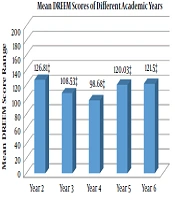
The DREEM mean score based on the academic year is shown in Figure 1. Overall, the trend of students’ perception throughout the five years is seen as a semi U-shape curve. The two arms of the curve are those representing the first and final years in the program, while its bottom is representing its middle year, Year 4, which can be interpreted as having “plenty of problems”.
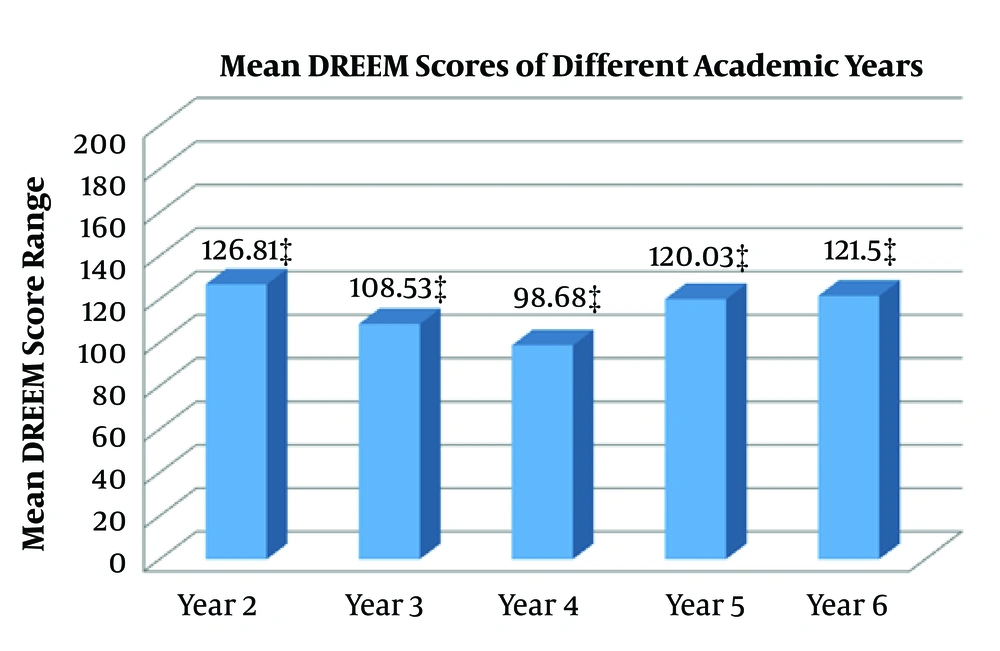
Figure 1.
Mean DREEM Score of Different Academic Years, ‡More positive than negative (> 100), §Plenty of problems
Analysis of Variance (ANOVA) showed highly statistically significant differences between the different years regarding all subscales' scores and the overall DREEM score (Table 1).
Table 1.
The ANOVA Test for Comparing Mean Scores (±SD) in Different Academic Years
| Subscale | Academic Years' Means ± SD | P Value (ANOVA) | ||||
|---|---|---|---|---|---|---|
| 2 (n=70) | 3 (n=66) | 4 (n=81) | 5 (n=59) | 6 (n=64) | ||
| Perception of Learning (Max Score: 48) | 29.14 ± 5.58 | 25.76 ± 5.89 | 23.09 ± 6.25 | 27.51 ± 6.14) | 28.53 ± 5.24 | 0.000a |
| Perception of Teaching (Max Score: 44) | 28.81 ± 5.19 | 23.85 ± 6.39 | 22.41 ± 5.56 | 28.32 ± 5.70) | 29.47 ± 6.93 | 0.000a |
| Academic Self-Perception (Max Score: 32) | 21.71 ± 4.54 | 18.70 ± 5.07 | 16.60 ± 5.07 | 20.92 ± 4.73 | 20.50 ± 4.9 | 0.000a |
| Perception of Atmosphere (Max Score: 48) | 30.64 ± 6.41 | 24.71 ± 6.26 | 23.21 ± 6.65 | 27.61 ± 6.09 | 27.00 ± 6.95 | 0.000a |
| Social Self-Perception (Max Score: 28) | 16.50 ± 4.17 | 15.52 ± 4.76 | 13.37 ± 4.14 | 15.68 ± 3.31 | 16.00 ± 3.62 | 0.000a |
| Overall DREEM (Max Score: 200) | 126.81 ± 22.2 | 108.53 ± 23.49 | 98.68 ± 24.42 | 120.03 ± 20.87 | 121.50 ± 23.9 | 0.000a |
aStatistically significant.
Regarding gender differences, the mean scores of the five subscales were higher on the females’ side. The results were statistically significant in the subscales of perception of learning, perception of teaching, and academic self-perception; accordingly, the difference in the overall DREEM score between males and females was statistically significant (Table 2).
Table 2.
Comparison Between Males and Females' Perception of Different Subscales of the Educational Environment
| Subscale | Males (n=170) Mean ± SD | Females (n=170), Mean ± SD | P Value (t-test) |
|---|---|---|---|
| Perception of Learning (Max Score: 48) | 25.82 ± 6.27 | 27.47 ± 6.14 | 0.008a |
| Perception of Teaching (Max Score: 44) | 25.44 ± 6.62 | 27.29 ± 6.50 | 0.002a |
| Academic Self-Perception (Max Score: 32) | 18.76 ± 5.17 | 20.33 ± 5.14 | 0.003a |
| Perception of Atmosphere (Max Score: 48) | 26.04 ± 6.33 | 26.98 ± 7.56 | 0.176 |
| Social Self-Perception (Max Score: 28) | 15.14 ± 3.63 | 15.52 ± 4.69 | 0.394 |
| Overall DREEM (Max Score: 200) | 111.18 ± 24.06 | 117.59 ± 26.16 | 0.008a |
aStatistically significant.
The comparison of the DREEM overall score and scores of different subscales obtained in our study with those of some medical colleges nationally (within KSA) and internationally (in the United Kingdom, Canada, and Egypt) revealed variable results (Table 3).
Table 3.
Comparing DREEM Scores with Those of Other Medical Schools Nationally, Regionally, and Internationally (all decimals are rounded to the nearest integers)z
| Subscale | ISNC (This study) (n=340) | National | International | ||||
|---|---|---|---|---|---|---|---|
| KSU (n=74) | KAU (n=452) | UQU (n=278) | CMCC (n=407) | SCU( n=316) | UD (n=145) | ||
| Perception of Learning (Maximum Score: 48) | 27 | 23 | 23 | 25 | 19 | 28 | 34 |
| Perception of Teaching (Maximum Score: 44) | 26 | 24 | 23 | 24 | 24 | 26 | 29 |
| Academic Self-Perception (Maximum Score: 32) | 20 | 14 | 17 | 18 | 15 | 19 | 23 |
| Perception of Atmosphere (Maximum Score: 48) | 27 | 25 | 23 | 25 | 25 | 26 | 35 |
| Social Self-Perception (Maximum Score: 28) | 15 | 15 | 14 | 15 | 15 | 14 | 20 |
| Overall DREEM (Maximum Score: 200) | 114 | 100 | 100 | 107 | 97 | 114 | 141 |
zAbbreviations: KSU: King Saud University College of Medicine (2012); KAU: King Abdulaziz University Faculty of Medicine (2004); UQU: Umm Al-Qura University College of Medicine (2004); CMCC: Canadian Memorial Chiropractic College in Canada (2004); SCU: Suez Canal University Faculty of Medicine (2013); UD: University of Dundee School of Medicine (2004).
Linear regression analysis of the relationship between the DREEM score and the current students' GPA was performed. As indicated in the table, each one-unit increase in the DREEM score was associated with a 0.008 increase in the GPA of students. This relationship was statistically significant (P = 0.001). In addition, the mean value of female students' GPA was higher than that of their male colleagues by 0.04. However, this difference was not statistically significant (P = 0.71) (Table 4).
Table 4.
Regression Analysis of the Relationship Between DREEM Score and GPA
| Dependent Variable | Independent Variables | Unstandardized Coefficients | Beta | t | P Value | |
|---|---|---|---|---|---|---|
| B | Std. Err. | |||||
| GPA | Gender | 0.040 | 0.106 | 0.039 | 0.373 | 0.710 |
| Year | -0.067 | 0.038 | -0.182 | -1.750 | 0.084 | |
| Residency | -0.073 | 0.053 | -0.141 | -1.386 | 0.169 | |
| DREEM Score | 0.008 | 0.002 | 0.363 | 3.592 | 0.001a | |
aStatistically significant.
5. Discussion
The results of this study revealed a DREEM overall mean score of 114.4/200 (n=340), which is interpreted as a “more positive than negative” educational environment. The comparison of the ‘profile’ generated by the results of our study about the educational environment with those of other schools, both national and international, traditional and innovative, public and private, gender-segregated and mixed, are instructive to generate recommendations about changes that can be made to enhance the perceived educational environment.
In comparison with other medical schools in Saudi Arabia, the overall DREEM score for our college was found to be higher than those of colleges of medicine at King Saud (15), King Abdulaziz, and Umm Al-Qura Universities (16), all of which are public medical schools with gender-segregated programs. At the regional, Middle Eastern level, the overall DREEM score of our college was found to be almost similar to that of the Suez Canal Faculty of Medicine in Egypt, which is a public medical school with gender-mixed programs (14). At the international level, the comparison with two medical schools’ educational environments revealed variable results. For example, our score was higher than that of the Canadian Memorial Chiropractic College (17) while lower than that of the Dundee School of Medicine in the United Kingdom (16, 18).
These similarities and variations in the DREEM scores could be attributed to differences in research factors, on the one side, and conditions surrounding each of these schools, on the other side. One example of research factors is the difference in the language of the applied DREEM version. Examples of school differences include the type of the medical school (public or private), adopted curriculum (innovative or traditional), educational strategies (teacher-centered or student-centered) (16), cultural and social backgrounds (religious and gender perspectives), and available resources in each of these schools (19). Given these factors and conditions, we can explain the similarity of our learning environment as perceived by the medical students with the learning environment of SCU in Egypt and the dissimilarity with that of the two international colleges.
Concerning the five subscales in this study, the lowest score of a subscale belonged to social self-perception. These findings corresponded with the findings of a similar Saudi context (16) and a study conducted at SCU, Egypt, where the scores of the social self-perception subscale were the lowest among the other subscales (14). The findings of the three studies, including our current study, could be referred to the overloaded five-year curricula of Saudi medical schools (16), lack of supportive academic environment, entertainment, refreshments (14), and religious and social activities in comparison with the core curricular activities (7).
The scores per academic grade were variable. The Year 4 score was the only exception as plenty of problems were reported. The highest score was reported in the first and final years of the program (Year 2 and Year 6, respectively). Concerning Year 2, this finding could be attributed to the high motivation and enthusiasm of newly engaged students in the study of medicine. This enthusiasm might have crept into their study progression. Older students usually become exhausted due to the multiplicity of courses, diversity of subjects, and frequent examinations. Studying in the clerkship phase (particularly in the final year or Year 6) is usually associated with satisfaction due to the interactive and dynamic nature of rotations, the relevance of the study to real-world practice, and the approaching of graduation. These findings were in line with those of a similar study in the International Islamic University in Malaysia, where Year 1 students had the highest score, with lower scores in the subsequent Years 2, 3, and 4 (20, 21). Similar results were also obtained in the Canadian Memorial Chiropractic College (18).
Studies have reported that male and female students learn and handle data diversely, and their instructive needs can be met with sex sensitivity (22). We found higher female scores in both the overall DREEM and the five subscales, with statistically significant differences in the overall DREEM score and the scores of Perception of learning, Perception of teaching, and Academic self-perception subscales. This is congruent with the results reported in a study carried out in Argentina in which a statistically significant difference was found between both genders, with women being generally more critical about the quality of teaching and the general climate of the school, especially in the areas of student participation in the class (10). On the other hand, differences were not statically significant in the scores of Perception of atmosphere and Social self-perception subscales. Similar findings were noted in studies conducted at Dundee School of Medicine in the UK (23), West Indies Medical Faculty in Trinidad and Tobago (16), and the Chiropractic College in Canada, where female students had higher mean scores than male students mainly in early two years of the curriculum (9). The opposite results have been reported in the studies conducted at two public Saudi medical schools at King Abdulaziz and Umm Al-Qura Universities (18).
These findings could be explained in several facets. First, although gender-segregated programs share the same Saudi context, yet in our context, this segregation is only spatial, as male and female faculty members do teaching of both genders in all grades. Thus, the environment is not purely segregated. Second, the context, being a private college, allows for the admission of international students and this is the case in the Dundee School of Medicine, UK, and Chiropractic College, Canada. This could be reflected in the existence of different cultural backgrounds, preconceptions, and other learning and social experiences that can be exchanged. Moreover, despite adopting the same curriculum and course structures in both male and female campuses, more expenditure is done for continuously improving social activities, student support measures, and facilities available for female students. In general, studies targeting the perception of the learning environment and behaviors of DREEM subscales among the segregated schools were very scarce. Inferences on the differences between the two genders were mostly obtained from studies conducted in non-segregated schools. A qualitative study could be performed to analyze in-depth features and determinants of female students’ satisfaction with their learning environment in this curriculum type and context.
Studies have confirmed that there is a strong connection between the learning environment and outcomes of students’ achievement and satisfaction (9). In this study, the mean DREEM score of female students was found to be higher than that of male students, which was associated with a higher GPA of female students than that of male students. This higher DREEM score with a higher GPA is consistent with the literature evidence of the association between these two parameters. A similar study conducted at the University of New Mexico reported that a positively perceived learning environment contributes to better academic performance (23). Another study conducted in Sudan reported that high achievers' perception of the learning environment is markedly noted than that of low achievers (24). These findings are consistent with those of Pimparyon et al. that low academic achievement is characterized by less satisfaction with the educational environment (23, 24).
5.1. Conclusion
Medical students’ perception of the educational environment in our college was found to be toward the positive side in all subscales.
The overall mean score of DREEM was also more positive than negative, with females perceiving the educational environment more positive than males. Satisfaction with the learning environment is correlated with scholastic achievement. In addition, the more positively perceived learning environment could explain higher scholastic achievement in female students than in male students.
Still, a multitude of factors, including gender, context, teaching, learning, and scholastic achievement, can interact and affect interchangeably the perceived educational environment.