Fulltext
The body of the article can be found in the PDF file.
Journal of Medical Education for Future Demands
Former Title: Journal of Medical Education | The Official Journal of School of Medical Education and Learning Technologies
Image Credit:J Med Edu
Authors
In current issue of the Journal of Medical Education, Afshar in the Editorial “The Role of Private Sector in Higher Education; From Quantity and Quality to Access and Social Justice” proposed the importance of justice and quality. (1) It seems that there are some differences between two types of private sector in higher education. One type of private financial support in higher education comes purely from private sector without any contribution of public sector. The second type of private finance in the higher education especially the type which has grown recently in Iranian higher education is a type of combination between public higher education and private sector the so called international branch of the university till recent years, and nowadays called selfgoverning campus of the university. (2) In this type of private contribution to public higher education those who have no or little money must pass very hard national examination to be accepted in the university, and those who can pay the tuition fee could enter to the best schools of that university without the exam (in the first year of the project) or by loose standards or lower cut off scores. Actually, this is an instance of the double standards.One of the elements of being equitable and avoiding discrimination is to prevent undue achievement by the owners of the power such as owners of political, religious, economic, or military power, and to avoid any distinction according to race, colour, sex, language, and etc. (3) In this type of private money absorption in the higher education, while the others have no extra way to enter to the university that would lead to achievement of scientific power, the owners of the economic powers’ daughters and sons could have a special chance to achieve scientific power by the power of their parents, and there is a different criterion to enter the university based on non-scientific differences.In such situation growing student movements against commercialism of knowledge and education which is contrary to their culture and also against fair distribution of educational opportunities is probable. (4-6) In this condition the pressure of stigma on the student with lower scores in the entrance and the other examinations is not ethically acceptable either.The other problem of this type of private financial support in higher education is the matter of distinguishing the clear border between public sector incomes regarding the private one. Some similar studies in combining public and private healthcare services showed that it is the private sector that finally has income from the public one contrary to the presuppositions. (7)From another view supporters of self-governing branch (previously called international branch, while it doesn’t have real international students, faculty members or staffs) could state some benefits for private contribution to public sector higher education such as taking financial resources from private to the public, preventing capital leakage of rich people in the country to abroad. More over, It is said that “it is better to spend your money to attain knowledge and degree comparing with those who spend their talents and academic knowledge and degree to attain money in an unethical way”; namely if rich persons tend to spend their money to improve their family members knowledge and to help the scientific sector of the public, it would be appreciated as a good practice and act. on the other hand, could see some talent students or graduates who committed immoral practices such as a case in which a doctor explicitly states to the laboratory or other Para clinics colleague: “how much do I get if I send you patients?” (8)Conclusion: Entering best fields of best universities by the lower cut off scores comparing other similar applicant merely because of parents’ economic status could consider as an exemplary of unequal opportunity for equal ones. Helping public science sector of the society via paid tuitions may diminishes the ugliness of injustice, however public sector incomes clearance is essential to make public benefit claims real and documented. In the other hand stigmatization of the student with lower scores after their entrance to the university also seems to be unethical.
© 2017, Author(s). This open-access article is available under the Creative Commons Attribution 4.0 (CC BY 4.0) International License (https://creativecommons.org/licenses/by/4.0/), which allows for unrestricted use, distribution, and reproduction in any medium, provided that the original work is properly cited.
Yazdani S, Dashti Rahmatabadi M. Intelligent Management in Higher Education. J Med Edu. 2018;17(3):e105648. doi: https://doi.org/10.22037/jme.v17i3.22505
Afshar L. The Role of Private Sector in Higher Education; From Quantity and Quality to Access and Social Justice. J Med Edu. 2017;16(1):e105554. doi: https://doi.org/10.22037/jme.v16i1.18063
Yazdani S, DashtiRahmatabadi M, Alimohamadi E. Encouraging Factors for Invest in Higher Education in the Private Sector in Iran. J Med Edu. 2017;16(1):e105559. doi: https://doi.org/10.22037/jme.v16i1.15772
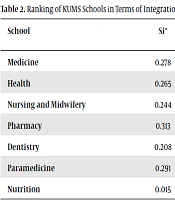
Marmarian G, Hassani M, Mohajeran B. Determinants of Equal Access to Higher Health Education Opportunities in Kermanshah University of Medical Sciences, Iran. Educ Res Med Sci. 2021;10(2):e119466. doi: https://doi.org/10.5812/erms.119466
Siabani S, Moradi M, Siabani H, Amolaei K, Siabani S. Educational Problems of Kermanshah Medical School: View Points of Students, Graduates and Faculty Members. J Med Edu. 2009;13(1 & 2):e105401. doi: https://doi.org/10.22037/jme.v13i1,2.1137
Last Update: 1 month ago
Last Update: 1 month ago
Last Update: 1 month ago
Last Update: 6 days ago
Last Update: 9 hours ago
Last Update: 4 days ago