Fulltext
The body of the article can be found in the PDF file.
Journal of Medical Education for Future Demands
Former Title: Journal of Medical Education | The Official Journal of School of Medical Education and Learning Technologies
Image Credit:J Med Edu
Authors
Higher education which has the main role in the training of skilled human resource can also be considered as the foundation of wealth creation in the country. The quantitative and qualitative expansion of higher education is inevitable. The facilities and the government budget are not responsive for the need, due to the increasing demand of young people for entering higher education in Iran. Therefore, developing and equipping universities and unpublicized and private higher education institutions have received considerable attention and have grown substantially. We aimed to evaluate educational experts regarding encouraging factors of the private sections for more participating in financing of higher education centers and institutions in Iran. Qualitative content analysis method has been used.The participants were selected using purposive sampling. The professors were in positions of policymaking and managing and had opinions on the challenges of universities financing. Data collection was conducted with semi-structured interview in 2016 and all ethical considerations associated with qualitative research were respected. The main concepts obtained from the interview were reported in the three main themes and their sub-classes. We have found that with the authorities given to universitiesby law, and preparing the transition from the based solely on government resources to the private section is provided by taking the appropriate decisions of managers to attract investors Universities can benefit from promoting different mechanisms to attract private financing in the higher education section. Solutions also were presented in this way. The idea of educational investment not only can promote the community investments towards higher education, but also has been the promotion of knowledge-based business in the community and promotes entrepreneurship and knowledge-based economy.
© 2017, Author(s). This open-access article is available under the Creative Commons Attribution 4.0 (CC BY 4.0) International License (https://creativecommons.org/licenses/by/4.0/), which allows for unrestricted use, distribution, and reproduction in any medium, provided that the original work is properly cited.
Afshar L. The Role of Private Sector in Higher Education; From Quantity and Quality to Access and Social Justice. J Med Edu. 2017;16(1):e105554. doi: https://doi.org/10.22037/jme.v16i1.18063
Yazdani S, Dashti Rahmatabadi M. Intelligent Management in Higher Education. J Med Edu. 2018;17(3):e105648. doi: https://doi.org/10.22037/jme.v17i3.22505
Enjoo SA. Money, Power, Equity and Higher Education. J Med Edu. 2017;16(4):e105588. doi: https://doi.org/10.22037/jme.v16i4.20263
Peirovi H, Niyati J, Niroomanesh S, Azargashb E. What Iranian Health Authorities Think About The Integration Of Medical Education And Health Services. J Med Edu. 2001;1(1):e104929. doi: https://doi.org/10.22037/jme.v1i1.5435
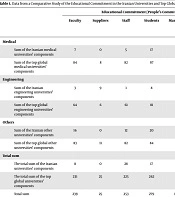
Vahedjavan V, Taghizade S. Comparing the Educational Commitment of Iranian and Top Global Universities with Emphasis on Medical Universities. Educ Res Med Sci. 2022;11(1):e123522. doi: https://doi.org/10.5812/erms-123522
More by these authors
Last Update: 2 days ago
Last Update: 2 days ago
Last Update: 2 days ago
Last Update: 6 days ago
Last Update: 9 hours ago
Last Update: 4 days ago