
1. Background
A novel coronavirus infection (COVID- 19) is an emerging viral respiratory disease that was first recognized in December 2019 in Wuhan, China (1). The World Health Organization, on 11 March 2020, declared the COVID-19 outbreak a global pandemic (2). In Iraq, with the occurrence of the first COVID-19 case in the Kurdistan Region, the authorities imposed strict control measures to limit the spread of the disease, including cancellation of religious ceremonies, holding gatherings, closure of schools and education institutes, closing borders and airports, and suspending non-emergency services in general hospitals (3-5). In addition, local authorities in Kurdistan Region diverted the city's limited resources, both human and financial, to cater for COVID-19 patients (3, 6).
There are studies that mentioned the psychological consequences of COVID-19 for students of residency and fellows training programs (7). However, to what extend the daily involvement of trainee junior and senior residents in surgical and clinical activities has been conceded by the COVID-19 pandemic is not clear yet. A study conducted in the Kurdistan region, Iraq, reported that the pandemic has influenced medical education programs (8). This study also mentioned the main challenges which medical students are faced during the COVID-19 pandemic, including the lack of required skills, accessibility of devices and infrastructures, getting sufficient practical training, and the performance evaluation methods (8). Another study also reported that residency training programs have been seriously impacted by the loss of surgical exposure and logbook development (9).
2. Objectives
Evidence regarding how and to what extent this pandemic will affect the residency educational programs, particularly surgical training, are limited. To date, few studies have investigated the impact of the COVID-19 pandemic on general residence training programs as well as the mental health and quality of life of students of these programs. Therefore, the current study aimed to demonstrate the impact of the COVID-19 pandemic on both residency training programs and its psychological consequences for students of these programs and their families in the Kurdistan Region, Iraq.
3. Methods
3.1. Study Design
In this cross-sectional study, which was conducted at Kurdistan Region, Iraq, from 12 - 25 August 2020, 275 junior and senior students of residency have participated. Data were collected using an online survey. The invitations were distributed through specific Facebook and Viber groups of students of residency in the Kurdistan Region, Iraq.
3.2. Questionnaires
The survey items about the impact of COVID-19 on residency training programs and its psychological consequences for individuals and their families were previously designed by (10). The survey contained 34 items, which were categorized into two thematic parts: (a) demographics characteristics; and (b) the impact of the COVID-19 pandemic on the quality of training program and its psychological consequences for trainees. The link of the survey was distributed through specific Facebook and Viber groups of students of residence of the Kurdistan Region, Iraq. All items were polar questions, based on YES/NO. This study has been previously described with the STROCSS criteria line (11).
3.3. Inclusion Criteria
All medical/surgical residents and fellows under the training programs in the Kurdistan region (Iraq). None medical students, general practitioners, and consultants were all excluded from the current study.
3.4. Statistical Analysis
Data were analyzed using the GraphPad Prism Version 8. The results were expressed as frequencies and percentages. The comparison between the junior and senior students of residency based on socio-demographic and characteristics toward the impact of the COVID-19 pandemic on their training was conducted using the Chi-Square or Fisher Exact tests. Statistical significance was considered when the P-value ≤ 0.05.
3.5. Ethics Approval
The Ethics Committee of the College of Medicine of the University of Zakho approved our study protocol and procedures of obtaining informed consent before the formal survey. Respondents were primarily asked to answer a question as YES or NO to confirm their commitment to participate voluntarily. After agreement, the participants were instructed to complete a self-reported online questionnaire.
4. Results
In the present study, 275 students of residency were recruited in order to evaluate the impact of the COVID-19 pandemic on their training program. The demographic characteristics of junior and senior students are presented in Table 1. Out of 275 participants, 50.9% were female and mostly older than 30 years (52.4%). Besides, 56% were married, and the most commonly cited specialty was surgical (36.4%), followed by medical (22.2%). Also, there was a statistically significant difference (P < 0.001) between demographics characteristics when comparing junior and senior residents in all variables (Table 1).
Table 1.
Demographic Characteristics According to Junior and Senior Residency Levels
| Variable | Junior Resident (N = 95)a | Senior Resident (N = 180)a | Total (N = 275)a | P Valueb |
|---|---|---|---|---|
| Gender | 0.001 | |||
| Male | 32 (33.7) | 103 (57.2) | 135 (49.1) | |
| Female | 63 (66.3) | 77 (42.8) | 140 (50.9) | |
| Age group (y) | 0.001 | |||
| 21 - 25 | 46 (48.4) | 1 (0.6) | 47 (17.1) | |
| 26 - 30 | 26 (27.4) | 58 (32.2) | 84 (30.6) | |
| > 30 | 23 (24.2) | 121 (67.2) | 144 (52.4) | |
| Marital status | 0.001 | |||
| Married | 34 (35.8) | 120 (66.7) | 154 (56) | |
| Single | 61 (64.2) | 60 (33.3) | 121 (44) | |
| Speciality | 0.001 | |||
| Surgical | 12 (12.6) | 88 (48.9) | 100 (36.4) | |
| Medical | 36 (37.9) | 25 (13.9) | 61 (22.2) | |
| Dermatology | 6 (6.3) | 9 (5) | 15 (5.5) | |
| General practitioner | 9 (9.5) | 5 (2.8) | 14 (5.1) | |
| Gynaecology | 5 (5.3) | 8 (4.4) | 13 (4.7) | |
| Radiology | 4 (4.2) | 7 (3.9) | 13 (4.7) | |
| Emergency Medicine | 4 (4.2) | 7 (3.9) | 11 (4) | |
| Paediatric | 7 (7.4) | 4 (2.2) | 11 (4) | |
| Urology | 4 (4.2) | 6 (3.3) | 10 (3.6) | |
| Pathology | 4 (4.2) | 6 (3.3) | 11 (3.6) | |
| Ophthalmology | 2 (2.1) | 9 (5) | 9 (3.3) | |
| ENT | 2 (2.1) | 6 (3.3) | 8 (2.9) |
Abbreviation: ENT, Ear, Nose, Throat.
aValues are presented as No. (%).
bP-values were performed using Chi-square (Fisher exact test); P-value was significant at P < 0.05 level.
The impact of COVID-19 on stress, anxiety, and support, separated by residency levels, is shown in Table 2. We found that 36% of participants worked in a quarantine area with significant differences between junior and senior residents (P < 0.005). About 39.6% of residents were forced to change the hospital due to the COVID-19 pandemic, but there was no significant difference between residents (P < 0.412). Approximately 50% of participants had a history of direct contact with COVID-19 patients and only 12.7% of them had enough training for the proper use of PPEs. In the present study, only 11.6% of residents had access to PPEs in the hospital and 13.8% of them were obtained full support from their program director and/or institute. Furthermore, 29.8% of participants stated that they obtained virtual teaching via a continuing education program with a statistically significant difference between junior and senior residents (P < 0.014) and 47.3% of residents were understood their role in the present situation. Surprisingly, about 90% of residents felt anxious and worried about the situation, but no statistically significant difference was found between them (P < 0.52). We also found that 83.3% of participants felt a low mood and 64.4% of them felt alone in the current situation. Additionally, nearly 37% of residents were aware of the new management protocols for the COVID-19 pandemic.
Table 2.
The Impact Of COVID-19 Pandemic on Support, Stress, And Anxiety According to Junior and Senior Residency Levels
| Questions | Junior Resident, (N = 95)a | Senior Resident (N = 180)a | Total (N = 275)a | P Value b |
|---|---|---|---|---|
| Do you work in a quarantine area? | 0.005 | |||
| Yes | 24 (25.3) | 75 (41.7) | 99 (36) | |
| No | 71 (74.7) | 105 (58.3) | 176 (64) | |
| Were you obliged to change the hospital because of this pandemic? | 0.412 | |||
| Yes | 39 (41.1) | 70 (38.9) | 109 (39.6) | |
| No | 56 (58.9) | 110 (61.1) | 166 (60.4) | |
| Do you get direct contact with COVID-19 patients? | 0.322 | |||
| Yes | 45 (47.4) | 92 (51.1) | 137 (49.8) | |
| No | 50 (52.6) | 88 (48.9) | 138 (50.2) | |
| Did you get training on-site for PPE in advance? | 0.433 | |||
| Yes | 13 (13.7) | 22 (12.2) | 35 (12.7) | |
| No | 82 (86.3) | 158 (87.8) | 240 (87.3) | |
| Do you have enough PPE available in the hospital? | 0.28 | |||
| Yes | 13 (13.7) | 19 (10.6) | 32 (11.6) | |
| No | 82 (86.3) | 161 (89.4) | 243 (88.4) | |
| Do you get full support from your program director and institute? | 0.278 | |||
| Yes | 11 (11.6) | 27 (15) | 38 (13.8) | |
| No | 84 (88.4) | 153 (85) | 237 (86.2) | |
| Do you get any form of virtual teaching? | 0.014 | |||
| Yes | 20 (21.1) | 62 (34.4) | 82 (29.8) | |
| No | 75 (78.9) | 118 (65.6) | 193 (70.2) | |
| Do you understand your role in this situation | 0.36 | |||
| Yes | 43 (45.3) | 87 (48.3) | 130 (47.3) | |
| No | 52 (54.7) | 93 (51.7) | 145 (52.7) | |
| Do you feel anxious and worried about the situation? | 0.522 | |||
| Yes | 85 (89.5) | 162 (90) | 247 (89.8) | |
| No | 10 (10.5) | 18 (10) | 28 (10.2) | |
| Do you feel a low mood? | 0.414 | |||
| Yes | 78 (82.1) | 151 (83.9) | 229 (83.3) | |
| No | 17 (17.9) | 29 (16.1) | 46 (16.7) | |
| Do you feel you are lonely at this time? | 0.536 | |||
| Yes | 61 (64.2) | 116 (64.4) | 177 (64.4) | |
| No | 34 (35.8) | 64 (35.6) | 98 (35.6) | |
| Are you aware of the new management protocols that are related to your specialty, which have been generated in the COVID-19 pandemic? | 0.46 | |||
| Yes | 34 (35.8) | 67 (37.2) | 101 (36.7) | |
| No | 61 (64.2) | 113 (62.8) | 174 (63.3) |
Abbreviation: PPE, personal protective equipment.
aValues are presented as No. (%).
bP-values were performed using Chi-square (Fisher exact test); P-value was significant at P < 0.05 level.
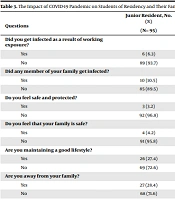
As mentioned before, we also investigated the impact of the COVID-19 pandemic on students of residency and their families (Table 3). It was found that 28 (10.2%) residents were infected with COVID-19, 22 (12.2%) of them were senior, and 6 (6.3%) were junior, and there was a statistically significant difference between them (P < 0.089). Among them, 66 (24%) students reported COVID-19 infection among their family members, and there was a statistical difference between residents (P < 0.001). About 17 (6.2%) participants reported a feeling of being safe and protected against COVID-19, and only 14 (5.1%) reported that their family members are safe and protected. The proportion of junior and senior residents who maintained a valuable lifestyle was 27.4% and 36.7%, respectively, with a statistically significant difference between them (P < 0.077). In addition, 26.5% of the residents were working away from their families, and 21.1% of them were forced to change their residence to protect their families and had a significant impact on the residency levels (P < 0.027).
Table 3.
The Impact of COVID-19 Pandemic on Students of Residency and Their Family Relationships According to Junior and Senior Residency Levels
| Questions | Junior Resident (N = 95)a | Senior Resident (N = 180)a | Total (N = 275)a | P Value b |
|---|---|---|---|---|
| Did you get infected as a result of working exposure? | 0.089 | |||
| Yes | 6 (6.3) | 22 (12.2) | 28 (10.2) | |
| No | 89 (93.7) | 158 (87.8) | 247 (89.8) | |
| Did any member of your family get infected? | 0.001 | |||
| Yes | 10 (10.5) | 56 (31.1) | 66 (24) | |
| No | 85 (89.5) | 124 (78.9) | 209 (76) | |
| Do you feel safe and protected? | 0.102 | |||
| Yes | 3 (3.2) | 14 (7.8) | 17 (6.2) | |
| No | 92 (96.8) | 166 (92.2) | 258 (93.8) | |
| Do you feel that your family is safe? | 0.434 | |||
| Yes | 4 (4.2) | 10 (5.6) | 14 (5.1) | |
| No | 91 (95.8) | 170 (94.4) | 261 (94.9) | |
| Are you maintaining a good lifestyle? | 0.077 | |||
| Yes | 26 (27.4) | 66 (36.7) | 92 (33.5) | |
| No | 69 (72.6) | 114 (63.3) | 183 (66.5 | |
| Are you away from your family? | 0.354 | |||
| Yes | 27 (28.4) | 46 (25.6) | 73 (26.5) | |
| No | 68 (71.6) | 134 (74.4) | 202 (73.5) | |
| Did you change your residence to protect your family? | 0.027 | |||
| Yes | 27 (28.4) | 31 (17.2) | 58 (21.1) | |
| No | 69 (72.6) | 148 (82.2) | 217 (78.9) |
aValues are presented as No. (%).
bP-values were performed using Chi-square (Fisher exact test); P-value was significant at P < 0.05 level.
The Impact of the COVID-19 pandemic on examination, separated by the residency level, is presented in Table 4. In this regard, 95 (34.5%) participants had a history of missing at least one exam during the COVID-19 pandemic, while almost all 253 (92%) reported a reduction in the training activities since the onset of the pandemic. In terms of surgical specialities, nearly 83% of residents reported reduced levels of surgical exposure and a decreased number of operations since the onset of the pandemic. Hence, it can be argued that the COVID-19 outbreak had a significant impact on the training of students of residency (P < 0.024). Around 50% of residents reported having enough time to read and studying during the pandemic, and had a significant impact on the level of residency (P < 0.001). However, only 14.2% of them were psychologically ready to study and read. Furthermore, around 81% of participants felt stress due to upcoming exams during the current pandemic and had a significant impact on the level of residency (P < 0.007).
Table 4.
The Impact Of COVID-19 Pandemic on the Examination According to Junior and Senior Residency Levels
| Questions | Junior Resident (N = 95)a | Senior Resident (N = 180)a | Total (N = 275)a | P Value b |
|---|---|---|---|---|
| Did you miss an exam during the pandemic? | 0.53 | |||
| Yes | 33 (34.7) | 62 (34.4) | 95 (34.5) | |
| No | 62 (65.3) | 118 (65.6) | 180 (65.5) | |
| Is there a reduction in the training activities during the COVID-19 pandemic? | 0.49 | |||
| Yes | 88 (92.6) | 165 (91.7) | 253 (92) | |
| No | 7 (7.4) | 15 (8.3) | 22 (8) | |
| For surgical specialties, is there a reduction in the level of surgical exposure and the number of operations during the COVID-19 pandemic? | 0.024 | |||
| Yes | 72(75.8) | 156 (86.7) | 228 (82.9) | |
| No | 23 (24.2) | 24 (13.3) | 47 (17.1) | |
| Do you have enough time to read and study during the pandemic? | 0.001 | |||
| Yes | 33 (34.7) | 104 (57.8) | 137 (49.8) | |
| No | 62 (65.3) | 76 (42.2) | 138 (50.2) | |
| Do you feel that you are psychologically prepared to study and read? | 0.509 | |||
| Yes | 13 (13.7) | 26 (14.4) | 39 (14.2) | |
| No | 82 (86.3) | 154 (85.6) | 236 (85.8) | |
| Do you feel stress because of the upcoming exams during the pandemic? | 0.007 | |||
| Yes | 69 (72.6) | 154 (85.6) | 223 (81.1) | |
| No | 26 (27.4) | 26 (14.4) | 52 (18.9) |
aValues are presented as No. (%).
bP-values were performed using Chi-square (Fisher exact test); P-value was significant at P < 0.05 level.
5. Discussion
Undoubtedly, the COVID-19 outbreak has influenced several aspects of our lives all around the world, including residency training programs. One of the most critical variations presented to the residency training programs is the cancelation of face-to-face interviews, medical meetings, events, and conferences, which are mostly replaced by live streams, recorded lectures, or webinars. One reason is to flatten the learning curve, in order to reduce the risk of exposure of students of residency to infected patients, which is an obvious concern. On the other hand, the students themselves have tendencies to reduce their interactions to avoid being infected with the disease.
According to the findings, 34.5% of residents had a history of missing at least one exam since the onset of the COVID-19 pandemic. However, 92% reported a reduction in training activities during the outbreak. It was also found that around 40% of residents were forced to change the hospital due to the COVID-19 pandemic and nearly 50% of them had a history of direct contact with COVID-19 patients. In terms of surgical specialties, nearly 83% of residents reported reduced levels of exposure with surgeries and a decreased number of operations since the onset of the pandemic. Such a reduction can partly be attributed to the cancellation of elective, non-urgent procedures due to the focus of hospitals on combating the COVID-19. Around 50% of residents reported enough time to read and studying during the pandemic. However, continuous exposure of students of residency with different clinical activities is of crucial importance. Hence, virtual clinics and telemedicine are of crucial importance. Additionally, the COVID-19 pandemic has increased the pressures on medical trainees. The significant decrease in trainees' participation in outpatient clinics can be attributed to the cancellation of several non-emergency visits by clinics, to minimize unnecessary contacts (12). A meta-analysis study, which has reviewed 12 articles on the psychological effects of COVID-19 among health staff, including resident doctors, found that about 23% of them had anxiety and 22.8% were depressed (13). In this study, it was found that 50% of recruited doctors had a history of direct contact with COVID-19 patients, while only 11.6% of them had access to PPEs in the hospital. Moreover, only 12.7% of them had enough training on how to properly use PPEs. This is in agreement with a study that has reported insufficiency of PPEs in the USA and Pakistan, which means working in unsafe environments without sufficient protection (14). In this study, approximately 90% of residents felt anxious and worried about the situation. We also found that 83.3% of residents felt a low mood, and 64.4% of them felt alone in the current situation. Anxiety, depression, and frustration in various degrees are reported among healthcare professionals in hospitals dealing with the severe acute respiratory syndrome (SARS) pandemic (15). Medical staff working in first-line facilities (e.g., emergency departments, intensive care units, and infectious diseases departments) are at increased risk of experiencing anxiety and depression (by about two times) compared to their colleagues in other departments who are not in direct contact with COVID-19 patients (16). The results of our study are in agreement with studies conducted in Germany and Hong Kong, which reported increased vulnerability of health staff, including resident doctors, to burnout, mental exhaustion, and anxiety (17, 18). Unfortunately, some studies reported suicide among health staff due to intense pressure faced because of extremely high psychological distress and fear of dying (19). A study that has studied factors that may provoke anxiety in health staff mentioned transmitting the infection to family members as a major concern (20). Most of the participants felt unsafe and reported that they could not protect their families. In this study, 24% of participants reported that their family members were infected with COVID-19. The infection rate of family members of senior residents was significantly higher than that of their junior counterparts. This difference can be attributed to their higher exposure to COVID-19 patients.
The current study has several strengths. To the best of our knowledge, this is one of the first studies that offer a unique opportunity to investigate the effects of the COVID-19 pandemic on the general and mental health of students of residency in the Kurdistan Region. This is particularly important, because the current research is among the few studies which have provided information about the psychological consequences of the COVID-19 pandemic. However, the current study had limitations, including financial supplies, a small sample size (N = 275), and a short period of data collection. Hence, caution should be taken when generalizing the findings to the whole Kurdish population in Iraq. The authors recommend performing a longitudinal study with a larger sample size.
5.1. Conclusion
The COVID-19 pandemic has negatively affected the residency training program in the Kurdistan Region, Iraq. Smart learning is crucial for adaptation to the new situation. The COVID-19 pandemic has caused high levels of psychological distress for medical residency and their families, which, combined with high rates of COVID-19 infection, has created problems for training students. Based on the findings, an urgent plan is required to reduce the psychological pressure of the pandemic and to protect doctors against the infection. Similarly, psychological and safety support for health staff, including resident trainees, at all levels should be ensured by the government.