
1. Background
Obesity is a chronic inflammatory condition and a primary global health concern for children. According to the latest children's obesity guidelines published by the World Health Organization (WHO) in 2017, approximately 41 million children under the age of 5 and 340 million children and adolescents aged 5 to 19 are obese. Obesity is a risk factor for diabetes, high blood pressure, cardiovascular diseases, cystic fibrosis, and asthma. The association between the prevalence of asthma and obesity has been established over the past two decades, especially in developing countries (1-5).
Studies have shown that obesity leads to poor asthma control by increasing the risk of exacerbations and medication use. Significant reductions in lung volume indices are associated with obesity in children with asthma, reducing respiratory capacity. Numerous mechanisms underlie the increasing incidence of asthma in obese children, including changes in lung mechanics, systemic inflammation, and metabolic disturbances. In addition, obesity increases cytokines and inflammatory factors secreted by adipose tissue, such as leptin, adiponectin, tumor necrosis factor-α (TNF-α), and interleukin. These results suggest a link between asthma attacks and obesity (4-7). A study by Buelo et al. reported that over 50% of obese asthma patients experienced bronchial spasms while exercising and performing physical activities. Additionally, they needed more corticosteroids and β-agonists agents to control their symptoms than normal-weight asthma patients (4).
Although new treatments have been found to control asthma, obese children with asthma need more medication to control symptoms and are more likely to be hospitalized in care units, reducing their quality of life. A study by Ross et al. showed that obesity-asthma is characterized by administering more drugs to control the disease, a higher incidence of ICU hospitalization, and reduced quality of life (7-9).
The relationship between body mass index (BMI) and the severity of asthma attacks in Iranian children has rarely been studied. Therefore, conducting a study to investigate the relationship between BMI and the severity of asthma attacks is essential. Our study hypothesized that obese children experienced a more significant number of attacks and more severe asthma exacerbations, and respiratory distress. Understanding the consequences of this relationship could help public health authorities to give better recommendations for asthma patients to improve their quality of life and decrease asthma attacks (1, 3-8).
2. Objectives
The present study investigated whether obese children have more asthma attacks, severe exacerbations, and respiratory distress.
3. Methods
3.1. Study Protocol and Sample Size
This descriptive cross-sectional study assessed the relationship between BMI and asthma attack severity in pediatric patients. The study was conducted on 149 children aged 5 and 14, referred to Taleghani Pediatric Hospital in Gorgan, Iran, diagnosed with asthma attacks in 2018 - 2019.
In our study, we used the Global Initiative for Asthma recommendations to classify the severity of asthma exacerbations. They are classified as severe, moderate, or mild asthma attacks based on the following parameters: Number of words spoken by the patient, respiratory rate, accessory muscle use, alertness, dyspnea, peak expiratory flow (PEF) after initial bronchodilator use, pulse per minute, pulse paradox, oxygen saturation, and wheezing (10).
During hospitalization, the pediatric pulmonologist ordered a pulmonary function test (PFT) and arterial blood gas (ABG) test to confirm the diagnosis of asthma. In addition, the patient's height, weight, and BMI were measured.
Patient's BMI was categorized based on the BMI-age chart for boys and girls aged 2-20 taken from the Centers for Disease Control and Prevention as follows: Underweight: Below the 5th percentile; normal: Between the 5th and 85th percentile; overweight: Between the 85th and 95th percentile, and obese: Equal to or greater than the 95th percentile (11).
All children with asthma aged 5 - 14 years referred to Taleghani Children's Hospital in Gorgan in 2018 - 2019 were included in the study. According to the study of Ahmadi et al., a sample size of 149 with 90% power and 5% error was obtained using the following formula (12).
3.2. Inclusion and Exclusion Criteria
The inclusion criteria included all patients admitted to the hospital with a diagnosis of asthma confirmed by standard PFT and ABG, aged 5 to 14 years, and having a one-year history of asthma treated with inhaled steroids. The exclusion criteria included children with comorbidities like pneumonia and chronic respiratory diseases (such as cystic fibrosis and primary ciliary dyskinesia), asthma risk factors such as sinusitis, parental smoking, and allergic rhinitis, and conditions like gastroesophageal reflux disease, chest abnormalities, and congenital lung diseases.
3.3. Ethics Approval
Informed consent was obtained from the legal guardians of the study participants. A copy of written consent is available for review by the editor of this journal. The purpose of this study was fully explained to the patient's legal guardian, and they were assured that the researcher would keep their information confidential. This study was conducted according to the principles of the Declaration of Helsinki. The Golestan University of Medical Sciences Ethics Committee approved it (Ethical Code IR.GOUMS.REC.1396.223).
3.4. Statistical Analysis
The obtained data were analyzed using SPSS-18 software. Fisher's exact test and Spearman's rank correlation coefficient were used to analyze the results. P-values of less than 0.05 were significant.
4. Results
Following the inclusion and exclusion criteria, 149 children aged 5 and 14 were recruited. The mean age of the patients was 8.8 ± 2.76 years, and 55.0% were below the mean age. In our study, 60.4% (n = 90) of the patients were boys, and 39.6% (n = 59) were girls. Table 1 presents the demographic variables of the patients.
Table 1.
Demographic Characteristics of Asthmatic Children
| Mean ± SD | Minimum | Maximum | |
|---|---|---|---|
| Duration of illness | 3.01 ± 1.54 | 0.50 | 6.00 |
| Age | 8.80 ± 2.76 | 5.00 | 14.00 |
| Body mass index | 17.41 ± 2.87 | 13.10 | 28.00 |
| Weight | 30.99 ± 12.41 | 16.00 | 68.00 |
| Height | 130.55 ± 15.69 | 105.00 | 172.00 |
According to the BMI-age chart, 1.3% of the patients were below the 5% percentile (underweight), 70.5% were in the 5-85% percentile (normal), 21.5% were in the 85-95% percentile (overweight), and 6.7% were above the 95% percentile (obese).
We found that 12.4% of normal weight, 15.6% of overweight, and 50.0% of obese patients had severe asthma attacks. A significant positive relationship existed between the severity of respiratory distress (P-value = 0.015) and the severity of asthma attack (P-value = 0.029) related to BMI status. The correlation of respiratory distress and asthma severity with BMI status was studied using Spearman's rank test, and both were significantly and positively correlated (cc = 0 .0194, P-value = 0.018 and cc = 0.263, P-value = 0.001, respectively).
The relationship between BMI status and the severity of asthma attacks was also studied by gender. A significant association was found between severe asthma attacks and higher BMI in boys but not in girls (P-value = 0.003 vs. 0.199). Also, the relationship between BMI status and the degree of respiratory distress was studied by sex; respiratory failure and higher BMI were correlated in boys but not in girls (P-value = 0.002 vs. 0.199).
Regarding age, the relationship between BMI and severity of asthma attacks and respiratory distress was most significant in children over eight years of age. All of the obese patients (100%) and only 17.6% of patients with normal BMI had severe asthma attacks (P-value = 0.001 and P-value = 0.001, respectively).
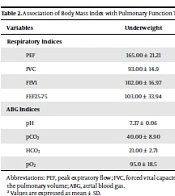
The PFT results based on BMI are presented in Table 2. As shown, FVC, FEV1, and FEV25-75 were significantly related to BMI status. Specifically, FVC and FEV1 were significantly lower in patients with higher BMI.
Table 2.
Association of Body Mass Index with Pulmonary Function Test and Atrial Blood Gas Results a
| Variables | Underweight | Normal | Overweight | Obese | P-Value b |
|---|---|---|---|---|---|
| Respiratory indices | |||||
| PEF | 165.00 ± 21.21 | 139.71 ± 31.75 | 148.12 ± 40.59 | 134.00 ± 20.65 | 0.382 |
| FVC | 93.00 ± 14.9 | 81.41 ± 15.01 | 95.65 ± 14.86 | 76.25 ± 5.17 | < 0.001 |
| FEV1 | 102.00 ± 16.97 | 83.19 ± 14.04 | 98.95 ± 15.37 | 82.37 ± 7.76 | < 0.001 |
| FEF25-75 | 103.00 ± 33.94 | 85.71 ± 21.31 | 103.80 ± 23.23 | 91.50 ± 14.49 | 0.010 |
| ABG indices | |||||
| pH | 7.37 ± 0.06 | 7.33 ± 0.06 | 7.33 ± 0.03 | 7.30 ± 0.03 | 0.372 |
| pCO2 | 40.00 ± 8.90 | 46.90 ± 8.14 | 46.11 ± 7.03 | 55.10 ± 6.20 | 0.010 |
| HCO3 | 21.00 ± 2.71 | 22.85 ± 2.66 | 23.09 ± 2.60 | 25.32 ± 2.36 | 0.041 |
| pO2 | 95.0 ± 18.5 | 92.09 ± 17.02 | 88.37 ± 21.50 | 79.33 ± 8.16 | 0.145 |
Abbreviations: PEF, peak expiratory flow; FVC, forced vital capacity; FEV1, forced expiratory volume in the first second; FEF25-75, forced expiratory flow at 25% and 75% of the pulmonary volume; ABG, atrial blood gas.
a Values are expressed as mean ± SD.
b A P-value less than 0.05 is considered significant.
Although overweight children presented with severe asthma attacks and respiratory distress, the number of annual asthma attacks was not related to their BMI status (P-value = 0.084). Also, 50% of underweight, 31.3% of normal weight, 34.4% of overweight, and 40% of obese patients had 3 to 4 attacks yearly. On the other hand, only 7.1% of normal BMI, 28.1% of overweight, and 10% of obese patients had 4 - 5 attacks per year.
The prevalence of tachypnea, chest retraction, and wheezing during expiration showed no significant association with BMI; only tachycardia and BMI revealed a significant relationship (P-value = 0.0001).
In Table 2, among the ABG indices, only pCO2 and HCO3 significantly increased with BMI status (P-values = 0.01 and 0.041, respectively). In Table 3, a summary of our results is presented.
Table 3.
Frequency Distribution of Study Variables Based on Body Mass Index
| Variables | Underweight | Normal | Overweight | Obese | P-Value a |
|---|---|---|---|---|---|
| Sex | 0.016 | ||||
| Male | 0 | 62 | 17 | 10 | |
| Female | 2 | 42 | 15 | 0 | |
| Asthma severity | 0.029 | ||||
| Mild | 2 | 47 | 12 | 1 | |
| Moderate | 0 | 45 | 15 | 4 | |
| Severe | 0 | 13 | 5 | 5 | |
| Respiratory distress | 0.015 | ||||
| Mild | 2 | 47 | 12 | 5 | |
| Moderate | 0 | 45 | 15 | 0 | |
| Severe | 0 | 13 | 5 | 5 | |
| Number of asthma attacks per year | 0.084 | ||||
| 1 - 2 times | 0 | 16 | 5 | 0 | |
| 2 - 3 times | 1 | 45 | 7 | 5 | |
| 3 - 4 times | 1 | 3 | 11 | 4 | |
| 4 - 5 times | 0 | 7 | 9 | 1 | |
| Tachypnea | 0.264 | ||||
| No | 0 | 24 | 5 | 0 | |
| Yes | 2 | 81 | 27 | 10 | |
| Chest retraction | 0.072 | ||||
| No | 2 | 44 | 12 | 1 | |
| Yes | 0 | 61 | 20 | 9 | |
| Exhale wheezing | 0.936 | ||||
| No | 0 | 1 | 0 | 0 | |
| Yes | 2 | 104 | 32 | 10 | |
| Tachycardia | < 0.001 | ||||
| No | 2 | 48 | 5 | 0 | |
| Yes | 0 | 57 | 27 | 10 | |
| PEF | 0.013 | ||||
| PEF > 80% | 2 | 61 | 15 | 1 | |
| 50% < PEF < 80% | 0 | 44 | 17 | 9 |
Abbreviation: PEF, peak expiratory flow
a Based on Fisher's test, a P-value less than 0.05 is significant.
5. Discussion
Asthma and obesity are common diseases in pediatrics. The phenotype "obesity-asthma" is defined as obesity modifies asthma in children with high BMI. This correlation is influenced by various factors, including gender, adiposity measurements, atopy, insulin resistance, inflammation, environmental factors, and genetic factors. Because of the heterogeneity of these factors and the results of different studies, it is difficult to explain the impact of each factor on the development of asthma in children. This increases the risk of worsening long-term asthma control, asthma attacks, and hospitalizations (12-16).
Obesity is a prevalent condition in children with severe asthma. Our study demonstrated a significant relationship between higher BMI and asthma attacks in children with asthma. About 28% of participants were either overweight or obese, and 15.6% of overweight and 50% of obese patients had severe asthma and respiratory distress. Similar to our findings, in the TENOR study of patients with severe asthma, about 31% and 57% of children and adults who had severe asthma were obese, and in the British Thoracic Society Difficult Asthma Registry, about 48% of patients with severe asthma were obese (17-20).
In our survey, 60.4% of participants were boys. Also, 100% of obese and 53.1% of overweight patients were boys. Sansone et al. reported that serum-free fatty acids and low-density lipoprotein (LDL) levels were higher in obese asthmatic children, especially boys, before puberty. However, after puberty, due to the influence of sex hormones (such as estragon) on the obesity-asthma relation and the increase in adipose tissue, the incidence predominates in the female sex. These reasons could partially explain previous reports that obesity is consistently associated with poorer asthma control in boys compared to girls (21-25).
According to our study, the severity of asthma attacks increased in patients with higher BMI. The number of asthma attacks per year was not related to BMI; therefore, this suggests that although a higher BMI is a factor in poor asthma control, it does not play a significant role in the incidence of these attacks. Obesity is responsible for an increase in inflammatory factors in various body systems. Mizuta et al. showed that factors such as interleukins (IL-1,4,5,6,13,17), cytokines, TNF-α, and Free Fatty Acid Receptor 1 (FFAR1) could promote inflammatory activity in obese patients (1, 26-28).
On the other hand, a relationship between obesity and insulin resistance has been established. A recent study by Tashiro and Shore (2) showed that insulin resistance reduces FEV1 and FVC and may develop airway hypersensitivity in obese children. In another matter, a study by Forno et al. indicated that neutrophils are the predominant cells in the sputum of patients with severe asthma, and their role in the etiology of severe asthma has been suggested. Several studies mentioned that obesity increases the number of neutrophils instead of eosinophils in the sputum of these patients. These factors affect the respiratory system and can induce airway hypersensitivity, bronchospasm, and mucus secretion, leading to asthma attacks, especially when superimposed on underlying inflammatory factors in asthmatic patients (2, 29-33).
The etiology of asthma symptoms is highly heterogeneous, leading to multiple asthma phenotypes. Symptoms during an asthma attack include cough, respiratory distress, and chest pain, and its common signs include tachycardia, tachycardia, retraction of the chest, and wheezing during exhalation. Our study found an association between respiratory distress and tachycardia and higher BMI in patients with severe asthma. Increased symptoms with higher weight may result from loss of mobility, worsening asthma, and comorbidities such as gastroesophageal reflux disease or sleep apnea. Obesity changes respiratory capacity by reducing lung and airway volume, leading to maximal response during an asthma attack and increasing symptoms during an attack. According to the study by Tashiro and Shore, obesity during conditions like stress or illness increases respiratory failure and heart rate, which corroborates the results of our study. Therefore, a higher BMI in children is associated with a higher incidence of symptoms commonly attributed to asthma (2, 21, 34-38).
Pulmonary function testing (PFT) is a standard method for evaluating airway obstruction. This test is used to assess asthma severity and response to treatment. In asthmatic patients, decreased FEV1/FVC and FEV1 ratios have been reported. Our study showed that FVC and FEV1 values were significantly lower in patients with higher BMI. Obesity disrupts the respiratory system through a variety of mechanisms. The production of inflammatory factors such as leptin production, insulin resistance, hypoxic inflammation, and the anatomical impact of high BMI on the respiratory system leads to decreased ERV, FRC, and FEV1/FVC values. In a correlational study, Khalid and Holguin showed that ERV and FRC were significantly lower in asthma patients with a higher BMI (2, 6, 21, 39-41).
Besides, ABG testing provides information to assess blood gas pressure and acid-base status. This method helps manage acute attacks and respiratory failure in patients with asthma. Moreover, ABG results during an asthma attack showed increased pCO2 and a compensatory increase in HCO3 concentration. Besides, pCO2 and HCO3 were significantly associated with BMI status. Narrowing and congestion of the respiratory tract can lead to hypoxemia during an acute asthma attack. Hyperventilation during an asthma attack causes respiratory alkalosis and, if not properly treated, progressive respiratory failure leads to hypercapnia and respiratory acidosis. In addition, obesity can reduce lung and airway volume, worsen asthma attacks and respiratory distress, and increase hypoxic sensitivity and inflammation. This correlation between asthma and obesity increases pCO2 and HCO3 and worsens ABG results (42-47).
Finally, we declared a significant positive relationship between the severity of respiratory distress and the severity of asthma attacks related to BMI status. Gender was recognized as an important factor that alters the relationship between asthma and obesity.
One of the study's strengths is that the relationship between BMI status and asthma attacks in children in Iran has not been studied to date. In most studies, the diagnosis of asthma at the time of the attack was based on the physician's diagnosis, but in our study, PFT and ABG during hospitalization were used to confirm the diagnosis, helping to reduce bias and errors. Among our limitations, obese children with asthma should be managed according to the same guidelines as underweight children. Healthcare providers should consider the lack of attention to differences in daily physical activity, weight loss, and monitoring for common obesity-related sequelae. Further studies are recommended to investigate weight loss through diet or surgical intervention in obese asthmatic patients.
5.1. Conclusions
Our study declared that patients with higher BMI had more severe attacks, severe exacerbations, and respiratory distress. Also, FVC and FEV1 were significantly lower in obese children. In children, obesity is a major risk factor for developing asthma, especially during the first years of life and at the onset of puberty. Asthma attacks are severe in obese and overweight children. Different mechanisms exist in obese patients with asthma, including airway hyperreactivity, inflammation, and airway remodeling. Although the exact relationship between asthma attacks and obesity is unclear, understanding this could lead to more therapeutic options.