
1. Background
In today's world, the significance of an ethical approach in medical professions is widely recognized and deemed essential (1). The nursing profession encompasses health promotion activities, disease prevention, and care for patients of all ages (2). Ethics and clinical practice are not separate (3). Professional ethics are an essential component for individuals aspiring to become professionals (4). It is crucial to pay attention to professional behavior and ethics, including moral sensitivity (5). Moral sensitivity is one of the essential dimensions of professional ethics, providing the basis for decision-making and clinical practice (6). Therefore, moral sensitivity and a sense of responsibility are significant for nurses providing care (7). Nurses should be accountable for their actions according to their moral obligations (8).
Nursing care is widely recognized as an indispensable component of healthcare services, requiring a comprehensive and holistic approach in all aspects, with no room for neglect (9). Nevertheless, nurses encounter situations where they inadvertently or intentionally fail to fulfill certain responsibilities due to factors such as organizational, personal, and psychological influences. This failure to provide necessary care can be referred to as missed nursing care (MNC), an unfortunate omission or oversight of care required by the patient (10). The missed care model was presented by Kalisch et al. in 2009 (11). According to the mentioned model, factors such as human resources, financial resources, and communication can lead to failure in care (12). Missed care leads to consequences such as increasing the length of hospitalization, reducing patient satisfaction and safety, and lowering the hospital’s reputation from the patients' perspective (13). The ability to predict facing these issues and recognize ethical problems and the appropriate decision-making solution are essential factors in providing standard care (7).
2. Objectives
This study aimed to predict missed nursing care based on moral sensitivity and care-related factors in 2021.
3. Methods
3.1. Study Design
This research is a cross-sectional study aimed at predicting missed nursing care based on moral sensitivity and care-related factors. The study was conducted from July 11, 2021, to October 30, 2021. The study aimed to predict missed nursing care based on moral sensitivity and care-related factors.
3.2. Study Settings and Participants
The study was conducted with a population of working nurses from the medical education centers affiliated with Ardabil University of Medical Sciences. To determine the sample size, Cochran's formula (as shown in Equation 1) was utilized, with (d = 0.05), (P = 0.5), (z = 1.96), and (N = 1368). A sample size of 345 nurses was calculated, accounting for a 15 % estimated attrition rate.
The ratio of nurses in various hospitals was determined as follows: Imam Khomeini (154), Fatemi (65), Alavi (48), Bu Ali (53), and Imam Reza (25). Random samples were then taken from each of the five departments: Surgery (77), internal medicine (65), emergency (94), special care (72), and pediatric (37). Questionnaires were distributed to nurses who met the inclusion criteria, which included having a bachelor's degree or higher, at least six months of work experience in their relevant department, and a willingness to participate in the study. Exclusion criteria consisted of incomplete questionnaire responses. The questionnaires were distributed randomly across different shifts and classes. A total of 345 participants were enrolled in the study, providing a diverse and representative sample of nurses from the five departments.
3.3. Data Collection and Measurement
Data collection tools used in this study included a demographic information questionnaire, Lutzen's modified moral sensitivity questionnaire (MSQ), Kalish's missed care questionnaire, and a questionnaire assessing factors related to Blackman's missed care. The demographic questionnaire gathered information on participants' age, sex, marital status, work experience, income, education level, workplace sector, and shift work status, including whether they had a second job. The MSQ, developed by Lutzen, is a 30-item questionnaire that measures nurses' moral sensitivity using a five-point Likert scale. The questionnaire was designed to assess the level of moral sensitivity among nurses in various clinical settings (14, 15). A new 25-item version of the Moral Sensitivity Questionnaire (MSQ) was introduced in a 2021 study, which assesses moral sensitivity using a five-point Likert scale. The questionnaire demonstrated strong reliability in the Iranian version, with a Cronbach's alpha coefficient of 0.89. The MSQ categorizes respondents' moral sensitivity into three levels based on their scores: Low (0 - 50), medium (51 - 75), and high (76 - 100) (16). The missed nursing care questionnaire (MNC), initially developed by Kalisch in 2006, underwent further psychometric evaluation by the same author in 2009 (11). It has been widely utilized for patient movement, turning, evaluation, training, planning, discharge, and drug prescription (17). This tool assesses the missing elements of nursing care and the reasons for their omission. It consists of 24 items that ask respondents to indicate how frequently they missed providing care during their last working shift using a four-point Likert scale with scores ranging from 1 to 4. The questionnaire scores range from 24 to 96, with higher scores indicating a greater likelihood of missed care. The validity and reliability of the questionnaire were evaluated using Cronbach's alpha coefficient, with estimated values of 0.99 and 0.91, respectively (18).
Blackman et al. designed a questionnaire of factors related to MNC in Australia in 2014 (12). The 17-question questionnaire consists of three sub-scales: Human resources, material resources, and communication. Upon validation in the context of Iran's nursing system, three additional items were incorporated, resulting in a total of 20 items. Responses are measured on a four-point Likert scale, with scores ranging from 20 to 80. Questions pertaining to human resources (1-4, 7, 12-14), financial resources (6, 9, 10, 16), and communication (5, 7, 12-14) were identified. The validity of the questionnaire in Iran was confirmed by Khajooee et al., showing a reliability coefficient of 0.98 and internal consistency with a Cronbach's alpha of 0.98 (18).
3.4. Data Analysis
Descriptive statistics (frequency, percentage, mean, and standard deviation) and inferential statistics (ANOVA, regression, and Pearson correlation) were conducted using SPSS 19 software. The significance level for data analysis was set at 0.05. No outliers or missing data were identified in the study.
3.5. Ethical Considerations
This article presents the findings of a research project conducted under the code of ethics I.R.ARUMS.REC.1400.101. The study adhered to all ethical principles related to research, including obtaining informed consent from participants, ensuring anonymity, respecting autonomy, avoiding harm, and protecting the rights of the institution and researchers.
4. Results
The results showed that 83.2% of the participating nurses (287 samples) were female, 80% were married (276 samples), and 69.9% (241 samples) had official employment status. Moral sensitivity had a positive significant relationship with age and work experience and a negative significant relationship with overtime per month (Table 1).
Table 1.
Relationship Between Moral Sensitivity and Demographic Characteristics
| Variables | Mean ± Standard Deviation | Sig. |
|---|---|---|
| Age | 32.19 ± 3.98 | P = 0.001 a; R = 0.105 |
| Work experience (y) | 6.23 ± 2.67 | P = 0.001 a; R = 0.184 |
| Overtime per month | 73.99 ± 21.95 | P > 0.001 a; R = -0.313 |
a Pearson correlation.
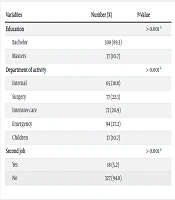
Missed nursing care had a significant relationship with education, department of activity, and having a second job (Table 2).
Table 2.
Relationship Between MNC and Demographic Characteristics
| Variables | Number (%) | P-Value |
|---|---|---|
| Education | > 0.001 a | |
| Bachelor | 308 (89.3) | |
| Masters | 37 (10.7) | |
| Department of activity | > 0.001 a | |
| Internal | 65 (18.8) | |
| Surgery | 77 (22.3) | |
| Intensive care | 72 (20.9) | |
| Emergency | 94 (27.2) | |
| Children | 37 (10.7) | |
| Second job | > 0.001 a | |
| Yes | 18 (5.2) | |
| No | 327 (94.8) |
a Independent-sample t-test.
In investigating the moral sensitivity of nurses, the mean score of moral sensitivity was found to be 70.75 ± 10.83 (Table 3).
Table 3.
Mean and Standard Deviation of Dimensions and Total Moral Sensitivity
| Moral Sensitivity | Mean ± SD | Mean ± SD of Item to Item |
|---|---|---|
| Respect for the client’s independence | 9.12 ± 1.90 | 0.63 ± 3.04 |
| Knowledge of how to communicate with the patient | 3.40 ± 14.72 | 0.68 ± 2.94 |
| Professional knowledge | 1.63 ± 4.46 | 0.81 ± 2.23 |
| Experiencing moral problems and conflicts | 1.70 ± 8.84 | 0.56 ± 2.94 |
| Applying ethical concepts in ethical decisions | 2.73 ± 14.19 | 0.54 ± 2.83 |
| Honesty and benevolence | 3.85 ± 19.41 | 0.55 ± 2.77 |
| Total moral sensitivity score | 10.83 ± 70.75 | 0.43 ± 2.83 |
Findings related to MNC showed that the total mean and standard deviation of MNC were 33.93 ± 10.35. The highest average MNC was related to "supervising the preparation of food for a patient who can eat by himself," with an average of 1.97, and "doing oral care," with an average of 1.92, respectively.
In the prediction of MNC based on the components of nurses’ moral sensitivity, the results showed that the features of moral sensitivity of nurses explain 0.4% of MNC. The path coefficient of independent to dependent components is equal to 1.574. This value represents the Pearson correlation between the features and the variable (Table 4).
Table 4.
Correlation Between Nurses' Moral Sensitivity and Missed Nursing Care (MNC)
| Order | Variables | 1 | 2 | 3 | 4 | 5 | 6 | 7 | 8 |
|---|---|---|---|---|---|---|---|---|---|
| 1 | Total moral sensitivity | 1 | |||||||
| 2 | Respect for independence | 0.535 | 1 | ||||||
| 3 | Knowledge of how to communicate with the patient | 0.675 a | 0.095 | 1 | |||||
| 4 | Professional knowledge | 0.623 a | 0.330 | 0.111 | 1 | ||||
| 5 | Experience moral conflicts | 0.678 a | 0.474 | 0.309 | 0.484 | 1 | |||
| 6 | Applying ethical concepts | 0.793 a | 0.355 | 0.550 | 0.344 | 0.460 | 1 | ||
| 7 | Honesty and aenevolence | 0.823 a | 0.324 | 0.393 | 0.608 | 0.425 | 0.508 | 1 | |
| 8 | The whole care is missed | -0.253 a | -0.345 a | -0.034 | -0.119 a | -0.280 a | -0.031 | -0.330 a | 1 |
a Correlation is significant at the 0.01 level (2-tailed).
There is a significant inverse relationship between moral sensitivity and missed care. Professional knowledge, experience of moral dilemmas and conflicts, respect for client independence, honesty, and benevolence predict missed care. Significant relationships were found between age, amount of overtime, second job, work experience, department, and education with missed care (Table 5).
Table 5.
Analysis of Regression Coefficients of Missed Care Based on Moral Sensitivity and Factors Related to Missed Care
| Predictor Variables | Non-standard Coefficient | Standard Coefficient Beta | P-Value | Statistical Values | |
|---|---|---|---|---|---|
| S.E | β | ||||
| Respect for the client’s independence | -0.010 | 0.022 | -0.119 | 0.027 | R = 1.574; R2 = 0.4 |
| Knowledge of how to communicate with the patient | -0.018 | 0.011 | -0.034 | 0.529 | R2 Adj = 0.379 |
| Professional knowledge | -0.008 | 0.044 | -0.280 | < 0.001 | F = 56.01; P < 0.001 |
| Experiencing moral problems and conflicts | -0.008 | 0.057 | -0.345 | < 0.001 | |
| Applying ethical concepts in ethical decisions | -0.014 | 0.008 | -0.031 | 0.571 | |
| Honesty and benevolence | -0.123 | 0.019 | -0.330 | < 0.001 | |
| Total moral sensitivity | 0.265 | 0.055 | -0.253 | < 0.001 | |
| Human resources | 3.42 | 19.65 | 0.22 | 0.001 | |
| Funds | 3.39 | 24.32 | 0.15 | 0.001 | |
| Connections | 3.37 | 25.45 | 0.13 | 0.01 | |
This study revealed that nurses exhibited a moderate level of moral sensitivity, consistent with findings from other studies conducted in Iran and elsewhere (19, 20). Mousavi et al. indicated medium to high levels of moral sensitivity among students and nurses at Aja University (21), whereas Filipova suggested that nurses lacked sufficient moral sensitivity for decision-making (22). These discrepancies in reported results suggest that various factors may influence nurses' moral sensitivity, including workplace conditions, overtime, work experience, departmental dynamics, and the extent of nursing care (23). Research indicates that higher levels of moral sensitivity among nurses correlate with improved quality of nursing care (24). The average level of moral sensitivity among nurses reflects their relative emphasis on adhering to ethical principles in patient care. Therefore, it is imperative for nurses to enhance their understanding of nursing ethics. Among the dimensions of moral sensitivity, the highest score was attributed to "honesty and benevolence," while the lowest score was associated with "professional knowledge." This finding aligns with the results reported by Abdou, wherein the dimension of honesty and benevolence received the highest score among moral sensitivity dimensions, consistent with the current study (5). In the study by Comrie, the highest score was related to the field of "applying moral concepts," and the lowest score was related to the field of "experiencing moral problems and conflicts" (19). The professional knowledge dimension of moral sensitivity refers to cases where decisions are made without the patient’s participation. The results of the present study also showed that nurses obtained the lowest score in the professional knowledge dimension. Not paying attention to the patient’s autonomy and the idea that the treatment team must help the patient’s decision-making are still neglected. Nurses participate less in their patients' treatment and care decisions. Additionally, the findings related to the determination of MNCs showed that the occurrence of MNCs in this research also exists like other research conducted worldwide. The highest mean associated with MNC was related to "supervising the preparation of food for a patient who can eat by himself" and "doing oral care." Also, the lowest mean was related to the statement "General evaluation of the patient in each work shift" and "Evaluation and care of the peripheral and central venous routes of the patient." The results of Cho et al.’s research in Seoul regarding the effect of increasing nursing staff on unperformed nursing care are consistent with our study. They showed that monitoring meals and movement, oral care, bathing, and skincare preparation are part of the MNC (25). The study by Kalisch in America showed that "changing the patient’s condition," "cooperation and supervision of going to the toilet in the first 15 minutes of the request," and "participating in interdisciplinary patient care conferences" are the most MNCs (17). We can attribute the differences in management and educational systems, as well as the variance in care styles across the studied departments, to explain the disparities observed in the types of MNC. Regarding the prediction of MNCs based on the components of moral sensitivity and related factors, the results indicated that nurses’ moral sensitivity components account for 0.4% of MNCs. Essentially, as nurses' moral sensitivity increases, MNC decreases, and vice versa. Additionally, components such as professional knowledge, experience of moral dilemmas, respect for client autonomy, honesty, and benevolence showed significant correlations with missed care. However, components like awareness of communication with the patient and application of ethical concepts in decision-making did not exhibit significant correlations. The highest correlation was noted with experiencing moral dilemmas and conflicts, while the lowest was observed with respect for client autonomy. Although nurses' clinical behaviors partly reflect their moral sensitivities, the research underscores the presence of other contributing factors to missed care, warranting further investigation. Policymakers and researchers in the healthcare system must take heed of these factors. Among the demographic variables, a statistically significant relationship was found between overtime and second jobs with moral sensitivity, indicating that nurses with increased overtime and workload experienced more missed care and received lower scores in moral sensitivity. Dehghani et al. also identified the frequency of work shifts and fatigue resulting from overtime as significant barriers to nurses' adherence to professional ethical standards (26). Extended weekly working hours lead to fatigue and dissatisfaction among nurses, resulting in reduced sensitivity to ethical issues. High workload can foster indifference and diminish nurses' performance. Additionally, a statistically significant correlation was observed between nurses' work experience and missed care, indicating a decrease in missed care with increasing work experience. As nurses age and accumulate more experience, they develop greater clinical skills and moral sensitivity, resulting in enhanced accuracy in care provision. Lutzen et al. demonstrated that nurses' moral sensitivity increases with greater work experience (27), a finding consistent with the results of this study. However, studies by Abbaszadeh et al. and Izadi et al. did not reveal a statistically significant relationship between moral sensitivity and work history (20, 28). In justifying these differences, it can be stated that moral sensitivity tends to increase with accumulating work experience when it is accompanied by ongoing learning, experience growth, and knowledge development. This trend arises because if work experience doesn't coincide with continuous education, there's a possibility that monotony and routine tasks might decrease nurses' sensitivity and their ability to handle new ethical challenges, thus weakening their decision-making skills (20). Considering the influence of organizational and environmental factors, disparities in the research settings between these two studies could contribute to these differences. Additionally, due to the limitation in sample size, caution is warranted when extrapolating the results to other populations.
5. Discussion
The average level of moral sensitivity among nurses reflects their awareness and attentiveness to this aspect of professional ethics. However, the results suggest that this level of moral sensitivity may not suffice for delivering comprehensive patient care and could lead to instances of care being missed or overlooked.
Based on the findings, it can be concluded that moral sensitivity, including respect for client autonomy, professional knowledge, experience with moral dilemmas, honesty, and benevolence, along with related factors such as human resources, finances, and communication, serve as predictors of missed nursing care (MNC). This implies that the higher the level of sensitivity nurses exhibit in clinical care, coupled with favorable human, financial, and communication resources, the fewer instances of missed care are likely to occur.
Ultimately, to mitigate missed care, fostering moral sensitivity among nurses should be considered a priority within the nursing system.