
1. Background
Due to the rapid global spread of COVID-19, the World Health Organization declared it a pandemic on March 11, 2020 (1, 2). Despite multiple protocols developed by various regulatory agencies, controlling this pandemic continues to be a significant global public health concern (3-5). It places unprecedented and significant pressure on healthcare systems and healthcare workers (HCWs) (6).
Healthcare workers, particularly nurses who are at the frontline of the battle against COVID-19, are at a high risk of infection (7-9). Nurses face numerous risks, including physical and mental challenges (10, 11), and many have been infected and have even died worldwide (12). The health system's ability to deliver safe and quality services to patients may be compromised due to occupational diseases induced by these issues (8). Therefore, controlling this pandemic depends crucially on protecting HCWs, especially nurses, from COVID-19 (13).
Wearing personal protective equipment (PPE) is one of the most critical ways to combat this pandemic, especially for HCWs, particularly nurses, who are on the front lines of this battle (14-16). It is crucial to emphasize the importance of adhering to preventive measures. Compliance plays a key role in controlling the transmission of infections and carries significant consequences for healthcare providers, including the risk of infection and even death (17-19).
Although adherence to standard precautions, including the use of PPE, is necessary for infection control, some studies have reported that HCWs do not always follow these precautionary measures consistently (20). While factors contributing to HCWs’ adherence to PPE have been identified (20-24), variables specifically related to nurses’ use of PPE have not been extensively studied in either Iran or globally. Understanding these factors during the COVID-19 pandemic can assist healthcare planners and policymakers in controlling the disease and improving public health.
2. Objectives
This study aims to examine the factors influencing nurses’ use of PPE during the COVID-19 pandemic, with the goal of informing future policymaking regarding nurses’ use of PPE and maintaining and enhancing their health.
3. Methods
3.1. Study Design
The present study is an analytical cross-sectional study conducted among nurses working in hospitals affiliated with Tehran University of Medical Sciences. The hospitals included are Imam Khomeini, Sina, Shariati, and Valiasr, encompassing emergency, non-emergency, and critical wards. Participants were selected using a convenience sampling method. Since nursing in Iran is an academic field that begins at the bachelor's level, the study included all eligible nurses ranging from those with bachelor's degrees to those with Ph.D.s in nursing. Inclusion criteria were a bachelor’s degree or higher, willingness to participate, experience caring for COVID-19 patients, and employment in one of the affiliated hospitals. The exclusion criterion was the failure to complete the questionnaires.
3.2. Study Setting and Participants
The following formula was used to calculate the minimum sample size required to estimate individual factors related to working nurses’ compliance with PPE standards, aiming for an estimation accuracy of d = 1.1 (ten percent or more of the estimated standard deviation) and a confidence level of 95 percent. Consequently, the minimum sample size determined was 423 individuals. Notably, the score range for individual factors, which ranged from 10 to 50, was greater than that for organizational factors. Therefore, this variable was used to calculate the sample size and estimate the standard deviation.
3.3. Data Collection Tool and Measurements
The data were collected between May 10 and September 1, 2022. The data collection tool consisted of two sections: The first part covered demographic characteristics such as age, gender, marital status, education, hospital, department, work experience, and employment status. The second part was a researcher-made questionnaire designed based on opinions from nursing experts and a literature review (14, 22, 23, 25-36). This tool comprises 17 items that assess the factors influencing nurses’ use or non-use of PPE, divided into individual factors (10 items) and organizational factors (7 items). The items are responded to on a 5-point Likert scale (strongly agree = 5, agree = 4, no opinion = 3, disagree = 2, strongly disagree = 1).
Individual factors had a score range of 10 to 50, while organizational factors ranged from 7 to 35. For individual factors related to PPE usage, a mean score of 50 indicates a very high level of compliance, 40 suggests high compliance, 30 indicates moderate compliance, 20 denotes low compliance, and 10 indicates very low compliance. For organizational factors, mean scores of 35 indicate a very high level of compliance, 28 shows high compliance, 21 indicates moderate compliance, 14 suggests low compliance, and 7 is indicative of very low compliance.
To assess the validity of the questionnaire, ten participants were interviewed. During these interviews, difficult words and statements were modified, and the feasibility and relevance of the questionnaire were evaluated. Additionally, eighteen participants completed the questionnaire, and the impact score for each item was calculated. Items with an impact score exceeding 1.5 were considered appropriate, while those below 1.5 were revised.
The questionnaire was then presented to an expert panel of 11 members for feedback, and it was revised based on their suggestions. The content validity of the questionnaire was determined using the content validity ratio (CVR) and the item-content validity index (I-CVI) (37-39). The CVR values ranged from 0.09 to 1, with an average of 0.70, surpassing the minimum required threshold. The I-CVI values ranged from 0.81 to 1, with an average of 0.94, indicating acceptable validity.
3.4. Data Analysis
The data were analyzed using SPSS statistical software (version 26). The demographic characteristics of the participants were described using descriptive statistics such as frequency, percentage, mean, and standard deviation. Given the large sample size, the central limit theorem allowed us to forego assessing the normality of the quantitative variables. Instead, we used the Levene's test to evaluate the homogeneity of variances between groups. Various analytical tests, including the independent t-test and one-way analysis of variance (ANOVA), were employed to accomplish the research objectives. A significance level of less than 0.05 was established.
3.5. Ethical Considerations
The current research has been registered with the research ethics committee at Tehran University of Medical Sciences under the ethics code IR.TUMS.MEDICINE.REC.1400.391. All participants received a comprehensive explanation of the study’s purpose, methodology, duration, and assurances of confidentiality and anonymity for their questionnaire responses. They were informed that participation was voluntary, and participants signed informed consent forms.
4. Results
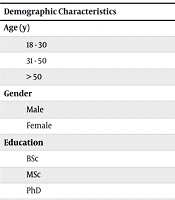
All 423 distributed questionnaires were completed and returned, resulting in a 100% response rate. Women constituted 70.20% of the sample, and married nurses accounted for 59.80% of the participants. The age of participants ranged from 22 to 57 years (Table 1).
Table 1.
Demographic Characteristics of the Participants
| Variables | No. (%) or Mean ± SD |
|---|---|
| Sex | |
| Male | 126 (29.80) |
| Female | 297 (70.20) |
| Marital status | |
| Single | 148 (35.00) |
| Married | 253 (59.80) |
| Divorced/widow | 22 (5.20) |
| Education | |
| Bachelor | 313 (74.00) |
| Master | 110 (26.00) |
| Employment status | |
| Permanent | 207 (48.90) |
| Temporary to permanent | 77 (18.20) |
| Contractual | 46 (10.90) |
| Corporate | 18 (4.30) |
| Newly graduated | 75 (17.70) |
| Department | |
| Critical | 69 (16.30) |
| General | 328 (77.50) |
| Emergency | 26 (6.10) |
| Age | 7.23 ± 33.26 |
The study examined the adherence of nurses to PPE standards during the COVID-19 pandemic and found the following results regarding individual and organizational factors. The mean and standard deviation for individual factors were 34.16 ± 6.53, and for organizational factors, they were 25.51 ± 5.82. To facilitate comparison, given the differences in the number of items in individual and organizational factors, these dimensions were assessed on a Likert scale ranging from 1 to 5. The adjusted mean and standard deviation for individual factors were 3.41 ± 0.65, and for organizational factors, they were 3.64 ± 0.83. Specific item analyses revealed the mean and standard deviation for using PPE to protect patients and concerns about family infection as 3.88 ± 1.11, and for awareness of the risk of infection transmission in the workplace as 3.59 ± 1.19.
The highest and lowest individual factors associated with nurses' non-use of PPE were identified as sensitivity/physical complications (such as skin complications) resulting from using the equipment (3.05 ± 1.22), and the difficulty of working with PPE and discomfort (2.34 ± 1.18), respectively. Regarding organizational factors, the level of support from officials in providing sufficient PPE (3.86 ± 1.18) and the overall safety culture in the organization (3.53 ± 1.17) were identified as the most and least significant factors, respectively.
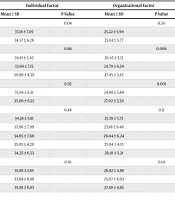
The analysis also examined the relationships between various factors and PPE usage by nurses. An independent t-test was used to compare gender and individual factors, as well as the level of education and organizational factors. A one-way analysis of variance was conducted to assess the impact of department on both individual and organizational factors, and marital status on organizational factors. Significant relationships were found in all cases (P < 0.05) (Table 2).
Table 2.
The Relationship Between Demographic Characteristics and Individual and Organizational Factors Related to Personal Protective Equipment Use by Nurses
| Variables | Individual Factor | Organizational Factor | ||
|---|---|---|---|---|
| Mean ± SD | P-Value | Mean ± SD | P-Value | |
| Sex | 0.04 | 0.50 | ||
| Male | 33.18 ± 7.05 | 25.22 ± 5.94 | ||
| Female | 34.57 ± 6.26 | 25.63 ± 5.77 | ||
| Marital status | 0.68 | 0.006 | ||
| Single | 34.41 ± 5.62 | 26.45 ± 5.13 | ||
| Married | 33.94 ± 7.15 | 24.79 ± 6.24 | ||
| Divorced/widow | 34.90 ± 4.56 | 27.45 ± 3.43 | ||
| Level of education | 0.92 | 0.001 | ||
| Bachelor | 33.84 ± 6.51 | 24.98 ± 5.84 | ||
| Master | 35.06 ± 6.55 | 27.02 ± 5.50 | ||
| Employment status | 0.48 | 0.11 | ||
| Permanent | 34.38 ± 5.81 | 25.78 ± 5.75 | ||
| Temporary-to permanent | 35.96 ± 7.99 | 23.88 ± 6.46 | ||
| Contractual | 34.65 ± 7.60 | 26.04 ± 6.24 | ||
| Corporate | 35.05 ± 4.20 | 25.94 ± 4.15 | ||
| Newly graduated | 34.25 ± 6.53 | 26.01 ± 5.21 | ||
| Department | 0.01 | 0.01 | ||
| Critical | 35.86 ± 3.85 | 26.92 ± 4.88 | ||
| General | 33.64 ± 6.88 | 25.07 ± 6.03 | ||
| Emergency | 35.88 ± 6.83 | 27.30 ± 4.36 | ||
5. Discussion
The current study aimed to identify factors associated with nurses’ use of PPE during the COVID-19 pandemic. The results indicated that organizational factors had a stronger association with PPE use among nurses than individual factors, echoing findings from Mokhtari et al., who emphasized the importance of environmental factors such as the availability of PPE and the presence of safety barriers. Several factors greatly influenced the effectiveness of nurses’ decisions regarding PPE use, including maintaining a clean and organized workplace, receiving feedback from supervisors and safety officials on PPE usage, and providing ongoing training. Additionally, addressing staff shortages, implementing quarantine and isolation policies, and limiting patient care time were crucial considerations. The high workload and work volume also significantly influenced nurses’ decisions regarding PPE use (42). Multiple studies have highlighted the negative impact of inadequate and subpar PPE, as well as a lack of proper monitoring of safety protocols, resulting in various injuries to employees (14, 43, 44). Therefore, it is critical to prioritize organizational factors, such as providing adequate safety equipment, to create a safe and conducive environment that minimizes adverse effects on the physical and mental health of both HCWs and patients.
According to the study findings, understanding the high probability of infection transmission in the workplace was the least significant individual factor in nurses’ use of PPE, while PPE usage to protect patients and concern for family infection emerged as the most important factors. Coskun Simsek and Gunay found that nurses expressed a high level of concern and fear about transmitting the disease to their family members during the pandemic, significantly emphasizing the use of PPE (45). Mokhtari et al. noted that individual factors had the least impact on nurses’ decisions regarding the use of PPE. These include belief in the effectiveness of PPE, understanding the organization’s safety requirements, the impact of subjective norms on the use of PPE, knowledge of the routes of transmission of the coronavirus, knowledge of how to use PPE, and understanding the risk of contracting COVID-19 (42). Other studies have also found that during infectious disease pandemics, the fear of transmitting the disease to family members is one of the most influential factors in the use of PPE and adherence to standard precautions by HCWs, particularly nurses (13, 46, 47).
The presence of sensitivity/physical complications, such as skin complications due to the use of PPE, and the difficulty of working and discomfort were identified as the most and least significant individual factors discouraging nurses’ use of PPE, respectively. According to a review study by Manookian et al., prolonged use of PPE in demanding work environments and resulting physical issues can potentially hinder HCWs' adherence to safety protocols (48). Additionally, numerous studies have highlighted the impact of physical issues from PPE usage on HCWs' functioning and communication abilities, potentially reducing nurses’ productivity and influencing the level of PPE usage (49-51). The study by Ahmed et al. investigated the availability of PPE among doctors in the United States and Pakistan during the COVID-19 pandemic, finding that a higher percentage of doctors in the US reported access to masks/N95 respirators, gloves, face-shields or goggles, and full-suit/gown. In contrast, doctors in Pakistan faced challenges with poor availability of PPE, with lower percentages having access to essential protective gear, and a significant number reported being forced to work without PPE, highlighting disparities in PPE access between the two countries (52). Consistent with the findings of the current study, Galanis et al. emphasized the importance of providing PPE for HCWs (53).
This study also found a significant relationship between gender and individual factors related to nurses’ compliance with PPE usage, where women were more likely to use PPE. Furthermore, a significant correlation was found between education and marital status in relation to the organizational factors that impact nurses’ use of PPE, with divorced or widowed individuals more willing to use PPE. Research studies have shown that there is a significant association between nursing compliance with PPE usage and gender, with female healthcare workers demonstrating better compliance (42).
A significant relationship was also identified between the department and individual and organizational factors related to nurses’ use of PPE, with the emergency department exhibiting maximum usage. In a study conducted by Neuwirth et al., it was found that staff in COVID-19 wards demonstrated a higher level of adherence to protective protocols, reporting 85% use of PPE and hand hygiene, significantly higher compared to the rates for non-COVID-19 wards (13). This study examined the extent to which staff in both COVID-19 and non-COVID-19 departments used PPE, however, the factors related to nurses’ compliance with PPE standards during the COVID-19 pandemic were not fully discussed, making this study distinct from the current one.
One of the limitations of the current study was the participants’ high workload and lack of time, which influenced their responses. To address this limitation, the researcher allowed participants more time to complete the questionnaire. Additionally, given our use of convenient sampling, it is important to exercise caution when generalizing the results.
5.1. Conclusions
This study explored the factors associated with nurses’ use of PPE during the COVID-19 pandemic. The research findings indicate that organizational factors, such as the preparation and provision of sufficient PPE, were the most critical in promoting the use of PPE. Conversely, some individuals opted not to use PPE due to concerns about sensitivity or physical complications, such as skin issues, that may arise from its use. Additionally, significant correlations were observed between gender and individual factors, education and organizational factors, marital status and organizational factors, and department and both individual and organizational factors in relation to nurses’ use of PPE. The findings of this study can serve as a valuable resource for health system planners, practitioners, and policymakers. These insights can inform their future policy-making and decision-making processes. By identifying and addressing the barriers to compliance with PPE usage and enhancing the factors that promote its effectiveness, they can effectively plan strategies to reduce or eliminate non-compliance.