
1. Background
Breast cancer is one of the most common malignancies in women globally (1). Studies show that the prevalence of cancer is projected to increase by over 50% in the next decade (2, 3). Among all types of cancer, breast cancer has the highest rate at 12.9% (4). The prevalence of breast cancer in Iranian women was reported to be 23.6% in a systematic review (5). Due to the long treatment interventions, a proper rehabilitation period should be considered for these patients to return to society (6, 7). Cancer affects not only physical health but also the communication, emotional, and psychosocial dimensions of the patient's life, generally affecting their quality of life (QoL) (1)). The nature of this disease is associated with feelings such as fear, anxiety, worry, and depression, which can negatively impact QoL (8, 9). This disease sometimes occurs at a young age in women, a time when they are often at the peak of their careers and managing their families (10, 11). Despite the relatively good prognosis, the adverse effects on the quality of life of patients and their families are undeniable (12).
The definition of quality of life is "a person's overall perception of life within the context of the culture and values in which they live, and its connection to their goals, expectations, and standards" (13). It is necessary to evaluate the quality of life of women with breast cancer in terms of physical, psychological, social, emotional, spiritual, and sexual aspects (12). Most patients with breast cancer express the physical dimensions of their quality of life with terms such as difficulty in performing daily activities, inability to walk, the need for help in doing personal tasks such as bathing, and also the need to rest (10). The psychological aspects of their quality of life are expressed with terms such as lack of concentration, feeling shame and embarrassment, distorted body image, anxiety, depression, and irritability (12). Expressions like difficulty interacting with others and reduced ability in professional activities indicate the social aspects of their quality of life (14, 15).
As a result, the best treatment approach for these patients includes addressing both the physical and psychosocial aspects, ensuring that attention to physical treatment does not diminish attention to the psychosocial aspects of patients (16). Quality of life is assessed using several available scales, providing therapists with a more reliable and accurate method to measure patients' quality of life (17). The psychometric evaluation of the European Organization for Research and Treatment of Cancer Quality of Life Questionnaire-C30 (EORTC QLQ-C30) has been conducted in different societies (18, 19). With the decreasing age of breast cancer patients in Iran and their significant roles in family and society, it is crucial to pay special attention to the quality of life of these women to prevent physical therapy from having adverse psychosocial effects on their personal and social lives. Considering the importance of quality of life in women with breast cancer, it is necessary to evaluate this scale in the cultural context of Iranian society.
2. Objectives
Therefore, in this research, we decided to psychometrically evaluate the quality of life scale for Iranian women with breast cancer.
3. Methods
3.1. Study Design and Sampling
This research is a methodological study aimed at assessing the psychometric properties of EORTC QLQ-C30, version 3, in Iranian women with breast cancer using a cross-sectional design. The questionnaire survey was conducted between September 2021 and April 2022 in three cities in Iran (Tehran, Shahroud, and Borojerd).
The inclusion criteria for the participants were Iranian nationality, the ability to read and write in Persian, age between 20 and 60, and no history of breast cancer among family members. A total of 404 women with breast cancer participated in this study. To perform factor analysis, the minimum sample size was 5 to 10 times the number of desired tool items. Since the original version of the questionnaire includes 30 items, 404 patients with cancer were included in the study through available sampling. The first 202 participants were used for exploratory factor analysis (EFA), and the second 202 were used for confirmatory factor analysis (CFA). To select cities, cluster sampling was used, and in the second stage, available samples were taken from the selected clusters of patients referred to university medical centers. The criteria for clustering provinces in the country were based on the Human Development Index (HDI). Provinces are categorized into three groups: Very high, high, and medium human development indicators. Tehran province and the city of Tehran were randomly selected from the very high category. Semnan province and the city of Shahroud were chosen from the high category. Lastly, Lorestan province and the city of Borujerd were selected from the medium category (20). The method of selecting the number of samples from each city was proportional to the size of the female population of each city. Stratified random sampling was used so that after determining the number of the female population of each city, the percentage of the sample size of each city was determined. Finally, 61% of the samples were selected from Tehran, 23% from Shahroud, and 16% from Borujerd.
Initially, patients were asked to fill out a demographic checklist, gathering information on the patients' age, marital and economic status, type of treatment, and cancer stage. The questionnaire used in this study was a Persian version of EORTC QLQ-C30. The European Organization for Research and Treatment of Cancer Quality of Life Questionnaire-C30 (version 3) (EORTC QLQ-C30 [version 3]) was developed by this organization. It is considered a "core" questionnaire that is widely used internationally and has been tested for its practicality, reliability, and validity (21, 22). This questionnaire consists of 30 questions. Questions 1 to 28 have 4-choice answers graded on a Likert scale, categorized from 1 (not at all) to 4 (very much). These questions measure the physical, mental, and social aspects of the person during the last week. The last two questions have 7-choice answers on a Likert scale, classified from 1 (very poor) to 7 (excellent). These final two questions assess the patient's overall quality of life and health over the past week (22).
3.2. Translation
The World Health Organization protocol was utilized to translate and adjust the quality of life assessment from English to Farsi (23). We used the forward translation method, and through two translators, the quality of life questionnaire was independently and separately translated from English to Farsi. A group of experts, including the two authors of this article and two other professional translators, then examined the two Persian versions of the quality of life questionnaire to create a single Persian version. Finally, the Farsi version was translated into English by a Farsi translator, and a group of experts confirmed the accuracy of the translation (23-25).
3.3. Face and Content Validity
The face and content validity ratio (CVR) and Content Validity Index (CVI) were assessed by 10 faculty members in the nursing and midwifery departments. The CVR examined the items' necessity according to the Lawshe criterion. CVI assessed the relevancy of items by dividing the number of items experts rated as relevant by the total number of experts (26).
3.4. Construct Validity
In this study, EFA and CFA were utilized to confirm the factor structure, construct validity, and reliability of the Persian version of the quality of life questionnaire. Construct validity was assessed using EFA, CFA, as well as discriminant and convergent validity techniques (26). Construct validity was examined through maximum-likelihood EFA with Promax rotation on the initial set of 202 responses. The data (n = 404) were randomly split into two parts for analysis. The first part (n = 202) was used for EFA in SPSS version 27, while the second part (n = 202) was used for CFA in AMOS version 24. The Kaiser-Meyer-Olkin test (KMO) and Bartlett's test of sphericity were utilized to verify the adequacy of the study sample and the model. The number of factors was determined based on parallel analysis (25). Using the formula: CV = 5.152 4÷√(n–2), the presence of an item in a latent factor was determined based on a factor loading of approximately 0.3. In this formula, n represents the sample size (n = 202). Items with communalities lower than 0.2 were excluded from the EFA. The eigenvalues (λ) were computed as the sum of squared factor loadings (SSL) across all items (k) for each factor, representing the proportion of variance in each item that can be attributed to the factor. The eigenvalue was then divided by the total number of items to determine the percentage of total variance explained by each factor (27).
To assess the structural factors, CFA was used with the maximum-likelihood method on a sample size of 202. The model fit was evaluated using various goodness-of-fit indices, including the root mean square error of approximation (RMSEA < 0.05), comparative fit index (CFI > 0.9), parsimonious comparative fit index (PCFI > 0.5), parsimonious normed fit index (PNFI > 0.5), incremental fit index (IFI > 0.9), and CMIN/DF (< 5). Items with standardized factor loadings below 0.5 were removed from the CFA model (27).
3.5. Convergent Validity and Discriminant Validity
Convergent and discriminant validity of the Persian version of the quality of life questionnaire were assessed. For convergent validity, composite reliability (CR) > 0.7 and average variance extracted (AVE) > 0.5 were required. Additionally, reliability was evaluated through internal consistency (Cronbach's alpha, MacDonald's omega), CR, and maximum reliability (MaxR) > 0.7 (24-27).
3.6. Multivariate Normality and Outliers
The normality of the data was evaluated in univariate and multivariate forms, with tests for outliers, skewness, and kurtosis. Multivariate normality was assessed using Mardia's multivariate kurtosis coefficient, with a coefficient < 8 indicating a departure from normality. Multivariate outliers were identified using Mahalanobis distance (P < 0.001) (26).
3.7. Reliability
Internal consistency was evaluated using Cronbach's alpha (α), McDonald's omega (Ω), and average inter-item correlation (AIC). Coefficients greater than 0.7 for both Ω and α, with AIC values between 0.2 and 0.4, were deemed acceptable. In structural equation modeling, CR replaced the Cronbach's alpha coefficient, with a CR value above 0.7 considered acceptable (24, 27).
3.8. Ethical Approval
The ethical committee of Alzahra University approved the study with the approval code IR.ALZAHRA.REC.1400.052. After selecting the three clusters, we contacted university medical centers in these cities and conducted sampling from women with breast cancer who met the study's criteria and completed the informed consent form. Additionally, permission was obtained from the European Organization for Research and Treatment of Cancer via email to use the QLQ-C30 and translate it into Persian. All participants provided written consent to take part in the study.
4. Results
A total of 404 Iranian women with breast cancer participated in this study. The demographic information of the participants is shown in Table 1.
Table 1.
Demographic Characteristics of Iranian Women with Breast Cancer (n = 404)
| Variables | No. (%) |
|---|---|
| Employment | |
| Unemployed | 148 (37) |
| Employed | 141 (35.25) |
| Retired | 111 (27.75) |
| Education level | |
| Under diploma | 114 (25.5) |
| Diploma | 259 (64.75) |
| Bachelor | 20 (5) |
| Master or doctorate | 7 (1.75) |
| Marital status | |
| Single | 55 (13.75) |
| Married | 300 (75) |
| Widow | 16 (4) |
| Divorced | 29 (7.25) |
| Economic status | |
| Poor | 37 (9.25) |
| Moderate | 212 (53) |
| Good | 151 (37.75) |
| Type of treatment | |
| Chemotherapy | 156 (39) |
| Radiotherapy | 5 (1.25) |
| Surgery | 18 (4.5) |
| Combined treatment | 221 (55.25) |
| Cancer Stage | |
| Stage I | 36 (9) |
| Stage II | 125 (31.25) |
| Stage III | 214 (53.5) |
| Stage IV | 25 (6.25) |
4.1. Face and Content Validity
The face and content validity were assessed by 10 faculty members in the nursing and midwifery group. Based on their opinions, the face validity was deemed appropriate. The content validity ratio (CVR) for all items was between 0.8 and 1, and the content validity index (CVI) was above 0.7.
4.2. Construct Validity
The results indicated that the Kaiser-Meyer-Olkin measure was 0.902 and Bartlett's test of sphericity was significant (P < 0.001, df = 27, chi-square = 3203.276), demonstrating the relevance and suitability of the data for factor analysis. The Persian version of the quality of life questionnaire met the criteria of eigenvalue > 1 and communalities > 0.2, with factor loadings > 0.3 for each item.
Five factors were extracted based on exploratory factor analysis (Table 2), comprising 24 items that explained 46.4% of the total variance. Four items were removed due to communality of less than 0.3 and factor loading of less than 0.3.
Table 2.
The Result of Exploratory Factor Analysis and Internal Consistency of Persian Version of the Quality of Life Questionnaire in Iranian Women with Breast Cancer (n = 202)
| Factor | Factor loading | h2 | λ | % Variance | Internal consistency |
|---|---|---|---|---|---|
| Psychological symptoms | α = 0.883; Ω = 0.890; AIC = 0.553 | ||||
| Q24. Did you feel depressed? | 0.888 | 0.752 | 3.111 | 12.70 | |
| Q23. Did you feel irritable? | 0.854 | 0.749 | |||
| Q21. Did you feel tense? | 0.754 | 0.672 | |||
| Q22. Did you worry? | 0.746 | 0.676 | |||
| Q25. Have you had difficulty remembering things? | 0.540 | 0.359 | |||
| Q20. Have you had difficulty in concentrating on things, like reading a newspaper or watching television? | 0.441 | 0.374 | |||
| Daily activity | α = 0.886; Ω = 0.889; AIC = 0.495 | ||||
| Q10. Did you need to rest? | 0.945 | 0.627 | 3.254 | 13.55 | |
| Q12. Have you felt weak? | 0.740 | 0.604 | |||
| Q18. Were you tired? | 0.663 | 0.626 | |||
| Q9. Have you had pain? | 0.645 | 0.535 | |||
| Q19. Did pain interfere with your daily activities? | 0.562 | 0.583 | |||
| Q11. Have you had trouble sleeping? | 0.497 | 0.385 | |||
| Q6. Were you limited in doing either your work or other daily activities? | 0.488 | 0.497 | |||
| Q7. Were you limited in pursuing your hobbies or other leisure time activities? | 0.397 | 0.404 | |||
| Physical problems | α = 0.774; Ω = 0.775; AIC = 0.477 | ||||
| Q15. Have you vomited? | 0.836 | 0.597 | 1.644 | 6.85 | |
| Q14. Have you felt nauseated? | 0.790 | 0.667 | |||
| Q4. Do you need to stay in bed or a chair during the day? | 0.448 | 0.384 | |||
| Q8. Were you short of breath? | 0.348 | 0.404 | |||
| Physical activity | α = 0.746; Ω = 0.791; AIC = 0.502 | ||||
| Q2. Do you have any trouble taking a long walk? | 0.967 | 0.849 | 1.696 | 7.10 | |
| Q3. Do you have any trouble taking a short walk outside of the house? | 0.781 | 0.629 | |||
| Q1. Do you have any trouble doing strenuous activities, like carrying a heavy shopping bag or a suitcase? | 0.427 | 0.396 | |||
| Social support | α = 0.781; Ω = 0.790; AIC = 0.549 | ||||
| Q26. Has your physical condition or medical treatment interfered with your family life? | 0.823 | 0.688 | 1.489 | 6.20 | |
| Q27. Has your physical condition or medical treatment interfered with your social activities? | 0.807 | 0.646 | |||
| Q28. Has your physical condition or medical treatment caused you financial difficulties? | 0.401 | 0.342 |
Abbreviations: h2, communalities; λ, eigenvalue; α, Cronbach's alpha coefficient; Ω, McDonald Omega coefficient; AIC, Average inter-item correlation.
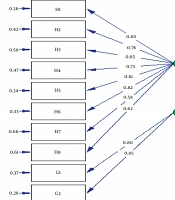
Next, a maximum likelihood confirmatory factor analysis (n = 202) was conducted to validate the factorial structure obtained from the exploratory factor analysis. Three pairs of measurement errors were allowed to vary freely to improve the model (e5 to e6, e13 to e14, and e20 to e21) (Figure 1). All items showed significant factor loadings ranging from 0.55 to 0.86 (Table 2). The final five-factor model, after examining modification indices (χ2 (239) = 739.45, P < 0.001, χ2/df = 3.09, GFI = 0.942, CFI = 0.936, NFI = 0.933, IFI = 0.94, TLI = 0.935, RMSEA (90% C.I.) = 0.043 [0.040, 0.071]), fit the data well.
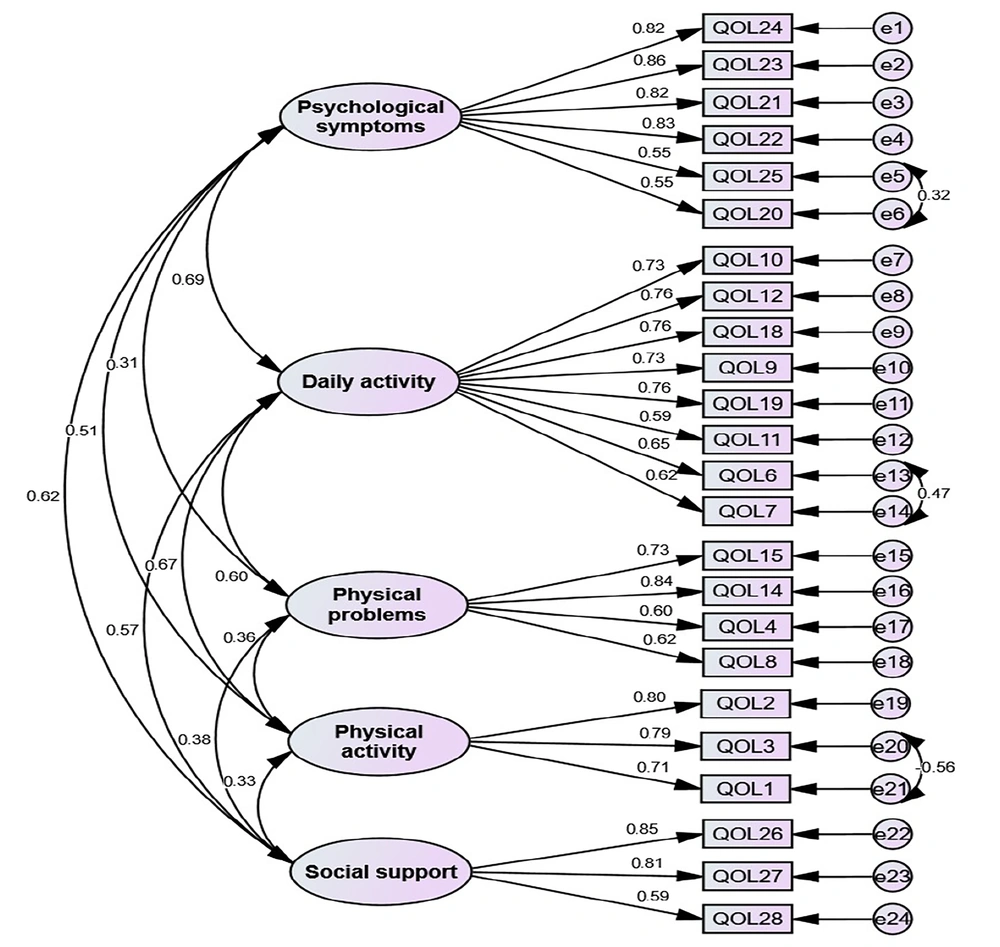
Figure 1.
The result of Confirmatory factor analysis of Persian version of the quality of life questionnaire in Iranian women with breast cancer (n = 202)
Additionally, the average variance extracted (AVE) for three factors was below the threshold of 0.5, while the maximum shared variance (MSV) and AVE were accurate measures of convergent validity. A CR greater than 0.7 was used to evaluate convergent validity in psychological studies, which was achieved in this study with CR values exceeding 0.7 for each factor (Table 3).
Table 3.
The Indices for Convergent and Discriminant Validity of Persian Version of the Quality of Life Questionnaire in Iranian Women with Breast Cancer in the Confirmatory Factor Analysis Model (n = 202)
| Factor | CR | AVE | MSV | MaxR (H) |
|---|---|---|---|---|
| Psychological symptoms | 0.882 | 0.562 | 0.483 | 0.909 |
| Daily activity | 0.886 | 0.495 | 0.483 | 0.893 |
| Physical problems | 0.793 | 0.494 | 0.363 | 0.823 |
| Physical activity | 0.810 | 0.587 | 0.452 | 0.815 |
| Social support | 0.801 | 0.578 | 0.388 | 0.837 |
4.3. Reliability
Cronbach's alpha, McDonald's omega, CR, and MaxR coefficients were all above 0.7 for each factor, and AIC values of 0.2 to 0.4 were interpreted as acceptable internal consistency (Table 2).
5. Discussion
One of the most important needs that women with breast cancer have is understanding the importance of measuring their overall quality of life. Therefore, having access to a reliable and valid scale to measure the quality of life of these patients is a top priority (2, 10). This research aimed to assess the psychometric properties of the Persian version of the quality of life questionnaire for breast cancer patients in Iran, a version of the main questionnaire.
The results of the statistical survey of this study showed that the Persian version of the EORTC QLQ-C30 questionnaire is a valid and reliable scale for evaluating the quality of life of patients with breast cancer. Other studies conducted in Turkey and Germany also reached similar results (28, 29). In a study conducted in Turkey, the Cronbach's α coefficient, which was checked for the reliability of the questionnaire, varied from 0.56 to 0.85 for multi-item scales. The correlation between EORTC QLQ-C30 subscales to check the validity of the questionnaire showed that most of the interscale correlations were significant at the 0.01 level. The general health/quality of life subscale was significantly correlated with all other subscales. Specifically, the correlations were as follows: Physical performance and role performance (0.69), physical performance and fatigue (-0.72), role performance and pain (-0.65), pain and fatigue (0.65), and the weakest correlation was between nausea/vomiting and other subscales (ranging from -0.19 to -0.41) (28).
In a study conducted in Germany, the reliability coefficients (Cronbach's alpha) for the functional scale were 0.80 and for the symptom scale were 0.63. However, Cronbach's alpha for individual symptom items was very low. Although correlations between the Karnofsky index and the QLQ-C30 dimensions were significant, the performance scale (0.44) and the global item (0.54) showed a moderate correlation, while there was little correlation for the symptom scale (0.18). The strongest correlation was observed between physical performance and symptoms, which was greater than 0.40. Additionally, a relatively weak correlation was observed between the scales of physical functions, emotional functions, social functions, and quality of life. In general, the correlation between scales was moderate (29).
Additionally, five factors were identified in the Persian version of the quality of life questionnaire through exploratory factor analysis. These factors included psychological symptoms, daily activities, physical problems, physical activity, and social support, encompassing physical, psychological, and social dimensions. In a similar study, two main factors were identified in exploratory factor analysis, representing the dimensions of "emotional distress" and "functional ability" (30). In another study conducted in Spanish society, two factors were extracted from the analysis of the factorial structure: Quality of life and physical health (31).
A study comparing the quality of life before and after treatment of breast cancer patients revealed differences in quality of life scores, suggesting that maintaining quality of life one month after treatment may indicate the stabilizing role of therapeutic interventions in a palliative environment. This highlights one of the applications of using the quality of life questionnaire in these patients (32). A comprehensive cancer management program should incorporate psychological counseling, emotional support, physical therapy, pain management, and other musculoskeletal treatments alongside drug therapy for breast cancer patients. Therefore, the quality of life questionnaire can aid in evaluating dimensions that facilitate the implementation of such comprehensive management programs (33).
The first factor focused on psychological symptoms, encompassing patient-perceived stress, negative body image, negative emotions like shame and embarrassment, decreased concentration, and lack of hope for the future (34, 35). Research has shown that facing breast cancer can be a psychological trauma for patients, associated with fears of disease recurrence, end-of-life concerns, and distorted body image. Psychotherapeutic and supportive approaches have been shown to improve the mental health of these patients (36). Complementary treatments supporting mental and social well-being alongside primary treatments have also proven effective in enhancing overall mental and social health (37). Thus, the psychological dimension plays a crucial role in evaluating the quality of life of women with breast cancer.
The second factor focused on daily activities. For women with breast cancer, decreased physical activity due to surgery, chemotherapy, or radiotherapy and the subsequent increase in inactivity require primary attention, as they can have negative consequences for their health (38). Daily physical activity during treatment has been shown to positively impact psychological states and help patients adapt to new conditions more quickly (39). These studies underscore the importance of the second dimension in the current research.
The third factor addressed physical problems, such as difficulty in eating, memory problems, fatigue, sleep disorders, dry skin, pain and swelling, and nausea, which are often influenced by the type of treatment received by breast cancer patients. Research has shown that addressing these physical problems, especially in younger patients, is crucial for improving overall performance and quality of life (40, 41). Access to high-quality exercise programs guided by physical therapy can aid in improving the physical quality of life, particularly during recovery (42). These findings highlight the importance of the third dimension of the psychometric questionnaire.
The fourth factor focused on physical activity, emphasizing the importance of maintaining a healthy lifestyle to reduce the risk of breast cancer occurrence and recurrence. Regular physical activity has been associated with lower mortality rates and improved treatment outcomes for breast cancer patients (43). Maintaining body weight within a normal range through physical activity is essential for enhancing treatment results. The significance of the fourth dimension in the psychometric questionnaire is evident from these studies (44).
Financial pressure, also known as financial toxicity, negatively impacts the quality of life of cancer patients. Studies show that it is linked to lower health-related quality of life and mental health issues. This can lead to lower adherence to treatment, increased symptoms, and overall decreased well-being. Financial stress can worsen existing mental health conditions like depression and anxiety. Patients may experience reduced physical health, less enjoyment in social activities, and increased worries about the future (45).
The fifth factor addressed social support, emphasizing the role of family and community support in the successful treatment of women with breast cancer. Patients often seek support from doctors, friends, family, and insurance companies, highlighting the importance of all-around strengthening of social support in reducing patient problems (46). Integrating social support into treatment programs and strengthening existing support systems is crucial for improving patient outcomes (43, 44). These studies confirm the importance of the fifth dimension of the psychometric questionnaire in Iranian society.
A strength of this study was the successful collaboration of a considerable number of breast cancer patients with the researcher, which was challenging given the health conditions of these women.
One limitation of this study was the restricted sampling to specific centers in Iran, raising questions about the generalizability of the findings to the entire country. Further research is needed to validate the applicability of this research nationwide.
5.1. Conclusions
The results of this study indicate that the quality of life scale demonstrates acceptable construct validity and reliability in assessing the quality of life of breast cancer patients. Therefore, the Persian version of this scale can serve as a valid and reliable tool for evaluating the quality of life of individuals in an Iranian context. Drawing the attention of health sector policymakers to the quality of life of these patients and focusing on different dimensions of their health is crucial for policy application. It is essential to provide comprehensive health services that address physical, mental, and social health to help these patients navigate their treatment more effectively.
One significant practical application of this research is the development of a suitable scale to evaluate the quality of life of breast cancer patients within the structure and cultural context of Iranian society. This scale can measure the physical, psychological, and social aspects of these individuals accurately. By utilizing this scale in support organizations, it becomes easier to identify the genuine needs of these patients and provide a more appropriate response to their demands. The results of this study can also be valuable for psychometric studies involving diverse populations and other research aimed at enhancing the quality of life scale.