
1. Background
Mental disorders manifest as clinically significant impairments in cognition, affective regulation, or behavior, causing distress (1). These conditions notably affect older individuals, as aging brings about various physical and psychological changes (2). The World Health Organization (WHO) estimates that 15% of 60-year-olds experience mental illnesses, primarily depression and dementia (3). Additionally, drug misuse, anxiety, and mood disorders are prevalent among older individuals (4). With the aging population expanding, experts anticipate a rise in mental health issues, necessitating the development of mental health systems and diagnostic approaches for this demographic (5). Given the higher healthcare costs associated with older age, early detection and treatment of mental illnesses are paramount (6), underscoring the importance of mental health literacy (MHL), which encompasses knowledge of mental illness prevention, symptoms, and treatments (7).
In 1997, Jorm defined MHL as the knowledge and beliefs about mental disorders that improve disease detection, management, and prevention (8). This concept encompasses awareness of specific disorders or mental distress, understanding of risk factors, knowledge about self-help interventions and available professional help, an attitude conducive to recognition, and appropriate help-seeking behavior, along with knowledge of mental health information (9). MHL plays a crucial role in reducing mental illnesses and associated social costs, as well as enhancing overall quality of life (10). Lower levels of MHL can detrimentally affect the quality of life of older individuals, who tend to exhibit poorer MHL and less knowledge about mental disorder diagnoses compared to younger adults, as observed by Bragg et al. Despite the growing population of older adults, developing countries have limited data on MHL (11). Despite several studies on mental health among older individuals in Iran, MHL remains inadequately researched.
One aspect influencing the understanding of mental illnesses and mental health literacy (MHL) among older adults is their cultural perspectives (12). Older individuals often fail to recognize their mental health issues due to the stigma surrounding such disorders, which hinders them from seeking necessary care and support (3). Seeking help entails reaching out to both formal and informal sources for knowledge, counseling, information, therapy, and general support in response to challenges or uncomfortable situations (13). The well-being of older individuals hinges on their willingness to seek help when needed, and the ability to manage their numerous symptoms with available services is essential within their communities (14). Despite facing various health challenges requiring heightened care, older individuals often opt not to seek assistance (15). According to Robb et al., younger individuals consult mental health specialists twice as often as older adults and possess greater health knowledge (16). The lack of help-seeking behavior and delayed diagnosis of mental issues in older individuals contribute to increased healthcare and societal burdens (5). Internal barriers such as stigma, fear of psychotherapy, and the perception that these symptoms are expected in old age hinder older adults from seeking help. External barriers include cost, insurance coverage, age discrimination, and transportation issues (17). Given that older individuals with mental disorders are at greater risk of physical ailments, their failure to seek early treatment poses a public health concern. Additionally, low MHL in older persons may impede the interpretation of health information and delay the utilization of mental health services (18). Yu et al. suggested that raising mental health awareness could increase help-seeking behavior (19). However, despite the prevalence of mental disorders among older adults and their insufficient help-seeking behavior, it has not yet been evaluated through a literature review whether MHL, as a determinant of mental health behaviors, can influence older individuals' attitudes toward seeking psychological help. Thus, this study aims to investigate the association between MHL and attitudes toward seeking professional psychological help (ATSPPH) in older adults.
2. Objectives
This study seeks to determine the relationship between mental health literacy (MHL) and attitudes toward seeking professional psychological help (ATSPPH) among older adults referred to health centers in Amol, Iran, in 2023.
3. Methods
This cross-sectional study was conducted on individuals aged 60 and above who were referred to health centers in Amol City, Mazandaran, Iran, in 2023 (from July to November). The sample size for the study was determined based on the research by Almansef, which reported a correlation coefficient of 0.26 between mental health literacy (MHL) and help-seeking behavior (20). Using the correlation study algorithm, 113 samples were calculated with 95% confidence and 90% power. Considering a possible decrease in participants, the final sample size was set at 150. Cluster random sampling was employed, selecting 20 out of the 47 health centers in Amol City, and eligible elderly individuals attending these centers were included in the study. Exclusion criteria included failure to complete the questionnaire, while inclusion criteria comprised individuals aged 60 and older, absence of cognitive impairment, and provision of informed consent.
The questionnaires used in this study included socio-demographic characteristics, the Mental Health Literacy Scale (MHLS), and the short form of the Attitudes Toward Seeking Professional Psychological Help Scale (ATSPPH-S). Considering the varying literacy levels among elderly participants, the researcher administered all questionnaire items, and responses were recorded from the elderly individuals.
(1) Socio-demographic characteristics encompassed variables such as age, gender, location, marital status, educational level, employment status, economic status, history of illness or physical disability (based on individual medical records), history of mental disorders in oneself or family (based on individual medical records), history of referral to a psychologist or psychiatrist, and experience of stressful events such as car accidents, falls, or acquiring a new disease in the last six months.
(2) O'Connor and Casey developed the Mental Health Literacy Scale (MHLS) in 2015. This Likert scale questionnaire consists of 35 items rated on a scale of 1 to 5, with scores ranging from 35 to 160, where higher scores indicate higher levels of MHLS (21). In this study, the modified MHLS by O'Connor and Casey was utilized for the Iranian population. This version comprises 29 items categorized into six domains: Information seeking (4 items), self-help (2 items), recognition of disorders (8 items), understanding of risk factors and causes (2 items), attitudes conducive to recognition and help-seeking (10 items), and seeking assistance from professionals (3 items). Items 1 to 15 are rated on a 4-point Likert scale, while items 16 to 29 are rated on a 5-point scale, resulting in scores ranging from 29 to 130. MacDonald's omega and Cronbach's alpha coefficients for all MHLS domains were 0.79 and 0.78, respectively, indicating its reliability across different age groups in Iran (22). In the present study, the reliability of this instrument was also assessed, yielding a Cronbach's alpha coefficient of 0.74.
(3) The Attitudes Toward Seeking Professional Psychological Help Scale (ATSPPH-S) is a 10-item scale developed by Fisher and Farnia in 1995 as a shorter version of the original 29-item scale. It assesses individuals' attitudes toward seeking professional mental health services using a 4-point Likert scale (0 = disagree, 1 = somewhat disagree, 2 = somewhat agree, 3 = agree). Scores range from 0 to 30, with higher scores indicating a more positive attitude toward seeking psychological help (23). Sharifi et al. evaluated the psychometric properties of this scale among Iranian adults in 2018, demonstrating its validity through confirmatory factor analysis and good reliability with a Cronbach's alpha coefficient of 0.84 (17). In the present study, the reliability of the ATSPPH-S was also assessed, yielding a Cronbach's alpha coefficient of 0.81.
This study used mean and standard deviation to calculate descriptive statistics. Also, considering the normal distribution of the data, which were in the range of (-2 -2) using skewness and kurtosis tests and Kolmogorov-Smirnov normality test results (P ˃ 0.05), parametric. Parametric tests, including independent t-tests and ANOVA, were employed to compare the means of mental health literacy and attitudes toward seeking professional psychological help based on demographic variables, considering the normal distribution of the data. The Pearson correlation coefficient was used to examine the relationship between mental health literacy and attitudes toward seeking professional psychological help. All analyses were conducted using SPSS 24, with a significance level set at 0.05.
Ethical considerations in this research were addressed by obtaining permission from the university ethics committee (Code: IR.MAZUMS.REC.1402.261), securing informed consent from the participants, and ensuring the anonymity of the participants. Participants were provided with an informed consent form and informed of their right to withdraw from the study at any time.
4. Results
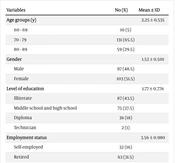
The study included 128 older adults, with a mean age of 66.36 (standard deviation = 6.51), ranging from 60 to 86 years. Among the participants, 55.5% were male, and the majority (85.2%) were married, with 60.9% residing in urban areas. In terms of education, 56.3% had undergraduate degrees, and 34.4% were self-employed, while 62% reported an average economic status (Table 1).
Table 1.
Demographic Characteristics of the Participants (N = 128)
| Variables and Categories | Values a |
|---|---|
| Age (y) | Min = 60; Max = 86 |
| Gender | |
| Mean | 66.3 ± 6.51; 71 (55.5) |
| Female | 57 (44.5) |
| Marital status | |
| Married | 100 (82.2) |
| Single | 7 (5.5) |
| Widowed/divorced | 12 (9.4) |
| Educational level | |
| Under diploma | 72 (56.3) |
| Diploma | 30 (23.4) |
| Associate degree | 7 (5.5) |
| Bachelor's degree | 14 (10.9) |
| Master’s degree and higher | 5 (3.9) |
| Location | |
| Rural | 50 (39.1) |
| Urban | 78 (60.9) |
| Economic status | |
| Weak | 8 (6.3) |
| Medium | 86 (67.2) |
| Good | 34 (26.6) |
| Job status | |
| Free | 44 (34.4) |
| Unemployed | 43 (33.6) |
| Retired | 41 (32.0) |
| History of illness or physical disability | |
| Yes | 46 (35.9) |
| No | 82 (64.1) |
| History of visiting a psychiatrist/psychologist | |
| Yes | 26 (20.3) |
| No | 102 (79.7) |
| Family history of mental disorder | |
| Yes | 18 (14.1) |
| No | 110 (85.9) |
| History of stressful events in the last six months | |
| Yes | 46 (35.9) |
| No | 82 (64.1) |
a Values are expressed as No. (%).
The mean MHL score for older adults was 76.63 (standard deviation = 8.88). The mean scores for each MHL subscale were as follows: 8.11 (3.01) for knowledge of where to seek information, 23.28 (3.84) for ability to recognize information, 5.12 (1.15) for knowledge of risk factors and causes, 21.92 (6.19) for attitudes promoting recognition or appropriate help-seeking behavior, 9.06 (1.07) for knowledge of available professional help, and 5.39 (0.93) for knowledge of self-treatment. Additionally, the mean score for the Attitudes Toward Seeking Professional Psychological Help Scale (ATSPPH-S) among older adults was 16.51 (standard deviation = 4.29) (Table 2).
Table 2.
Status of MHL and ATSPPH-S in the Participant (N = 128)
| Scale/Subscale | Mean a | Min | Max |
|---|---|---|---|
| MHL | 76.63 (8.88) | 53 | 105 |
| knowledge of where to seek information | 11.8 (3.01) | 4 | 20 |
| Ability to recognize information | 23.28 (3.84) | 8 | 31 |
| Knowledge of risk factors and causes | 5.12 (1.15) | 2 | 8 |
| Attitudes that promote recognition or appropriate help-seeking behavior | 21.92 (6.19) | 10 | 46 |
| Knowledge of professional help available | 9.06 (1.07) | 6 | 12 |
| Knowledge of self-treatment | 5.39 (0.93) | 4 | 8 |
| ATSPPH-S | 16.51 (4.29) | 4 | 30 |
a Values are expressed as mean (SD).
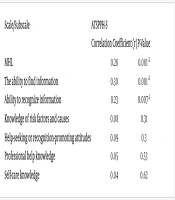
The Pearson correlation coefficient test revealed a statistically significant relationship (r = 0.28, P < 0.05) between MHL and ATSPPH-S in older adults. Further analysis showed that among the MHL subscales, only the ability to recognize mental disorders (r = 0.23, P < 0.05) and knowledge of where to seek information (r = 0.30, P < 0.05) had a positive and significant relationship with ATSPPH-S in older adults (Table 3).
Table 3.
The Results of Pearson's Correlation Analysis of the MHL Scale/Subscale with ATSPPH-S (N = 128)
| Scale/Subscale | ATSPPH-S | |
|---|---|---|
| Correlation Coefficient (r) | P-Value | |
| MHL | 0.28 | 0.001 a |
| The ability to find information | 0.30 | 0.001 a |
| Ability to recognize information | 0.23 | 0.007 a |
| Knowledge of risk factors and causes | 0.08 | 0.31 |
| Help-seeking or recognition-promoting attitudes | 0.09 | 0.3 |
| Professional help knowledge | 0.05 | 0.53 |
| Self-care knowledge | 0.04 | 0.62 |
a P < 0.05.
Demographic factors significantly influenced MHL and ATSPPH-S in older adults. Education level had a considerable impact on average MHL, with individuals holding bachelor's degrees exhibiting significantly higher MHL scores than those with diplomas (P < 0.05). Moreover, women had significantly higher mean ATSPPH-S scores than men (P < 0.05), and participants who had visited a psychiatrist or psychologist had significantly higher mean ATSPPH-S scores compared to those who had not (P < 0.05).
No significant differences were found in MHL and ATSPPH-S means based on age, employment status, economic position, marital status, location, history of mental disorders, or stressful events (P > 0.05). The results of significant factors are presented in Table 4.
Table 4.
Comparison of ATSPPH-S by Gender, Psychiatrist Visit History, and Education
| Variables | Mean (SD) | t | P-Value | DF | Levene's Test | Levene's Test P-Value |
|---|---|---|---|---|---|---|
| Gender | 2.12 | 0.03 a | 126 | 0.75 | 0.09 | |
| Woman | 17.40 (4.16) | |||||
| Man | 15.80 (4.29) | |||||
| History of visiting a psychiatrist/psychologist | 2.22 | 0.03 a | 126 | 0.40 | 0.69 | |
| Yes | 18.30 (4.72) | |||||
| No | 16.05 (4.07) | |||||
| Educational level | - | 12.29 | ≥ 0.001 | 4295 | ≤ 0.05 | 2.51 |
a P < 0.05.
5. Discussion
We examined the relationship between MHL and ATSPPH in older individuals, also assessing MHL and ATSPPH levels within this demographic. The average MHL among older adults in this study was 76.63 (8.88), similar to the study average. Upon reviewing the literature, we found no studies measuring MHL among elderly Iranian adults (11). However, studies by Bragg et al. and Ding et al. observed lower MHL averages in elderly populations (24), consistent with our findings. Conversely, studies by Jafari et al. and Noroozi et al. reported higher MHL averages (10, 25), contradicting our results. Our findings suggest that older individuals generally have lower MHL levels compared to the broader population, particularly younger individuals.
In our study, the mean ATSPPH score among older adults was 16.51 (4.29). A study by Sharifi et al. among Iranian older adults reported a similar average ATSPPH score (17). However, a study by Roh et al. among older American adults found a higher average ATSPPH score, indicating potential cultural and social differences between countries influencing older adults' attitudes toward seeking professional psychological help (26).
We found a positive correlation between MHL and ATSPPH among older individuals, indicating that those with higher MHL were more inclined to seek professional psychological help. While there is limited research on this relationship among older populations, studies by Almansef, Gorczynski and Sims-Schouten., Kantaş Yılmaz and ÜNKÜR have identified this link among broader populations and student groups, suggesting that increasing MHL and understanding of mental health symptoms among older individuals could improve their attitudes toward mental health care and increase service utilization (20, 27, 28).
Education level was found to be associated with MHL in this study, indicating that older individuals with higher education had higher MHL levels. This aligns with the findings of Ding et al., who observed a similar link between education and MHL in older populations (24). However, this contradicts the findings of Piper et al. in a study of older Australians (18). Such discrepancies may stem from differences in societal, economic, and cultural contexts. Noroozi et al. also identified this association in Iran's population (25), supporting the positive relationship between education and MHL in Iranian society.
The study revealed a significant association between gender and ATSPPH, with older women showing a greater inclination to seek professional psychological care. This finding is consistent with studies by Roh et al., Mackenzie et al., and Kessler et al. among older populations (26, 29, 30). Kantaş Yılmaz and ÜNKÜR similarly confirmed this link among student populations (28). To date, no study has reported a higher propensity for seeking psychological help among men. According to these studies, women are more inclined to seek help as they tend to be more comfortable expressing emotions and discussing mental health issues openly compared to men.
The study also found a significant relationship between a history of visiting a psychologist or psychiatrist and participants' ATSPPH. Older adults with such a history demonstrated a greater willingness to seek professional psychological help than those without. This finding is consistent with Kessler et al.'s study among older German adults (30). It suggests that a positive past experience with mental health professionals leads to better understanding of the counseling and treatment process, reducing fears and misconceptions about seeking help and fostering greater comfort in expressing problems.
This study represents the first investigation into MHL and ATSPPH among Iranian older adults, highlighting its strength. However, a limitation is that the results may not be generalizable to all populations due to the cultural dependency of MHL and ATSPPH. Therefore, it is recommended that further research be conducted in diverse geographical locations to enhance understanding in this field.
5.1. Conclusions
The results of this study demonstrated a positive and significant relationship between older adults' MHL levels and their ATSPPH. Furthermore, a significant association was found between older adults' MHL and their educational levels, as well as between their ATSPPH and their gender and history of visiting a psychologist or psychiatrist. These findings have several implications. Firstly, interventions to enhance MHL and promote positive ATSPPH among older adults are crucial. Many senior citizens have low literacy levels and have not attended university. Consequently, the education sector requires support in addressing these issues. Communication barriers and limited acculturation can hinder low-literacy individuals' participation in health education and promotion activities. To effectively promote MHL and positive ATSPPH among older adults, educational interventions must be tailored to their age, literacy levels, and cultural backgrounds.
Moreover, the observed relationship between MHL and educational attainment highlights the importance of lifelong learning opportunities for older adults. Providing accessible and relevant educational programs can help improve their MHL and, subsequently, their willingness to seek professional psychological help when needed.
Additionally, the association between ATSPPH and gender underscores the need for gender-sensitive approaches in mental health promotion efforts targeting older adults. Addressing gender-specific barriers, stigma, and sociocultural norms may be necessary to encourage help-seeking behavior among both men and women in this age group. Implications also extend to the healthcare system, emphasizing the necessity for age-friendly and culturally competent mental health services. Ensuring accessibility, affordability, and understanding of the needs and preferences of older adults can enhance their engagement with professional psychological support when required.