
1. Background
Advancements in genetic testing technologies have significantly expanded the possibilities for prenatal screening of chromosomal abnormalities, such as Down syndrome (DS). First-trimester maternal serum screening, using biochemical markers alongside ultrasound findings and maternal age, has traditionally facilitated noninvasive prenatal risk estimation (1-4). With the advent of non-invasive prenatal testing (NIPT), the landscape for detecting trisomy 21, 18, and 13 has been markedly improved due to the method's sensitivity and specificity through the analysis of free fetal DNA in maternal plasma (5, 6).
Globally, NIPT has become an increasingly prevalent method for prenatal screening. Its integration into national healthcare programs has been supported by collaborative research studies and consortia, which have been instrumental in streamlining the adoption of NIPT as a routine screening tool worldwide. This global implementation effort highlights the commitment of governments and private health authorities to harness the benefits of advanced genetic testing technologies, ultimately contributing to enhanced prenatal care and improved maternal and fetal outcomes (7-11).
In China, where NIPT has been available since 2010, the technology has seen a surge in usage following the abolishment of the one-child policy. The increased demand among older women for safer prenatal testing options has led to studies suggesting that NIPT be included in health insurance coverage (8, 12). Similarly, in Hong Kong, NIPT has been integrated into the public health system as a second-tier screening option for high-risk pregnancies (11). In Japan, the introduction of NIPT in 2013 has gradually increased its prevalence in prenatal care, demonstrating the country's evolving approach to maternal and fetal health (12, 13). Implementation studies in Japan have shown a significant reduction in invasive procedures, underscoring NIPT's potential to enhance prenatal diagnostic processes while ensuring safety and cost-effectiveness (14).
However, acceptance and integration of NIPT are subject to a complex interplay of healthcare infrastructure, economic factors, and ethical deliberations across different populations (15-18). Despite its advantages, integrating NIPT into standard prenatal care in Vietnam faces challenges, including accessibility, public knowledge, and policy support (19-21). Given the growing use of NIPT in prenatal care and the potential implications for healthcare policies and decision-making, further research is needed to understand the impact of NIPT on prenatal care and develop healthcare policies that ensure its accessibility, ethical use, and cultural sensitivity in different populations. However, little is known about the preference of pregnant women toward the screening and diagnostic tests for DS, especially among those whose results from double test screening are moderate and high risk. Therefore, this study aimed to investigate the preferences and related factors for DS screening tests among pregnant women at risk of DS in a public hospital in Vietnam. The study's findings are expected to contribute to the optimization of prenatal screening strategies by promoting informed decision-making supported by accessible, ethical, and culturally sensitive healthcare policies (22).
2. Objectives
This study aims to explore the preferences and related factors for subsequent screening and diagnostic tests among Vietnamese women at risk of DS, including NIPT and amniocentesis.
3. Methods
3.1. Study Design and Setting
This cross-sectional study was conducted at a public hospital in Vietnam from January 2022 to January 2023. The routine first-trimester screening involved evaluating maternal serum screening outcomes in pregnant women, assessing free β-human chorionic gonadotropin (β-hCG) and pregnancy-associated plasma protein A (PAPP-A) for Down syndrome risk assessment. The evaluation criteria for the study were based on Down syndrome risk thresholds, with a specific focus on a screening threshold of 1/250. Screening results were categorized as positive if the assessed risk was equal to or greater than the threshold and negative if it was below. Specific risk categories included very high risk (≥ 1/50), high risk (1/51 to 1/250), moderate risk (1/251 to 1/1000), and low risk (< 1/1000) (23-25).
3.2. Participant Selection
Pregnant women who visited the hospital for antenatal care during their first trimester underwent a double test to determine whether they had an increased risk of DS. The risk thresholds ranged from 1/51 to 1/1000 based on the results of the double test. Those who met these criteria were potential participants in the survey. To be included in the survey, participants had to have singleton pregnancies, a gestational age between 11 + 0 and 13 + 6 weeks, and provide informed consent. Individuals with known chromosomal or fetal anomalies detected by ultrasound were excluded from the study, as were those who refused to participate.
The sample size was calculated based on the formula for estimating one proportion (26).
Assuming a 70% acceptance rate for diagnostic tests, with a margin of error of 10% and a confidence level of 95%, the estimated sample size was 81 patients. However, since simple random sampling was difficult to perform in an outpatient survey, we instead used convenience sampling. Additionally, we expanded the sample size to 125 women to increase representativeness.
3.3. Screening Procedures
The double test, comprising maternal serum levels of free β-hCG and PAPP-A, was measured using a standardized immunoassay (3). Risk assessments were calculated by combining these biochemical markers with factors such as maternal age, weight, and gestational age at the time of blood draw. Results were classified into risk groups according to predefined thresholds: A risk of DS above 1/250 was considered high (positive), while risks below this threshold were considered low (negative). This categorization helped guide subsequent diagnostic pathways. The entire screening procedure was thoroughly documented to ensure consistency and repeatability.
3.4. Diagnostic Choices and Consent
Following risk stratification, participants received counseling on their options for further testing, which included NIPT and invasive procedures such as amniocentesis. Counseling was conducted by experienced obstetricians who provided comprehensive information about the screening tests, ensuring that participants were fully informed about the benefits and risks associated with each testing option. Counseling took place in a private room to ensure patient privacy. Informed consent was obtained from all participants who opted for further diagnostic procedures, following hospital ethics policies.
3.5. Data Collection
After counseling from obstetricians and making decisions on screening and diagnostic tests, participants underwent data collection utilizing a structured questionnaire administered through direct interviews by nurses trained specifically for this study. Data collection encompassed both clinical data and survey responses.
Clinical data: Extracted from electronic medical records, this included quantitative results from the first-trimester Double test screening—specifically, levels of free β-hCG and PAPP-A.
Survey data: Conducted to gather detailed demographic characteristics, personal preferences regarding diagnostic tests, and the reasons for participants' choices. The questionnaire was carefully designed to be intuitive and non-intrusive, ensuring accurate and comprehensive data collection without causing respondent fatigue. Areas covered included socio-demographic information, test decision factors, and preferences for further diagnostic procedures.
Interviews were conducted in a private hospital setting to ensure confidentiality and comfort, with each session lasting about 15 - 20 minutes. Data were immediately recorded into secure hospital tablets to ensure accuracy and facilitate efficient data management.
3.6. Statistical Analysis
Categorical variables underwent analysis using chi-square and Fisher exact tests. Logistic regression analysis was employed to identify factors influencing the choice of further diagnostic tests, with significance set at P < 0.05. Descriptive statistics, including mean and standard deviation, summarized the characteristics of the study participants. Descriptive analysis involved frequency tables to describe the proportion of outcomes across the study population, and 95% confidence intervals were applied for all tests to ensure result reliability. All data were coded and analyzed using statistical software Stata and R for comprehensive data visualization and analysis.
3.7. Ethical Considerations
The research adhered to the highest standards of integrity and respect for participants. The study protocol received approval from the ethics committee of the participating healthcare center, ensuring compliance with all relevant national and international guidelines. The ethical approval code provided by the committee was No.13/QĐ-BVSN on 16 January 2022. All participants provided written informed consent, ensuring confidentiality and the right to withdraw from the study at any time without any consequences.
4. Results
4.1. Characteristics of the Participants
Out of 125 participants, 71.2% (89) were pregnant women aged under 35 years. Participants were categorized into risk groups based on double test results, with risk groups divided into high-risk (1/51 - 1/250) and moderate-risk (1/251 - 1/1000) categories, as shown in Table 1.
Table 1.
Classification of Risk Groups Based on the Results of the Double Screening Test
| Risk Group | No. (%) | 95% Confidence Interval |
|---|---|---|
| High risk (1/51 - 1/250) | 33 (26.4) | [18.67%, 34.13%] |
| Moderate risk (1/251 - 1/1000) | 92 (73.6) | [65.87%, 81.33%] |
| Total | 125 (100) |
4.2. Consent Rates for Down Syndrome Testing at Different Risk Thresholds
Figure 1 illustrates the consent rates for further testing among pregnant women stratified by two distinct risk thresholds for Down syndrome. Among women in the high-risk group (1/51 to 1/500), 23 out of 33, or 69.7% (95% CI: [54.02%, 85.38%]), consented to further diagnostic procedures, while in the moderate-risk group (1/251 to 1/1000), 62 out of 92, or 67.4% (95% CI: [57.81%, 76.97%]), consented to additional testing.
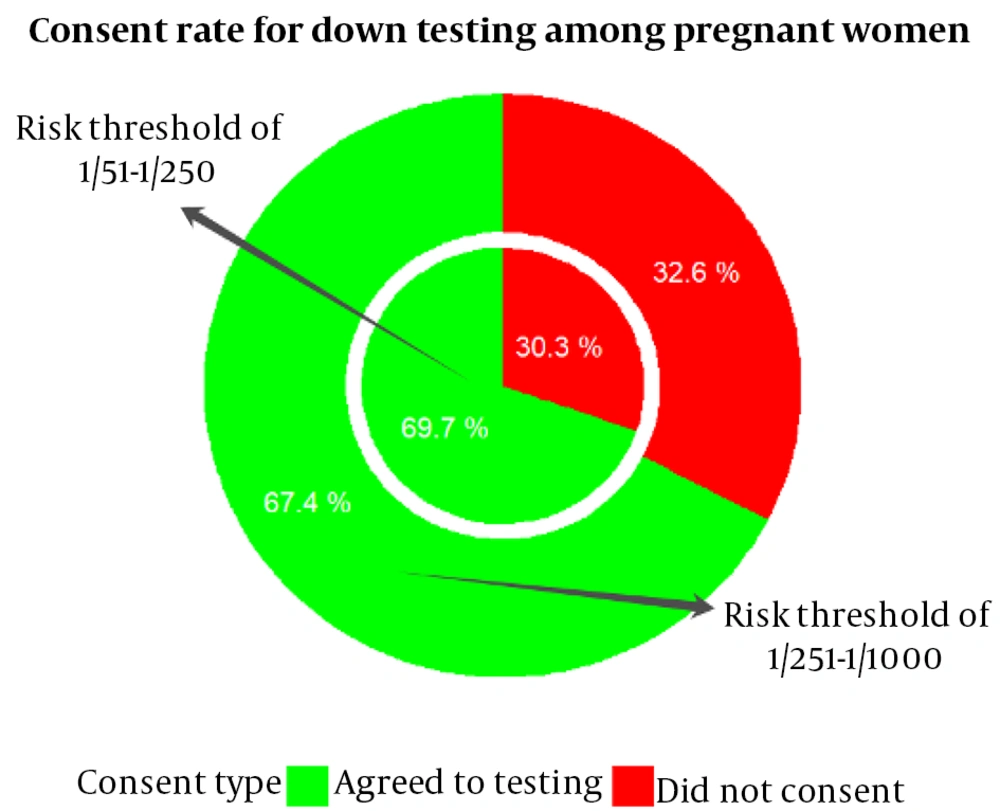
Figure 1.
Comparative consent rates for Down syndrome testing among pregnant women at different risk thresholds
4.3. Diagnostic Choices by Risk Group
The selection of diagnostic procedures after screening is detailed in Table 2. A notable preference for NIPT over amniocentesis was observed among moderate-risk participants. Of the 33 women in the high-risk group, a small subset opted for amniocentesis (8 women, 34.78%), while a significant proportion chose NIPT (15 women, 65.22%), and the rest did not seek further testing (10 women). In the moderate-risk group, consisting of 92 women, the majority favored NIPT (62 women), and a large number abstained from additional testing (30 women), with none selecting amniocentesis.
Table 2.
Diagnostic Choices of Pregnant Women by Risk Groups (n = 85) a
| Risk Group | NIPT | Amniocentesis | Total |
|---|---|---|---|
| High risk (1/51 - 1/250) | 15 (65.22) | 8 (34.78) | 23 (100) |
| Moderate risk (1/251- 1/1000) | 62 (100) | 0 (0) | 62 (100) |
a Values are expressed as No. (%).
4.4. Reasons for Declining Further Testing
Table 3 categorizes the reasons participants chose not to carry out further diagnostic tests. The most cited reason was the preference for additional ultrasound follow-up, as noted by 70% of the participants. Financial constraints and the decision to terminate the pregnancy due to sufficient family size were each reported by 7.5% of the cohort. Ten percent of women declined further testing based on religious beliefs, willing to accept any outcome, while 5% preferred to seek additional tests in higher-level hospitals. This breakdown provides critical information on the multifaceted decision-making process behind pursuing or declining further prenatal diagnostic procedures.
Table 3.
Reasons for Denying Further Testing Among Pregnant Women (n = 40)
| Reason | No. (%) |
|---|---|
| Lack of financial resources | 3 (7.5) |
| Further monitoring with ultrasound | 28 (70) |
| Decision to terminate due to sufficient family size | 3 (7.5) |
| Religious beliefs to accept any outcome | 4 (10) |
| Further testing at higher-level hospitals | 2 (5) |
Table 4 presents the diagnostic decisions taken by a cohort of 125 pregnant women, segmented according to the risk assessed for DS and further classified by age. The data shows that within the high-risk category, 7 out of 8 amniocentesis cases were chosen by women under 35 years of age. In contrast, women under 35 years of age also showed a strong inclination toward NIPT, representing 41.57% of this group, while 42.70% opted out of both testing options. In the moderate-risk category, the overwhelming majority, 80.52%, selected NIPT.
Table 4.
Preferences of the Diagnostic Test Following the Stratification of Risk of Down Syndrome by Age Group a
| Total (n = 125) | Age Groups (y) | P-Value | ||
|---|---|---|---|---|
| < 35 (n = 89) | ≥ 35 (n = 36) | |||
| Amniocentesis among high risk | 8 (6.40) | 7 (7.87) | 1 (2.78) | < 0.0001 |
| NIPT among high risk | 15 (12.00) | 7 (7.87) | 8 (22.22) | |
| NIPT among moderate risk | 62 (49.60) | 37 (41.57) | 25 (69.44) | |
| None of these tests | 40 (32.00) | 38 (42.70) | 2 (5.56) | |
a Values are expressed as No. (%).
4.5. Comparative Analysis of Screening Results
For participants who opted for NIPT following a double test result, Figure 2 presents the concordance and discordance in the screening results.
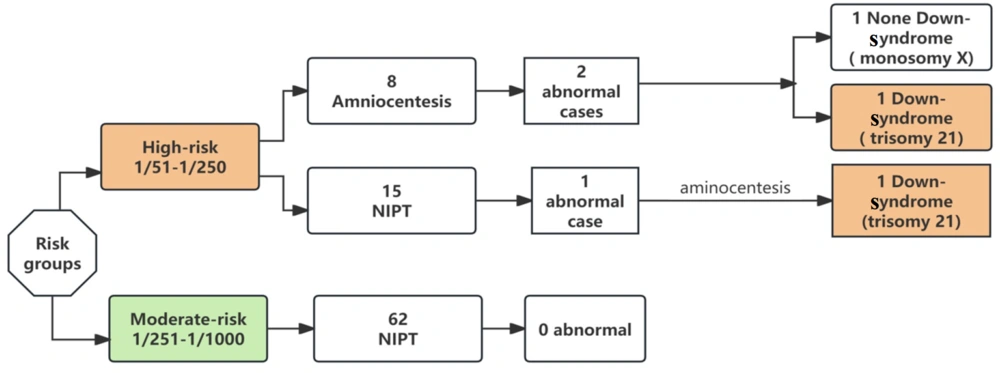
Figure 2.
Flow diagram of diagnostic results according to risk groups and screening tests
Among the 23 pregnant women in the high-risk group, 8 initially opted for amniocentesis, resulting in 2 abnormal cases (1 trisomy 21 and 1 monosomy X). One out of 15 participants in the high-risk group who chose NIPT screening was found to have trisomy 21 abnormalities confirmed through amniocentesis.
5. Discussion
This study illuminates the current prenatal diagnostic preferences in Vietnam, with a focus on NIPT among pregnant women considered to be at moderate risk of DS. According to international healthcare trends, there is a distinct favoring of NIPT due to its noninvasiveness and high accuracy, which corresponds to global shifts toward gentler diagnostic modalities while ensuring reliable results (5, 16). This preference is consistent with the findings of Phan et al., who demonstrated the effectiveness of the triSure NIPT procedure in Vietnam, underscoring the potential for NIPT to be applied in low-income settings (20).
Reflecting on participant demographics, our study cohort, primarily under the age of 35, reinforces established trends in prenatal care engagement (27). This mirrors the situation in Japan, as described by Takahashi et al., where NIPT is mainly indicated for pregnant women over 35 years of age, highlighting different policy and practice landscapes in prenatal diagnostics across countries (18). Interestingly, a study in Singapore revealed that Chinese women were significantly more likely to choose NIPT over invasive prenatal diagnosis (IPD), whereas Indian women showed a preference for IPD. This cultural distinction might suggest that demographic and cultural backgrounds significantly influence prenatal decision-making, which could be reflected in Vietnam's diverse population (28). Additionally, an American study highlighted geographical variations in the adoption of NIPT, with the highest uptake noted in the West Coast centers (62.9%), compared to East Coast centers (41.6%) and Midwest centers (21.8%), primarily due to indications of advanced maternal age (AMA) (29). This signifies a potential regional influence on prenatal screening preferences, which may also be relevant in the context of Vietnam's diverse economic and cultural landscapes.
Risk categorization in our research underscores the vital role of tailored risk evaluation in informed decision-making within prenatal care (30). This is complemented by the cost-utility analysis performed by Anh et al., indicating NIPT as a cost-effective alternative for high-risk pregnant women in Vietnam, presenting a strong case for the broader adoption and insurance coverage of NIPT in developing countries (19, 31). The diagnostic preferences indicated by our study participants show a growing acceptance of NIPT over invasive methods such as amniocentesis, signaling a shift toward patient-centric benefits (32, 33).
The divergence in diagnostic preferences by age group in our study suggests a significant influence of age on prenatal diagnostic decisions. Contrary to traditional trends where older women show higher uptake rates for NIPT, our findings from a cohort of 125 pregnant women in Vietnam reveal a strong inclination towards NIPT across all age groups. Notably, within our high-risk category, younger women under 35 were as likely to choose NIPT as their older counterparts, with 41.57% of younger women opting for NIPT while a similar majority (80.52%) in the moderate risk category chose NIPT, regardless of age (P < 0.0001). This generational shift indicates evolving perceptions and broad acceptance of less invasive prenatal testing technologies among Vietnamese women.
Our results align with a study in Singapore, where women aged ≥ 35 years preferred NIPT over IPD, with 62.3% opting for NIPT compared to 29.5% for IPD (P = 0.0052) (28). Interestingly, the Singapore study also reported that younger women (< 35 years) were almost equally likely to choose NIPT or IPD, a contrast to our findings where younger women distinctly favored NIPT (28). This suggests that the preference for NIPT among younger Vietnamese women may reflect unique cultural or healthcare system influences not observed in the Singapore context.
In contrast, another study from Singapore focusing on willingness-to-pay (WTP) for NIPT revealed that while older, more educated women, or those intending to terminate a pregnancy if affected, showed a higher WTP for NIPT, the general population was not willing to pay extra for NIPT over standard testing as a first-line screening method. This highlights a discrepancy between perceived value and actual financial commitment to NIPT in different cultural and economic settings, underscoring the complex dynamics that influence prenatal testing decisions globally (34).
The study showcases several strengths that enhance its value in the field of prenatal diagnostics. Firstly, the engagement of a diverse cohort of 125 pregnant women from varied socio-economic backgrounds in Vietnam helps to ensure that the findings are reflective of a broad spectrum of the population, enhancing their relevance within the regional context. Furthermore, the study delves deep into the diagnostic preferences between NIPT and amniocentesis across different risk thresholds, providing a detailed understanding of prenatal testing choices in a nuanced manner. Additionally, the use of chi-square analysis to discern significant differences in testing preferences across age groups imbues the study with statistical rigor, strengthening the reliability of the conclusions drawn.
However, the study is not without its limitations. The regional focus on Vietnam, while providing depth, may limit the generalizability of the findings to other regions without adaptations to local medical practices and cultural factors. Furthermore, the cross-sectional design of the study captures preferences at a single point in time, which does not allow for an understanding of how these preferences might change throughout the pregnancy or in response to shifts in healthcare policy. Future research could extend these findings by expanding the geographic scope and adopting a longitudinal design, offering a more dynamic view of prenatal screening behaviors and their outcomes globally.
5.1. Conclusions
In conclusion, the present study shows that the NIPT test was preferred over invasive methods in screening for Down syndrome among at-risk pregnant women in Vietnam. The main reasons for choosing subsequent tests include personal health beliefs, economic status, and the perceived reliability of the NIPT test over invasive procedures. There is a need for individualized counseling and education, as well as increased support for noninvasive testing options through healthcare policy and improved insurance coverage. The study’s findings suggest that a shift towards less invasive prenatal testing methods could lead to broader changes in prenatal care practices, especially in developing countries like Vietnam.