


1. Background
Fertility and reproduction are fundamental to the survival of human life, and infertility has always been a significant problem in an individual's life, deeply and fundamentally affecting the structure of an infertile couple's social (occupation, social relationships) and individual lives (physical and psychological health) (1). Zarif Golbar Yazdi et al. in a study showed that neglecting the emotional disorders of infertile couples and the secondary symptoms of infertility could lead to problems in interpersonal relationships, marital dissatisfaction, and decreased sexual desires, potentially resulting in a defective cycle that might decrease the chances of successful infertility treatment (2). Studies have shown that 23% - 52% of infertile women experience mild to severe levels of depression. Depression can negatively affect the process of infertility treatment, the course of treatment, and hope for the treatment outcome (3, 4).
Since infertility and undergoing fertility-assisted technologies are considered life crises, with emotional burdens that can affect individuals personally and socially, having psychological and social support during different stages of infertility treatment is of great importance for women (5-). Various psychological and non-psychological therapeutic methods have been applied for treating depression among infertile women, including group consultation with a collaborative approach (5), ear acupressure (6), schema therapy (7), psychodrama (8), and reality therapy (9). Considering the existing limitations for the practical application of psychological and non-psychological therapeutic methods, more studies seem necessary to find effective, low-cost, and accessible methods that do not require the presence of a psychologist. Expressive writing is an intervention for the expression of emotions, first introduced by Pennebaker and Beall (1986), which recommends participants write down their deepest thoughts and emotions about one of the upsetting events in their life during 3 to 4 sessions (preferably, an experience that has not been shared with others) (10).
Various studies have evaluated the success of expressive writing as an effective, low-cost, and accessible method for treating anxiety and depression and improving the symptoms of diseases and various problems. These include the effect of expressive writing on postpartum depression (11), fear of delivery (12), post-traumatic stress disorder (13), health outcomes in patients suffering from breast cancer (14), and the effect of expressive writing on women who are terminating their pregnancy due to fetal abnormalities (15). However, regarding its effect on infertile women, only one study has been published globally (16), and no similar study has been conducted in Iran, where cultural differences may affect the effectiveness of this method.
2. Objectives
The present study was performed to determine the effect of expressive writing on depression and anxiety in infertile women.
3. Methods
3.1. Study Design
The present study was a controlled randomized controlled trial registered in the Iranian Registry of Clinical Trials (code: IRCT20091001002531N6). Data from the intervention and control groups were gathered simultaneously.
3.2. Participants and Setting
The study population included all infertile women who sought assisted reproductive treatment, met the inclusion criteria, and visited infertility clinics in Isfahan, including the Maryam Infertility Center affiliated with Shahid Beheshti Hospital and the Isfahan Infertility Center, from August to December 2021. Isfahan city is a metropolitan and multicultural region in the central area of Iran, housing these two infertility centers.
3.3. Inclusion and Exclusion Criteria
The inclusion criteria were a willingness to participate in the study, having diagnosed infertility [based on infertility diagnosis protocols and being candidates for assisted reproductive technology (ART) by infertility specialists] (17), being a candidate for receiving assisted reproductive treatment (except for women seeking egg donation and surrogacy), being married, aged 18 to 45 years, having a high school diploma or higher degrees, not participating in any other study related to treating depression and anxiety at the same time, and not visiting a psychiatrist or psychologist during the study. The exclusion criteria included not completing the expressive writing (3 days), unwillingness to continue participation at any stage of the study, and becoming pregnant at any stage of the study.
3.4. Sample Size Calculation
The sample size was calculated based on information from a previous similar study regarding the Depression Index, considering 8.9 as the estimated standard deviation (10) and 5 units as the minimum clinically detectable effect size (between the intervention and control groups). Hence, using the sample size formula:
3.5. Randomization
The researcher visited the infertility centers randomly. Each morning before leaving home, the researcher picked a number from a bag containing 10 pieces of paper with either an even or odd number. If the number was even, she visited the Isfahan Infertility Center, and if the number was odd, she visited the Maryam Infertility Clinic. For random allocation to the intervention and control groups, the researcher asked participants to take a sealed opaque package out of 102 randomly. Fifty-one packages contained questionnaires and checklists coded 1 (related to the intervention group: Expressive writing), and 51 packages contained the same questionnaires and checklists coded 2 (related to the control group: Neutral writing). This process continued until there were 51 samples in both groups. The study is single-blinded because the data analyzer was not aware of the meaning of the control and intervention groups.
3.6. Questionnaires
In the present study, data were gathered using two questionnaires. The first questionnaire included demographic characteristics such as age, occupation, educational level, and duration of infertility. The second questionnaire was the Depression/Anxiety/Stress Scale-21 (DASS-21), which contains 21 items: Seven items for assessing each structure of depression, anxiety, and stress, scored using a 4-point Likert scale from 0 (not applicable at all) to 3 (completely applicable). Since this questionnaire is the short form of the main questionnaire with 42 items, the final score of each subscale would be doubled (18). The psychometric features of DASS-21 have been assessed and confirmed in a study by Sahebi et al. in an Iranian population. The internal consistency coefficients of the depression and anxiety subscales were 0.93 and 0.90, respectively, and the test-retest coefficients with an interval of 3 weeks for the depression and anxiety subscales were 0.84 and 0.89, respectively. Additionally, the intraclass correlation between the two administrations for the subscales was 0.78 and 0.87, respectively. All these findings indicate the desirable reliability of the studied scale (19).
3.7. Data Collection
The questionnaires were completed by the participants before the intervention and twice after the intervention (immediately after and 2 weeks following the intervention). The interval between the intervention and ART was 2 to 3 weeks, allowing for a 2-week follow-up to ensure all samples were followed up before ART. Additionally, the previous similar study did not include a follow-up (16). The questionnaires were completed by the participants in the presence of the researcher.
3.8. Procedures
Each morning before leaving home, the researcher picked a number from a bag. If the number was even, she visited the Isfahan Infertility Center, and if the number was odd, she visited the Maryam Infertility Clinic. Both centers were similar in terms of conditions, ensuring that any differences between the two groups were not related to differences between the centers. After introducing herself to the infertile women, the researcher explained the objectives and method of the study and then asked about the inclusion criteria. If any of the women met the inclusion criteria and were willing to participate, they were enrolled in the study after signing written informed consent, and then the DASS-21 was completed by the participants. They were then randomly allocated into the intervention or control group. In the intervention group, the researcher instructed the participants to write down their deepest feelings, thoughts, and concerns about not having a child and their concerns about assisted reproductive techniques for 3 days, 20 minutes per day (16). Participants were encouraged to write any words or phrases that came to mind during writing without worrying about the correctness or politeness of their words and sentences, meaning that grammar or correct spelling was not important, and words that could fully express their feelings should be written. To ensure correct understanding, the researcher asked participants to write about something sad other than infertility to identify any issues in their writing. In the control group, participants were asked to write about their daily life events that would not evoke emotions and feelings, such as cleaning, cooking, ironing, and dusting, for 3 days, 20 minutes per day. The recommended subject by the researcher was their daily schedule, meaning that every day, after waking up, participants should write their daily schedule within 20 minutes.
Every day during the 3 days of intervention, a message was sent to participants in both groups to remind them about writing, and they were asked to inform us after completing their writing. On the 4th day, the DASS-21 was completed again during a 20-minute phone call with each participant. Two weeks after the intervention, the questionnaire was completed by the participants for the third time.
3.9. Data Analysis
To analyze the demographic characteristics and fertility variables, the mean age and infertility duration were compared between the two groups using the Independent t-test. Additionally, job and education levels were compared using the chi-squared test. Data related to dependent variables, including depression and anxiety, were analyzed using Repeated Measures ANOVA and the Independent t-test with SPSS software version 21. The normality of the distribution of the variables was assessed by the Kolmogorov-Smirnov test. Results showed no significant difference between the depression and anxiety levels of the intervention and control groups before the intervention; however, since the P-values were close to 0.05, this could be considered a confounding factor in the results. Therefore, to eliminate this confounding factor, ANCOVA test was used.
3.10. Ethical Considerations
To conduct the study, the project was first approved by Isfahan University of Medical Sciences (approval code: 3400747) and the Ethics Committee of the University (ethics code: IR.MUI.NUREMA.REC.1400.198). Written informed consent was obtained from all participants, and they were assured of their right to withdraw from the study at any stage without any consequences. The questionnaires were anonymous, and participants were assured that their information would remain confidential. After the study concluded, expressive writing was also taught to the participants in the control group. Moreover, the study was registered and approved on the Iranian Registry for Clinical Trials website with the code IRCT20091001002531N6.
4. Results
In this study, 124 infertile women were assessed for eligibility, but the analysis was conducted on 51 women in the control group and 51 women in the intervention group (Figure 1). The participants in the intervention and control groups showed no significant differences regarding their demographic and fertility characteristics (P > 0.05) (Table 1).
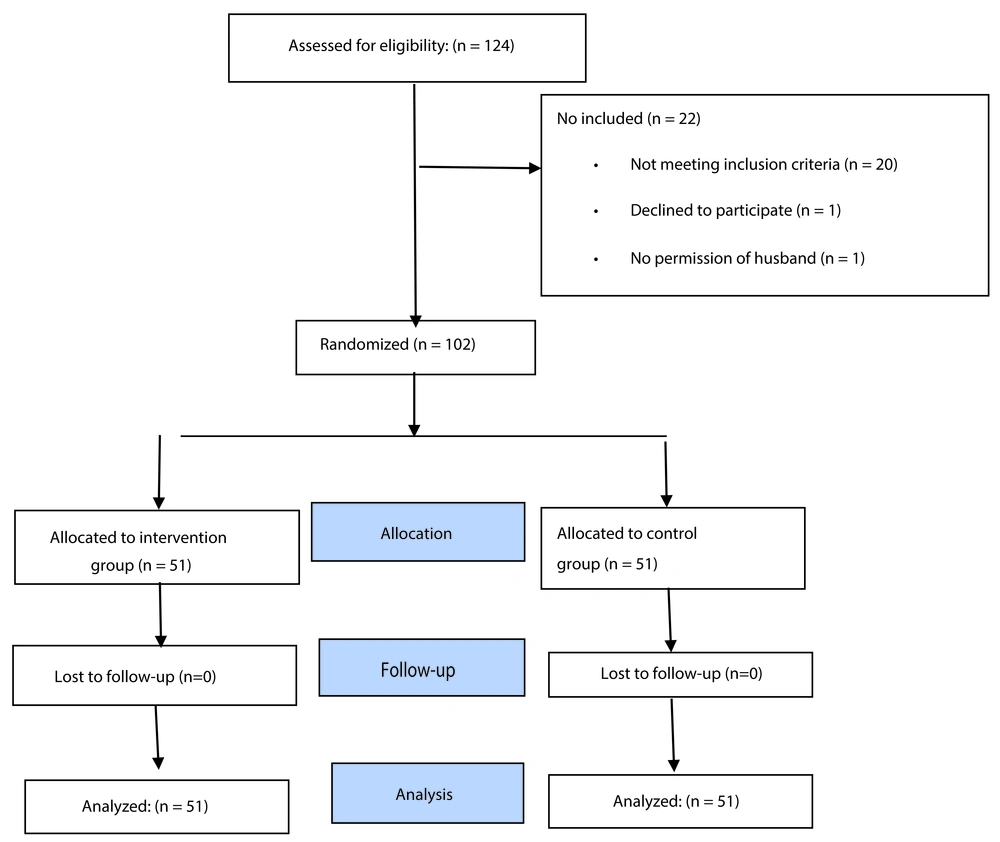
Figure 1.
Participant flow diagram (CONSORT diagram)
Table 1.Comparison of Women’s Demographic Characteristics and Fertility Variables Between Intervention and Control Groups a
| Variables | Control | Intervention | Statistical Test |
|---|---|---|---|
| Age (y) | 34.06 ± 6.82 | 33.23 ± 6.95 | t = -0.608 b, P = 0.545 |
| Infertility duration (y) | 6.74 ± 4.98 | 6.4 ± 5.74 | t = -0.028 b, P = 0.781 |
| Job | X = 7.230 c, P = 0.065, df=3 | ||
| Unemployed | 31 (62. 00) | 37 (71.20) | |
| Employed | 19 (38. 00) | 15 (28.80) | |
| Education | X = 0.153 c, P = 0.696, df = 1 | ||
| Diploma or lower | 2 (40. 00) | 24 (46.20) | |
| University | 3 (60. 00) | 28 (53.80) |
a Values are expressed as mean ± SD or No. (%).
b Independent t-test.
c Chi-squared test.
Furthermore, the independent t-test showed no significant difference between the intervention and control groups regarding the mean score of depression before the intervention (P > 0.05). A comparison of the mean scores of depression and anxiety between the intervention and control groups, before, immediately after, and two weeks following the intervention, is shown in Tables 2 and 3.
Table 2.Comparison of the Mean Score of Depression Between the Intervention and Control Groups Before, Immediately After, and Two Weeks After the Intervention a
| Variables | Before the Intervention | Right After the Intervention | Two Weeks After the Intervention | Repeated Measures ANOVA | |||||||||
|---|---|---|---|---|---|---|---|---|---|---|---|---|---|
| Time | Intervention | ||||||||||||
| P-Value | F-Value | Effect Sizes | 95% CI of the Difference | P-Value | F-Value | Effect Sizes | 95% CI of the Difference | ||||||
| Lower | Upper | Lower | Upper | ||||||||||
| Depression | <0.001 | 33.878 | 0.255 | -9.020 | -3.983 | ||||||||
| Control | 15.64 ± 11.53 | 12.20 ± 11.20 | 12.56 ± 11.00 | <0.001 | 14.251 | 41.055 | 9.432 | 15.686 | |||||
| Intervention | 12.84 ± 10.74 | 4.11 ± 6.01 | 3.80 ± 4.46 | <0.001 | 41.055 | 0.446 | 2.564 | 5.052 | |||||
| Statistical test | |||||||||||||
| P-value | 0.208 | < 0.001 | < 0.001 | - | - | - | - | - | - | - | - | - | - |
| Statistics | t = -1.267 | F = 26.738 | F = 34.538 | - | - | - | - | - | - | - | - | - | - |
| Effect sizes | 0.251301 | 0.214 | 0.261 | - | - | - | - | - | - | - | - | - | - |
| 95% CI of the difference | |||||||||||||
| Lower | -7.16972 | -9.182 | -9.451 | - | - | - | - | - | - | - | - | - | - |
| Upper | 1.58203 | -4.089 | -4.680 | - | - | - | - | - | - | - | - | - | - |
a Values are expressed as mean ± SD.
Table 3.Comparison of the Mean Score of Anxiety between the Intervention and Control Groups Before, Immediately After, and Two Weeks After the Intervention
| Variables | Before the Intervention | Right After the Intervention | Two Weeks After the Intervention | Repeated Measures ANOVA | |||||||||
|---|---|---|---|---|---|---|---|---|---|---|---|---|---|
| Time | Intervention | ||||||||||||
| P-Value | F-Value | Effect Sizes | 95% CI of the Difference | P-Value | F-Value | Effect Sizes | 95% CI of the Difference | ||||||
| Lower | Upper | Lower | Upper | ||||||||||
| Anxiety | <0.001 | 24.593 | 0.199 | -6.258 | -2.325 | ||||||||
| Control | 12.64 ± 9.34 | 8.56 ± 8.60 | 8.88 ± 8.52 | <0.001 | 22.102 | 0.311 | 6.457 | 11.303 | |||||
| Intervention | 9.42 ± 7.90 | 2.61 ± 3.93 | 2.30 ± 3.07 | <0.001 | 46.699 | 0.478 | 1.451 | 3.165 | |||||
| Statistical test | |||||||||||||
| P-value | 0.208 | < 0.001 | < 0.001 | - | - | - | - | - | - | - | - | - | - |
| Statistics | t = -1.857 | F = 18.546 | F = 27.975 | - | - | - | - | - | - | - | - | - | - |
| Effect sizes | 0.372254 | 0.159 | 0.222 | - | - | - | - | - | - | - | - | - | - |
| 95% CI of the difference | |||||||||||||
| Lower | -6.65127 | -6.250 | -6.811 | - | - | - | - | - | - | - | - | - | - |
| Upper | 0.21743 | -2.307 | -3.094 | - | - | - | - | - | - | - | - | - | - |
In the control group, a post-hoc test with paired comparisons showed a significant difference between the mean score of depression before the intervention and immediately after the intervention, as well as before the intervention and two weeks after the intervention (P < 0.001 and P = 0.002, respectively). This indicates that the mean score at both stages after the intervention was lower than before the intervention. However, no significant difference was observed between the mean score of depression immediately after the intervention and two weeks after the intervention, meaning that while the mean score of depression was reduced following neutral writing, it remained stable during the two-week interval after the intervention (P = 0.247).
The post-hoc test for the intervention group also showed a significant difference between the mean score of depression before the intervention and immediately after the intervention, as well as before the intervention and two weeks after the intervention (P < 0.001 for both comparisons). Therefore, the mean score was lower than before the intervention at both stages after the intervention. However, the mean score of depression immediately after the intervention and two weeks after the intervention showed no significant difference, indicating that depression was reduced following expressive writing but remained almost unchanged during the two-week interval after the intervention (P = 0.033).
Furthermore, the post-hoc test in the control group showed a significant difference between the mean score of anxiety before the intervention and immediately after the intervention, as well as before the intervention and two weeks after the intervention (P < 0.001 for both comparisons). This indicates that the mean score was lower than before the intervention at both stages after the intervention. However, no significant difference was observed between the mean score of anxiety immediately after the intervention and two weeks after the intervention, meaning that while the mean score of anxiety was reduced following neutral writing, it did not change during the two-week interval after the intervention, and its reduction was not statistically significant (P = 0.469) (Table 3).
In the intervention group, the post-hoc test showed a significant difference between the mean score of anxiety before the intervention and immediately after the intervention, as well as before the intervention and two weeks after the intervention (P < 0.001 for both comparisons). This indicates that the mean score at both stages after the intervention was lower than before the intervention. However, the mean score of anxiety showed no significant difference between immediately after the intervention and two weeks after the intervention. Therefore, while the mean score of anxiety was reduced following expressive writing, it did not change during the two-week interval following the intervention.
5. Discussion
The aim of the present study was to determine “the effect of expressive writing on depression and anxiety among infertile women who visited infertility centers in Isfahan in 2022”. Results showed that the changes in the mean scores of depression and anxiety in the control group were statistically significant over time (at the three stages: Before, immediately after, and two weeks after the intervention). Additionally, a post-hoc test with paired comparisons in the control group showed a significant difference between the mean scores of depression and anxiety before and immediately after the intervention, as well as before and two weeks after the intervention. This indicates that the mean scores at both stages after the intervention were lower than before the intervention. However, no significant differences were observed between the mean scores of depression and anxiety immediately after and two weeks after the intervention, meaning that while the mean scores of depression and anxiety decreased following neutral writing, they remained unchanged during the two-week interval after the intervention.
To explain these results, it could be said that writing, whether in the form of expressive or neutral, is considered a type of behavioral cognitive intervention through which individuals write down their emotions and daily events in a private setting, regardless of grammar or correctness. In fact, it is a method based on mindfulness, which is an effective therapy for treating psychological problems and enhancing the quality of life (20).
Changes in the mean scores of depression and anxiety in the intervention group over time — before the intervention, immediately after the intervention, and two weeks after the intervention — were statistically significant. Additionally, a post-hoc test in the intervention group showed a significant difference between the mean scores of depression and anxiety before and immediately after the intervention, as well as before and two weeks after the intervention. This indicates that the mean scores at both stages after the intervention were lower than before the intervention. However, the differences in the mean scores of depression and anxiety between immediately after and two weeks after the intervention were not statistically significant. This means that the mean scores of depression and anxiety decreased following expressive writing and were lower immediately after the intervention than before, but during the subsequent two-week interval, there was no significant decrease or increase, and the scores remained almost unchanged.
Considering the results of the present study regarding the more significant decrease in the mean scores of depression and anxiety in the intervention group compared to the control group, it can be noted that an old belief in psychology supports the theory that individuals can achieve a better understanding of their motivations, thoughts, feelings, and goals through talking or writing about their personal and emotional problems. In fact, when writing about an event with emotional load, that event becomes a narrative in which unclear emotions and notes find meaning through defined words and phrases, leading to necessary recognition and awareness of untold and unconscious fears and emotions (21). On the other hand, writing about important and traumatic life experiences can improve physical and emotional health conditions. In fact, besides improving depression and stress, expressive writing can enhance compatibility skills, thinking methods, physical and mental health, problem-solving ability, growth, and personality evolution (22). Expressive writing can be used as a powerful tool for discovering an individual's conscience in any life situation, and when verbal expression of problems becomes difficult, this method can be helpful.
Parv et al. evaluated the effectiveness of a two-minute session for emotional-writing expression on depression, anxiety, and stress among students suffering from mental trauma. For this purpose, depression and anxiety were measured before and three weeks after the intervention, and positive and negative emotions were assessed right before and after the intervention. Their results showed that, in the short term, two-minute emotional writing expression significantly increased negative emotions, while in the long term, it decreased depression and anxiety. Additionally, this intervention was more effective in students who had more severe mental trauma or lower economic status. The results of this study demonstrated that emotional writing expression was effective in reducing depression, anxiety, and stress. The findings of the present study align with those of the aforementioned study (23).
Similarly, in the study by Moradmand and Khanbani, titled "The Effectiveness of Educating Writing Emotional Expression on Self-Efficacy and Emotional Control in Anxious Students", the writing emotional expression intervention was conducted over four 30-minute sessions, one session per week. Their results showed a significant difference, following the education of writing emotional expression, between the scores of self-efficacy, emotional control, and anxiety variables in the intervention and control groups at the follow-up stage. This indicates that emotional writing expression decreased symptoms of anxiety and improved self-efficacy and emotional control (24). The results of the present study are consistent with the findings of this study.
In the study by Panagopoulou et al. on the effect of expressive writing (emotional expression) on the anxiety of women undergoing infertility treatment at Aristotle University of Thessaloniki, infertile women were allocated into three groups: Expressive writing (emotional expression), reality writing, and control. The results showed no significant difference between the three groups regarding their anxiety scores, and interestingly, infertility treatment was more successful in the control group than in the other groups. These results were not consistent with the findings of the present study (25).
To explain this contradiction, it should be noted that the different timelines of the studies and the varying conditions of the participants might have caused the difference in results. In the present study, infertile women were enrolled before starting assisted reproductive treatments and, over three consecutive days, wrote down their deepest feelings and emotions about infertility for 20 minutes per day at their homes. In contrast, in the aforementioned study, women were enrolled 2 to 3 days after embryo transfer. It could be suggested that expressive writing might not be as effective on anxiety when predicting a stressful event as it is before, during, or after the occurrence of a stressful event.
Changes in the mean score of depression at the three stages of the study — before, immediately after, and two weeks after the intervention — showed a significant difference between the intervention and control groups. This result aligns with the study by Farrokhzad et al., which evaluated the effect of emotional discharge of feelings on the level of depression among female cancer patients. The results of that study showed that writing down emotions and feelings (expressive writing) improved depression among cancer patients. Therefore, the researchers concluded that this method could be used as a cost-effective, non-aggressive method in the care process of cancer patients (26).
In the study by Kloss and Lisman, which evaluated the effect of expressive writing on depression and anxiety, researchers found that expressive writing had a significant effect on improving anxiety but showed no significant effect on depression (27). The results of this study were not in line with the results of the present study, which might be due to differences in the depression measurement tools used in these studies.
Furthermore, the results of the present study showed a significant difference in the mean score of anxiety between the intervention and control groups at the three stages of the study — before, immediately after, and two weeks after the intervention. In the present study, the effect of expressive writing on different levels of depression and anxiety was not evaluated. However, in the study by Harizchi et al., which evaluated the effect of writing emotional expression on the level of depression and anxiety among multiple sclerosis patients, results indicated the positive effect of expressive writing on severe and moderate levels of depression and anxiety. However, in participants with mild depression and anxiety, the intervention was not effective, and in some cases, the Depression Index decreased in the second questionnaire (28).
5.1. Conclusions
The results of the present study showed that both expressive writing and neutral writing could decrease the levels of depression and anxiety in infertile women, but expressive writing was more effective. Therefore, it is recommended that expressive writing be performed as a simple, low-cost, available, and effective intervention for reducing depression and anxiety levels in infertile women by midwives and gynecologists. It is suggested to investigate the effect of positive and negative expressive writing on other psychological problems of infertile women.
5.2. Limitations and Strengths
One limitation of the present study, which was impossible to eliminate, was the effect of personal and cultural factors that might have affected participants' freedom in writing. Another uncontrollable potential limitation was chronic depression unrelated to infertility, which could be a confounding variable. Additionally, the present study is not population-based, so the findings are generalizable only to infertile women who are candidates for ART, excluding those seeking egg donation and surrogacy.


