
1. Background
In early December 2019, the first patient with a disease caused by the new coronavirus was reported from the city of Wuhan, China (1). This disease affects all groups of society, especially vulnerable groups. According to studies, pregnant women are one of the most vulnerable groups to COVID-19 (2). To control the spread of this disease, the World Health Organization (WHO) proposed measures such as travel restrictions, avoidance of gatherings, social distancing, and isolation. Different countries of the world also implemented preventive measures at different levels. Worrying about contracting the disease, along with the application of these restrictions, caused psychological consequences such as anxiety, stress, depression, and fear among people worldwide (3). These restrictions were more severe for cultural and social reasons, especially for pregnant women (3).
The findings of studies conducted on pregnant women during the COVID-19 pandemic showed that pregnant women had high levels of worry and anxiety, and the level of anxiety increased closer to the time of delivery (4, 5). A meta-analysis study also showed that the levels of depression and anxiety during pregnancy and after delivery increased during the COVID-19 pandemic (6). In fact, due to the pandemic nature of COVID-19 and its danger, all people consider themselves to be susceptible to it; therefore, one of the problems that can occur during this disease is the presence of hypochondria. Hypochondria is a type of psychological disorder in which a person believes that she/he has a serious illness despite having physical health (7, 8). A person suffering from hypochondria, despite not seeing problems and diseases in clinical and laboratory examinations, does not trust their doctor's diagnosis, seeks excessive medical care or requests frequent changes in medical care, and may even fear the possibility of contracting a disease from medical care. Conventional medicine should be avoided (9). People suffering from this psychological disorder suffer from depression, anxiety, and distress more often than non-suffering people (10).
Symptoms of hypochondria disorder can start at any age, but this disorder is more common in people aged 20 to 30, which is the age range where women are most likely to become pregnant (11). In a study in Iran, the prevalence of hypochondria was estimated at 28.8%, which was greater in age less than 30 years (12). One study in Iran showed that after adjusting for other variables, the prevalence of hypochondria was greater in pregnant women and postpartum than in nonpregnant women and was 42%, which is probably related to physical and hormonal changes during pregnancy (13, 14). Due to stress and anxiety, hypochondria can be associated with unfavorable pregnancy outcomes such as preeclampsia, low birth weight, and nausea and vomiting (15, 16). In addition, psychological problems during pregnancy affect recovery, psychological balance, mothers' attitudes, and adaptation to child care duties (17). However, the complications of psychological problems in the third trimester of pregnancy are not only aimed at the woman herself but also cause physical and psychological disorders in the baby (18).
One of the factors that can affect the prevalence of hypochondria is pandemic diseases such as COVID-19. One study showed that during the COVID-19 pandemic, the mean prevalence of hypochondriasis was 33.37 ± 14.87 in the general population in southern Iran (19). In addition, another study showed the average mean score of hypochondriasis was 41.13 ± 18.06 among pregnant women in northeast Iran during the COVID-19 pandemic (20). Although the COVID-19 pandemic has subsided, it is feared that outbreaks of this disease or the occurrence of new endemics will continue to threaten societies and that its effect on pregnant women may be greater than that on other population groups. On the other hand, considering that the effect of this disease on the rate of hypochondria in pregnant women in the west of Iran has not been investigated, this study was designed and conducted.
2. Objectives
The aim of this study was to investigate the factors related to hypochondria during the COVID-19 pandemic in pregnant women referred to health centers in Aligudarz city, Iran.
3. Methods
3.1. Study Design
This cross-sectional, descriptive-analytical study was conducted in Aligudarz city, Lorestan province, Iran, in 2021.
3.2. Study Participants
The statistical population consisted of pregnant women who referred to the health centers of Aligudarz city, Iran. Considering the conditions of the COVID-19 pandemic, the hypochondria rate was considered to be 50%. With a confidence level of 95% and an accuracy rate of 0.06, the number of samples was determined to be 267 pregnant women. The inclusion criteria included willingness to participate in the study, pregnant women not suffering from chronic diseases (such as diabetes, blood pressure, cardiovascular, pulmonary, and renal diseases), no history of known psychological diseases, and the use of psychiatric drugs according to the information available in the health system, and not having active COVID-19 disease. The exclusion criterion was incomplete questionnaires.
The sampling method used in this study involved a regular quota and included random sampling with K = 1. Thus, 6 comprehensive health centers, 3 health centers, and 2 clinics affiliated with the hospitals of Aligudarz city were considered sampling centers. Then, according to the population of pregnant women covered by each center, a quota was allocated to that center. In the next step, pregnant women were sampled in a systematic random manner with K = 1, so that pregnant women who were referred to the centers to receive care and met the inclusion criteria entered the study one by one.
3.3. Instruments
3.3.1. Demographic-Fertility Information Questionnaire
This included details such as age, education, and occupation of the woman and her husband, gestational age, number of pregnancies, presence of pregnancy complications, history of COVID-19 in one's own close relatives, any cases of death due to COVID-19 disease in close relatives, the presence of medical staff in the family, adherence to COVID-19 preventive guidelines by pregnant women and her family, access to cyberspace, satisfaction with married life, economic status of the family, and having a job in contact with clients for both the pregnant women and their husbands.
3.3.2. Hypochondria Questionnaire
Designed and developed by Evans in 1980, this questionnaire consists of 36 questions scored based on a 4-point Likert scale (never = 0, sometimes = 1, most of the time = 2, and always = 3), measuring hypochondria with a total score of 0 - 67. Based on the obtained score, individuals were categorized into healthy (score 0 - 20), borderline (21 - 30), mild (31 - 40), moderate (41 - 60), and extreme (above 60) groups (21).
The reliability of the Persian version of this questionnaire was examined and confirmed in a previous study, with a Cronbach's alpha coefficient of 0.89 reported. Additionally, the high correlation of the questionnaire with other hypochondria assessment tests, such as the Minnesota Multiphasic Personality Inventory (MMPI) and the 90-item Symptom Checklist (SCL-90), indicates its appropriate validity (22).
3.4. Data Collection
After explaining the objectives of the research to the pregnant women and obtaining their informed consent, the participants completed a demographic-fertility information questionnaire and a hypochondria questionnaire in person.
3.5. Statistical Analysis
SPSS version 21 software was used for data analysis. A significance level of less than 0.05 was considered. Descriptive statistics tests (mean ± SD, frequency), independent t-tests, analyses of variance, and Pearson's correlation coefficients were used to analyze the data.
3.6. Ethical Considerations
The study with the code IR.MUI.RESEARCH.REC.1400.298 was approved by the ethics committee of Isfahan University of Medical Sciences. Written informed consent was obtained from all participants, and they were assured that the information would remain confidential. The questionnaires were completed in a quiet and private environment, in compliance with COVID-19 preventive guidelines. Additionally, all research participants were assured that they could withdraw from the study at any time and for any reason without facing any consequences.
4. Results
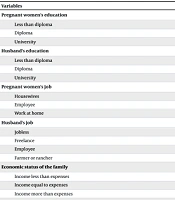
In this study, 267 pregnant women completed the questionnaires. Approximately 58% of participants were between 20 and 30 weeks of pregnancy. In 14% of pregnant women, pregnancy was complicated by gestational diabetes or preeclampsia. Table 1 shows the pregnant women’s demographic and obstetric characteristics. The frequency of COVID-19 related factors is reported in Table 2.
Table 1.
Pregnant Women’s Demographic and Obstetrics Characteristics a
| Variables | Values |
|---|---|
| Pregnant women's age (y) | 29.7 ± 5.7 |
| Husband's age (y) | 33.3± 4.8 |
| History of abortion | |
| Yes | 100 (37.5) |
| No | 167 (62.5) |
| History of stillbirth | |
| Yes | 3 (1.1) |
| No | 264 (98.9) |
| Pregnant women's education | |
| Less than diploma | 30 (11.2) |
| Diploma | 156 (58.4) |
| University | 81 (30.3) |
| Husband's education | |
| Less than diploma | 41 (15.4) |
| Diploma | 94 (35.2) |
| University | 132 (49.4) |
| Pregnant women's job | |
| Housewives | 244 (83.9) |
| Employee | 25 (9.4) |
| Work at home | 18 (6.7) |
| Husband's job | |
| Jobless | 10 (3.7) |
| Freelance | 184 (68.9) |
| Employee | 56 (21) |
| Farmer or rancher | 17 (6.4) |
| Economic status of the family | |
| Income less than expenses | 134 (50.2) |
| Income equal to expenses | 115 (43.1) |
| Income more than expenses | 18 (6.7) |
| Satisfaction with married life | |
| Yes | 229 (85.8) |
| No | 38 (14.2) |
a Values are expressed as mean ± SD or No. (%).
Table 2.
Frequency of COVID-19 Related Factors in Pregnant Women
| Variables | Number (%) |
|---|---|
| History of COVID-19 in pregnant women | |
| Yes | 97 (36.3) |
| No | 170 (63.7) |
| History of COVID-19 in close relatives | |
| Yes | 127 (47.6) |
| No | 140 (52.2) |
| Death due to COVID-19 in the close relatives | |
| Yes | 18 (6.7) |
| No | 249 (93.3) |
| Adherence to COVID-19 preventive guidelines by pregnant woman | |
| Yes | 152 (56.9) |
| No | 115 (43.1) |
| Adherence to COVID-19 preventive guidelines by family | |
| Yes | 119 (44.6) |
| No | 148 (55.4) |
| The presence of medical staff in the family | |
| Yes | 55 (20.6) |
| No | 212 (79.4) |
| Having job in contact with clients in pregnant women | |
| Yes | 52 (19.5) |
| No | 215 (80.5) |
| Having job in contact with clients in pregnant woman's husband | |
| Yes | 178 (66.7) |
| No | 89 (33.3) |
The findings showed that the mean and standard deviation of hypochondria disorder scores of the participants were 34.1 ± 18.4, with a range of 10-67. Moreover, 31.5% (84 people) of the pregnant women were healthy, 27.7% (74 people) had borderline hypochondria, 8.3% (22 people) had mild hypochondria, 14.2% (38 people) had moderate hypochondria, and 18.3% (49 people) had severe hypochondria. In total, 31.5% of the pregnant women had no hypochondria, while 68.5% had borderline to severe hypochondria overall.
Pearson's correlation coefficient showed that increasing the hypochondria score had a positive and significant correlation with maternal age, gestational age, and the number of abortions and stillbirths. In other words, as these variables increase, the hypochondria score increases. The number of children and the number of pregnancies did not significantly correlate with the hypochondria score (Table 1).
The hypochondria of pregnant women did not have a statistically significant relationship with any of the other qualitative demographic factors or other qualitative variables, except for the pregnant women's history of being infected with COVID-19 and nonadherence to COVID-19 preventive guidelines. The hypochondria scores of pregnant women who had a history of COVID-19 infection and those who did not adhere to the COVID-19 preventive guidelines were significantly greater than those of pregnant women who did not have a history of infection and adhered to the guidelines (Tables 3 and 4).
Table 3.
Pregnant Women’s Demographic and Obstetrics Characteristics and Their Relationship with Hypochondria Disorder
| Variables | Correlation Coefficient with Hypochondria Disorder a | P-Value |
|---|---|---|
| Pregnant women's age | 0.217 | 0.001 |
| Husband's age | 0.159 | 0.009 |
| Gestational age | 0.170 | 0.005 |
| Number of pregnancies | 0.092 | 0.135 |
| Number of child | -0.077 | 0.209 |
| Number of abortion | 0.490 | 0.001 |
| Number of stillbirth | 0.159 | 0.009 |
a Pearson coefficient.
Table 4.
Relationship of Hypochondria Disorder Score with Qualitative Demographic Characteristics and COVID-19 Related Factors in Pregnant Women a
| Variables | Hypochondria Score | P-Value |
|---|---|---|
| Pregnant women's education | 0.576 b | |
| Less than diploma | 31 ± 18.2 | |
| Diploma | 34.2 ± 18.3 | |
| University | 35.2 ± 18.8 | |
| Husband's education | 0.446 b | |
| Less than diploma | 34.7 ± 19.1 | |
| Diploma | 32.2 ± 17.6 | |
| University | 35.3 ± 18.8 | |
| Pregnant women's job | 0.729 b | |
| Housewives | 34.1 ± 18.5 | |
| Employee | 36.4 ± 17.7 | |
| Work at home | 31.8 ± 18.9 | |
| Husband's job | 0.179 b | |
| Jobless | 6.5 ± 17.9 | |
| Freelance | 33.3 ± 18.8 | |
| Employee | 38.1 ± 17.7 | |
| Farmer or rancher | 28.1 ± 15.2 | |
| Economic status of the family | 0.390 b | |
| Income less than expenses | 32.9 ± 17.5 | |
| Income equal to expenses | 34.7 ± 19.1 | |
| Income more than expenses | 38.9 ± 21.1 | |
| Satisfaction with married life | 0.093 c | |
| Yes | 33.4 ± 18.2 | |
| No | 38.8 ± 18.1 | |
| Occurrence of pregnancy complications | 0.699 b | |
| Yes | 35.2 ± 21.7 | |
| No | 33.9 ± 17.9 | |
| History of COVID-19 in pregnant women | 0.020 c | |
| Yes | 37.6 ± 19.1 | |
| No | 32.2 ± 17.9 | |
| History of COVID-19 in close relatives | 0.448 c | |
| Yes | 35 ± 18.5 | |
| No | 33.3 ± 18.4 | |
| Death due to COVID-19 in the close relatives | 0.521 c | |
| Yes | 36.8 ± 22.8 | |
| No | 33.9 ± 18.1 | |
| Adherence to COVID-19 preventive guidelines by pregnant woman | 0.043 c | |
| Yes | 32.1 ± 17.9 | |
| No | 36.7 ± 18.9 | |
| Adherence to COVID-19 preventive guidelines by family | 0.731 c | |
| Yes | 33.7 ± 18.5 | |
| No | 34.5 ± 18.4 | |
| The presence of medical staff in the family | 0.116 c | |
| Yes | 37.6 ± 18.2 | |
| No | 33.2 ± 18.4 | |
| Having job in contact with clients in pregnant women | 0.110 c | |
| Yes | 37.8 ± 19.8 | |
| No | 33.2 ± 18 | |
| Having job in contact with clients in pregnant woman's husband | 0.341 c | |
| Yes | 34.9 ± 18.4 | |
| No | 32.6 ± 18.4 |
a Values are expressed as mean ± SD.
b ANOVA.
ct-test.
5. Discussion
The aim of this study was to investigate the factors related to hypochondria during the COVID-19 pandemic in pregnant women referred to the health centers of Aligudarz city, Iran, in 2021. The findings of the present study showed that approximately 68% of the pregnant women who participated in the study experienced some degree of hypochondria during the COVID-19 pandemic, with the majority of these women having borderline hypochondria. Results from another study also show that the mean ± SD score of hypochondriasis was 41.13 ± 18.06 among pregnant women during the COVID-19 pandemic (20).
The findings of studies conducted on other populations also show that the COVID-19 pandemic led to hypochondria. For example, a study involving 125 retired people aged 60 to 70 years in Shiraz, Iran, showed that 78.4% of participants had some degree of hypochondria during the COVID-19 pandemic, with the majority having mild hypochondria (23). According to the findings of another study in 2022, conducted on 256 adults in the United States during the COVID-19 pandemic, COVID-19 phobia and hypochondriasis were the main factors of fear following the pandemic (24). Another study during the COVID-19 epidemic in China reported that 44.11% of the general population suffered from hypochondria, and 2.9% sought counseling (25).
The difference in the rate of hypochondria between different studies may be due to differences in the data collection tools, the populations selected for the study, the sampling time of these studies, as well as cultural diversity. According to the findings of another study, one of the risk factors for increasing depression and anxiety during pregnancy is the COVID-19 pandemic (6). Based on the findings of research in 2021, conducted on 674 pregnant women, 94% of the participants agreed that the spread of COVID-19 increased their general anxiety (26). Another study conducted on 200 primiparous pregnant women in Iran who visited health centers for routine pregnancy care showed that during the COVID-19 pandemic, increased anxiety in pregnant women can increase the choice of cesarean delivery, which can be associated with unfavorable consequences compared to vaginal delivery (27).
During pandemics, the main focus is on the control of infectious diseases and their consequences on the main organs of the body, but the psychiatric consequences of such diseases should not be ignored. Following the COVID-19 pandemic and due to the implementation of preventive guidelines, restrictions such as isolation at home, reduction in social relations, lack of sufficient knowledge of the disease, receiving false news, fear of death, and occupational and financial problems had a deep impact on communities, especially pregnant individuals, leading to a rise in psychiatric problems, one of which was the increase in hypochondria (3, 28). For example, some studies stated that in addition to the stress caused by the disease, factors such as stay-at-home orders can cause problems such as depression, irritability, insomnia, fear, aggression, frustration, and boredom (29-31).
During the COVID-19 pandemic, the high contagiousness of the disease, the high risk of death and complications, health and treatment restrictions, lack of vaccines, and unpleasant news increased concerns about possible infections. The results of the present study showed that with increasing gestational age, the number of hypochondria cases increased significantly. Another study on 300 pregnant women during the COVID-19 pandemic showed that pregnant women have high levels of worry and anxiety, and that the level of this anxiety increases as the time of delivery approaches (4). Although the topic of the above study is somewhat different from the present study, both studies showed that the severity of psychiatric problems in pregnant women increases with increasing gestational age, and in this respect, the present study is consistent with the above study.
One of the findings of the present study was that with increasing age of the pregnant woman and even the age of their husbands, the number of hypochondria cases increased significantly. Consistent with the findings of the present study, a significant positive correlation between age and the presence of hypochondria was observed in a study in Iran (19). Another study also showed that the number of hypochondria cases increases significantly with increasing age (20). In contrast, a study conducted in 2012 reported no statistically significant relationship between age and the presence of hypochondria (32). The possible cause of this difference may be the difference in the statistical population and the time of the study, as the last study was performed before the COVID-19 pandemic.
One of the findings of the present study was that the mean hypochondria score was significantly greater in pregnant women who had a history of COVID-19. Results from another study showed that a history of COVID-19 in relatives was associated with significantly higher mean scores of hypochondriasis (20). This finding may be because the unpleasant experience of contracting COVID-19 as a psychological trauma causes pregnant women to worry about reinfection. Additionally, this research showed that the mean hypochondria score was significantly greater in pregnant women who were less adherent to the COVID-19 preventive guidelines. These findings suggest that pregnant women may not be able to fully adhere to preventive guidelines for various reasons, such as the inability to provide sanitary items, job requirements, and living and working in crowded environments, which may cause them to be more susceptible to the disease and to anticipate symptoms of the disease at any time.
In contrast, another study found no significant relationship between the pregnant woman and her family’s adherence to Coronavirus prevention protocols and Corona anxiety (5). This difference may be explained by the use of different questionnaires, such as the Corona Disease Anxiety Scale, in the other study. The present study showed that the presence of hypochondria was not significantly related to a history of COVID-19 infection in pregnant women's husbands or to the death of a close relative due to COVID-19 infection. In contrast, a study involving 1633 people from the general population of Iran in 2019 found that the most common factors affecting hypochondria were infection of family members and friends with COVID-19, death of close relatives and friends, and contact with people infected with or suspected of contracting COVID-19 (33). This finding also contrasts with another study in Iran (20). The difference may be attributed to variations in the participants and their characteristics, such as age and culture.
In the present study, a statistically significant relationship between the presence of hypochondria and a history of abortion and stillbirth was observed. Results from another study show that a history of abortion and unwanted pregnancy was associated with significantly higher mean scores of hypochondriasis (20). The reason for this finding may be that the history of these complications in most pregnancies, acting as psychological trauma, has made pregnant women sensitive, worried, and vulnerable, leading them to often think about contracting COVID-19 and its negative effects on their pregnancy.
The strengths of this study include the novelty of the topic and the investigation of the relationship between the hypochondria of pregnant women and demographic-fertility variables in the west of Iran. The limitations of this study include the sample size, uncertainty regarding the accuracy of respondents, psychological factors related to pregnancy during the COVID-19 pandemic, and personality differences. Another potential limitation was the possible nonreferral of pregnant women who did not go to the clinic due to concerns about contracting COVID-19. Additionally, the type of study cannot establish a causative relationship, indicating a need for more robust studies.
5.1. Conclusions
Hypochondria is one of the adverse psychological consequences of COVID-19. Pregnant women are particularly vulnerable to hypochondria, making it essential to focus on this group during future pandemics of infectious diseases. It is necessary that pregnant women, especially those with risk factor characteristics, receive more attention and screening during such times. Additionally, due to the effects of hypochondria on the health of pregnant women and their fetuses or newborns, interventions such as psychiatric counseling and psychotherapy may be necessary, particularly during future pandemics of infectious diseases.