


1. Background
Cardiovascular diseases are the leading cause of death worldwide, accounting for approximately 17.3 million deaths per year. This figure is expected to reach more than 23.6 million by 2030, surpassing all types of cancer in threat to human life (1). These diseases make up 35% of all global deaths, with approximately 75% of cardiac deaths attributed to coronary artery disease (CAD). The CAD is a general term for various disorders that block blood flow in the coronary arteries (2). In Iran, cardiovascular diseases are also the primary cause of death, accounting for about 46% of all deaths (3). Coronary angiography is a diagnostic method used for identifying CAD. It is considered a definitive test to assess the extent and severity of involvement in the coronary arteries (4). In the United States, there was a 28% increase in cardiovascular surgeries and diagnostic and therapeutic procedures, including angiography, from 2000 to 2010 (1). In Iran, approximately 16 to 18 thousand angiographies are conducted each year (5). Specifically, in Semnan province, Kowsar Hospital performed 1570 angiographies and 687 angioplasties in 2019 (6). Despite the benefits and high diagnostic power of coronary angiography, this method has many physical and psychological complications due to its invasive nature (7). Psychological complications such as anxiety are also common in hospitalized patients undergoing angiography. The presence of anxiety in these patients can indeed increase mortality (8). Studies on anxiety before angiography have shown that 59 to 80% of patients experience stress and anxiety prior to the procedure (9, 10). High levels of anxiety in patients undergoing angiography can lead to increased secretion of catecholamines, elevated cardiovascular pressure and workload, and chest pain, all of which can jeopardize the patient's condition during the procedure (7).
Anxiety before angiography can lead to changes in vital signs, such as increased systolic and diastolic blood pressure and heart rate, ultimately increasing myocardial oxygen demand and exacerbating CAD symptoms (11). However, reducing or controlling anxiety can help decrease systolic blood pressure (12). Therefore, reducing anxiety before coronary angiography offers numerous clinical benefits for patients and is a key goal of nursing care (13). In fact, one of the primary responsibilities of nurses is to alleviate anxiety in patients, as anxiety levels greatly impact patient comfort and relaxation. Thus, nurses should incorporate strategies to reduce patient anxiety into their care plans (14, 15). In general, two types of pharmacological and non-pharmacological methods are used to reduce anxiety levels in patients (16). There is no evidence that drugs are more effective than other behavioral treatments and exercise (17). Given the side effects of chemical drugs, the acceptance of non-pharmacological and complementary treatments has increased today. Non-pharmacological methods or complementary medicine mostly have few side effects and risks and can be used alone or in combination with other methods (18). One of the complementary medicine methods that has received much attention from specialists today is relaxation techniques. Relaxation is considered a state of relative freedom from the mental and physical effects of stress (19, 20). Muscle relaxation regulates the activity of the nervous system, increases pleasant feelings, improves mental concentration, and is one of the best complementary treatment methods for reducing the complications of mental and psychosomatic diseases such as anxiety and depression (21).
Muscle relaxation is a widely used psychological intervention in studies, and as a behavioral intervention, it reduces tension and relieves pain. Various techniques are involved in relaxation, with the Jacobson and Benson relaxation techniques being the most important. The main difference between these two methods is that in the Jacobson relaxation method, the muscle affects the mind and muscle contraction occurs, while in the Benson relaxation method, the mind affects the muscles and body to reduce tension in individuals. Both techniques are used to improve psychological problems (22). Jacobson relaxation is a complementary therapy introduced and developed by Edmund Jacobson in 1938. It is simple to perform, easy to teach to patients, cost-effective, requires no special equipment, and can be easily done by patients (21). In this technique, the individual relaxes specific target muscles by alternately contracting and relaxing them (15). Benson muscle relaxation is another non-invasive and non-drug therapy suitable for reducing anxiety levels. Introduced by Herbert Benson in 1970, it is very easy to learn and perform, does not cost patients anything, and can be used by all age groups (23). The results of some previous studies indicate that the use of the Benson muscle relaxation technique is significantly beneficial in improving psychological factors such as anxiety and depression (24, 25).
Although the relaxation methods of Jacobson and Benson are recognized for their effectiveness in addressing psychological problems, they differ in practical application, and there are limited trial studies that have compared the effects of these two methods on anxiety in heart patients.
2. Objectives
Since one of the key responsibilities of nurses is to minimize anxiety, especially before procedures like coronary artery angiography (CAA), this study aimed to compare the impact of Jacobson and Benson relaxation techniques on anxiety levels in patients prior to undergoing CAA.
3. Methods
3.1. Study Design
This study was a triple-blind randomized clinical trial. The study measured the level of anxiety before and after the intervention in three groups: Jacobson relaxation, Benson relaxation, and routine care. In this triple-blind study, the participants, interventionist, evaluator, and the person performing the statistical analysis were unaware of the type of intervention. The blinding of the interventions was defined as Jacobson method (A), Benson method (B), and routine care (C) for them.
3.2. Study Sample
In this study, the research sample was selected from patients who were candidates for angiography and were referred to the Angiography Center of Kowsar Hospital in Semnan for the first time. Convenience sampling was used as the sampling method. The gender of the research units was randomized by block. Assignment of individuals to the intervention groups [Jacobson group (A), Benson group (B), and routine care group (C)] was done randomly using random 6-unit blocks with the Sealed Envelope software. To determine the sample size, a pilot study was conducted with 7 subjects in each group. The mean ± standard deviation of the changes in situational anxiety scores before and after the intervention were 6.00 ± 2.31 in the Jacobson group and 8.57 ± 2.76 in the Benson group.
With a confidence level of 99% and a power of 90%, the formula was used to calculate that 32 subjects should be included in each intervention group (effect size was equal to 0.8):
The same number was determined for the routine care group, totaling 96 subjects across the three groups. The inclusion criteria were as follows: Participants had to be fully conscious, aged between 40 and 80 years, able to answer the questionnaire during an interview, have no education related to psychology, no neuromuscular diseases, no known mental illness, no history of taking anti-anxiety or depressive medications in the past year, no adverse events within a month before the intervention, no participation in similar muscle relaxation courses in the past 6 months, undergoing angiography for the first time and electively (not following acute myocardial infarction), having a state anxiety score of 31 or higher and a trait anxiety score of less than 45, being of Iranian nationality, having no hemodynamic instability (systolic blood pressure not less than 90 mmHg), no cardiac arrhythmia, and a willingness to participate in the study. The exclusion criteria were: Unwillingness to continue participating in the study, exercise intolerance or worsening of the patient's condition, hemodynamic instability (systolic blood pressure less than 90 mmHg or more than 180 mmHg), and any emergency conditions (such as severe pain, arrhythmia, and tachycardia) that occurred to the patient during the study (Figure 1).
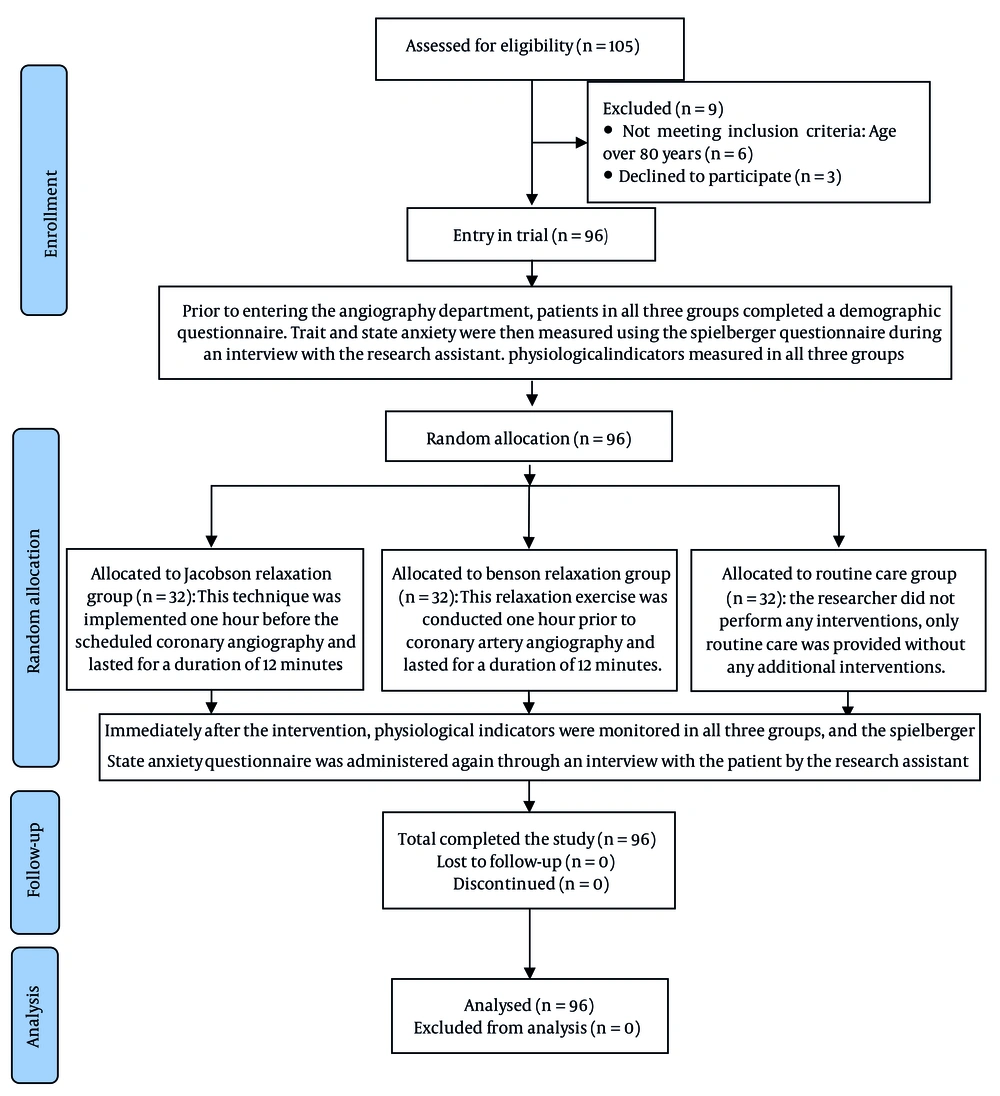
Figure 1.
CONSORT flowchart of the study
3.3. Research Tools
A demographic questionnaire was utilized to gather patient information, such as age, gender, marital status, education, occupation, duration of symptoms, and smoking history. The Spielberger Trait and State Anxiety Questionnaire was used to assess patient anxiety before and after the intervention. The reliability of the State Anxiety Questionnaire was evaluated after the preliminary study using the split-half method, resulting in a reliability coefficient of 0.74.
3.4. Ethical Considerations
Sampling commenced after receiving approval from the Ethics Committee of Semnan University of Medical Sciences (approval No.: IR.SEMUMS.REC.1403.001) and registration in the Iranian Clinical Trials Center (IRCT) under the number IRCT20151228025732N82, along with permission from hospital authorities. The researcher introduced himself to eligible participants, explained the research objectives and methods, ensured confidentiality, and addressed any questions. If participants agreed to participate, informed consent was obtained, and they were enrolled in the study. In the informed consent form, patients were informed that they would be randomly assigned to one of three groups (Jacobson relaxation, Benson relaxation, and usual care).
3.5. Procedures
All patients who participated in the study were randomly assigned to one of three groups: Jacobson relaxation, Benson relaxation, and routine care, using a randomized block design. Assessments and measurements were conducted before and immediately after the intervention by a research assistant. Prior to entering the Angiography Department, patients in all three groups completed a demographic questionnaire. Trait and state anxiety were then measured using the Spielberger Questionnaire during an interview with the research assistant. Trait anxiety was measured as a demographic variable and to help meet the entry criteria.
In the Jacobson relaxation group, the Jacobson progressive muscle relaxation method was presented to the subjects through recorded instructions played on JBL Live 770NC headphones equipped with True Adaptive Noise Cancelling to minimize ambient noise during periods when no therapeutic intervention was being administered. Patients were instructed to follow the progressive muscle relaxation method as directed. The relaxation process began by having the patient lie down in their room on their back with their palms facing upwards, the head of the bed elevated at a 30-degree angle, and their eyes closed. Prior to relaxation, the muscles in each part of the patient's body were carefully identified and divided. Patients were then guided to contract each muscle group as tightly as possible upon command, followed by a specific command to relax those muscles. The relaxation sequence commenced with the right hand, with the patients tightening and loosening the fingers of the right hand before progressing up the arm towards the shoulders and head. This technique was implemented one hour before the scheduled coronary angiography and lasted for a duration of 12 minutes.
In the Benson relaxation group, the Benson muscle relaxation method was presented to the subjects through recorded instructions played on JBL Live 770NC headphones with active noise cancellation to minimize background noise when no therapeutic intervention was taking place. Patients were instructed to follow the Benson relaxation method as guided by the broadcast instructions. The relaxation method involved the participant lying supine in their room with palms facing upwards, the head of the bed elevated at a 30-degree angle, and eyes closed. They were advised to select a soothing word that evoked feelings of peace and to begin deep, rhythmic breathing by inhaling through the nose and exhaling through the mouth while mentally repeating the chosen word. Simultaneously, they were instructed to progressively relax their muscles starting from the toes and working their way up the body until all muscles were completely relaxed. Patients were encouraged to remain still and avoid sudden movements following the completion of the technique. This relaxation exercise was conducted one hour prior to CAA and lasted for a duration of 12 minutes.
In the routine care group, the researcher did not perform any interventions; only routine care (including standard pre-procedure instructions) was provided without any additional interventions. Immediately after the intervention, physiological indicators were monitored in all three groups, and the Spielberger State Anxiety Questionnaire was administered again through an interview with the patient by the research assistant.
3.6. Data Analysis
Statistical analysis was conducted using SPSS.26 software. Descriptive and inferential statistical methods were utilized to analyze the data. The research data were described, categorized, and compared by determining the percentage and creating absolute and relative frequency tables. To analyze the data distribution for normality, the Shapiro-Wilk test was first conducted. If the data were normally distributed, the paired t-test was used to compare scores before and after the intervention. If the data were not normally distributed, the Mann-Whitney test was used. To compare mean scores and differences between the scores of the three different groups, the analysis of variance statistical test was used for normally distributed data, and the Kruskal-Wallis statistical test was used for non-normally distributed data. Additionally, analysis of covariance was utilized to control for the impact of anxiety scores prior to the intervention when comparing the three groups. The Bonferroni post-hoc test was used for pairwise comparisons between means in different cases. A significance level of P < 0.05 was used.
4. Results
To achieve the intended goal of the study, which was to compare the effects of the relaxation methods of Jacobson and Benson on anxiety in patients before CAA, 96 patients undergoing CAA hospitalized in the Angiography Department of Kowsar Hospital in Semnan were studied. Most of the patients in the Jacobson relaxation group (46.9%), Benson relaxation group (43.8%), and routine care group (59.4%) were between 61 - 80 years old. The average age of all patients studied was 58.59 ± 10.55. The majority of patients in all groups were urban residents, married, had an education level below a diploma, were self-employed or housewives, and were non-smokers with symptoms lasting less than one month. There was no significant difference in mean trait anxiety before the intervention among the three groups (Table 1). The difference between the level of situational anxiety before and after the intervention was significant in both the Jacobson and Benson relaxation groups (P < 0.001).
Table 1.Mean and Standard Deviation of Trait Anxiety Before the Intervention of the Research Units in the Three Groups
| Variable | Mean ± SD | P-Value |
|---|---|---|
| Study groups | 0.734 a | |
| Jacobson relaxation | 36.13 ± 5.05 | |
| Benson relaxation | 36.06 ± 3.81 | |
| Routine care | 36.88 ± 4.82 |
a ANOVA test.
After the intervention, the average situational anxiety score decreased by 11.06 in the Jacobson group, 9.69 in the Benson group, and only 0.13 in the routine care group (Table 2). The results of the analysis of covariance, by removing the effect of the situational anxiety score before the intervention (as a covariate), revealed a significant difference in mean situational anxiety among the three groups [F(2,92) = 55.5, P < 0.001, partial eta squared (η2 = 0.547)]. Bonferroni test results indicated that the situational anxiety scores after the intervention were significantly lower in both the Jacobson and the Benson relaxation groups (P < 0.001) compared to the routine care group. However, there was no significant difference in anxiety scores between the Benson and Jacobson groups (P > 0.999).
Table 2.Mean ± Standard Deviation Levels of State Anxiety Before and After Intervention, and Their Difference in the Three Groups: Jacobson Relaxation, Benson Relaxation, and Routine Care a
| Groups | Before Intervention | After Intervention | Difference Before and After Intervention (95% CI) | P-Value |
|---|---|---|---|---|
| Jacobson relaxation | 40.69 ± 6.46 | 29.63 ± 4.40 | 11.06 ± 5.44 (9.10, 13.02) | < 0.001 b |
| Benson relaxation | 38.91 ± 7.00 | 29.22 ± 4.92 | 9.69 ± 6.89 (7.20, 12.17) | < 0.001 b |
| Routine care | 38.41 ± 5.86 | 38.28 ± 6.19 | 0.13 ± 2.54 (-0.79, 1.04) | 0.818 b |
| P-Value | 0.175 c | < 0.001 c | - | - |
Abbreviation: CI, confidence interval.
a Values are expressed as mean ± SD.
b Wilcoxon test.
c Kruskal-Wallis test.
5. Discussion
Regarding the comparison of the mean trait anxiety before the intervention of the research units in the three groups of Jacobson relaxation, Benson relaxation, and routine care, the results showed that the difference between the mean trait anxiety (latent) before the intervention in the three groups was not significant, and the groups were similar in this respect. In a study conducted by Ghods et al. to investigate the effect of Jacobson relaxation on the anxiety levels of patients undergoing percutaneous coronary interventions (PCIs) at Nikan Hospital in Tehran, the results indicated that there was no significant difference in the mean trait anxiety levels between the two intervention and control groups before the intervention (26).
Regarding the mean state anxiety levels before, after, and the difference before and after the intervention in the three groups of Jacobson relaxation, Benson relaxation, and routine care, the results show that the difference between the mean state anxiety levels before and after the intervention was significant in the Jacobson and Benson relaxation groups, but this difference was not significant in the routine care group. Additionally, the difference between the mean situational anxiety score after the intervention was significant in the three groups of Jacobson relaxation, Benson relaxation, and routine care. In pairwise comparisons of the groups, a significant difference was seen between the mean situational anxiety score after the intervention of the Jacobson relaxation group with the routine care group, and the Benson relaxation group with the routine care group, but this difference was not significant between the two Jacobson and Benson relaxation groups. The results of this part of the present study are consistent with the results of many studies that show relaxation techniques reduce anxiety in patients (27-29). In the study by Huddar et al., which aimed to compare Jacobson and Benson relaxation on anxiety in cancer patients in India, the results showed that both techniques were equally effective in reducing anxiety. These results were completely consistent with the results of our study (25).
In a study conducted by Ghods et al. at Nikan Hospital in Tehran, it was found that Jacobson relaxation was effective in reducing anxiety in patients before PCI (26). Another study by Khakha et al. aimed to determine the effects of Jacobson relaxation and deep breathing exercises on anxiety, psychological distress, and sleep quality in elderly hospitalized patients in India. The results indicated a reduction in anxiety and psychological distress, as well as an improvement in sleep quality, in elderly patients following the use of Jacobson relaxation techniques and deep breathing exercises (30). Furthermore, a study by Abdelkhalek et al. aimed to determine the effect of the Jacobson relaxation technique on anxiety in burn patients at the Plastic Reconstructive Surgery Center of Mansoura University, Egypt. The results showed a significant reduction in anxiety with the use of the Jacobson relaxation technique (31).
Progressive muscle relaxation (Jacobson) has been shown to reduce autonomic central nervous system stimulation and increase parasympathetic activity. It also appears to induce attentional shifts and distractions. During progressive muscle relaxation, the patient becomes detached from the stressful situation at hand, and thus the distraction created prevents the increase in anxiety (26).
The effects of Benson relaxation on reducing anxiety have been observed in many studies (24, 32-35). In a study by Tahmasebi and Hasani at the Sari Heart Center, which aimed to determine the effect of Benson relaxation on anxiety in patients undergoing coronary angiography, the results showed that the Benson relaxation technique significantly reduced anxiety levels in the intervention group (36). Similarly, the study by Saifan et al. in Jordan, which aimed to investigate the effectiveness of the Benson relaxation technique in reducing depression, anxiety, and stress among patients with multiple sclerosis, showed that the Benson relaxation technique reduced levels of depression, anxiety, and stress (37). Contrary to these results, the study by Sahrayi Zarghi et al., which aimed to investigate the effect of the Benson relaxation technique on anxiety in patients with acute coronary syndrome, found that the anxiety of patients following Benson relaxation did not decrease significantly (38). Also, in a study by Seifi et al. in Mazandaran, Benson relaxation did not affect the severity of anxiety in patients with heart failure in the cardiac intensive care unit (39).
Benson relaxation improves individual and social functioning by enhancing autonomic nervous activity and relaxing muscles, ultimately increasing positive feelings in the individual (32). Regarding the mechanism and cause of the overall effect of relaxation in reducing anxiety, it should be noted that patients hospitalized in cardiac care units are at risk of hemodynamic instability secondary to anxiety and stress (40). Anxiety can affect beta-adrenergic receptors by increasing sympathetic secretions (41). Following anxiety, plasma concentrations of epinephrine and norepinephrine, levels of adrenocorticoid hormones, prostaglandins, prolactin, and cortisol increase (26, 32), resulting in heightened physiological responses of the body such as respiratory rate, heart rate, blood pressure, and oxygen consumption (26). This also increases myocardial oxygen demand, thereby elevating the risk of ischemia, necrosis, and myocardial infarction and exacerbating CAD symptoms (11).
Relaxation, by creating a balance between the posterior and anterior hypothalamus, reducing sympathetic nervous system activity, and catecholamine secretion, reduces muscle tension and its adverse physiological effects. These changes indicate the positive effect of relaxation on patients' anxiety. The effect of relaxation is also attributed to its impact on some blood chemical variables, including a decrease in adrenal hormones, leading to a reduction in anxiety in patients (32). In fact, muscle relaxation regulates the activity of the nervous system, enhances pleasant feelings, increases mental concentration (21), and is considered a state of relative liberation from the mental and physical effects of stress (19, 20).
5.1. Conclusions
The results of this study suggest that both the Jacobson and Benson progressive muscle relaxation methods are effective in reducing state anxiety in patients prior to CAA. However, there was no significant difference in the effectiveness of these two methods. Therefore, both the Jacobson relaxation method and the Benson relaxation method can be recommended as uncomplicated and cost-effective ways to reduce anxiety and calm patients before CAA. Given the similar effects and differences in the techniques used for Jacobson and Benson relaxation, the choice of relaxation method in a clinical setting should be based on the specific clinical conditions and the patient's individual status.
5.2. Study Limitations
One of the limitations of this study is that anxiety was examined solely as a subjective symptom using the instrument employed, relying only on the patients' responses. Therefore, it is recommended that future studies consider more objective symptoms of anxiety, such as laboratory measurements of cortisol levels, to provide more accurate results in this area. Another limitation of this study is that CAA was performed by three different doctors. The way of interaction and initial behavior of each doctor with the patient is different, and the level of patients' trust in their doctors can influence their anxiety levels; these variables were not taken into account in this study. Additionally, patients' preferences and personal experiences can impact their anxiety levels, which were not controlled for in this study. Cultural and environmental factors that affect the anxiety levels of participating patients, as well as differences in their ability to learn and correctly perform relaxation techniques, may also be limitations of this study. Moreover, since the study was designed and conducted at a single center and the sample was homogeneous (patients from one province in Iran), the generalizability of its results is limited.


