


1. Background
Chronic kidney disease (CKD) is a significant global public health concern, characterized by the progressive decline of renal function, ultimately culminating in end-stage renal disease (ESRD) (1). It is estimated that approximately 850 million individuals worldwide are affected by CKD (2). In Iran, the prevalence of renal failure is reported at 380 cases per million population, with around 90,000 patients undergoing hemodialysis as of 2021 (3). Hemodialysis remains the most commonly employed therapeutic and maintenance modality for patients with ESRD, playing a vital role in prolonging their survival (4). Patients with ESRD occasionally require emergency hemodialysis in addition to their scheduled sessions (5). Emergency hemodialysis is often necessitated by factors such as delayed referral to a nephrologist or inadequate follow-up of the treatment regimen (6, 7).
Although hemodialysis provides essential therapeutic benefits, it is also associated with a wide range of physical, psychological, and social complications, which may contribute to the development of mental health disorders over time in this patient population (8). Stress is one of the most common psychological issues among patients undergoing hemodialysis, representing a natural physiological response to external or internal stressors and stimuli (9, 10). The prevalence of stress in this patient population has been estimated at 51.7% (11). Fear is another frequently observed psychological disorder in hemodialysis patients, often stemming from mistrust of medical interventions or concerns about disability and death (12). The presence of fear may contribute to delays or complete avoidance of timely hemodialysis sessions, potentially resulting in emergency dialysis situations (13).
In managing mental disorders among hemodialysis patients, various complementary medicine approaches, including yoga, acupuncture, and acupressure, have been employed to alleviate stress (11, 14, 15). Among these complementary and alternative therapies, acupressure has gained particular attention due to its non-invasive nature, low risk, cost-effectiveness, and the absence of a requirement for specialized training for the practitioner (16, 17). Multiple studies have demonstrated the efficacy of acupressure in reducing stress (15, 18) and anxiety (18-21) in patients undergoing routine hemodialysis. However, to date, no studies have investigated the use of this method specifically for reducing fear and stress in patients undergoing emergency hemodialysis.
2. Objectives
Therefore, the present study aimed to evaluate the effect of acupressure on amounts of fear and stress in patients undergoing emergency hemodialysis.
3. Methods
This study was designed as a randomized controlled trial with three parallel groups, conducted between May and October 2024. The study population comprised all patients undergoing emergency hemodialysis referred to Imam Khomeini Educational and Medical Center in Sari, Iran. Inclusion criteria were as follows: Age 18 years or older; eligibility for emergency hemodialysis as determined by a nephrologist; full mental alertness; absence of cognitive impairment; a minimum of six months of prior hemodialysis treatment; no history of amputations or pressure point wounds; a score of 44 or higher on the Visual Analogue Scale (VAS) assessing fear and stress (22); no acute psychiatric disorders such as panic attacks or anxiety disorders; no use of sedative medications within the past two weeks; no engagement in complementary therapies such as acupuncture, hypnosis, or yoga within the past six months; no exposure to stressful life events within the past six weeks; and no use of opium within five hours prior to the initiation of hemodialysis (23).
Exclusion criteria included lack of willingness to continue participation, the requirement for cardiopulmonary resuscitation due to hemodynamic instability during hemodialysis, and a reduced level of consciousness during the procedure. Additionally, patients who exhibited elevated levels of fear and stress necessitating therapeutic intervention, as determined by the attending physician, were excluded from the study. Notably, none of the participants experienced such increases in fear or stress during the study.
Following the acquisition of ethics approval code IR.MAZUMS.REC.1403.012 and clinical trial registration number IRCT20110906007494N45, the researcher collected samples from the hemodialysis ward of Imam Khomeini Educational and Medical Center in Sari. Prior to enrollment, the researcher introduced the study and explained its objectives, after which written informed consent was obtained from all participants. Confidentiality of personal information was assured, and participants were informed of their right to withdraw from the study at any time without consequences.
3.1. Sample Size
This study employed convenience sampling. The sample size calculation was based on the findings of Gurusamy and Gandhimathi, who reported a mean (± standard deviation) stress score of 30.80 ± 6.05 in the intervention group and 65.98 ± 6.85 in the control group four weeks post-intervention (15). Given that the present study assessed participants immediately following the intervention, and based on the research team’s expectation of a 20% difference in mean scores between the two groups (approximately 7 units), a sample size of 24 participants per group was estimated using a 5% significance level (α = 0.05) and 95% power (1 - β = 0.95). To account for an anticipated 20% attrition rate, the sample size was increased to 30 participants per group, resulting in a total of 90 participants.
3.2. Random Allocation
To allocate participants into three groups, a stratified block randomization method was employed based on gender. The unit of randomization was the individual, and blocks of three were created separately for each gender. A total of 30 blocks (15 for women and 15 for men) were prepared. Group assignments (A, B, and C) and their sequence within each block were determined using the Random Allocation Software, version 2. Subsequently, the numbers 1 to 3 were randomly assigned to the envelopes corresponding to each block, aligning with the group codes (A, B, and C) generated by the software. Group A represented the acupressure intervention, group B the sham intervention, and group C served as the control. Each assignment was sealed in an opaque envelope to ensure allocation concealment.
3.3. Intervention
In the acupressure group, each intervention session involved symmetrical pressure applied to six specific acupoints: ST36, K3, GB34, SP6, K1, and GV29, using the researcher’s thumb with a force of 3 kg for three minutes per point, totaling 18 minutes per session (24). The intervention was administered at one and two hours after the initiation of hemodialysis. The ST36 (Zusanli) point is located four finger-widths below the lower border of the patella and approximately 2.5 cm lateral to the tibial crest (15, 25). The K3 (Taixi) point lies in the depression between the medial malleolus and the Achilles tendon (18, 25). The GB34 point is situated in the anteroinferior depression of the fibular head (15). The SP6 (Sanyinjiao) point is located on the medial aspect of the lower leg, three CUNs above the prominence of the medial malleolus, along the posterior border of the tibia, on the spleen meridian (15, 25, 26). The K1 (Yongquan) point is positioned at the junction of the anterior one-third and posterior two-thirds of the sole, between the second and third toes (15, 26). The GV29 (Yintang) point is located at the midpoint between the eyebrows (18).
In the sham group, to create conditions comparable to the intervention and control groups, pressure was applied approximately 2 centimeters away from the actual acupressure points instead of directly on them (24, 27, 28). In the control group, no acupressure intervention was conducted by the research team to avoid inducing fear or stress. Furthermore, all participants across the three groups received standard patient education, including guidance on appropriate diet and fluid restrictions, fistula care, and instructions regarding Permicet and Chaldon for 10 minutes, along with routine nursing care provided in the hemodialysis unit. For all three groups, the questionnaires were completed by an individual other than the therapist.
3.4. Study Outcomes
The primary outcomes of the study were amounts of fear and stress. These outcomes were measured during the first hour of the intervention, one and two hours afterward, and immediately prior to the patient’s disconnection from the hemodialysis machine.
3.5. Study Instruments
The instruments used in this study included a demographic and medical information questionnaire, the mini mental state examination (MMSE), and two VASs for assessing fear and stress. The demographic and medical questionnaire collected data on variables such as age, gender, occupation, marital status, educational level, place of residence, history of hemodialysis, presence of underlying diseases, reasons for undergoing emergency hemodialysis, type of vascular access, causes of fear related to emergency hemodialysis, and presenting symptoms at the initiation of emergency hemodialysis.
Fear was assessed using a VAS, consisting of a 100 mm horizontal line, with 0 mm representing "no fear" and 100 mm indicating "maximum fear". Patients marked the point on the scale that best represented their amount of fear. The scale was categorized as follows: 0 - 4 mm (no fear), 5 - 44 mm (mild fear), 45 - 74 mm (moderate fear), and 75 - 100 mm (severe fear). A score of 45 mm or higher was an inclusion criterion (22). This instrument has been used in both national (29) and international (30, 31) studies for evaluating dental fear and fear associated with hemodialysis procedures (32).
The validity of the VAS for stress assessment is supported by its correlation with the Perceived Stress Scale (r = 0.58, P < 0.001) and the Short Form Stress Scale (r = 0.6120, P < 0.001) (33). Stress was evaluated using a VAS with the same 100 mm format as the fear assessment (22). This tool is widely used in stress-related research (33-36), including studies on hemodialysis patients (37-39), and has been employed in Iranian research on occupational stress among hospital midwives (40) and stress during the first stage of labor in primiparous women (41).
3.6. Data Analysis
Data were described using frequency, percentage, mean, and standard deviation. For inferential analysis, the normality of the variables was assessed using the Shapiro-Wilk test. The chi-square test and Fisher’s exact test were used to examine relationships between qualitative variables. Depending on the normality of the variables, analysis of variance (ANOVA) was conducted to compare mean fear and stress, followed by the Bonferroni post hoc test. Repeated measures ANOVA (rANOVA) was used to compare mean fear and stress at different time points within each group, accompanied by Cohen’s effect size test. All analyses were conducted using SPSS version 23, with a significance level set at P < 0.05. Data analysis was performed according to the per-protocol method.
4. Results
A total of 122 patients undergoing emergency hemodialysis were screened for eligibility based on the inclusion criteria. Of these, 90 patients met the criteria and were subsequently enrolled in the study. The participants were then randomly allocated into three groups (Figure 1).
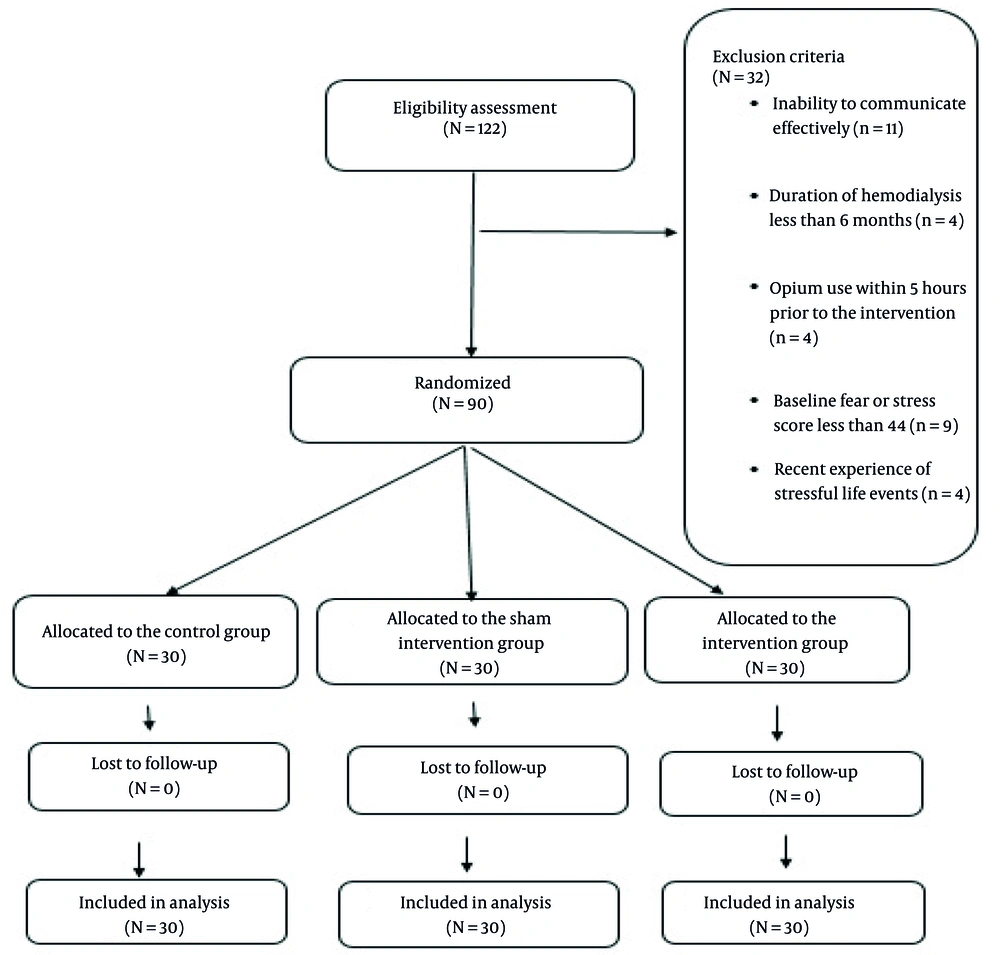
Figure 1.
The flow diagram of participants through the stages of study entry, randomization, follow-up, and data analysis
A comparison of the mean demographic and clinical variables among the three study groups revealed no statistically significant differences (Table 1).
Table 1.Comparison of Demographic and Clinical Characteristics Among the Three Groups a
| Variables | Acupressure Group | Sham Intervention Group | Control Group | Total | P-Value |
|---|---|---|---|---|---|
| Gender | 0.999 b | ||||
| Female | 15 (50) | 15 (50) | 15 (50) | 45 (50) | |
| Male | 15 (50) | 15 (50) | 15 (50) | 45 (50) | |
| Occupation | 0.742 c | ||||
| Housewife | 15 (50) | 11 (36.7) | 14 (46.7) | 40 (44.4) | |
| Employee | 0 | 1 (3.3) | 1 (3.3) | 2 (2.2) | |
| Retired | 8 (26.7) | 7 (23. 3) | 9 (30) | 24 (26.7) | |
| Self-employed | 7 (23.3) | 11 (36.7) | 6 (20) | 24 (26.7) | |
| Marital Status | 0.749 b | ||||
| Married | 25 (83.3) | 26 (86.7) | 27 (90) | 78 (86.86) | |
| Unmarried | 5 (16.67) | 4 (13.33) | 3 (10) | 12 (13.33) | |
| Education level | 0.492 c | ||||
| < Diploma | 23 (76.7) | 21 (70) | 18 (60) | 62 (68.9) | |
| Diploma | 5 (16.7) | 8 (26.7) | 11 (36.7) | 24 (26.7) | |
| Bachelor’s | 1 (3.3) | 1 (3.3) | 2 (6.7) | 4 (4.4) | |
| Diabetes | 0.732 b | ||||
| Yes | 17 (56.7) | 16 (53.3) | 17 (56.7) | 47 (52.2) | |
| No | 16 (53.3) | 14 (46.7) | 13 (43.3) | 43 (47.8) | |
| Hypertension | 0.870 b | ||||
| Yes | 17 (56.7) | 18 (60) | 19 (63.3) | 54 (60) | |
| No | 13 (43.3) | 12(40) | 11 (36.7) | 36 (40) | |
| Pulmonary disease | 0.572 b | ||||
| Yes | 8 (26.7) | 5 (16.7) | 8 (26.7) | 21 (23.3) | |
| No | 22 (73.3) | 25 (83.3) | 22 (73.3) | 69 (76.7) |
a Values are expressed as No. (%).
b Chi-square test.
c Fisher’s exact test.
Based on the data presented in Table 2 and the results of the ANOVA, no statistically significant differences were observed in the mean fear scores among the three groups prior to the intervention. However, at the fourth time point, immediately before disconnection from the hemodialysis machine, a statistically significant difference was found between the groups (P < 0.001). Specifically, the mean fear score was lowest in the acupressure group, followed by the sham intervention group, and highest in the control group.
Table 2.Comparison of Mean Fear and Stress Scores Among the Three Groups at Different Times a
| Times | Fear | Stress | ||||||
|---|---|---|---|---|---|---|---|---|
| Acupressure Group | Sham Group | Control Group | P-Value | Acupressure Group | Sham Group | Control Group | P-Value | |
| Before intervention | 81.53 ± 10.19 | 79.4 ± 13.04 | 76.37 ± 12.97 | 0.259 b | 81.23 ± 9.62 | 80.5 ± 13.02 | 77.7 ± 12.36 | 0.473 b |
| One hour after | 72.93 ± 8.93 | 74.53 ± 12.87 | 73.3 ± 12.82 | 0.857 b | 72 ± 19.15 | 75.03 ± 12.21 | 74.63 ± 12.08 | 0.527 b |
| Two hours after | 65.33 ± 8.43 | 69.37 ± 12.59 | 70.6 ± 12.64 | 0.179 b | 64.83 ± 8.28 | 70.3 ± 11.98 | 72 ± 12.13 | 0.034 b |
| Before disconnection | 56.1 ± 6.9 | 64.37 ± 12.4 | 68.67 ± 12.94 | < 0.001 c | 57.23 ± 7.28 | 65.4 ± 12.25 | 69.96 ± 12.03 | < 0.001 c |
| P-value | < 0.001 c | < 0.001 c | < 0.001 c | < 0.001 c | < 0.001 c | < 0.001 c | ||
Abbreviations: ANOVA, analysis of variance; rANOVA, repeated measures ANOVA..
a Values are expressed as mean ± SD.
b ANOVA test.
c rANOVA test.
Regarding the mean stress scores, ANOVA results indicated no significant differences among the groups prior to the intervention. Nonetheless, significant differences emerged at the third and fourth time points, two hours after the intervention (P = 0.034) and immediately before disconnection from the hemodialysis machine (P < 0.001), respectively. At both time points, the acupressure group demonstrated significantly lower mean stress scores compared to the sham intervention and control groups (Table 2).
Furthermore, the results of the rANOVA revealed that within each of the three study groups, the trends in changes in both the mean fear and mean stress scores across different time points were statistically significant (P < 0.001) (Figures 2 and 3).
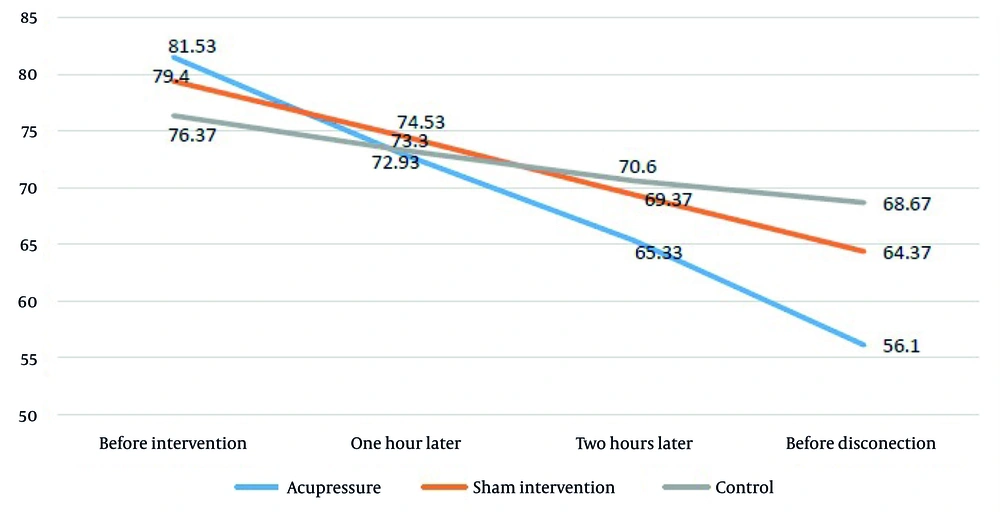
Figure 2.
Trend of changes in the mean fear score over time in the acupressure, sham intervention, and control groups
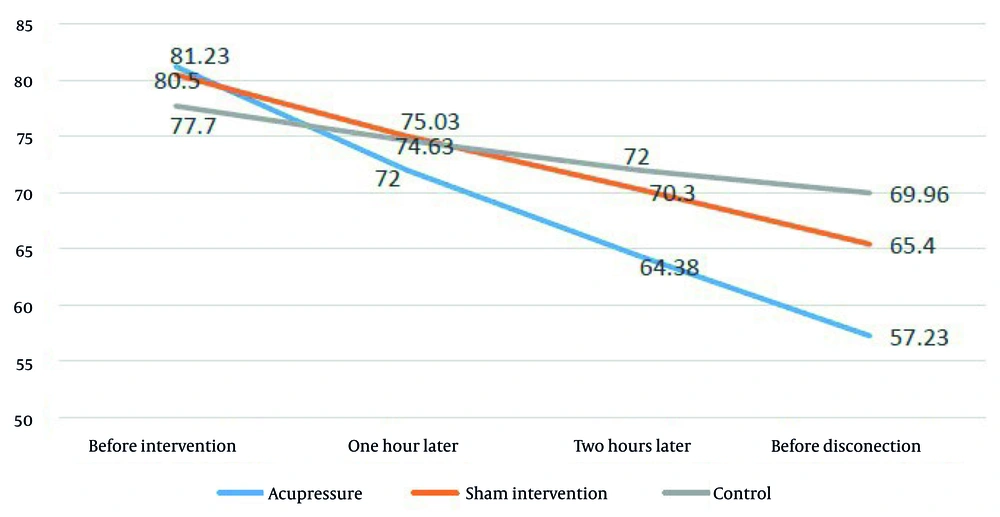
Figure 3.
Trend of changes in the mean stress score over time in the acupressure, sham intervention, and control groups
To identify pairwise differences between the study groups, the Bonferroni post hoc test was employed. The results indicated that the mean fear score prior to disconnection from the hemodialysis machine was significantly lower in the acupressure group compared to both the sham intervention group (P = 0.015) and the control group (P < 0.001). Specifically, the mean fear score in the acupressure group was 8.27 points lower than in the sham intervention group and 12.57 points lower than in the control group. However, no statistically significant difference was observed between the sham intervention and control groups (P = 0.413). Regarding the pairwise comparisons of mean stress scores, the Bonferroni post hoc test revealed that two hours after the intervention, the acupressure group showed a statistically significant reduction in stress compared to the control group (P = 0.039). Additionally, prior to disconnection from the hemodialysis machine, the acupressure group exhibited significantly lower stress scores than both the sham intervention group (P = 0.013) and the control group (P < 0.001) (Table 3).
Table 3.Pairwise Comparison of Mean of Fear and Stress at Different Times
| Outcome, Times and Group Comparison | Mean difference of Fear and Stress at Different Times | P-Value a |
|---|---|---|
| Fear | ||
| Before disconnection | ||
| Acupressure | ||
| Sham | -8.27 ± 2.87 | 0.015 |
| Control | -12.57 ± 2.87 | < 0.001 |
| Sham | ||
| Control | -4.30 ± 2.87 | 0.413 |
| Stress | ||
| Two hours after | ||
| Acupressure | ||
| Sham | -5.47 ± 2.83 | 0.169 |
| Control | -7.17 ± 2.83 | 0.039 |
| Sham | ||
| Control | -1.70 ± 2.83 | 0.999 |
| Before disconnection | ||
| Acupressure | ||
| Sham | -8.17 ± 2.83 | 0.013 |
| Control | -12.70 ± 2.83 | < 0.001 |
| Sham | ||
| Control | -4.53 ± 2.83 | 0.320 |
a Bonferroni post hoc test.
To evaluate the magnitude of the effect between groups, Cohen’s effect size classification was used, where values less than 0.2 indicate a small effect, 0.5 a medium effect, and 0.8 or greater a large effect size. The results of Cohen’s test demonstrated that the effect size for fear scores prior to the patient’s disconnection from the hemodialysis machine was 1.21 between the acupressure and control groups, and 0.82 between the acupressure and sham intervention groups, indicating a large effect size in both comparisons. Similarly, regarding the mean stress scores, the effect size was 1.28 between the acupressure and control groups and 0.81 between the acupressure and sham intervention groups, again reflecting a large effect size between groups (Table 4).
Table 4.Effect Sizes of Fear and Stress in the Group
| Times | Fear | Stress | ||||
|---|---|---|---|---|---|---|
| Acupressure vs. Control | Sham vs. Control | Acupressure vs. Sham | Acupressure vs. Control (Fear) | Sham vs. Control (Fear) | Acupressure vs. Sham | |
| One hour after | 0.03 | 0.09 | 0.14 | 0.24 | 0.03 | 0.28 |
| Two hours after | 0.49 | 0.10 | 0.37 | 0.69 | 0.14 | 0.53 |
| Before disconnection | 1.21 | 0.40 | 0.82 | 1.28 | 0.37 | 0.81 |
5. Discussion
The present study was a randomized controlled trial aimed at determining the effect of acupressure on amounts of fear and stress in emergency hemodialysis patients, and comparing its effect with two groups: Sham intervention and control. In summary, the researcher reached the following conclusions from the review and analysis of the findings. The findings of this study, which assessed the amount of fear among hemodialysis patients at various time points, demonstrated a statistically significant reduction in mean fear scores across all three study groups, from the first hour of the intervention until the patients were disconnected from the hemodialysis machine. Notably, the reduction in fear was more pronounced in the acupressure group compared to the sham and control groups.
A review of existing literature on the effects of acupressure on psychological conditions such as fear, stress, and anxiety revealed a lack of studies examining its impact within groups at multiple time points during an intervention. Previous research on fear in hemodialysis patients has primarily focused on specific types of fear, such as fear of falling and fear of needles (42, 43). Moreover, these studies employed various fear assessment tools and did not evaluate fear during emergency hemodialysis sessions.
When comparing fear amounts at the measured time points across the acupressure, sham intervention, and control groups, the results indicated no statistically significant differences in mean fear scores between the groups at baseline (prior to the intervention), one hour post-intervention, and two hours post-intervention. A statistically significant difference emerged only immediately before disconnection from the hemodialysis machine, with the acupressure group exhibiting a greater reduction in mean fear scores compared to both the sham and control groups. Furthermore, the results of Cohen’s test demonstrated that the effect size of the fear score prior to disconnection from the hemodialysis machine was 1.21 between the acupressure and control groups, and 0.82 between the acupressure and sham intervention groups, indicating a large effect size between the groups (44, 45).
A review of the available literature revealed no prior studies specifically investigating the effect of acupressure on fear in hemodialysis patients. However, several studies have examined its impact on anxiety in this population. Moradi et al. (20) reported that acupressure significantly improved both latent and obvious anxiety in hemodialysis patients compared to controls. Similarly, Siasari et al. (21) found that administering acupressure three times per week over a four-week period significantly reduced anxiety levels in this patient group. Suandika et al. (25) also confirmed the effectiveness of acupressure in reducing anxiety among hemodialysis patients in a clinical trial.
Regarding the comparison of stress amounts at the measured time points within the acupressure, sham intervention, and control groups, the results indicated that stress scores decreased in all three groups from the initial measurement (prior to the intervention) to the final time point (immediately before disconnection from the hemodialysis machine). This reduction was statistically significant across all groups. However, the reduction in mean stress scores was more pronounced in the acupressure group compared to the sham intervention and control groups.
A review of the literature revealed no studies examining the effect of time on acupressure’s impact on stress specifically in emergency hemodialysis patients. Nonetheless, the pre-intervention mean stress scores in this study may be compared with those reported in previous research. For instance, Gurusamy and Gandhimathi (15) reported a mean pre-intervention stress score of 66.90 ± 4.28, which is lower than the corresponding values in the present study: 81.23 ± 9.62 in the acupressure group, 80.5 ± 13.02 in the sham intervention group, and 77.7 ± 12.36 in the control group. This discrepancy may be attributed to the emergency nature of hemodialysis in the current study, as the patients underwent unscheduled treatment, potentially contributing to elevated stress levels.
In comparing mean stress amounts between the acupressure and control groups at the designated time points, a statistically significant difference was observed two hours after the start of the intervention, as well as immediately before patient disconnection from the hemodialysis machine. Specifically, stress scores in the acupressure group were significantly lower than those in both the sham intervention and control groups at these time points. Additionally, Cohen’s test results revealed a large effect size for the stress score prior to patient separation from the hemodialysis machine, with values of 1.28 between the acupressure and control groups and 0.81 between the acupressure and sham intervention groups (44, 45).
Consistent with the findings of the present study, Gurusamy and Gandhimathi (15) conducted a controlled trial to evaluate the effectiveness of acupressure on stress in hemodialysis patients. Their results demonstrated that acupressure significantly reduced stress levels in the intervention group at both the fourth and eighth weeks of treatment compared to the control group. Hmwe et al. (18) also demonstrated that administering acupressure for four weeks (three 15-minute sessions per week) significantly reduced stress in hemodialysis patients in the intervention group compared to the control group. Although the findings of these prior studies align with the results of the present study, it is important to note that the current investigation focused specifically on patients undergoing emergency hemodialysis. In this context, stress amounts were assessed from the initiation of treatment until immediately prior to disconnection from the hemodialysis machine. These findings suggest that acupressure may not only be effective in reducing stress during routine hemodialysis but may also serve as a beneficial intervention for mitigating stress in patients undergoing emergency hemodialysis.
5.1. Conclusions
A comparison of the changes in mean fear and stress scores within the groups during the study period revealed that, while significant changes in both fear and stress scores occurred in all three groups—acupressure, sham intervention, and control—the changes were more pronounced in the acupressure group compared to the sham intervention and control groups. Based on the observed effectiveness of acupressure in reducing fear and stress amounts in emergency hemodialysis patients, it is concluded that this intervention can be utilized as a complementary approach to alleviate fear and stress in this patient population.
5.2. Limitations
Although the researcher could not control the external problems and crises that participants faced, such as economic and social issues, these factors may have influenced the amounts of fear and stress experienced by the participants.


