
1. Background
Chronic kidney disease (CKD) is a prevalent condition posing significant global health risks, with an estimated prevalence of approximately 13.4% (1). End-stage renal disease (ESRD), the most severe stage of CKD, is characterized by a glomerular filtration rate (GFR) less than 15 mL/min/1.73 m2 and can lead to mortality without renal replacement therapy (RRT) (2). Currently, nearly 4 million people rely on RRT, with hemodialysis (HD) being the most common modality (69%). Although HD sustains life, it is associated with substantial limitations in cost, accessibility, and treatment outcomes, with considerable disparities observed across countries (3).
Patients undergoing HD face numerous psychological stresses due to physical changes and disease-related factors, resulting in high rates of anxiety and depression (4, 5). Uncontrolled mental disorders adversely affect treatment processes and prognosis. Previous studies have reported depression prevalence ranging from 28.2% to 85.98% and anxiety disorders from 23.2% to 84.11% in HD patients. Contributing factors include age, gender, occupation, duration of dialysis, smoking, physical activity, and comorbidities (6-9). In addition to the physical and financial burden, HD patients in low- and middle-income countries often receive limited psychosocial support, and mental health screening is not routinely integrated into dialysis care.
The burden of CKD is rapidly increasing in low- and middle-income countries, including Vietnam (10), driven by the rise of diabetes, hypertension, and population aging. Yet, mental health issues among Vietnamese HD patients remain under-investigated, especially in the southern region. Existing care models still focus mainly on biomedical parameters, overlooking emotional and psychological needs. This lack of contextual data hinders the development of targeted interventions to support mental well-being in this vulnerable group.
2. Objectives
This study aims to investigate the prevalence of anxiety and depression disorders and the related factors in CKD patients undergoing HD, to provide evidence for early detection strategies and to propose appropriate measures to enhance mental healthcare for these patients in Vietnam.
3. Methods
3.1. Study Design
A cross-sectional study was conducted from February to March 2024 at the Department of Nephrology-Dialysis, University Medical Center Ho Chi Minh City (UMC HCMC), to assess the prevalence and factors associated with anxiety and depression among CKD patients on HD. Eligible participants were adults aged 18 years or older who were undergoing HD and provided informed consent to participate. Exclusion criteria included emergency cases, ongoing cancer treatment, hearing or cognitive impairments, diagnosed psychiatric disorders, or incomplete responses to the Anxiety and Depression Assessment Scales. Participants were identified and selected based on patient lists and medical records.
The sample size was calculated using the formula for estimating a proportion. Based on a study by Qawaqzeh et al. (11), which reported depression and anxiety rates of 55.2% and 50%, respectively, in HD patients in Jordan, with d = 0.1, the minimum sample size was 95 for depression and 97 for anxiety. Allowing a 10% attrition rate, the final sample size was 108 patients.
3.2. Data Collection
Data were gathered through a pre-designed, interviewer-administered questionnaire consisting of multiple-choice questions. A convenience sampling method was employed to recruit participants who met the inclusion criteria. The questionnaire comprised a total of 28 items, including 5 items on sociodemographic characteristics, 5 on clinical characteristics, 3 on living habits (which included sub-questions on exercise frequency), 1 related to supportive relationships, and 14 items from the Hospital Anxiety and Depression Scale (HADS).
3.3. Hospital Anxiety and Depression Scale
Anxiety and depression were assessed using the HADS, developed by Zigmond and Snaith in 1983 (12). The HADS is a widely used, validated, and concise tool consisting of 14 items — 7 assessing anxiety and 7 assessing depression. Each item is scored from 0 to 3, with a maximum score of 21 points for each subscale, indicating symptom severity. Although the anxiety and depression items are interspersed, they are scored separately using established cut-off thresholds to identify symptom levels (13).
The HADS is efficient, typically requiring only 2 - 5 minutes to complete, and is considered easy to score (14). In studies conducted in Vietnam, the HADS has demonstrated good internal consistency, with Cronbach’s alpha coefficients of 0.80 or higher for both subscales and the overall scale (15, 16).
3.4. Statistical Analysis
Data were entered using Epidata 4.6 and analyzed with Stata 17. Continuous variables are presented as mean ± standard deviation (SD), and categorical variables as frequencies and percentages. Chi-square or Fisher’s exact tests were used to examine associations between variables. A generalized linear model (GLM) estimated prevalence ratios (PR) with 95% confidence intervals for ordinal or nominal predictors and binary outcomes. Statistical significance was set at P < 0.05.
3.5. Ethical Consideration
This study was approved by the Biomedical Ethics Committee of the University of Medicine and Pharmacy at Ho Chi Minh City (approval No. 231047-DHYD) and conducted in accordance with the Declaration of Helsinki. Written informed consent was obtained from all participants. Confidentiality and anonymity were maintained throughout the research.
4. Results
Of 115 screened HD patients, 108 met the inclusion criteria and were analyzed. Exclusions (n = 7) comprised the following: Refusal to participate (n = 2), non-CKD (n = 2), emergency dialysis (n = 2), and active cancer treatment (n = 1).
4.1. Participant Characteristics
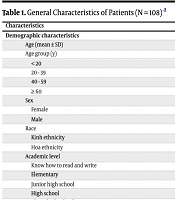
Table 1 summarizes the general characteristics of the 108 study participants. The mean age was 59.5 ± 18.6 years (range: 19 - 96), with 55.6% aged 60 years or older. Females comprised 61.1% of the sample, and 87.0% identified as Kinh ethnicity. Most participants had attained at least a junior high school education or higher. The majority reported a medium economic status. Regarding clinical characteristics, the most common duration of HD was between one and less than three years (48.1%). Most patients (80.5%) received HD three times per week. Smoking and alcohol consumption were uncommon, reported by 6.5% and 2.8% of participants, respectively. Approximately half of the participants (49.1%) engaged in regular exercise.
Table 1.
General Characteristics of Patients (N = 108) a
| Characteristics | Values |
|---|---|
| Demographic characteristics | |
| Age (mean ± SD) | 59.5 ± 18.6 |
| Age group (y) | |
| < 20 | 2 (1.8) |
| 20 - 39 | 19 (17.6) |
| 40 - 59 | 27 (25.0) |
| ≥ 60 | 60 (55.6) |
| Sex | |
| Female | 66 (61.1) |
| Male | 42 (38.9) |
| Race | |
| Kinh ethnicity | 94 (87.0) |
| Hoa ethnicity | 14 (13.0) |
| Academic level | |
| Know how to read and write | 7 (6.5) |
| Elementary | 19 (17.6) |
| Junior high school | 23 (21.3) |
| High school | 22 (20.4) |
| Above high school | 37 (34.2) |
| Home economics | |
| Lack | 5 (4.6) |
| Medium | 75 (69.4) |
| Wealthier | 26 (24.1) |
| Rich | 2 (1.9) |
| Clinical characteristics | |
| Duration of HD (y) | |
| < 1 | 26 (24.1) |
| 1 to < 3 | 52 (48.1) |
| 3 to < 5 | 23 (21.3) |
| ≥ 5 | 7 (6.5) |
| Frequency of HD/week | |
| 2 times | 18 (16.7) |
| 3 times | 87 (80.5) |
| > 3 times | 3 (2.8) |
| Complications during HD | 45 (41.7) |
| Comorbidities (n = 102) | |
| Hypertension | 81 (79.4) |
| Diabetes | 51 (50.0) |
| Cardiovascular | 53 (52.0) |
| Other diseases | 48 (47.1) |
| Living habits characteristics | |
| Habits | |
| Smoking | 7 (6.5) |
| Drinking alcohol | 3 (2.8) |
| Doing exercise | 53 (49.1) |
| Number of exercise days (n = 53) | |
| < 2 | 5 (9.4) |
| 2 - 5 | 21 (39.6) |
| ≥ 5 | 27 (51.0) |
| Supportive relationships | |
| Support outside the family | 24 (22.2) |
Abbreviations: SD, standard deviation; HD, hemodialysis.
a Values are expressed as No. (%) unless indicated.
4.2. Prevalence of Anxiety and Depression
Among the 108 patients, 40.7% exhibited signs of depression, with 36.1% classified as having mild symptoms, while 23.2% showed no signs of depression. Regarding anxiety, 29.6% of patients presented symptoms, including 28.7% with mild anxiety, and 41.7% reported no anxiety symptoms. Furthermore, 13.0% of patients were diagnosed with both anxiety and depression disorders (Table 2).
Table 2.
Prevalence of Anxiety and Depression Based on Hospital Anxiety and Depression Scale Scores (N = 108) a
| HADS Scores | Depression | Anxiety |
|---|---|---|
| Normal (0 - 7 points) | 25 (23.2) | 45 (41.7) |
| Borderline abnormal (8 - 10 points) | 39 (36.1) | 31 (28.7) |
| Abnormal (11 - 21 points) | 44 (40.7) | 32 (29.6) |
| Both depression and anxiety | ||
| No | 94 (87.0) | - |
| Yes | 14 (13.0) | - |
Abbreviation: HADS, Hospital Anxiety and Depression Scale.
a Values are expressed as No. (%).
4.3. Factors Associated with Anxiety and Depression
Factors associated with anxiety and depression are summarized in Table 3. Anxiety was significantly more prevalent in patients aged 40 - 59 compared to those under 40 years (51.8% vs. 14.3%, P = 0.023), and in smokers (71.4% vs. 28.6%, P = 0.023). Conversely, anxiety was less common in patients with wealthier economic status (11.5%, P = 0.001) and was absent in those undergoing HD more than three times per week (P < 0.001).
Table 3.
Factors Related to Anxiety and Depression (N = 108) a
| Characteristic | Anxiety | Depression | ||||
|---|---|---|---|---|---|---|
| Yes | No | P-Value | Yes | No | P-Value | |
| Demographic characteristics | ||||||
| Age group (y) | ||||||
| < 40 | 3 (14.3) | 18 (85.7) | - | 2 (9.5) | 19 (90.5) | - |
| 40 - 59 | 14 (51.8) | 13 (48.2) | 0.023 | 10 (37.0) | 17 (63.0) | 0.001 |
| ≥ 60 | 15 (25.0) | 45 (75.0) | 0.336 | 32 (53.3) | 28 (46.7) | |
| Sex | ||||||
| Female | 17 (25.8) | 49 (74.2) | 0.269 | 30 (45.5) | 36 (54.5) | 0.211 |
| Male | 15 (35.7) | 27 (64.3) | - | 14 (33.3) | 28 (66.7) | - |
| Ethnicity | ||||||
| Kinh ethnicity | 28 (29.8) | 66 (70.2) | - | 34 (36.2) | 60 (63.8) | - |
| Hoa ethnicity | 4 (28.6) | 10 (71.4) | 0.927 | 10 (71.4) | 4 (28.6) | 0.002 |
| Education level | ||||||
| Literate | 1 (14.3) | 6 (85.7) | - | 6 (85.7) | 1 (14.3) | - |
| Elementary | 4 (21.0) | 15 (79.0) | 0.707 | 12 (63.2) | 7 (36.8) | - |
| Junior high school | 10 (43.5) | 13 (56.5) | 0.246 | 11 (47.8) | 12 (52.2) | < 0.001 |
| High school | 9 (40.9) | 13 (59.1) | 0.276 | 5 (22.7) | 17 (77.3) | - |
| Above high school | 8 (21.6) | 29 (78.4) | 0.673 | 10 (27.0) | 27 (73.0) | - |
| Socioeconomic status | ||||||
| Low | 3 (60.0) | 2 (40.0) | - | 2 (40.0) | 3 (60.0) | - |
| Medium | 26 (34.7) | 49 (65.3) | - | 32 (42.7) | 43 (57.3) | 0.909 |
| Wealthier | 3 (11.5) | 23 (88.5) | 0.001 | 9 (34.6) | 17 (65.4) | 0.814 |
| Rich | 0 | 2 (100) | - | 1 (50.0) | 1 (50.0) | 0.804 |
| Clinical characteristics | ||||||
| HD duration (y) | ||||||
| < 1 | 8 (30.8) | 18 (69.2) | - | 8 (30.8) | 18 (69.2) | - |
| 1 to < 3 | 13 (25.0) | 39 (75.0) | 0.586 | 23 (44.2) | 29 (55.8) | 0.278 |
| 3 to < 5 | 10 (43.5) | 13 (56.5) | 0.363 | 11 (47.8) | 12 (52.2) | 0.230 |
| ≥ 5 | 1 (14.3) | 6 (85.7) | 0.432 | 2 (28.6) | 5 (71.4) | 0.912 |
| HD frequency/week | ||||||
| 2 times | 6 (33.3) | 12 (66.7) | - | 5 (27.8) | 13 (72.2) | - |
| 3 times | 26 (29.9) | 61 (70.1) | 0.770 | 37 (42.5) | 50 (57.5) | 0.289 |
| > 3 times | 0 | 3 (100) | < 0.001 | 2 (66.7) | 1 (33.3) | 0.118 |
| Complications during HD | 12 (26.7) | 33 (73.3) | 0.569 | 24 (53.3) | 21 (46.7) | 0.024 |
| Comorbidities (n = 102) | ||||||
| Hypertension | 26 (32.1) | 55 (67.9) | 0.242 | 35 (43.2) | 46 (56.8) | 0.672 |
| Diabetes | 15 (29.4) | 36 (70.6) | 1.000 | 28 (54.9) | 23 (45.1) | 0.009 |
| Cardiovascular | 15 (28.3) | 38 (71.7) | 0.798 | 25 (47.2) | 28 (52.8) | 0.286 |
| Other diseases | 11 (22.9) | 37 (77.1) | 0.175 | 21 (43.7) | 27 (56.3) | 0.759 |
| Life style characteristics | ||||||
| Habits | ||||||
| Smoke | 5 (71.4) | 2 (28.6) | 0.023 b | 2 (28.6) | 5 (71.4) | 0.698 b |
| Drink alcohol | 2 (66.7) | 1 (33.3) | 0.209 b | 0 | 3 (100) | 0.269 b |
| Do exercise | 15 (28.3) | 38 (71.7) | 0.767 | 16 (30.2) | 37 (69.8) | 0.029 |
| Number of exercise days (n = 53) | ||||||
| < 2 | 1 (20.0) | 4 (80.0) | - | 3 (60.0) | 2 (40.0) | - |
| 2 - 5 | 5 (23.8) | 16 (76.2) | 0.860 | 8 (38.1) | 13 (61.9) | 0.023 |
| ≥ 5 | 9 (33.3) | 18 (66.7) | 0.588 | 5 (18.5) | 22 (81.5) | - |
| Supportive relationships | ||||||
| Support outside the family | 10 (41.7) | 14 (58.3) | 0.143 | 5 (20.8) | 19 (79.2) | 0.024 |
Abbreviation: HD, hemodialysis.
a Values are expressed as No. (%).
b Fisher exact test.
Depression was associated with a wider range of factors, including older age (P = 0.001), Hoa ethnicity (71.4% vs. 36.2% in Kinh, P = 0.002), lower educational attainment (P < 0.001), and the presence of diabetes (P = 0.009). Clinical factors such as complications during HD (P = 0.024) and lifestyle factors like lower physical activity (< 5 days/week, P = 0.023) were also significant predictors. Finally, a lack of external family support was significantly associated with depression (P = 0.024).
5. Discussion
Depression and anxiety remain significant psychological burdens among patients undergoing RRT (6-9). From February to March 2024, 108 CKD patients on HD at UMC HCMC were surveyed; nearly one-third had anxiety, over 40% had depression, and about 13% experienced both. These rates exceed those in the general population (17), but remain lower than rates reported for other chronic illnesses such as cancer (18-20).
Globally, anxiety and depression rates among CKD patients vary. Seeman et al. reported rates of 40.8% for depression, 39.6% for anxiety, and 24.1% for both, while Alshelleh et al. and Elezi et al. found rates as high as 85.98% and 84.11%, respectively (9, 21, 22). In contrast, a study from the Arab region found lower prevalence rates, with 24.6% of CKD patients experiencing depression and 19.7% experiencing anxiety in a sample of 122 patients. In Vietnam, few single-center studies exist, and our anxiety rate was five times higher than that reported in another study, despite using the same HADS. Differences across studies may stem from symptom overlap with uremic syndrome, which can obscure accurate detection of depression (23, 24).
Significantly, patients with complications during HD or comorbidities were at greater risk of anxiety and depression. Demographic and lifestyle factors also had negative impacts. Those aged 40 - 59 had a 3.63-fold higher anxiety rate than those under 40 years (P = 0.023), and smokers had a 2.67-fold higher rate than non-smokers (P = 0.023). This aligns with Nagy et al., who also found higher anxiety risk in smokers, whereas Gerogianni et al. reported that older age is associated with both anxiety and depression, consistent with our findings (8, 25). Better economic status was linked to lower anxiety (P = 0.001), likely due to improved healthcare access and family support, which also aligns with the findings of Qawaqzeh et al. (11).
Furthermore, we observed significant differences in depression rates by ethnicity, particularly among the Hoa ethnicity, which has been rarely addressed in previous studies. Education level was associated with depression; a study in Mexico similarly reported lower depression rates among patients with higher education (P = 0.001) (26). Our study also showed that those with a history of complications during HD had a 1.68-fold higher depression rate (P = 0.024), which is in line with Meng et al., who found a 4.36-fold increase (7). Additionally, patients with diabetes had a 4.4-fold higher risk of depression compared to those without diabetes, consistent with Aatif et al. (6). Regular physical activity correlated with lower depression (P = 0.023), supporting Al-Jabi et al., who found a 4.43-fold higher risk among inactive individuals (27).
The single-center, cross-sectional design with a modest sample size (n = 108) may limit generalizability and the ability to establish causality. Potential selection bias from convenience sampling also warrants caution. Therefore, these results require validation through larger, multicenter studies.
5.1. Conclusions
This study shows a relatively high prevalence of anxiety and depression among CKD patients undergoing HD. Anxiety was associated with factors such as age group, smoking status, and economic level, while depression was linked to age, educational attainment, ethnicity, complications during HD, diabetes comorbidities, physical activity, and availability of external support. These findings highlight the urgent need for integrating psychological assessment and tailored mental health interventions into routine care for CKD patients on HD. Early identification and management of mental health issues can improve patients’ psychological well-being, enhance adherence to treatment, and ultimately lead to better clinical outcomes and quality of life. Healthcare systems should prioritize multidisciplinary approaches, including mental health professionals and social support services, to address the complex biopsychosocial needs of this vulnerable population.
5.2. Limitations
The single-center, cross-sectional design with a modest sample size may limit generalizability and the ability to establish causality. Potential selection bias from convenience sampling also warrants caution. Therefore, future research should employ multicenter recruitment strategies, larger sample sizes, and longitudinal designs to validate these findings and further explore psychosocial determinants of mental health among HD patients in Vietnam.