
1. Background
Educating learners is one of the important strategies to ensure the success of service programs in all social dimensions. In this regard, providing correct education in accordance with current scientific principles is the only way to achieve desired levels of learning and improve motivation (1). The main goal of education is to create learning in learners, and this happens through teaching (2). In fact, a teaching model or educational method is a model or plan that can be used to design a program or subject, educational materials, and guide the teacher's actions. Therefore, choosing the right teaching method for learning is very important (3).
There are various methods for providing education. Today, education methods are classified into two general categories: Traditional and modern (4). In traditional education, the student has the least role in the learning process and is no more than a listener (5). However, in recent decades, the need to revise traditional teaching methods and use new, active, and student-centered learning methods has been felt by educational systems, and the use of these methods has become common in various sciences, including medicine. It seems that student-centered education can lead to increased student satisfaction, accelerated learning, development of problem-solving skills, and continued learning and critical thinking (6).
One of the methods considered for teaching courses is the jigsaw teaching method, which is a model of the participatory teaching method. In this method, learners are divided into groups of four to five people. They form special and specialized teams, study a topic or discussion from the book in more depth, and then return to their teams to teach their learning to other members of the group. Finally, all learners take individual tests, and the scoring of each group is determined based on the average scores of the members of that group (7, 8).
Cardiopulmonary resuscitation (CPR) training is critical for emergency medicine students due to the rising prevalence of cardiac issues and the need for precise, immediate action to save lives (9). Current CPR education includes theoretical lectures and practical clinical exposure, but these methods face challenges, such as rapid forgetting of material and limited real-world application (10, 11). Previous studies have extensively evaluated traditional CPR training methods, such as lectures and clinical practice, highlighting their limitations in knowledge retention and skill application (12). While collaborative learning methods, such as problem-based learning, have been studied in medical education (13, 14), the jigsaw method — a cooperative learning strategy emphasizing peer teaching and interdependence — has not been specifically investigated for CPR training or its impact on understanding the learning environment. This gap is significant, as the jigsaw method could address the need for active, contextually relevant learning in high-stakes fields like emergency medicine. Thus, this study fills this gap by comparing the jigsaw method with traditional approaches in the context of CPR education.
While traditional teaching methods are widely used, innovative approaches like the jigsaw method, which fosters collaborative learning, remain underexplored for CPR training.
2. Objectives
This study compares the effects of jigsaw and traditional educational methods on learning outcomes and the learning environment for nursing and emergency medicine students at Zahedan University of Medical Sciences in the CPR course in 2024.
3. Methods
3.1. Study Design
This interventional study employed a pre- and post-test design to compare the effects of jigsaw versus traditional teaching methods on CPR learning outcomes and perceptions of the educational environment among nursing and emergency medicine students. The study was conducted at Zahedan University of Medical Sciences, Iran, during the first semester of the 2024 - 2025 academic year.
3.2. Participants
The study population comprised nursing and emergency medicine students in their 4th to 6th semesters at the Faculty of Nursing and Midwifery. Based on a power calculation using data from Hanani et al. (2019) (10 ± 12, α = 0.05, power = 0.90) (15), with a 10% probability of dropouts considered, a minimum sample size of 42 per group was required. Students were selected from two groups: Nursing and emergency medicine, to provide two perspectives on the CPR discussion. The educational content provided to the students was the same, but due to the individuals' perspectives on their field of study, placing individuals from these two fields of study together allowed for a comparison in terms of their perspectives.
1. Inclusion criteria:
- Enrolled in nursing or emergency medicine programs, semesters 4 - 6.
- Not enrolled in concurrent CPR training courses.
2. Exclusion criteria:
- Unwillingness to continue participation.
- Withdrawal from the study or academic program.
3.3. Data Collection Tools
The study utilized a demographic and educational questionnaire to collect data on participants’ age, gender, academic semester, and field of study. The study employed the Dundee Ready Education Environment Measure (DREEM) Questionnaire, developed by Roff (9). This tool assesses perceptions of the educational environment across five domains: Perception of learning, instructors, academic self-ability, educational atmosphere, and social conditions. The DREEM Questionnaire contains 50 items scored on a 5-point Likert scale from 0 (strongly disagree) to 4 (strongly agree), yielding a total score range of 50 to 200. The study confirmed the Persian version of the DREEM Questionnaire as reliable, with a Cronbach’s alpha of 0.88 overall and 0.71 - 0.75 for subscales (16). The validity and reliability of the tool were confirmed in the Iranian context, with Cronbach's alpha = 0.933 for reliability and Content Validity Index (CVI) = 0.91 for validity (17). In the present study, Cronbach's alpha for the questionnaire was 0.86.
3.3.1. Data Collection Process and Randomization
Students were enrolled in the study using census and convenience sampling. All students who met the inclusion criteria were selected. The purpose of the study was explained to them, and those who were willing to participate in the research completed the informed consent form. Students were then divided into two groups, intervention and control, using a simple random assignment method. The total number of students was 100, who were randomly assigned to two groups of 50.
In this study, a simple random assignment method was used, so each participant had an equal chance of being in each of the research groups. The random assignment method was as follows: After explaining the purpose of the study to the learners and obtaining written consent from them, they were randomly assigned to the intervention and control groups by selecting colored cards that were placed in a white envelope. Green and blue colored cards were prepared and randomly placed in a white envelope, and the learners randomly selected a card. The green color indicated that the individual entered the control group, and the blue color indicated that the individual entered the intervention group.
The participants were assigned to either the intervention or the control group, and data collection occurred in two phases:
1. Pre-intervention: After obtaining ethical approval and faculty permission, the researcher administered the demographic questionnaire and DREEM Questionnaire to all participants.
2. Post-intervention: The DREEM Questionnaire was administered immediately after the two-day workshop to evaluate changes in the perception of the educational environment of CPR. Questionnaires were collected in sealed envelopes to ensure confidentiality.
3.4. Intervention
The intervention was conducted over two days in a controlled classroom setting at Zahedan University of Medical Sciences. Both groups received identical 20-page CPR educational content, developed by the researcher based on international guidelines (e.g., American Heart Association, 2020) (18). The content covered CPR theory, practical techniques, and emergency protocols. Training was delivered by the researcher, a certified CPR instructor, to ensure consistency.
3.4.1. Control Group (Traditional Method)
The control group participated in a two-day workshop using the traditional lecture-based method. Each day included two 60-minute sessions, structured as follows:
1. Pre-test (15 minutes): Measuring understanding of the learning environment with the DREEM Questionnaire and completing the questionnaire by the control group.
2. Lecture (90 minutes): The researcher delivered content using PowerPoint slides and a video projector, covering theoretical and practical CPR aspects. Students received the 20-page booklet for reference.
3. Post-test (20 minutes): The perception of the learning environment after implementing the traditional teaching method was measured using the DREEM Questionnaire.
The traditional method emphasized instructor-led teaching with minimal student interaction, reflecting standard CPR training practices.
3.4.2. Intervention Group (Jigsaw Method)
The intervention group participated in a two-day jigsaw-based workshop designed to foster collaborative learning, peer teaching, and critical thinking, aligning with the dynamic, team-oriented demands of emergency medicine (19). Each day included two sessions, structured as follows:
1. Pre-test (15 minutes): Measuring understanding of the learning environment with the DREEM Questionnaire and completing the questionnaire by the intervention group.
2. Jigsaw process (90 minutes):
- Individual study (15 minutes): Students were randomly divided into groups of 4 - 5, each receiving the 20-page CPR content. Each member was assigned one page (e.g., covering specific topics like chest compression techniques, airway management, or defibrillation protocols) to study individually. Students were encouraged to highlight key points and prepare questions to ensure deep engagement with the material.
- Expert groups (20 minutes): Students with the same page formed “expert groups” to discuss and consolidate their understanding. They were tasked with creating a concise summary of their page, resolving ambiguities through peer discussion, and preparing to teach the content to others. The researcher provided guidance, clarified complex concepts (e.g., compression depth or rhythm recognition), and ensured alignment with CPR guidelines. Visual aids, such as diagrams of CPR cycles, were available to support discussions.
- Home groups (35 minutes): Students returned to their original groups. Each member presented their page’s content for 5 minutes, using structured teaching strategies (e.g., summarizing key points, providing examples, and answering questions). A peer-selected group leader facilitated discussion, ensured equitable participation, and managed time. Following presentations, a 10-minute group discussion integrated all content, with students applying concepts to hypothetical scenarios (e.g., managing a cardiac arrest in a pre-hospital setting). This step aimed to enhance critical thinking and practical application.
- Feedback and reflection (10 minutes): After presentations, the researcher led a brief debriefing, addressing common misconceptions, reinforcing key CPR principles, and encouraging students to reflect on their learning process. Students completed a short reflection form to note challenges and insights, which was used to refine subsequent sessions.
- Researcher oversight (throughout): The researcher acted as a facilitator, ensuring adherence to the schedule, maintaining group dynamics, and providing real-time feedback. For example, if a student struggled to explain a concept, the researcher offered prompts or analogies (e.g., comparing chest compression rhythm to a metronome) to aid understanding.
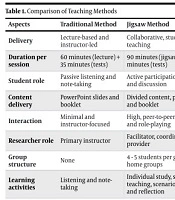
3. Post-test (20 minutes): The perception of the learning environment after implementing the jigsaw teaching method was measured using the DREEM Questionnaire. The summary of the intervention is presented in Table 1.
Table 1.
Comparison of Teaching Methods
| Aspects | Traditional Method | Jigsaw Method |
|---|---|---|
| Delivery | Lecture-based and instructor-led | Collaborative, student-led with peer teaching |
| Duration per session | 60 minutes (lecture) + 35 minutes (tests) | 90 minutes (jigsaw activities) + 35 minutes (tests) |
| Student role | Passive listening and note-taking | Active participation, peer teaching, and discussion |
| Content delivery | PowerPoint slides and booklet | Divided content, peer presentations, and booklet |
| Interaction | Minimal and instructor-focused | High, peer-to-peer, group discussions, and role-playing |
| Researcher role | Primary instructor | Facilitator, coordinator, and feedback provider |
| Group structure | None | 4 - 5 students per group, expert and home groups |
| Learning activities | Listening and note-taking | Individual study, summarizing, teaching, scenario-based discussion, and reflection |
| Feedback mechanism | Limited to post-lecture Q&A | Real-time feedback, group discussions, and post-session reflection |
| Engagement tools | Slides and verbal explanations | Mnemonics, role-playing, visual aids, and reflection forms |
Regarding the management of the possible issue of contamination between the two groups, the researcher first held a class and workshop for the control group to control the conditions. Immediately after the completion of their 2-day workshop, the classroom lesson was presented using the jigsaw method to the intervention group. After implementing the intervention and holding the workshops, the educational content was provided to both groups in the form of a booklet so that they could benefit from the materials.
3.5. Ethical Considerations
This study was based on the principles of the Helsinki Declaration, and ethical issues were confirmed by the Ethics Committee of the Zahedan University of Medical Sciences with the IR.ZAUMS.REC.1403.282 number. Informed consent was obtained from all participants, and the confidentiality of all data and information sources was maintained.
3.6. Data Analysis
Data were analyzed using SPSS version 24. Descriptive statistics summarized demographic and educational characteristics. The chi-square test compared categorical variables (e.g., gender, semester) between groups. Independent t-tests evaluated differences in DREEM scores and CPR post-test scores between groups, with a significance level of P < 0.05. Paired t-tests assessed within-group changes in DREEM and CPR scores pre- and post-intervention. Normality of data was confirmed using the Kolmogorov-Smirnov test.
4. Results
4.1. Participant Characteristics
One hundred students (50 nursing, 50 emergency medicine) completed the study with no attrition. The mean age was 20.60 ± 0.52 years in the jigsaw group and 20.70 ± 0.56 years in the traditional group (P = 0.38, independent t-test). Baseline characteristics were comparable (Table 2).
Table 2.
Baseline Demographic and Educational Characteristics of Participants a
| Characteristics | Jigsaw Group (N = 50) | Traditional Group (N = 50) | P-Value |
|---|---|---|---|
| Age (y); mean ± SD | 20.60 ± 0.52 | 20.70 ± 0.56 | 0.38 b |
| Gender | 0.56 c | ||
| Male | 24 (48.0) | 27 (54.0) | |
| Female | 26 (52.0) | 23 (46.0) | |
| Academic semester | 0.79 c | ||
| Fourth | 16 (32.0) | 14 (28.0) | |
| Fifth | 18 (36.0) | 20 (40.0) | |
| Sixth | 16 (32.0) | 16 (32.0) | |
| Field of study | 0.84 c | ||
| Nursing | 26 (52.0) | 24 (48.0) | |
| Emergency medicine | 24 (48.0) | 26 (52.0) |
a Values are expressed as No. (%) unless indicated.
b Independent t-test.
c Chi-square test.
4.2. Learning Environment Outcomes
The jigsaw group’s mean DREEM score increased from 47.12 ± 5.30 to 158.40 ± 10.80 (P < 0.001), shifting from a weak to a strong educational climate. The traditional group showed no significant change (48.60 ± 5.00 to 49.20 ± 4.90, P = 0.68). Post-intervention, the jigsaw group’s DREEM score was significantly higher than the traditional group’s (158.40 ± 10.80 vs. 49.20 ± 4.90, P < 0.001; Table 3).
Table 3.
Total Dundee Ready Education Environment Measure Scores Before and After Intervention a
| Groups | Pre-Intervention | Post-Intervention | Within-Group P-Value b | Between-Group P-Value (Post) c |
|---|---|---|---|---|
| Jigsaw (n = 50) | 47.12 ± 5.30 | 158.40 ± 10.80 | < 0.001 | < 0.001 |
| Traditional (n = 50) | 48.60 ± 5.00 | 49.20 ± 4.90 | 0.68 | - |
a Values are expressed as mean ± SD.
b Paired t-test.
c Independent t-test.
All DREEM subscales improved significantly in the jigsaw group (P < 0.001), with the largest gain in perception of learning (11.60 ± 2.15 to 38.50 ± 3.10). The traditional group showed no significant changes (P > 0.05, Table 4).
Table 4.
Dundee Ready Education Environment Measure Subscale Scores Before and After Intervention a
| Domains | Pre-Intervention | Post-Intervention | P-Value b |
|---|---|---|---|
| Perception of learning (0 - 48) | |||
| Jigsaw | 11.60 ± 2.15 | 38.50 ± 3.10 | < 0.001 |
| Traditional | 12.10 ± 2.00 | 12.40 ± 2.15 | 0.62 |
| Perception of instructors (0 - 44) | |||
| Jigsaw | 11.00 ± 1.90 | 35.20 ± 2.85 | < 0.001 |
| Traditional | 11.30 ± 1.85 | 11.55 ± 1.90 | 0.67 |
| Academic self-ability (0 - 32) | |||
| Jigsaw | 8.70 ± 1.65 | 26.50 ± 2.20 | < 0.001 |
| Traditional | 9.00 ± 1.60 | 9.15 ± 1.65 | 0.75 |
| Educational atmosphere (0 - 48) | |||
| Jigsaw | 12.15 ± 2.40 | 39.80 ± 3.35 | < 0.001 |
| Traditional | 12.50 ± 2.25 | 12.70 ± 2.20 | 0.80 |
| Social conditions (0 - 28) | |||
| Jigsaw | 3.70 ± 1.25 | 18.90 ± 2.05 | < 0.001 |
| Traditional | 3.80 ± 1.20 | 3.90 ± 1.25 | 0.82 |
a Values are expressed as mean ± SD.
b Paired t-test.
5. Discussion
The present study demonstrated that the jigsaw teaching method significantly outperformed the traditional lecture-based method in enhancing both the perception of the learning environment and CPR skills among nursing and emergency medicine students. The jigsaw method’s collaborative, peer-driven approach fostered a robust educational climate, as evidenced by marked improvements in DREEM scores across all subscales, including perception of learning, instructors, academic self-ability, educational atmosphere, and social conditions. In addition, there was no statistically significant difference between the two groups in terms of age, gender, and academic semester. In both groups, the educational atmosphere domain had the greatest impact.
These findings are consistent with a growing body of literature supporting cooperative learning strategies in medical education. A meta-analysis shows that collaborative methods, such as problem-based learning and team-based learning, enhance student engagement, critical thinking, and knowledge retention compared to traditional lectures, particularly in clinical skills training (20). Similarly, a study found that peer-teaching models, akin to the jigsaw method, improve nursing students’ understanding and application of clinical concepts by fostering accountability and active participation (21).
The jigsaw method’s structured process — individual study, expert group discussions, and home group presentations — likely amplified these benefits by encouraging students to engage deeply with CPR content and teach it to peers, a process known to enhance retention through the “learning-by-teaching” effect (22). The significant improvement in the DREEM subscale for perception of learning aligns with other research, which reported that interactive, hands-on training methods create a more student-centered learning environment, thereby increasing motivation and confidence in clinical skills like CPR (23).
The jigsaw method’s success in improving the perception of the educational environment can be interpreted through the lens of constructivist learning theory (24). By requiring students to summarize, discuss, and teach CPR protocols, the jigsaw method facilitated active recall and peer feedback, which are known to strengthen neural connections and enhance long-term retention (25). Furthermore, the method’s emphasis on teamwork and communication mirrors the collaborative nature of emergency medical practice, where rapid decision-making and effective communication are critical.
The jigsaw method’s success may also be linked to its alignment with self-determination theory, which emphasizes autonomy, competence, and relatedness as drivers of intrinsic motivation (26). By allowing students to take ownership of their learning (autonomy), master CPR skills through peer teaching (competence), and build connections through group work (relatedness), the jigsaw method likely enhanced students’ intrinsic motivation, leading to superior outcomes (27). This interpretation is supported by another study (28), which found that learning environments fostering these psychological needs improve academic performance and well-being in health professions education.
5.1. Conclusions
This study highlights the jigsaw teaching method’s superiority over traditional lecture-based instruction in enhancing the learning environment among nursing and emergency medicine students. By fostering collaboration, peer teaching, and active engagement, the jigsaw method created a robust educational climate and significantly improved students’ mastery of CPR, a critical skill in emergency medicine. These findings underscore the value of cooperative learning strategies in addressing the limitations of passive teaching methods, particularly for clinical training where practical application and teamwork are paramount. The alignment of the jigsaw method with constructivist and self-determination theories further explains its success in promoting deep learning and student motivation.
5.2. Limitations
This study has several limitations. First, the two-day intervention period was short, and the study did not assess long-term retention or sustained changes in the learning environment, which are critical for evaluating educational impact. Third, the jigsaw method’s effectiveness may have been influenced by the researcher’s active facilitation, which may not be feasible in settings with less experienced or resource-constrained instructors. Fourth, while qualitative feedback provided valuable insights, it was not systematically analyzed, limiting our understanding of nuanced student experiences. Finally, the study did not control for prior CPR exposure or individual learning styles, which could have influenced outcomes.