
1. Background
Health literacy is a cornerstone of public health, empowering individuals to access, understand, and apply health information to make informed decisions and improve their well-being (1). It is a key component of the World Health Organization (WHO)’s Health 2020 framework, which emphasizes its role in addressing twenty-first-century health challenges (2). Health literacy is critical for achieving positive healthcare outcomes, as modern healthcare systems require individuals to navigate increasingly complex information and services (3, 4). Enhancing health literacy not only supports individual health but also protects against misinformation and promotes patient-centered care (5). This is particularly important for women, as their health literacy directly impacts their engagement in health promotion and preventive behaviors (6). The WHO defines sexual health literacy as the ability to understand and use sexual health information to reduce risks, such as sexually transmitted infections (STIs), while promoting overall well-being beyond physical health (7). Factors such as gender, age, education, and cultural background can significantly influence sexual health literacy (8-11).
Low health literacy, especially in sexual and reproductive health (SRH), is linked to adverse outcomes, including higher mortality rates, poor health, reduced self-efficacy, and lower quality of life (12). While several tools exist to measure general health literacy, such as the Health Literacy Questionnaire (HHLQ) (13), Health Literacy Measure for Adolescents (HELMA) (14), and Health Literacy Instrument for Adults (HELIA) (15), there is no gold standard for assessing sexual and reproductive health literacy (SRHEL) across all domains. Existing scales often focus on specific areas, such as maternal health (16), adolescent health (17), HIV (18), breast cancer (19), or cervical cancer (20). The lack of a comprehensive tool to measure SRHEL is particularly evident in Iran, where no validated instrument exists to assess all domains of SRHEL among women. Given the significant impact of SRHEL on women’s quality of life and societal health outcomes (21), there is an urgent need for a psychometrically robust tool to address this gap. Such a tool would provide a foundation for targeted interventions aimed at improving SRHEL and empowering women to make informed health decisions.
2. Objectives
This study addresses this need by designing and validating a comprehensive SRHEL tool tailored to Iranian women.
3. Methods
In 2024, a sequential exploratory mixed-methods study was conducted in Iran to rigorously design and assess the SRHEL tool for women.
3.1. Stage 1 (Qualitative Study and Literature Review)
The first stage involved a qualitative study utilizing Graneheim and Lundman's conventional content analysis approach (22, 23). Twenty-three semi-structured, in-depth interviews were conducted to elucidate the concepts and dimensions of SRHEL until data saturation was achieved. Phrases and sentences from each interview were categorized according to shared aspects. Purposive sampling was used. Inclusion criteria comprised Iranian married women aged 18 - 49 years, literate (able to read and write), and without cognitive or mental disorders. For the specialist group, inclusion criteria were holding a PhD in health, medical education, or reproductive health and at least five years of professional experience. To assess the credibility and rigor of the qualitative data, the four criteria proposed by Lincoln and Guba were applied (24). Data collection continued until no new data or themes emerged from the interviews, confirming data saturation.
An extensive literature review was performed using the keywords “Health literacy”, “reproductive health”, “fertility”, “sexual health”, “women's health literacy”, “tool”, “questionnaire”, “instrument”, “inventory”, and “scale” in the following databases: Scopus, Proquest, PubMed, Science Direct, Google Scholar, SID, and Magiran. In total, 42 articles and questionnaires related to women’s health literacy and SRH were examined. Ten items were extracted, with three final items approved by the research team and added to the item pool.
3.2. Stage 2 (Tool Design and Psychometric Evaluation)
In designing the tool, Waltz’s four stages of tool development were utilized (25). An inductive-deductive method was employed for item extraction (26, 27). Psychometric analysis included assessment of content validity, face validity, construct validity, reliability, and stability of the questionnaire (28, 29). Content validity was evaluated by a panel of ten experts using both qualitative and quantitative approaches; content validity ratio (CVR) and Content Validity Index (CVI) were calculated. Face validity was investigated qualitatively with ten married women and quantitatively with a sample of twenty married women. Construct validity was assessed by exploratory factor analysis (EFA) with varimax rotation, conducted in a sample of 402 married women of reproductive age in Tehran, Iran, using SPSS software (version 27).
Reliability was established through internal consistency using Cronbach’s alpha (30) in the entire sample, and stability was determined by conducting a test-retest over a two-week interval and calculating intra-class correlation coefficients in a subsample of 30 married women (31).
This study adhered to the CONSORT checklist and the ethical standards of the Declaration of Helsinki. A fundamental principle underpinning this research was respect for individuals, specifically their right to self-determination and informed decision-making regarding their participation at all stages of the study (32). All participants completed and signed the informed consent form. Remaining ethical principles were largely inapplicable to this study.
4. Results
4.1. Stage 1 (Qualitative Study and Literature Review)
In the first stage, 23 interviews were conducted with women of reproductive age, who had a mean age of 36.1 ± 3.9 years, and with specialists, who had a mean age of 49.8 ± 5.6 years. Among the women participating in the qualitative section, 27% had a high school diploma, 36.5% had less than a diploma, and 36.5% held a university degree. Overall, 63% were homemakers and 37% were employed. Among the key informants, 35% were associate professors, 46% were assistant professors, and 19% were full professors.
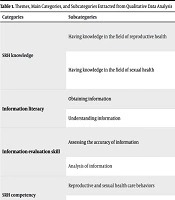
In total, 1,588 primary codes, 20 final codes, 8 subcategories, and 4 main categories were identified. The details of the coding process are provided in Table 1.
Table 1.
Themes, Main Categories, and Subcategories Extracted from Qualitative Data Analysis
| Categories | Subcategories | Final Codes |
|---|---|---|
| SRH knowledge | Having knowledge in the field of reproductive health | The importance of taking care of our reproductive health |
| Awareness in the physical field of reproductive health | ||
| Awareness in the psychological field of reproductive health | ||
| Having knowledge in the field of sexual health | Awareness about healthy sex | |
| The importance of proper sex | ||
| Awareness in the field of sexual relations and pregnancy | ||
| Awareness in the field of sexually transmitted diseases | ||
| Information literacy | Obtaining information | Capability to obtain information from various sources |
| Obtaining information in various fields of reproductive and sexual health | ||
| Understanding information | Comprehension of written information | |
| Ability to understand verbal information | ||
| Information evaluation skill | Assessing the accuracy of information | Assessing the logic and accuracy of the information |
| Recognizing the validity of information sources | ||
| Consult with experts to verify the accuracy of the information | ||
| Analysis of information | Ability to evaluate information | |
| Conclusion based on the information | ||
| SRH competency | Reproductive and sexual health care behaviors | Ability to make decision |
| Self-care pertaining to reproductive health | ||
| Behaviors to ensure sexual health | Enjoying fulfilling sexual intimacy | |
| Resolving perceived sexual problems |
Abbreviation: SRH, sexual and reproductive health.
In this stage of the research, women’s reproductive health literacy was defined as “gaining knowledge, understanding accurate information about sexual and reproductive health, and applying this information to adopt health-promoting behaviors”, as perceived by married women and health experts.
4.2. Stage 2 (Design and Psychometry)
4.2.1. Phase 1
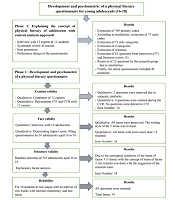
The focus was on designing and testing the tool. The researcher first defined the concept using an inductive approach, then designed the final tool through a comparative approach and an extensive literature review. The concept and dimensions of women’s SRHEL were defined as “a multidimensional concept influenced by their understanding and experience. This includes knowledge of reproductive and sexual health, as well as acquiring, evaluating, and using information to promote reproductive health.”
4.2.2. Phase 2
The performance goals of the tool were established as follows: Measuring knowledge of SRH, measuring the acquisition and understanding of information in reproductive health, measuring the evaluation of information in the field of reproductive health, and assessing the use of information in promoting reproductive health.
4.2.3. Phase 3
The research team created a mapping and preliminary design of the questionnaire. After expert review and detailed revisions, 69 items from the qualitative section were included. For greater accuracy, the research team conducted a comprehensive literature review using keywords such as health literacy, reproductive health, fertility, sexual health, women’s health literacy, and related terms in databases including Scopus, PubMed, ProQuest, Science Direct, SID, Google Scholar, and Magiran. Among 42 related articles, only three new items — reading consent forms, understanding expert information, and sharing knowledge — were approved and added to the initial 69 items.
4.2.4. Phase 4
The structure of the questionnaire was finalized. The questionnaire comprises 72 self-reported items, each rated on a 5-point Likert scale ranging from “never” to “always”. All questions are graded consistently in the same direction, with no reverse-coded items.
4.2.5. Phase 5: Psychometric Evaluation of the Sexual and Reproductive Health Literacy Tool
4.2.5.1. Validity Assessment of the Women’s Health Literacy Tool
- Qualitative evaluation by expert panel review: Based on review by ten tool-designing experts for grammar, word usage, item placement, and scoring accuracy, two items were added and six items were merged into three, resulting in a total of 71 items.
- Quantitative evaluation: Ten health experts assessed the relevance, clarity, and simplicity of each item using a four-point scale.
- The CVR was calculated for each item, with the Lawshe table requiring a minimum CVR score of 0.62 for ten experts (33). Twenty-six items scoring below this threshold were removed.
- Item-Level Content Validity Index (I-CVI): The I-CVI scores and modified kappa statistics for all items exceeded the thresholds (0.78 and 0.75, respectively), so no additional items were omitted at this stage (34).
- The overall Scale-Level Content Validity Index (S-CVI/Ave) was 0.975, surpassing the commonly accepted criterion of 0.9 for an excellent rating (35).
- The total scale content validity ratio (S-CVR) was 0.88, indicating strong validity for the women’s reproductive health literacy tool (35).
- Face validity assessment was conducted using both qualitative and quantitative methodologies (36). In the quantitative component, items were evaluated by measuring their impact scores, based on responses from 20 members of the research community who completed the questionnaire. Only one item received an impact score of less than 1.5 and was subsequently removed. In the qualitative component, feedback from ten participants was utilized to modify items and improve their difficulty, appropriateness, and clarity.
- Construct validity was evaluated in 402 married women aged 18 - 49 years using the 44-item tool. The Kaiser-Meyer-Olkin (KMO) value (0.924) indicated excellent sampling adequacy, and Bartlett’s test of sphericity (χ2 = 9287.618, P ≤ 0.0001) confirmed significant sample correlation, supporting EFA. Variables with eigenvalues ≥ 0.4 were selected, and one item was removed, leaving 43 items for factor extraction. Table 2 presents the eigenvalues, variance percentages, and cumulative variance explained by each factor. Using Kaiser’s criterion (31) (eigenvalues > 1), nine factors initially explained 63.36% of the variance. After principal components analysis and Varimax rotation with four, five, and six factors, five factors were accepted, accounting for 52.33% of the variance. Items with factor loadings below 0.40 were excluded to ensure a clear and interpretable factor structure.
Table 2.
Initial Eigenvalues of Factors of Women’s Reproductive Health Literacy Questionnaire Based on Five Factors a
| Items | Eigenvalue | The Sum of the Squares of Factor Loads Before the Rotation | The Sum of the Squares of Factor Loads After the Rotation | ||||||
|---|---|---|---|---|---|---|---|---|---|
| Cumulative Variance | Variance | Total | Cumulative Variance | Variance | Total | Cumulative Variance | Variance | Total | |
| 1 | 32.027 | 32.027 | 13.772 | 32.027 | 32.027 | 13.772 | 17.852 | 17.852 | 7.676 |
| 2 | 40.709 | 8.681 | 3.733 | 40.709 | 8.681 | 3.733 | 29.810 | 11.958 | 5.142 |
| 3 | 45.116 | 4.407 | 1.895 | 45.116 | 4.407 | 1.895 | 37.689 | 7.879 | 3.388 |
| 4 | 48.950 | 3.834 | 1.649 | 48.950 | 3.834 | 1.649 | 45.351 | 7.663 | 3.295 |
| 5 | 52.329 | 3.379 | 1.453 | 52.329 | 3.379 | 1.453 | 52.329 | 6.978 | 3.000 |
a Values are expressed as percentage.
After calculating the correlation matrix, variables with high correlations were grouped into five factors. The results of the "Women's Sexual and Reproductive Health Literacy Tool" are presented in Table 3.
Table 3.
Factor Loading of Tool’s Items Based on Varimax Rotation Into Five Factors
| No. | Items | Factor Load | ||||
|---|---|---|---|---|---|---|
| 1 | 2 | 3 | 4 | 5 | ||
| 1 | I can get information about reproductive health (puberty, pregnancy and childbirth, family planning, women's diseases, sexual relations...) by reading books and magazines. | 0.267 | 0.170 | 0.581 | -0.071 | 0.206 |
| 2 | I can search for reproductive health information on the Internet (websites, channels, and virtual pages). | 0.243 | 0.078 | 0.506 | 0.010 | 0.084 |
| 3 | I can get reproductive health information through radio and television programs. | 0.248 | 0.130 | 0.642 | -0.163 | 0.189 |
| 4 | I can get reproductive health information from health workers (such as doctors and midwives). | 0.110 | 0.285 | 0.411 | -0.104 | 0.314 |
| 5 | I can get information about reproductive health through relatives and knowledgeable friends and acquaintances. | 0.362 | 0.009 | 0.532 | -0.167 | 0.188 |
| 6 | If necessary, I obtain information about the anatomy and function of the components of the female reproductive system from various sources. | 0.501 | 0.018 | 0.492 | 0.140 | 0.056 |
| 7 | If necessary, I obtain information about puberty changes from various sources. | 0.554 | 0.032 | 0.443 | 0.112 | 0.122 |
| 8 | I can distinguish between abnormal periods and normal ones. | 0.318 | -0.025 | 0.020 | 0.187 | 0.238 |
| 9 | If needed, I get information about personal menstrual hygiene from different sources. | 0.628 | 0.081 | 0.129 | 0.194 | 0.145 |
| 10 | I get information about premarital counseling and tests from various sources. | 0.646 | 0.139 | 0.252 | 0.102 | 0.130 |
| 11 | I get the information I need about pre-conception practices and preparations from various sources. | 0.701 | 0.274 | 0.112 | 0.024 | 0.162 |
| 12 | I get information about pregnancy related matters (nutrition, common problems, danger signs, pregnancy tests, etc.) from various sources. | 0.753 | 0.208 | -0.045 | -0.008 | 0.175 |
| 13 | I get the information I need in the field of natural birth or caesarean section from different sources. | 0.758 | 0.184 | 0.023 | -0.011 | 0.172 |
| 14 | I get the information I need to breastfeed my baby from different sources. | 0.684 | 0.275 | 0.030 | -0.076 | 0.192 |
| 15 | I get the necessary information about postpartum problems from various sources. | 0.734 | 0.268 | 0.108 | -0.024 | 0.162 |
| 16 | In order to choose the right method of preventing pregnancy, I get information from different sources about the method of use, the degree of effect, side effects and contraindications. | 0.628 | 0.160 | 0.266 | 0.140 | 0.174 |
| 17 | In case of diseases specific to women (such as genital infections, etc.), I get information from different sources. | 0.595 | 0.102 | 0.162 | 0.212 | 0.164 |
| 18 | I get information about women's cancer screening (breast exam, mammography and pap smear...) from different sources. | 0.505 | 0.191 | 0.403 | 0.211 | 0.140 |
| 19 | If necessary, I get appropriate information about menopause from different sources. | 0.493 | 0.224 | 0.491 | 0.234 | 0.100 |
| 20 | I obtain information about sexual activity from reliable sources. | 0.543 | 0.251 | 0.242 | 0.382 | 0.022 |
| 21 | In case of sexual problems, I can get information from different sources. | 0.602 | 0.146 | 0.289 | 0.411 | -0.015 |
| 22 | If needed, I get information about sexually transmitted diseases from different sources. | 0.550 | 0.200 | 0.399 | 0.399 | 0.047 |
| 23 | I understand information I get from books, pamphlets, and websites. | 0.377 | 0.219 | 0.106 | 0.218 | 0.401 |
| 24 | I understand and understand the reproductive health information broadcast on radio and television. | 0.205 | 0.026 | 0.261 | 0.095 | 0.647 |
| 25 | I understand the advice and information regarding reproductive health given to me by relatives, friends and knowledgeable acquaintances. | 0.282 | 0.358 | 0.130 | 0.353 | 0.326 |
| 26 | I understand the information given to me by health professionals (such as doctors and midwives). | 0.156 | 0.294 | -0.127 | 0.031 | 0.719 |
| 27 | I compare reproductive health information from different sources. | 0.289 | 0.255 | 0.250 | 0.247 | 0.478 |
| 28 | If there is contradictory information about a subject, I consult knowledgeable people if necessary. | 0.207 | 0.431 | 0.102 | 0.205 | 0.483 |
| 29 | I evaluate the accuracy of the information obtained from various sources. | 0.304 | -0.095 | 0.286 | 0.021 | 0.609 |
| 30 | I apply the correct information obtained in the field of fertility in life. | 0.130 | 0.540 | 0.018 | 0.298 | 0.357 |
| 31 | I am physically active in my daily life to maintain and improve my reproductive health. | 0.160 | 0.495 | 0.306 | 0.268 | 0.042 |
| 32 | I get enough sleep and rest to maintain and promote my reproductive health. | 0.120 | 0.661 | 0.210 | 0.105 | 0.038 |
| 33 | I eat enough from all food groups to maintain my reproductive health. | 0.184 | 0.642 | 0.168 | 0.130 | 0.124 |
| 34 | I do age-appropriate medical examinations and tests to maintain my health. | 0.117 | 0.707 | 0.228 | 0.123 | -0.015 |
| 35 | If I have a problem or disease in the field of fertility and sex, I will make a decision about taking the appropriate action using the information obtained. | 0.243 | 0.626 | 0.029 | 0.253 | 0.044 |
| 36 | Before pregnancy, I go to health centers or doctors or midwives to check my physical condition and take the necessary measures. | 0.160 | 0.671 | 0.057 | 0.108 | 0.048 |
| 37 | I use the supplements and medicines needed for pregnancy at the right time. | 0.193 | 0.625 | -0.236 | 0.115 | 0.202 |
| 38 | I refer to suitable medical centers when there are risk factors in pregnancy. | 0.162 | 0.590 | -0.298 | 0.087 | 0.257 |
| 39 | I use the recommendations and instructions from the educational classes in the field of reproductive health (such as pre-marriage classes, pregnancy and childbirth, and sexual issues...). | 0.069 | 0.366 | 0.135 | 0.399 | 0.210 |
| 40 | I perform screenings for common women's cancers (annual breast exam, mammography at age 40 and older, pap smear, etc.). | 0.165 | 0.401 | 0.282 | 0.381 | 0.031 |
| 41 | If necessary, I talk about sexual issues with my husband | 0.149 | 0.207 | -0.241 | 0.670 | 0.115 |
| 42 | If there is a sexual problem, I will take action to solve it. | 0.118 | 0.234 | -0.235 | 0.779 | 0.059 |
| 43 | If there is a sexual problem, I go to a counselor if necessary. | 0.018 | 0.260 | 0.047 | 0.709 | 0.065 |
During varimax rotation on 43 items across five factors, items 6, 7, 18, and 19 had loadings > 0.4 in both factors 1 and 3, but were assigned to factor 1 due to higher loadings and better content alignment. Similarly, item 21, with loadings > 0.4 in both factors 1 and 4, was placed in factor 1 for the same reasons. Items 8, 25, and 39 were removed from the tool as they did not achieve a factor loading of > 0.4 in any of the five factors, leaving 40 items in the final tool. The distribution of items across the factors is as follows: Factor 1 (16 items), factor 2 (10 items), factor 3 (5 items), factor 4 (3 items), and factor 5 (6 items).
4.2.5.2. Tool’s Reliability
- Cronbach's alpha was calculated for each factor and for the total instrument in a sample of 402 married women. Alpha values ranged from 0.73 to 0.93 for the different factors and were 0.91 for the total instrument, indicating proper reliability (30, 31, 37).
- The stability of the tool was assessed using test-retest and intracluster correlation (95% confidence interval) in 40 married women who completed the online questionnaire twice, with a two-week interval. Results showed correlation coefficients ranging from 0.81 to 0.88 across different areas and 0.93 for the total, indicating acceptable stability (31, 38).
The final SRHEL tool includes 40 questions across 5 domains: Information acquisition skills, behaviors, understanding and evaluating information, and using information for reproductive and sexual health. Scores range from 40 to 200 (with higher scores indicating better health literacy) and are standardized to 0 - 100 per domain, with 100 representing the best and 0 the worst health literacy state (Appendix 1 in the Supplementary File).
5. Discussion
The development of the SRHEL tool represents a significant advancement in the measurement of a complex, context-sensitive, and often underassessed dimension of women’s health. Unlike many existing instruments that focus narrowly on knowledge or specific life stages (e.g., adolescence or pregnancy), the SRHEL tool captures the dynamic, multidimensional nature of SRHEL across the reproductive lifespan. Its five-domain structure — information acquisition, understanding, evaluation, reproductive health behaviors, and sexual health behaviors — reflects a modern, action-oriented conceptualization of health literacy that aligns with critical health literacy frameworks and empowers women as active agents in their health decision-making (39, 40).
One of the most notable strengths of the SRHEL is its integration of behavioral and cognitive dimensions within a single framework. While tools such as the HLS-EU-Q47 (41) or TOFHLA (15) primarily assess functional and communicative aspects of general health literacy, they do not adequately capture how individuals critically appraise and apply information in sensitive domains such as sexuality and reproduction. In contrast, the SRHEL includes dedicated items on evaluating source credibility, resolving contradictions in information, and engaging in sexual problem-solving — dimensions that reflect higher-order cognitive skills essential for navigating misinformation, especially in digital environments (42).
Furthermore, the separation of sexual health behaviors from reproductive health behaviors as distinct factors is a methodological and conceptual innovation. Most existing tools conflate these domains or reduce sexual health to risk prevention (e.g., STIs, unwanted pregnancy) (43). The SRHEL, however, incorporates items related to sexual satisfaction, communication with partners, and help-seeking for sexual concerns, reflecting a positive, rights-based approach to sexual health as defined by the WHO (44). This is particularly important in cultural contexts such as Iran, where open discussion of sexuality remains limited, and measurement tools frequently avoid addressing sexual well-being beyond procreation.
In comparison with existing instruments, the SRHEL demonstrates multiple advantages. The Sexual Health Literacy Scale (SHLS) by Lee et al. focuses on adolescents and emphasizes knowledge and attitudes but lacks behavioral application items (45). The Maternal Health Literacy Scale (MHLS) targets prenatal and postnatal care but does not address sexual health or information evaluation (46). The HIV/AIDS HHLQ is disease-specific and not generalizable to broader SRH contexts (18). Instruments such as the HLS-14 and its derivatives, while widely used, do not include SRH-specific content and may miss culturally relevant sources of information such as family, religious leaders, or traditional medicine (47). In contrast, the SRHEL explicitly incorporates diverse information sources — including internet, health workers, relatives, and media — acknowledging the pluralistic ways in which women in Iran access SRH information. This aligns with global trends showing that interpersonal and community-based sources remain critical, especially in low- and middle-income countries (48). The inclusion of such sources enhances the tool’s ecological validity and suitability for designing culturally responsive interventions.
The SRHEL was developed through a mixed-methods, inductive approach grounded in the lived experiences of Iranian women and health professionals. This ensures that the tool reflects local norms, language, and health-seeking behaviors. For example, items related to consulting with experts when information is contradictory, or discussing sexual issues with one’s spouse, are highly relevant in a society where family dynamics and gender roles strongly shape health communication (49). This level of cultural tailoring is often lacking in translated or adapted tools, which may suffer from construct bias or semantic inaccuracy (50). Furthermore, the use of a five-point Likert scale measuring frequency (“never” to “always”) allows for a behavioral gradient assessment, moving beyond dichotomous, knowledge-based responses. This enables researchers and clinicians to identify not only whether women know something, but how consistently they act on that knowledge — a crucial distinction for evaluating health literacy in practice.
The validated SRHEL tool offers practical applications across research, clinical practice, and public health policy. It can identify vulnerable groups — such as rural or low-educated women — with limited SRHEL, enabling targeted interventions (1). The tool is also valuable for evaluating the effectiveness of sexual and reproductive health education programs, including school-based, premarital, and community initiatives (2). In clinical settings, it can guide patient-centered counseling by highlighting individual strengths and gaps in information use, thereby improving communication and shared decision-making (3). Additionally, SRHEL can inform the design of digital health platforms by assessing users’ needs in accessing and evaluating SRH information (4). At the national level, integrating this tool into health monitoring systems supports evidence-based policymaking and aligns with global efforts to promote health literacy as a key determinant of health equity, such as the WHO’s Health 2020 and Health for All frameworks (5).
Given the strong reliability [Cronbach’s alpha = 0.91, intraclass correlation coefficient (ICC) = 0.93] and content validity (S-CVI/Ave = 0.975), the SRHEL is ready for implementation in both research and clinical settings. Future studies should explore its convergent validity with other health literacy measures, test its factor structure through confirmatory factor analysis (CFA), and assess its sensitivity to change in intervention studies.
5.1. Conclusions
The SRHEL tool is a valid and reliable instrument for measuring SRHEL among reproductive-aged women in Iran. Its multidimensional structure captures not only knowledge but also critical skills in information appraisal and health-promoting behaviors. This tool provides a foundational resource for identifying literacy gaps, tailoring health education, and improving patient-provider communication. Importantly, SRHEL holds significant potential for informing national health policies and monitoring systems, enabling evidence-based planning to reduce disparities and strengthen women’s health outcomes within Iran’s public health framework. Its integration into routine health assessments can support the development of targeted, equity-focused interventions aligned with global health literacy goals.