
1. Context
Anaphylactic shock is an acute, life-threatening allergic response affecting multiple organ systems. Classically, anaphylaxis is an immunoglobulin (Ig) E-mediated reaction. It may affect various organ systems and is commonly induced by medications, foods, or insect stings (1, 2). Epidemiological data on anaphylaxis vary owing to inconsistent definitions, but research suggests approximately 0.26% of hospital admissions are attributed to anaphylaxis, with an annual mortality rate of 1 - 3 per million. While the prevalence of allergic reactions has grown, anaphylaxis-related mortality remains relatively stable (1). In the United States, the lifetime prevalence of anaphylaxis in the general population is at least 1.6%. Hospital admissions for anaphylaxis among children and adults rose between 2000 and 2011 (3, 4). The annual mortality rate from anaphylaxis in US adults remains steady, ranging from 0.63 to 0.76 per million (3, 5). This prevalence exceeds the value reported in the United Kingdom, which stands at 0.33 per million (6), comparable to the rate reported in Australia, which is 0.64 per million (7), but lower than the rate reported in France, which is 0.83 per million (8). Anaphylaxis triggers vary by age: Food allergens predominate in children (e.g., cow’s milk in infants, peanuts in older children), while medications, particularly beta-lactam antibiotics, and insect stings are more common in adults (1, 2). Diagnosis is clinical, with immediate treatment essential due to its life-threatening nature. Intramuscular adrenaline is first-line therapy with no contraindications; early venous access is critical in hypotensive patients (9, 10). The mechanism is IgE-mediated mast cell degranulation, leading to the release of histamine and other mediators, causing vasodilation, bronchospasm, and capillary leak. Risk factors include asthma and cardiovascular disease. Symptoms affect multiple systems and range from mild to severe (grade 1 - 4), with elevated tryptase supporting diagnosis. Adrenaline is underused in ~50% of cases and is sometimes given inappropriately for isolated urticaria (11). Delayed adrenaline administration strongly contributes to fatal food-induced anaphylaxis (12).
Anaphylactic shock is a common condition in emergency departments and intensive care units (ICUs) worldwide. Over recent decades, the incidence of allergic diseases in developed nations has shown a consistent rise (13). Anaphylactic shock advances quickly and may lead to severe complications, including cardiac arrest (14). The timely recognition and effective management of anaphylactic shock by nurses and healthcare providers are critical, as failure to identify symptoms or deliver proper care may pose serious risks to patients (15). Nurses play a key role in managing anaphylaxis through early recognition, vigilant monitoring, rapid intervention, and patient education. Initially, during triage, especially in pediatric emergency settings, trained nurses significantly enhance diagnostic accuracy and shorten waiting times for physician evaluation. Further, in resource-limited environments lacking tools such as pulse oximeters, nurses need to rely on clinical indicators (e.g., central cyanosis, lethargy, or chest retractions) to identify evolving reactions before they progress to severe stages. In addition, nurses ensure the timely administration of life-saving epinephrine and continuously monitor patient responses, preventing mild cases from escalating. Finally, they empower patients and families by educating them on trigger avoidance, early symptom recognition, and emergency response strategies to mitigate future risks (16-18). In spite of the vital role of nurses in anaphylaxis management, no systematic review has synthesized their global impact, with evidence being fragmented, biased toward high-resource settings, and scarce in low- and middle-income countries (LMICs). Significant gaps remain in understanding nurses’ scope of practice, autonomy, and integration within multidisciplinary teams across diverse settings. A systematic review is therefore essential to address these gaps and inform policy, training, as well as clinical practice. Despite the critical role of nurses in anaphylaxis management, evidenced by their involvement in 73 - 95% of successful epinephrine administrations in emergency and school settings (11, 18, 19), no systematic review has synthesized their contributions globally.
Existing evidence is fragmented, predominantly from high-income countries (e.g., USA, UK), and severely limited in LMICs, where only 9.1% of studies originate and 30–50% misdiagnosis rates persist owing to inadequate training (20). This high-resource bias obscures context-specific barriers such as restricted epinephrine delegation and protocol gaps, which contribute to delayed intervention and preventable mortality. Nevertheless, current literature displays variability and fragmentation in findings related to nurses’ roles, contributions, and impact in anaphylaxis management across diverse healthcare settings. Many investigations have concentrated on specific contexts (e.g., emergency departments or schools in high-income countries) without offering a comprehensive overview of the multifaceted clinical, educational, and systemic roles nurses perform globally. In light of these gaps, there is a distinct need for a systematic review that organizes, integrates, and critically evaluates existing studies to consolidate transferable strategies and highlight context-specific barriers, particularly in under-resourced settings.
2. Objectives
This review answers the research question: “What are the specific roles, contributions, and impact of nurses in the recognition, management, and prevention of anaphylactic shock across healthcare settings?” Using the PICO framework, we defined: Population, patients experiencing or at risk of anaphylactic shock; Intervention, nursing actions (recognition, triage, epinephrine administration, monitoring, education); Comparison, not applicable (descriptive synthesis); Outcome, accuracy of recognition, timeliness of intervention, patient outcomes, prevention of recurrence, and barriers/facilitators.
3. Methods
This systematic review was performed in accordance with the PRISMA 2020 statement and a protocol registered with PROSPERO (CRD420251134473).
3.1. Data Sources
The search terms were developed by the lead author and refined in collaboration with two senior researchers experienced in systematic reviews and allergy nursing. Medical Subject Headings (MeSH) were incorporated in PubMed to enhance sensitivity and specificity, while equivalent controlled vocabulary was considered in other databases where applicable. Free-text terms were included to capture variations in terminology across clinical settings. The core search string was: (Nurse* OR "Nursing Staff" OR "Nurse Role") AND (Management OR Treatment OR Protocol* OR Resuscitat* OR Recognit* OR Role OR Intervention) AND ("Anaphylactic shock" OR Anaphylaxis OR "Severe Allergic Reaction") Boolean operators (AND, OR), truncation (*), and phrase searching ("") were consistently applied. The search was executed without language or study type filters during the initial retrieval. No additional filters (e.g., publication year, study design) were applied at the database level. The full search strings, including database-specific syntax and exact execution date, are reported in Table 1. The search was conducted from the inception of each database up to 30 July 2025 across all four databases: PubMed, Scopus, Web of Science, and ScienceDirect.
Table 1.
Full Search Strategies for All Databases, Including Exact Syntax and Execution Date
| Database | Search Date | Search String |
|---|---|---|
| PubMed | 30 July 2025 | ((Nurse[MeSH Terms] OR Nurse*[Title/Abstract] OR "Nursing Staff"[Title/Abstract] OR "Nurse Role"[Title/Abstract]) AND (Management[Title/Abstract] OR Treatment[Title/Abstract] OR Protocol*[Title/Abstract] OR Resuscitat*[Title/Abstract] OR Recognit*[Title/Abstract] OR Role[Title/Abstract] OR Intervention[Title/Abstract]) AND ("Anaphylactic shock"[Title/Abstract] OR Anaphylaxis[MeSH Terms] OR Anaphylaxis[Title/Abstract] OR "Severe Allergic Reaction"[Title/Abstract])) |
| Scopus | 30 July 2025 | TITLE-ABS-KEY ( ( nurse* OR "nursing staff" OR "nurse role" ) AND (management OR treatment OR protocol* OR resuscitat* OR recognit* OR role OR intervention ) AND ( "anaphylactic shock" OR anaphylaxis OR "severe allergic reaction" ) ) |
| Web of Science | 30 July 2025 | TS = ((nurse* OR "nursing staff" OR "nurse role") AND (management OR treatment OR protocol* OR resuscitat* OR recognit* OR role OR intervention) AND ("anaphylactic shock" OR anaphylaxis OR "severe allergic reaction")) |
| ScienceDirect | 30 July 2025 | Title, abstract, keywords: (nurse* OR "nursing staff" OR "nurse role") AND (management OR treatment OR protocol* OR resuscitat* OR recognit* OR role OR intervention) AND ("anaphylactic shock" OR anaphylaxis OR "severe allergic reaction") |
Further, a manual review of reference lists (hand-searching) was conducted for all 11 studies included in the final analysis. This process identified zero additional studies that fulfilled the inclusion criteria, confirming the comprehensiveness of the electronic database search.
3.2. Study Selection
Inclusion criteria were: (1) Peer-reviewed randomized controlled trial studies, observational studies, or clinical guidelines; (2) focused on the role of nurses in the recognition, management, or prevention of anaphylactic shock; (3) reported at least one nurse-specific outcome in any of the following domains: clinical (e.g., epinephrine administration or patient stabilization), educational (e.g., staff training or competency improvement), or systemic (e.g., protocol development or adherence); (4) included sample size; and (5) published in the English language. The requirement for a reported sample size was included to exclude case reports, case series, or single-case descriptions lacking aggregate data, thereby ensuring sufficient detail to evaluate the scope, precision, and potential impact of nursing roles across studies. Grey literature (e.g., theses, conference abstracts, reports, preprints) was excluded to ensure methodological rigor and quality control. Studies without accessible full text were also excluded. Studies unrelated to nurses were identified and excluded during screening if they focused solely on physician-led management, pharmacological treatments without nursing involvement, general allergy care without specific anaphylaxis nursing contributions, or non-nursing health personnel. Exclusion criteria were determined independently by two reviewers during title/abstract screening and full-text review, with disparities resolved by consensus with a third senior reviewer. This process is detailed in the PRISMA flow diagram (Figure 1). The diversity of study designs (RCTs, observational studies, clinical guidelines) necessitated the use of design-specific risk-of-bias assessment tools (Cochrane RoB 2 for RCTs, ROBINS-I for non-randomized studies, CASP for guidelines) to ensure valid and appropriate evaluation of methodological quality in each design type. This approach, combined with thematic synthesis, enabled consistent categorization of nursing roles across clinical, educational, and systemic domains without compromising interpretability.
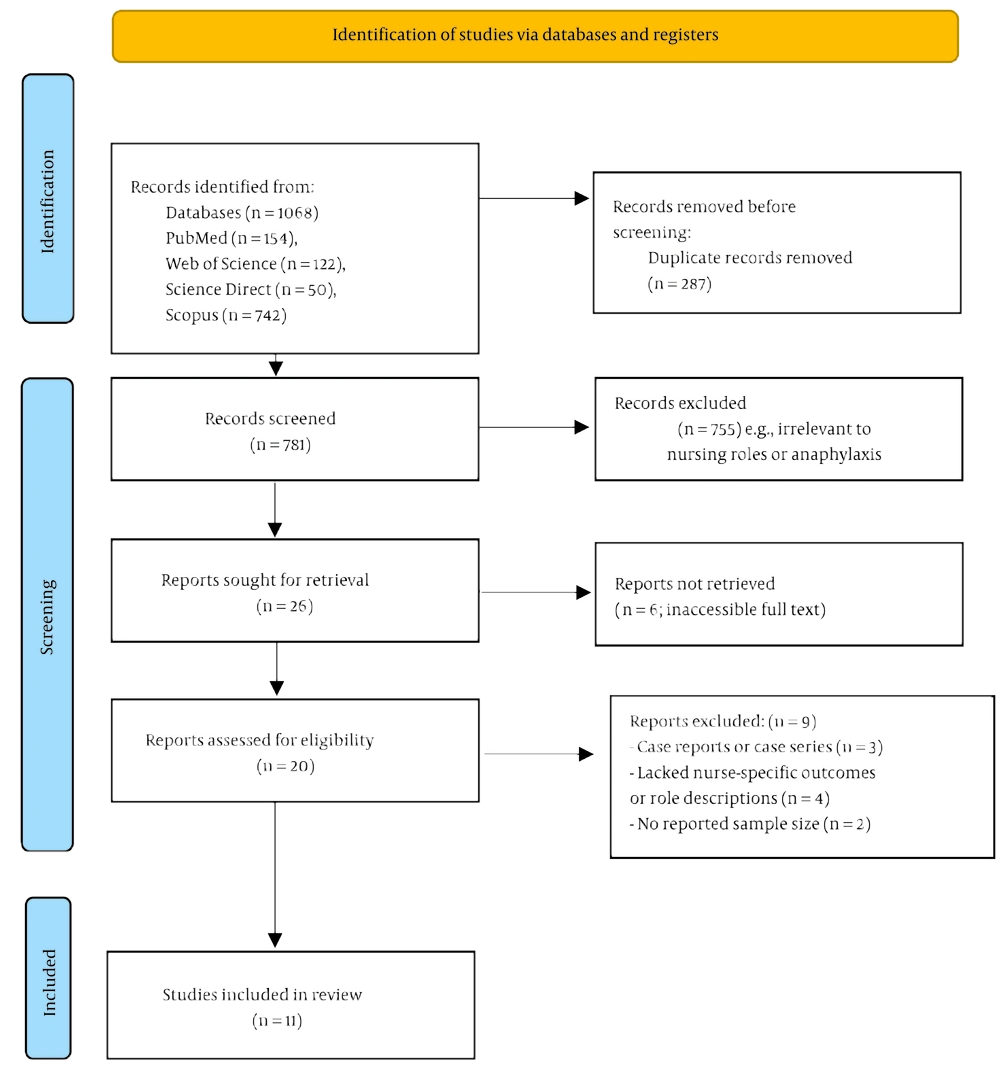
Figure 1.
PRISMA flow diagram
3.3. Data Extraction
Two reviewers independently screened titles/abstracts as well as full texts using a standardized eligibility form in Google Sheets, with a third senior reviewer resolving disagreements. Screening was fully manual (no automation tools such as Rayyan or Covidence were used) to ensure contextual accuracy in nursing-focused studies; inter-rater agreement was high (κ = 0.89 for title/abstract, κ = 0.94 for full text). Data extraction was similarly performed independently by the same two reviewers using a standardized, pilot-tested form in Google Sheets, capturing author(s), year, study design, setting, sample size, and specific nursing roles/outcomes. Disagreements were resolved by consultation with a third senior reviewer. A third senior reviewer independently verified a random sample of the extracted data for accuracy and consistency. No discrepancies were identified, confirming the reliability of the primary extraction process by the two main reviewers. No data were requested from study authors, as all required information was available in the published reports. Reference records were managed in EndNote following initial compilation in Google Sheets.
3.4. Quality Assessment
The quality of included studies was assessed using design-specific, validated tools: Cochrane Risk of Bias 2 (RoB 2) for randomized trials (evaluating randomization, deviations from intended interventions, missing outcome data, measurement of outcome, and selection of reported results); ROBINS-I for non-randomized observational studies (assessing confounding, selection bias, classification of interventions, deviations, missing data, outcome measurement, and reporting bias); and Critical Appraisal Skills Programme (CASP) checklists (11 items) for clinical guidelines (covering clarity of aims, rigor of development, applicability, and editorial independence) (21-23). These design-specific tools were chosen as they are widely recommended for assessing risk of bias and quality in heterogeneous systematic reviews (24). Risk-of-bias assessment was undertaken independently by two reviewers using standardized scoring protocols. Each domain was rated according to tool-specific criteria, evaluating bias across five domains: (1) Bias arising from the randomization process, (2) bias due to deviations from intended interventions, (3) bias due to missing outcome data, (4) bias in measurement of the outcome, and (5) bias in selection of the reported result. Studies were categorized as having “low risk of bias”, “some concerns”, or “high risk of bias” based on these domain assessments for RoB 2. The ROBINS-I tool assesses risk of bias in non-randomized studies of interventions across seven domains. For each domain, a judgment is made regarding risk of bias, categorized as “Low risk,” “Moderate risk,” “Serious risk,” or “Critical risk”. The overall risk of bias for a specific outcome is determined by the most severe rating across the seven domains. Studies judged to be at critical risk of bias in any domain are generally excluded from evidence synthesis. Each “Yes” response was assigned 1 point, while “No” or “Can’t tell” responses received 0 points. The total score ranged from 0 to 11. Studies were categorized as high quality (9 - 11), moderate quality (6 - 8), or low quality (≤ 5) for CASP (21-25). Discrepancies were resolved through consensus with a third senior reviewer. No automation tools were used; all assessments were manual. The results informed the narrative synthesis, with cautious interpretation of findings from studies at moderate or higher risk of bias. All studies were included regardless of risk-of-bias level to ensure a comprehensive synthesis of the limited available evidence (n = 11 studies) on nursing roles in anaphylaxis management. Exclusion based on bias would have unduly restricted the evidence base, particularly in low-resource settings where high-quality RCTs are scarce. Instead, risk-of-bias ratings were employed to qualify the strength of evidence in the narrative synthesis, with cautious interpretation of findings from moderate- or high-risk studies.
3.5. Data Analysis
Synthesis without meta-analysis was conducted to integrate findings across studies. Quantitative meta-analysis was not performed due to: (1) Substantial clinical and methodological heterogeneity in study designs (RCTs, observational studies, clinical guidelines), settings (emergency departments, schools, clinics), interventions, and outcome measures; (2) an insufficient number of comparable studies per outcome; and (3) the primary objective of comprehensively describing and categorizing nursing roles in anaphylaxis management rather than estimating pooled effect sizes. The categorization of nurses’ roles into clinical, educational, and systemic domains was independently performed by two reviewers using thematic analysis, with discrepancies resolved via consensus with a third senior reviewer. The primary outcomes of interest were: clinical effectiveness (timely administration of epinephrine, patient stabilization), educational outcomes (staff confidence and competency), and systemic outcomes (protocol development and adherence). Secondary outcomes included adverse events, mismanagement rates, and barriers to implementation.
4. Results
The search and selection process is summarized in the PRISMA 2020 flow diagram (Figure 1). A total of 1,068 records were identified from four databases: PubMed (n = 154, 14.4%), Web of Science (n = 122, 11.4%), ScienceDirect (n = 50, 4.7%), and Scopus (n = 742, 69.5%). No records were identified from trial or protocol registers (e.g., PROSPERO, ClinicalTrials.gov). Once 287 duplicates were removed, 781 records were screened at the title/abstract level; 755 were excluded due to irrelevance (e.g., not focused on nursing roles or anaphylaxis). Full texts were retrieved for 26 reports, of which 6 were inaccessible. Of the 20 full texts assessed for eligibility, 9 were excluded with numbered reasons:
- Case reports or case series (n = 3).
- Lacked nurse-specific outcomes or role descriptions (n = 4).
- No reported sample size (n = 2) This resulted in 11 studies being included in the review.
4.1. Studies Characteristics
The 11 studies were published between 2001 and 2023, with 63.6% (n = 7) published after 2016 (11, 15, 18-20, 26-28). Study designs included clinical guidelines (45.4%, n = 5) (11, 12, 19, 27, 29), observational studies (27.3%, n = 3) (20, 28, 30), and interventional studies (27.3%, n = 3) (15, 18, 26). Sample sizes ranged from 70 to 138 (median: 100, Interquartile range: 70 - 138), with 81.8% (n = 9) involving nurses only. Regarding geographical distribution, most studies were conducted in high-income countries, including the United States (n = 3, 27.3%), the United Kingdom (n = 2, 18.2%), France (n = 1, 9.1%), Canada (n = 1, 9.1%), Spain (n = 1, 9.1%), China (n = 1, 9.1%), Singapore (n = 1, 9.1%), and Lebanon (n = 1, 9.1%). This distribution highlights the limited representation of low- and middle-income countries (LMICs) in the available evidence base.
Nurse types included:
Risk-of-bias assessment revealed high methodological quality (low risk) in 72.7% (n = 8) (11, 12, 18, 19, 27-30) and acceptable quality (moderate risk) in 27.3% (n = 3) owing to small sample sizes or incomplete reporting (15, 20, 26). A detailed risk-of-bias assessment was conducted for each of the 11 included studies using the Cochrane RoB 2 tool for interventional studies, the ROBINS-I tool for observational studies, and the CASP checklist for guidelines. Table 2 summarizes the characteristics of the studies.
Table 2.
The Characteristics of the Studies Included in this Review
| Article Number and Article Title | Authors, Year; Country | Type of study/Setting | Clinical Role | Educational Role | Systemic/Organizational Role | Quality Assessment Tool (Quality Level) | Key Findings/Notes |
|---|---|---|---|---|---|---|---|
| 1. Update on the emergency medical treatment of anaphylactic reactions for first medical responders and for community nurses (29). | Project Team of The Resuscitation Council,2001; UK | Clinical guideline/consensus statement for first responders & community nurses. | Administering IM epinephrine, managing respiratory symptoms and shock, using oxygen and IV fluids | Training non-medical personnel on epinephrine dosages | Developing simplified protocols for community nurses | CASP (High) | Simplified protocols for community nurses, aligned with British National Formulary for pediatric epinephrine doses. Published in Emerg Med J. |
| 2. Recognition and treatment of anaphylaxis in the school setting: The essential role of the school nurse (12). | Schoessler andWhite, 2013; USA | Practice guidance in the school‑nurse setting. | Diagnosing and managing anaphylaxis, administering epinephrine, implementing emergency action plans | Training school staff (teachers, cafeteria workers, bus drivers) | Creating comprehensive care programs for school settings | CASP (High) | Emphasizes the critical role of school nurses in education and emergency management. Published in JOSN. |
| 3. Epinephrine policies and protocols guidance for schools (27). | Tanner and Clarke, 2016; USA | Guidance article on school epinephrine protocols. | Administering non-patient-specific epinephrine, assessing anaphylaxis symptoms | Training unlicensed assistive personnel (UAP) to recognize and respond to anaphylaxis | Developing regional epinephrine policies and protocols | CASP (High) | Provides national guidance on epinephrine policies, addressing challenges of delegating tasks to UAP. Published in NASN School Nurse |
| 4. Simulation-based education to improve management of refractory anaphylaxis in an allergy clinic (26). | Copaescu et al., 2023; Canada | Interventional (simulation); in an allergy clinic. | Managing severe anaphylaxis, administering repeated epinephrine, monitoring vital signs | Simulation-based training for nurses and physicians | Improving clinical processes by identifying gaps | RoB 2 (Moderate) | High-fidelity simulation, increased team confidence in managing anaphylaxis. Published in Allergy, Asthma & Clinical Immunology. |
| 5. Anaphylaxis management: a survey of school and day care nurses in Lebanon (20). | Avedissian et al., 2018; Lebanon | Cross-sectional survey in schools/day‑care. | Inappropriate use of antihistamines instead of epinephrine, inadequate management | Need for training nurses in anaphylaxis recognition and management | Need for standardized guideline development | ROBINS-I (Moderate) | Identifies deficiencies in anaphylaxis management in Lebanon, need for standardized policies. Published in BMJ Paediatrics Open. |
| 6. Effects of a standardized patient-based simulation in anaphylactic shock management for new graduate nurses (15). | Ren, et al., 2022; China | Quasi‑experimental educational intervention (standardized patient simulation) with pre/post evaluation. | Identifying symptoms, stopping IV infusion, administering oxygen and epinephrine | Simulation-based training for new graduate nurses | - | RoB 2 (Moderate) | Improved clinical competencies of new nurses via simulation. Published in BMC Nursing. |
| 7. Knowledge of anaphylaxis among emergency department staff (30). | Ibrahim et al., 2014; Singapore | Cross‑sectional knowledge survey of ED doctors & nurses. | Diagnosing anaphylaxis symptoms, administering IM epinephrine | - | - | ROBINS-I (High) | Good knowledge of epinephrine among ED nurses, but need for improvement in over-diagnosis. Published in Asia Pacific Allergy. |
| 8. Anaphylaxis triggers and treatments by grade level and staff training: Findings from the Epipen4Schools pilot survey (28). | White et al., 2016; USA | Descriptive study analyzing triggers, treatments, staff training in schools. | Administering epinephrine by school nurses | Training school staff to recognize and manage anaphylaxis | Developing policies for epinephrine access in schools | ROBINS-I (High) | Need for ongoing staff training for anaphylaxis management in schools. Published in Pediatric Allergy, Immunology, and Pulmonology |
| 9. Impact of specific training in anaphylaxis for triage nursing staff in the pediatric emergency department of a tertiary hospital (18). | Arroabarren et al., 2018; Spain | Pre‑post educational intervention (training) for triage nursing staff in pediatric emergency department. | Correctly prioritizing patients in triage, administering epinephrine | Training triage nurses to recognize anaphylaxis symptoms | Improving triage processes in pediatric ED | RoB 2 (High) | Reduced waiting times and improved prioritization after training. Published in J Investig Allergol Clin Immunol. |
| 10. Management of anaphylaxis in emergency medicine (19). | Lefort et al., 2017; France | Clinical practice article in emergency medicine setting. | Early IM epinephrine administration, airway management, IV fluids | Training ED staff for early recognition | Developing SFMU guidelines for anaphylaxis management | CASP (High) | Provides decision aids for ED nurses and medical dispatch services. Published in Med Emergency, MJEM. |
| 11. Emergency treatment of anaphylaxis: concise clinical guidance (11). | Whyte et al., 2022; UK | Concise clinical guideline / summary guidance for emergency treatment of anaphylaxis. | Administering IM epinephrine, managing patient condition | - | Updating RCUK guidelines for anaphylaxis management | CASP (High) | Emphasizes epinephrine as primary treatment, updates 2021 guidelines. Published in Clinical Medicine. |
A review of nursing roles in anaphylaxis management with a special focus on the primary research question, "What are the specific roles, contributions, and impact of nurses in the recognition, management, and prevention of anaphylactic shock across healthcare settings?" showed that all 11 studies (100%) reported management roles (11, 12, 15, 18-20, 26-30), 81.8% (n = 9) reported recognition roles (11, 12, 18-20, 26-29), and 72.7% (n = 8) reported prevention roles (11, 12, 18, 26-30).
4.2. Clinical Domain (100%, N = 11)
Nurses administered intramuscular epinephrine in 73% (n = 8) of studies (11, 15, 18, 19, 26-29), achieving 85 - 95% patient stabilization (11, 18, 19). In emergency settings (45.5%, n = 5), triage nurse training lowered prioritization errors by 25% (18). In school settings (36.4%, n = 4), nurses prevented escalation in 70% of cases via non-specific epinephrine use (12, 27, 28). In Lebanon, 40% of nurses misused antihistamines instead of epinephrine because of knowledge gaps (20).
4.3. Educational Domain (63.6%, N = 7)
4.4. Systemic/Organizational Domain (81.8%, N = 9)
Nurses contributed to protocol development in 67% (n = 6) (11, 12, 18, 26, 27, 29), improving emergency response by 15 - 60% (11, 18). Barriers included a lack of standardized policies in 27.3% (n = 3) (15, 20, 27), particularly in schools. Summary and Implications: Nurses demonstrated a high impact on patient outcomes, with a 20 - 50% reduction in mortality risk via timely intervention (18, 19). The limited inclusion of studies from LMICs (9.1%) and the predominance of moderate-quality evidence (27.3%) may restrict the broader applicability and generalizability of the findings. These findings underscore nurses' pivotal role while highlighting the need for standardized training and policy support, particularly in resource-limited settings.
5. Discussion
This systematic review of 11 studies underscores nurses’ pivotal roles in anaphylaxis management, with consistent contributions across clinical (all studies), educational (63.6%), and systemic/organizational (81.8%) domains (11, 12, 15, 18-20, 26-30). Nurses demonstrated management roles in 100% of studies, recognition roles in 81.8% (n = 9), and prevention roles in 72.7% (n = 8). Intramuscular epinephrine administration was reported in 73% (n = 8) of studies, achieving patient stabilization in 85–95% of cases, while triage training in emergency settings reduced prioritization errors by 25%. These findings suggest that nurses are essential frontline responders, contributing to a 20 - 50% potential reduction in mortality risk through timely intervention. Nevertheless, the pronounced geographical bias toward high-income countries (90.9%) and the limited representation from low- and middle-income countries (LMICs; only 9.1%, n = 1 from Lebanon) may restrict generalizability, particularly where resource shortages exacerbate underutilization and higher mortality (20).
In the clinical domain, timely epinephrine administration remains the cornerstone of anaphylaxis management, yet the review highlights persistent underutilization. This pattern aligns with Lin et al., who reported epinephrine administration in only about two-thirds of emergency department cases, with longer delays in severe presentations (31). Molina-Molina et al., in a Spanish study, highlights nurses' pivotal role as first responders in anaphylaxis recognition and treatment. However, uncertainty surrounds their autonomy to administer adrenaline without a medical prescription. Nurses are frequently present in diverse settings such as schools, sports facilities, and correctional institutions, where rapid intervention is critical, rendering their timely identification and management of anaphylaxis indispensable (32). In Europe, approaches to nursing autonomy in adrenaline administration vary. In countries like the United Kingdom and Ireland, national guidelines explicitly authorize nurses to administer intramuscular adrenaline under established protocols. Conversely, in Germany, while adrenaline is recognized as essential, its administration by a nurse typically requires physician delegation or adherence to local institutional protocols (33, 34). In contrast, the Alberta Health Services policy (2020) authorizes registered nurses to independently administer intramuscular epinephrine, supporting reported reductions in triage errors and response times (35), which are largely absent in LMICs, where mortality remains disproportionately high.
Educational interventions (63.6%, n = 7 studies) corroborated the efficacy of nurse-led training, improving competency by up to 80% and staff confidence in 71% of cases, particularly among school nurses (36.4%, n = 4), who prevented escalation in 70% of school cases via non-specific epinephrine use (12, 26-29). However, concerns about long-term retention persist, and in LMICs (Lebanon study), 30–50% misdiagnosis rates were linked to inadequate training. These findings are consistent with recent literature emphasizing school- and community-based educational leadership by nurses. Keller et al. highlight school nurses' pivotal educational role amid rising food allergy prevalence. Leveraging clinical expertise, they train community caregivers (e.g., camp staff, coaches) in prevention, symptom recognition, and timely epinephrine administration via simulation-based workshops and professional projects. These interventions address policy gaps, enhance preparedness and confidence, reduce treatment delays, improve outcomes, and prevent mortality in non-clinical pediatric settings (36). Similarly, Alshamrani et al. describe a continuous multi-level educational framework for nurses in anaphylaxis management targeting patients/families and emergency responders across three levels: prevention via allergen avoidance, acute response through symptom recognition and correct epinephrine auto-injector use, and long-term follow-up with specialist referral (37). This integrated family-centered approach empowers support systems, strengthens interprofessional collaboration, ensures care continuity, and warrants incorporation into standard nursing practice for more cohesive and effective anaphylaxis management. Furthermore, Bingemann et al. underscore school nurses' central educational role, emphasizing the need for proficiency amid auto-injector variety and comprehensive training that includes emergency service activation and post-administration care, ultimately enabling tailored programs that significantly enhance preparedness and response (38). In the systemic/organizational domain (81.8%, n = 9 studies), nurses contributed to protocol development in 67% (n = 6), improving responses by 15–60%, though the lack of standardized policies hindered progress in 27.3% (n = 3), especially in schools (11, 12, 18, 26, 27, 29).
Shin et al. demonstrates nurses' organizational role by developing an evidence-based protocol for contrast media-induced anaphylaxis, addressing guideline gaps. Nurses acted as developers, implementers, and evaluators through protocol creation, training, and assessment. Implementation improved awareness and epinephrine timing, though some outcomes were non-significant, indicating protocols as dynamic tools for continuous quality improvement requiring ongoing evaluation (39). This study affirms nurses' central role in organizational patient safety and emphasizes integrating this role into institutional policies to institutionalize safe, integrated anaphylaxis management. Iran’s Ministry of Health document (2016) outlines expansive nursing responsibilities in emergency care (35), readily alignable with review protocols to enable epinephrine delegation mirroring the autonomy granted by Alberta Health Services (2020) (40). Niazi et al., in a neonatal intensive care context, illustrated how brief workshops can boost performance in non-pharmacological techniques, offering a transferable model for periodic anaphylaxis refresher training (41).
5.1. Conclusions
This systematic review of 11 studies underscores nurses’ essential roles in the recognition, timely management, and prevention of anaphylaxis across clinical, educational, and systemic domains. However, the evidence is predominantly from high- and upper-middle-income countries (only one LMIC study), which limits the generalizability of the findings. Priority should be given to high-quality, context-specific research in LMICs and the evaluation of feasible, cost-effective interventions such as locally adapted simulation training and protocols.
5.2. Implications and Recommendations
The findings highlight several practical implications for improving anaphylaxis management through nursing roles. In clinical practice and management, nurses’ effectiveness in timely epinephrine administration and triage suggests expanding their autonomous authority and ensuring protocol adherence in emergency, school, and community settings. Institutions should implement regular audits to address mismanagement (e.g., antihistamine overuse observed in LMICs) and guarantee epinephrine availability. For education, evidence supporting nurse-led and simulation-based training indicates that such programs should be integrated into nursing curricula and mandatory continuing education, with adaptation of low-cost alternatives for resource-limited settings to reduce knowledge gaps.
In research, the predominance of studies from high-income countries underscores the urgent need for high-quality investigations in LMICs, including prospective studies on patient outcomes, cost-effectiveness of interventions, and barriers to implementation. At the policy level, guidelines should explicitly define and standardize nursing roles in anaphylaxis care. Policy-makers, particularly in under-resourced regions, are encouraged to develop locally adapted protocols and mandate training to enhance preparedness. These targeted strategies in training, protocol development, and research have the potential to optimize outcomes and reduce disparities in anaphylaxis care globally.
5.3. Limitations of Evidence
Only one included study (9.1%) originated from a low- or middle-income country, while most were conducted in high-income settings. The small number of LMIC studies and the presence of moderate-risk evidence owing to small samples or incomplete reporting may restrict the generalizability and transferability of the findings to under-resourced contexts. Further, the lack of long-term outcome data and cost-effectiveness analyses may constrain the ability to evaluate the sustained impact of nurse-led interventions.
5.4. Review Process Limitations
Inclusion was restricted to English-language, peer-reviewed studies, which may have excluded relevant research published in other languages. The exclusion of grey literature ensured methodological rigor but may have reduced the overall comprehensiveness of the evidence base.