
1. Background
The increasing frequency and unpredictability of disasters pose significant challenges to global emergency medical services (EMS), particularly in disaster-prone regions such as Iran (1). Over the past two decades, disasters have affected approximately 1.23 million people worldwide (2), with Asia bearing the brunt, accounting for 44% of all disaster events, 58% of fatalities, and 70% of affected individuals (3). Iran, situated in a seismically active and disaster-prone region, faces frequent natural disasters, which underscores the vital role of EMS in mitigating their impact (4). In this context, the competencies of emergency medical technicians (EMTs) are pivotal for effective pre-hospital care and crisis response, especially in high-risk, disaster-related scenarios (1). Pre-hospital EMTs constitute the largest group of healthcare professionals within EMS and serve as primary responders in disaster preparedness and response (5, 6). Their ability to provide timely and effective care depends on several key factors: The presence of trained EMTs at the scene, rapid response times, high skill proficiency, prompt on-scene interventions, and efficient transport to appropriate medical facilities (7).
Despite these requirements, recent systematic reviews highlight persistent global gaps in EMT training, particularly in low- and middle-income countries (LMICs) (2). A 2023 meta-analysis of 87 studies (2010 - 2022) revealed that pre-hospital care systems in LMICs are often fragmented and lack sufficient trained personnel, standardised equipment, and robust infrastructure (8). Similarly, a 2022 study in South Africa noted that emergency medical providers struggle with psychiatric emergencies due to limited knowledge and inadequate training (9). International research further emphasises deficiencies in EMT competencies across various domains. Studies in Europe, the United States, Australia, China, and Turkey have assessed EMTs' preparedness, knowledge, psychological resilience, and core crisis management competencies, consistently identifying shortcomings in at least one competency area. For instance, a 2023 study in China reported that EMTs exhibited confusion and stress during disaster response due to inadequate preparation, underscoring the need for advanced training programmes (10-12). Similarly, a 2024 study in Northwest Ethiopia at the University of Gondar Comprehensive Specialized Hospital found that the knowledge and practice of emergency professionals in pre-hospital emergency care were insufficient compared to global benchmarks, further highlighting the necessity of targeted educational interventions (13).
Global research indicates that many countries, particularly those with lower income levels, often face challenges with the preparedness and skills of their pre-hospital emergency teams (8, 14). In Iran, as in other developing nations, centralised health systems coexist with high rates of road traffic accidents and natural disasters like earthquakes, making the assessment of emergency personnel's competencies essential (4, 15). A 2023 descriptive-analytical study in Iran identified ethical-legal gaps among EMTs, with approximately 76% of participants exhibiting moderate levels of depression. A significant correlation was observed between technicians' desire to change or leave their role and their mean depression scores (16). One research conducted in Iran has highlighted a lack of thorough and validated assessments of pre-hospital personnel's skills, advocating for more robust methodological research in this area (4). The urgency of this issue is compounded by the fact that pre-hospital centres are often the initial point of contact for critically ill patients. Suboptimal performance in these settings can precipitate severe consequences, including mortality, disability, and significant ethical and legal ramifications (17, 18). Despite the World Health Organization's strategic guidelines on disaster preparedness and risk reduction, a clear discrepancy persists between established standards and the actual competencies of pre-hospital emergency personnel, especially in countries with underdeveloped or fragmented EMS (19). Common barriers to effective emergency care include insufficient continuing education, suboptimal interprofessional collaboration, resource limitations, and moral distress (15, 20, 21). One study also identified several significant barriers to effective cardiopulmonary resuscitation (CPR) in Iranian pre-hospital services, including inadequate training, lack of coordination, and resource shortages (6). Similar patterns have been documented in other countries grappling with comparable healthcare challenges; research in Kuwait, South Africa, Pakistan, and Indonesia emphasises the necessity of tailored disaster training, collaborative simulation exercises, and culturally attuned, coordinated response frameworks (9, 13, 22).
Nevertheless, existing data on the competencies of pre-hospital emergency personnel in Iran remain sparse and inconsistent. The present study addresses these gaps through a first-of-its-kind nationwide census using a culturally validated Nursing Competence in Crisis Assessment Tool, facilitating a quantitative mapping of regional and demographic variations overlooked in prior, disparate research. By comparing against international benchmarks and the Iranian context, it provides actionable recommendations for EMS educational reforms that will ultimately bolster crisis preparedness and align with global norms.
2. Objectives
The aim of this study is to determine the competencies of emergency technicians in Iran's EMS for critical situations. The study utilised a culturally validated instrument to identify demographic and occupational predictors of competence through multinomial logistic regression, providing evidence-based recommendations for region- and workplace-specific educational interventions to enhance crisis preparedness and align with international EMS standards.
3. Methods
3.1. Study Design
This cross-sectional, descriptive-analytical study, conducted from 20 January to 15 December 2020, targeted all eligible and active EMTs registered in the National EMS Organisation's database. This study was approved by the Institutional Review Board of the Ethics Committee at Shahrekord University of Medical Sciences (reference code: IR.SKUMS.REC.1397.261).
3.2. Participants
The study employed a nationwide census approach to recruit EMTs from pre-hospital EMS across Iran, targeting all eligible personnel registered in the EMS database of the Iranian Ministry of Health, Treatment, and Medical Education as of December 2020. The study utilised the comprehensive EMS database to ensure maximum representation across all 31 provinces, urban and roadside bases, and diverse demographic and occupational profiles.
3.2.1. Inclusion Criteria
Participants were required to be (1) actively employed as an EMT in Iranian pre-hospital emergency services, (2) have at least one year of work experience in pre-hospital emergency services to ensure adequate exposure to critical conditions, (3) possess at least an associate degree in EMS, nursing, or a related field, and (4) provide written informed consent to participate in the study. These criteria ensured that participants had the relevant professional experience and qualifications for assessing competence in critical situations.
3.2.2. Exclusion Criteria
Emergency medical technicians were excluded from the study if they were (1) on leave or inactive during the study period (from 20 January to 15 December 2020), (2) did not complete at least 90% of the items on the assessment tool, or (3) withdrew their consent during data collection. These criteria were applied to maintain data quality and relevance to the study objectives.
3.3. Data Collection Instrument
Data were collected using the Nursing Competence in Crisis Assessment Tool, a validated and reliable instrument developed to assess EMTs in critical situations (23). The tool consisted of two main sections: Demographic and professional information. The section on competency domains included 65 items distributed across four distinct domains: Managerial competencies (15 items), technical-specialised competencies (29 items), ethical and legal competencies (6 items), and individual-specific competencies (15 items). Each item was assessed using a 5-point Likert scale. Total scores, which could range from 65 to 325, were classified as poor (65 - 130), moderate (131 - 255), and good (256 - 325). The scores for each domain were aggregated, with maximum possible scores being 75 for managerial, 145 for technical-specialised, 30 for ethical and legal, and 75 for individual-specific competencies. The instrument's validity was confirmed through content validity, assessed by an expert panel review, and construct validity, determined by exploratory factor analysis (24). The instrument's reliability was robust, as indicated by Cronbach's alpha coefficients: 0.91 for managerial, 0.97 for technical-specialised, 0.82 for ethical-legal, 0.88 for individual-specific, and 0.98 overall (24). External reliability was assessed via test-retest reliability, yielding an intraclass correlation coefficient (ICC) of 0.90 (95% CI [0.86, 0.93]) over a two-week interval, indicating excellent response stability.
3.4. Data Collection Process
Data collection was conducted using the Nursing Competence in Crisis Assessment Tool, hosted on the Porsline platform, a secure web-based survey tool compliant with data privacy standards. The National Medical Emergency Organisation, under the Iranian Ministry of Health, Treatment, and Medical Education, provided access to its centralised database of all registered EMTs, including verified email addresses and mobile phone numbers for technicians across Iran's 31 provinces. EMTs were contacted via email and SMS, informing them of the study's objectives, voluntary participation, response confidentiality, and data protection measures. Written informed consent was obtained via a digital consent form integrated into the Porsline platform, completed by participants before accessing the survey.
3.5. Data Analysis
Data were analysed using SPSS software, version 26. Descriptive statistics, including mean, standard deviation, frequency, and percentage, were used to summarise demographic characteristics (e.g., education, employment type, service location) and competency scores. To investigate potential interactions and confounding effects among variables, a multinomial logistic regression was performed to assess the influence of demographic and occupational factors on competency levels. Due to the absence of participants in the ‘Poor’ competence category (0%), the outcome variable was dichotomized into ‘Moderate’ and ‘Good’ for the regression analysis, with ‘Good’ as the reference category. Independent variables included education, employment type, university type, university rank, mean experience, provincial clusters, service location, age, work history, and marital status. Model fit was assessed using chi-square tests, with pseudo R-square measures (Cox and Snell, Nagelkerke, McFadden) to evaluate the explained variance. Likelihood ratio tests and parameter estimates (odds ratios with 95% confidence intervals) were used to identify significant predictors. The level of statistical significance for all analyses was set at P < 0.05, ensuring a robust evaluation of factors influencing EMT competence.
4. Results
A total of 1,695 EMTs were recruited, with 1,693 valid cases included in the final analysis after excluding two participants due to incomplete responses. All participants were male, consistent with the gender distribution of EMTs in Iran's pre-hospital EMS at the time of the study. Most participants held a bachelor's degree, were married, and were employed in urban emergency services. A significant majority graduated from public universities (Table 1).
Table 1.
Demographic and Occupational Characteristics and their Relation with Competence in Iranian Emergency Medical Technicians (N = 1,693) a
| Variables and Category | Total | Strong Competence | Moderate Competence | P-Value (χ²) |
|---|---|---|---|---|
| Age (y) | 35.0 ± 4.95 | 35.1 ± 4.94 b | 34.9 ± 5.06 b | t = 0.693, P = 0.489 |
| Work experience (y) | 9.8 ± 5.6 | 9.9 ± 5.6 b | 9.7 ± 5.8 b | t = 0.507, P = 0.612 |
| Education | 0.332 (χ² = 2.207) | |||
| Associate | 769 (45.4) | 616 (80.1) | 153 (19.9) | |
| Bachelor’s | 825 (48.7) | 664 (80.5) | 161 (19.5) | |
| Master’s/PhD | 99 (5.8) | 83 (83.8) | 16 (16.2) | |
| Employment type | 0.398 (χ² = 4.058) | |||
| Contractual | 455 (26.9) | 364 (80.0) | 91 (20.0) | |
| Temporary | 435 (25.7) | 348 (80.0) | 87 (20.0) | |
| Official | 411 (24.3) | 332 (80.8) | 79 (19.2) | |
| Company-based | 267 (15.8) | 215 (80.5) | 52 (19.5) | |
| Scheme-based | 125 (7.4) | 102 (81.6) | 23 (18.4) | |
| University type | 0.872 (χ² = 0.026) | |||
| Governmental | 1,553 (91.7) | 1,248 (80.4) | 305 (19.6) | |
| Private | 140 (8.3) | 110 (78.6) | 30 (21.4) | |
| University ranking | 0.559 (χ² = 1.162) | |||
| Rank 1 | 772 (45.6) | 622 (80.6) | 150 (19.4) | |
| Rank 2 | 702 (41.5) | 562 (80.1) | 140 (19.9) | |
| Rank 3 | 219 (12.9) | 174 (79.5) | 45 (20.5) | |
| Place of service | 0.049 (χ² = 3.888) | |||
| Urban | 925 (54.6) | 728 (78.7) | 197 (21.3) | |
| Roadside | 768 (45.4) | 630 (82.0) | 138 (18.0) | |
| Marital status | 0.202 (χ² = 1.625) | |||
| Married | 1,332 (78.7) | 1,074 (80.6) | 258 (19.4) | |
| Single/other | 361 (21.3) | 284 (78.7) | 77 (21.3) |
a Means ± SDs refer to age and work experience in the respective competence groups (not competence scores), the other values are presented as No. (%).
b The means are compared between Strong and Moderate groups using independent-samples t-test.
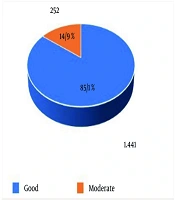
Most EMTs had good competency and nobody had poor competency (Figure 1).
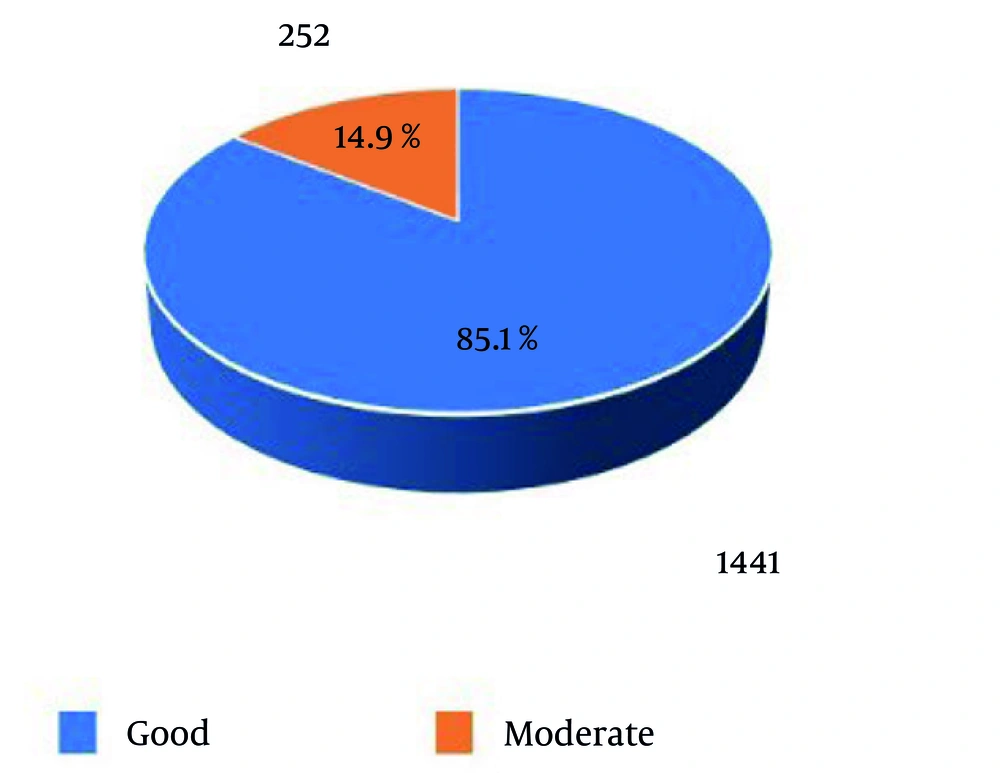
Figure 1.
Competency levels among prehospital emergency technicians in Iran
A significant difference in competency levels was observed across provincial clusters (P < 0.001). The relation of demographic and occupational characteristics with competency is presented in Table 1.
The logistic regression model showed a statistically significant fit, indicating that the included predictors collectively explained variance in competence levels. Pseudo R-square values were modest (Cox & Snell = 0.044; Nagelkerke = 0.077), suggesting that the model accounted for 4.4% - 7.7% of the variance in competency, likely due to the high prevalence of the “good” category (85.1%). In the final model, only provincial cluster and place of service were retained as predictors, as other variables (including mean work experience) were excluded due to non-significance. The overall model fit statistics are presented in Table 2.
Table 2.
Multinomial Logistic Regression Model Fit Statistics
| Statistic | Value | (df) | P-Value |
|---|---|---|---|
| Chi-square | 75.903 | 37 | .000 |
| Cox and Snell R² | .044 | - | - |
| Nagelkerke R² | .077 | - | - |
| McFadden R² | .053 | - | - |
The parameter estimates (Table 3) compare the odds of moderate versus good competence (reference category). Significant predictors included provincial clusters and place of service. Several provinces, such as Kurdistan, Khuzestan-Lorestan, Kerman-Kermanshah, and Ardabil, showed a significantly higher likelihood of strong competence compared with the reference cluster. Likewise, EMTs serving at roadside bases demonstrated slightly lower odds of moderate competence, indicating higher overall competence than those working in urban settings. Non-significant variables (e.g., education, employment type, marital status) showed no independent effect on competence levels.
Table 3.
Multinomial Logistic Regression Results for Predictors of Emergency Medical Technicians Competence Levels
| Variables and Category | B | OR | 95% CI for OR a | P-Value |
|---|---|---|---|---|
| Provincial clusters | ||||
| West Azerbaijan | -1.135 | 0.321 | [0.150, 0.687] | 0.003 |
| Ardabil | -1.220 | 0.295 | [0.109, 0.798] | 0.016 |
| Isfahan | -0.999 | 0.368 | [0.150, 0.903] | 0.029 |
| Alborz, Tehran, Qom | -0.766 | 0.465 | [0.227, 0.951] | 0.036 |
| Bushehr and Ilam | -1.572 | 0.208 | [0.044, 0.972] | 0.046 |
| Khorasan Razavi, North Khorasan | -1.171 | 0.310 | [0.142, 0.676] | 0.003 |
| Khuzestan and Lorestan | -1.525 | 0.218 | [0.103, 0.461] | < 0.001 |
| Zanjan | -0.818 | 0.442 | [0.195, 1.001] | 0.050 |
| Semnan | -1.060 | 0.346 | [0.128, 0.939] | 0.037 |
| Sistan and Baluchestan | -1.125 | 0.325 | [0.171, 0.614] | 0.001 |
| Qazvin | -0.971 | 0.379 | [0.148, 0.971] | 0.043 |
| Kurdistan | -1.785 | 0.168 | [0.047, 0.598] | 0.006 |
| Kerman and Kermanshah | -1.570 | 0.208 | [0.087, 0.499] | < 0.001 |
| Markazi | -1.292 | 0.275 | [0.086, 0.876] | 0.029 |
| Place of service | ||||
| Roadside | -0.295 | 0.745 | [0.555, 1.000] | 0.050 |
a Confidence intervals are reported to three decimal places. For Zanjan and Roadside categories, the upper bound of the 95% CI (1.001 and 1.000, respectively) indicates results at the threshold of statistical significance.
5. Discussion
This study aimed to assess the competencies of EMTs in Iran's pre-hospital EMS for critical situations, utilising a validated instrument and a nationwide census approach. The majority of EMTs demonstrated strong competence, with the remaining group showing moderate competence; no participants fell into the weak category, which is consistent with the overall pattern observed in our findings. This distribution may reflect recent improvements in Iran’s EMS training infrastructure (4). This contrasts with earlier Iranian research conducted in clinical settings, which reported predominantly moderate competence among nurses, likely due to smaller regional samples and limited training opportunities prior to 2020 (25). Although that study focused on hospital nurses rather than EMTs, it similarly highlights competency gaps linked to training accessibility. International comparisons also highlight substantial disparities in EMS training and system capacity across LMICs. A recent systematic review reported that fragmented EMS infrastructure and limited access to structured training are common challenges (8). These system-level inconsistencies are consistent with our finding that, despite a high proportion of EMTs demonstrating strong competence, a notable subgroup still exhibited moderate competence.
In addition to national and international evidence, regional data within Iran also support the presence of substantial variability in EMT competence. A recent OSCE-based evaluation of EMS paramedics in Guilan Province reported markedly lower competency levels than those observed in our national sample. In that study, 56.3% of paramedics demonstrated weak clinical competency and 31.3% showed moderate competency, with no participants achieving a good level of competence. Significant deficiencies were identified in critical skills such as spinal immobilization and vehicle extrication, while education and work experience were significantly associated with performance (26). These findings highlight pronounced provincial disparities and reinforce our conclusion that contextual and environmental factors rather than individual characteristics alone play a central role in shaping competency levels among EMS personnel in Iran. Furthermore, progressive improvements in EMS training programs over time may also contribute to the higher competence levels observed in our study compared with earlier research.
The multinomial logistic regression analysis identified significant predictors of competency levels, highlighting the influence of geographical and workplace factors over individual characteristics. These findings offer insights into EMS preparedness in a disaster-prone country and inform targeted educational interventions. Provincial clusters emerged as a significant predictor of competence, with clusters such as Kurdistan and Khuzestan–Lorestan showing substantially lower odds of moderate competence compared with the reference group. This is likely due to frequent exposure to natural disasters, which enhances practical skills in managerial and technical domains (27). In contrast, non-significant clusters like Mazandaran may face fewer resources or catastrophic events, which aligns with a global review of LMICs where rural-urban divides reduced competence by 15% to 30% due to unequal training access (8). Internationally, in the Middle East, higher competence was observed in high-risk zones, suggesting that crisis exposure generally enhances EMS skills (3). Place of service was another significant predictor, with EMTs at roadside bases showing a 26% lower likelihood of being in the moderate competence category compared to urban-base EMTs. This may stem from exposure to diverse incidents (e.g., road traffic accidents), which hones trauma management skills. Supporting this, a 2021 qualitative study in Saudi Arabia found that rural/roadside EMS personnel exhibit higher practical skills in trauma due to frequent high-acuity cases, recommending targeted training for urban staff (26). Similarly, a 2024 Iranian study in mega-cities noted greater field experience in peripheral/roadside areas for road trauma management (27). Internationally, a 2023 systematic review of low- and middle-income country EMS systems highlighted work environment as a key predictor, with field exposure often outweighing formal education in crisis settings (8). However, contrasting evidence from a 2020 Saudi study highlighted longer response times and resource shortages in rural/roadside areas, potentially reducing overall performance compared to urban settings (28). These mixed findings underscore the complex role of workplace environment in competence development, with experiential exposure often benefiting roadside EMTs despite logistical challenges.
Individual factors such as education and years of service were not significant predictors in our multivariate model, even though they showed associations in univariate analyses. A similar pattern was reported in a quasi-experimental study conducted among military nurses in Tehran, where having an associate or bachelor's degree initially appeared to correlate with crisis-management skills in univariate comparisons. However, these educational differences became non-significant after controlling for contextual factors such as the type of crisis-management training received (5). Although this study was conducted on nurses rather than EMTs, it supports the broader notion that environmental and experiential factors may outweigh individual demographic characteristics in determining crisis-related competencies. This implies that a shift towards simulation-based and interprofessional education is warranted. Furthermore, a quasi-experimental study conducted among fourth-year nursing students during their emergency department internship found that, although theoretical instruction improved triage decision-making, simulation-based triage training led to greater gains in knowledge and performance (29). Therefore, simulation-based training should be integrated into traditional learning methods. These findings highlight Iran's potential for targeted interventions, such as region-specific simulations, to uplift moderate and poor competency groups.
The model's moderate explanatory power suggests that unmeasured variables, such as access to training or simulation equipment, may account for additional variance. While provincial cluster and place of service were identified as significant predictors, it is likely that other unmeasured contextual and personal factors such as the quality of local training programs, resource availability, and individual motivation also influence competency levels. This is consistent with a 2023 global review of low- and middle-income country EMS systems, where training infrastructure and resource availability explained competency variations (8). In Iran, operational inefficiencies, rising demand, and limited resources have been identified as barriers to EMS performance, supporting the need for greater resources in lower-performing areas (27). These findings underscore the importance of regionalized, simulation-based training programs to address competency gaps, especially in disaster-prone Iran, and provide a basis for policy interventions by the National Medical Emergency Organization.
This study provides a comprehensive, nationwide assessment of EMT competencies in Iran's pre-hospital EMS, moving beyond the limitations of previous fragmented research. Limitations include a low pseudo R-square, suggesting that unmeasured factors (e.g., training quality) and data imbalance may have reduced sensitivity for moderate predictors. The cross-sectional design precludes causal inference, and reliance on self-reported data via the instrument may introduce bias, although its high reliability mitigates this issue. All participants in this study were male, which limits the generalizability of the findings to female EMTs. This demographic homogeneity reflects the fact that the EMT workforce in the study setting is predominantly male. Additionally, the inclusion of 21 provincial clusters increased the model’s complexity and consumed a substantial number of degrees of freedom; however, this level of geographic detail was retained to capture meaningful regional variation in competence. Future studies should consider longitudinal designs and structural equation modelling to explore indirect effects.
5.1. Conclusions
The study revealed that most Iranian EMTs demonstrated good competency, with a smaller proportion showing moderate competency. These findings highlight an overall satisfactory level of preparedness, while also indicating areas for further improvement. By identifying regional variations and work environments as pivotal drivers of preparedness, the study underscores critical opportunities for enhancing EMS performance. Targeted, simulation-based training, especially in regions with frequent crises and urban settings, holds promise for bridging competency gaps, aligning Iranian EMS with global standards, and enhancing crisis response to save lives.