
1. Background
Ectopic pregnancy (EP), defined as embryo implantation outside the uterine cavity, most commonly in the fallopian tubes, remains a major obstetric complication worldwide. Despite substantial advances in diagnostic imaging and minimally invasive therapeutic strategies, EP remains a leading cause of first-trimester maternal morbidity and mortality and poses a substantial risk to future fertility in women of reproductive age (1).
Recurrent ectopic pregnancy (REP), defined as more than 1 occurrence of EP in the same woman, represents a significant clinical challenge. REP threatens the current pregnancy and may impair future fertility, contribute to psychological distress, and increase the health care burden. The estimated recurrence rate of EP varies across studies, ranging from 10% to 27%, depending on the population and management strategies (2).
Previous studies have identified several risk factors for EP, including prior EP, infertility, pelvic or abdominal surgery (including cesarean section), use of intrauterine devices (IUDs), prior tubal surgery or tubal ligation, and a history of pelvic inflammatory disease (PID) (3). A national study among Iranian women found significant associations between EP and prior ectopic pregnancy, IUD use, prior pelvic or abdominal surgery, and prior tubal ligation (4).
Although the general risk factors for EP are well documented, relatively few studies have directly compared demographic, reproductive, and clinical characteristics between women with primary EP and those with REP. Available evidence suggests that recurrent cases may differ in important ways. For example, a multicenter study reported higher frequencies of prior infertility, lower educational attainment, and increased pelvic and peritubal adhesions among women with REP compared with primary cases (5). Similarly, a cohort study with long-term follow-up found that REP after an initial episode was associated with prior miscarriages, PID, and a lower likelihood of surgical management of the first EP (6). Importantly, the distribution of these risk factors and clinical features appears to vary substantially across regions, influenced by sociocultural context, access to health care, the prevalence of infections, contraceptive practices, and obstetric patterns such as cesarean section rates. In Iran, population-based data have shown an increasing incidence of EP over time, with notable proportions of affected women having histories of infertility, prior EP, or PID (7), while a systematic review reported a markedly higher prevalence of EP among infertile women undergoing assisted reproductive technologies than among the general obstetric population (8).
Recent regional studies on pregnancy-related complications further support the importance of evaluating maternal and reproductive factors within local clinical contexts. For example, Samadi et al. reported that maternal age, previous abortion history, and low anti-Mullerian hormone levels were associated with subsequent pregnancy outcomes in women with recurrent unexplained miscarriage, indicating the relevance of reproductive history and hormonal status to adverse pregnancy outcomes (9). In addition, recent case-control studies from southern Iran on intrahepatic cholestasis of pregnancy and COVID-19 during pregnancy have emphasized that maternal complications may show population-specific patterns and should be interpreted in relation to local health care and demographic contexts (10, 11). These studies underscore the need for region-specific assessment of pregnancy-related risk profiles.
2. Objectives
Given this heterogeneity across regions and populations, no published studies have specifically compared primary and recurrent EP in southeastern Iran. Such region-specific data are crucial for informing local clinical protocols, early diagnostic strategies, patient counseling, and fertility-preserving interventions. Therefore, this study aimed to compare demographic, obstetric, contraceptive, and clinical characteristics, including gestational age at presentation and serum β-hCG levels, between women with recurrent EP and those with primary EP in Zahedan, Iran, from 2017 to 2021. Through this comparison, we sought to determine whether recurrent EP constitutes a clinically distinct subgroup in this population and to delineate potential local risk factors and presentation patterns that may differ from those reported elsewhere.
3. Methods
3.1. Study Design and Setting
This cross-sectional study was conducted at Ali Ibn Abi Talib Specialized and Subspecialized Hospital in Zahedan, Iran, between March 2017 and March 2021. The study was approved by the Ethics Committee of Zahedan University of Medical Sciences (IR.ZAUMS.REC.1400.363), and written informed consent was obtained from all participants. Women of reproductive age (17 - 45 years) who were admitted with a confirmed diagnosis of EP were included. Participants were categorized into 2 groups: primary EP, defined as the first occurrence of an ectopic gestation, and recurrent EP, defined as at least 1 previous EP during the reproductive years. Patients with incomplete medical records or those who could not be reached for follow-up were excluded.
Because all eligible women with primary or recurrent EP who presented during the study period were included, no a priori sample size calculation was performed (12). Therefore, the study represents a census of available cases rather than a sample drawn from a larger population. However, the final sample size of 39 women per group limited the study’s statistical power, particularly for detecting small-to-moderate between-group differences.
3.2. Data Collection
Data were extracted from hospital records using a predefined checklist and supplemented with structured telephone interviews when variables were incomplete or required confirmation. The diagnosis of EP was confirmed based on hospital clinical records, using a combination of clinical presentation, serum β-hCG measurements, transvaginal ultrasonography findings, and intraoperative findings when surgical management was performed.
Demographic information included age, educational level, and smoking status. Educational level was defined as low if the participant had completed 12 or fewer years of formal schooling. Obstetric and gynecological history included gravidity, parity, prior cesarean section, and a history of infertility, defined as failure to conceive after 12 months of unprotected intercourse. Contraceptive use, including oral contraceptive pills, IUDs, condoms, or no contraceptive method, was also recorded. Clinical parameters collected at admission included gestational age (weeks), serum β-hCG levels, and presenting symptoms, including abdominal pain, vaginal bleeding, syncope, vomiting, and diarrhea.
3.3. Missing Data Handling
Missing data were assessed for all study variables before analysis. Variables required for group classification as primary versus recurrent EP were complete for all participants. For clinical and laboratory variables at admission, analyses were conducted using complete-case analysis. Participants with missing data for a given variable were excluded only from analyses involving that specific variable. No imputation methods were applied because of the low frequency of missing data and the exploratory nature of the study.
3.4. Statistical Analysis
Statistical analyses were performed using IBM SPSS Statistics, version 21. Continuous variables were tested for normality using the Kolmogorov-Smirnov test with Lilliefors correction and compared using Student t tests. Categorical variables were compared using chi-square or Fisher exact tests, as appropriate. Effect sizes for continuous variables were calculated using Cohen d to quantify standardized mean differences between groups. For categorical variables, odds ratios with 95% confidence intervals were computed from the group counts. Statistical significance was set at P < 0.05.
A post hoc power calculation was performed to contextualize the study findings. With 39 participants in each group, a 2-sided alpha level of 0.05, and 80% statistical power, the study was able to detect a large standardized mean difference of approximately Cohen d ≥ 0.64 for continuous variables. For categorical variables, the detectable odds ratio depended on the baseline prevalence of each exposure; however, the study was mainly powered to detect relatively large effects, approximately OR ≥ 3.5 under common exposure distributions. Therefore, smaller but potentially clinically relevant differences may have been missed.
4. Results
4.1. Participant Flow and Data Completeness
During the study period, 85 eligible women with EP were identified. Seven women were excluded because they could not be contacted for supplementary data collection, leaving 78 participants for the final analysis. Overall, 78 women met the inclusion criteria, with 39 in each group. Data completeness was ≥ 95% for all variables included in the analysis; therefore, analyses were based on the available data for each variable.
4.2. Demographic Characteristics
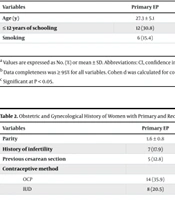
Women with recurrent EP were significantly older than those with primary EP (31.6 ± 6.0 vs 27.3 ± 5.1 years; P = 0.012; Cohen d = 0.77). Low educational attainment was more common in the recurrent group than in the primary group (53.8% vs 30.8%; OR = 2.62; 95% CI, 1.04 - 6.63; P = 0.031), as was smoking (35.9% vs 15.4%; OR = 3.08; 95% CI, 1.04 - 9.15; P = 0.024) (Table 1).
Table 1.
| Variables | Primary EP | Recurrent EP | P-Value c |
|---|---|---|---|
| Age (y) | 27.3 ± 5.1 | 31.6 ± 6.0 | 0.012 |
| ≤ 12 years of schooling | 12 (30.8) | 21 (53.8) | 0.031 |
| Smoking | 6 (15.4) | 14 (35.9) | 0.024 |
a Values are expressed as No. (%) or mean ± SD. Abbreviations: CI, confidence interval; EP, ectopic pregnancy; OR, odds ratio; SD, standard deviation.
b Data completeness was ≥ 95% for all variables. Cohen d was calculated for continuous variables.
c Significant at P < 0.05.
4.3. Obstetric and Gynecological History
As shown in Table 2, analyses of obstetric and gynecological history indicated that women with recurrent EP had significantly lower parity than those with primary EP (0.9 ± 0.7 vs 1.6 ± 0.8; P = 0.018; Cohen d = -0.93). A history of infertility was more prevalent in the recurrent group (41.0% vs 17.9%; OR = 3.18; 95% CI, 1.13 - 8.97; P = 0.022), and a prior cesarean section was also more frequent (33.3% vs 12.8%; OR = 3.40; 95% CI, 1.08 - 10.75; P = 0.027). Contraceptive use differed between groups, with recurrent EP more commonly associated with IUD use (46.2% vs 20.5%; OR = 3.32; 95% CI, 1.22 - 9.03; P = 0.015), whereas primary EP was more frequently associated with oral contraceptive pill use (35.9% vs 17.9%; OR = 0.39; 95% CI, 0.14 - 1.11; P = 0.048).
Table 2.
| Variables | Primary EP | Recurrent EP | P-Value c | Effect Size/OR (95 CI) |
|---|---|---|---|---|
| Parity | 1.6 ± 0.8 | 0.9 ± 0.7 | 0.018 | Cohen d = -0.93 |
| History of infertility | 7 (17.9) | 16 (41.0) | 0.022 | 3.18 (1.13 - 8.97) |
| Previous cesarean section | 5 (12.8) | 13 (33.3) | 0.027 | 3.40 (1.08 - 10.75) |
| Contraceptive method | ||||
| OCP | 14 (35.9) | 7 (17.9) | 0.048 | 0.39 (0.14 - 1.11) |
| IUD | 8 (20.5) | 18 (46.2) | 0.015 | 3.32 (1.22 - 9.03) |
a Values are expressed as No. (%) or mean ± SD. Abbreviations: CI, confidence interval; EP, ectopic pregnancy; IUD, intrauterine device; OCP, oral contraceptive pill; OR, odds ratio; SD, standard deviation.
b Data completeness was ≥ 95% for all variables. Cohen d was calculated for continuous variables.
c Significant at P < 0.05.
4.4. Clinical and Laboratory Findings at Admission
Clinical and laboratory findings at admission (Table 3) showed that women with recurrent EP presented at a significantly earlier gestational age (6.1 ± 1.4 vs 7.4 ± 1.6 weeks; P = 0.009; Cohen d = -0.86) and had lower serum β-hCG levels (1740 ± 960 vs 2650 ± 1180 mIU/mL; P = 0.013; Cohen d = -0.85). Abdominal pain was more frequent among recurrent cases (84.6% vs 64.1%; OR = 3.08; 95% CI, 1.04 - 9.15; P = 0.037), as was syncope (28.2% vs 10.3%; OR = 3.44; 95% CI, 0.99 - 11.97; P = 0.041). No significant differences were observed between groups in vaginal bleeding, vomiting, or diarrhea. Analyses of clinical and laboratory variables were based on the available data for each variable.
Table 3.
| Variables | Primary EP | Recurrent EP | P-Value | Effect Size/OR (95 CI) |
|---|---|---|---|---|
| Gestational age (wk) | 7.4 ± 1.6 | 6.1 ± 1.4 | 0.009 c | Cohen d = -0.86 |
| β-hCG (mIU/mL) | 2650 ± 1180 | 1740 ± 960 | 0.013 c | Cohen d = -0.85 |
| Abdominal pain | 25 (64.1) | 33 (84.6) | 0.037 c | 3.08 (1.04 - 9.15) |
| Vaginal bleeding | 17 (43.6) | 21 (53.8) | 0.311 | 1.51 (0.62 - 3.69) |
| Syncope | 4 (10.3) | 11 (28.2) | 0.041 c | 3.44 (0.99 - 11.97) |
| Vomiting | 6 (15.4) | 9 (23.1) | 0.376 | 1.65 (0.52 - 5.19) |
| Diarrhea | 3 (7.7) | 5 (12.8) | 0.521 | 1.76 (0.39 - 7.96) |
a Values are expressed as No. (%) or mean ± SD. Abbreviations: β-hCG, beta-human chorionic gonadotropin; CI, confidence interval; EP, ectopic pregnancy; OR, odds ratio; SD, standard deviation.
b Data completeness was ≥ 95% for all variables. Cohen d was calculated for continuous variables.
c Significant at P < 0.05.
5. Discussion
In this study, we compared the demographic, reproductive, and clinical characteristics of women with primary versus recurrent EP at a referral center in southeastern Iran. Women with recurrent EP were older, had lower parity, and had higher frequencies of infertility, smoking, and prior cesarean section. They also presented at an earlier gestational age and with lower serum β-hCG levels than women with primary EP.
These findings are broadly consistent with those of Hurrell et al., who described recurrent EP as a distinct clinical subgroup that may present earlier and require careful diagnostic attention. From a clinical perspective, women with a history of EP may benefit from early counseling, prompt evaluation after a positive pregnancy test, serial β-hCG assessment, and early transvaginal ultrasonography in subsequent pregnancies (13). However, because our results are based on unadjusted comparisons, these implications should be interpreted cautiously.
Several of our findings align with previously published international data showing that older maternal age, a history of infertility, and tubal damage or prior pelvic surgery are important risk factors for EP and REP. For example, Zhang et al. reported an adjusted odds ratio (AOR = 3.84; 95% CI, 2.16 - 6.86) for infertility as a predictor of REP (14). Moreover, Li et al. found that prior use of an IUD and prior adnexal surgery were associated with an increased risk of EP (15). Hurrell et al. observed that recurrent EPs tend to present at earlier gestational ages and with lower β-hCG levels than primary EPs (13).
Meanwhile, Tan et al., in an in vitro fertilization population, showed that factors such as conservative treatment of a prior EP and embryo transfer characteristics, including frozen-thawed or cleavage-stage embryos, increased the risk of recurrence (16). Mahajan et al. further reported that prior EP, tubal ligation, pelvic or abdominal surgery, infertility, cesarean section, and smoking were significant risk factors for EP overall, although their study did not differentiate between recurrent and primary cases (17). In addition, a broad meta-analysis of EP risk, including factors such as advanced maternal age, infertility, pelvic surgery, IUD use, and smoking, supports a multifactorial etiology for EP in diverse populations. However, variability across populations has been documented; for instance, while some studies observed a strong association between smoking and EP risk (3), others, including Gaskins et al., reported weaker or nonsignificant associations (18).
Differences between studies may reflect heterogeneity in health care access, referral patterns, surgical practices, and reproductive behaviors across countries. For example, varying prevalence rates of PID, infertility treatments, and contraceptive use can substantially influence EP risk patterns. The biological mechanisms underlying recurrent EP are also multifactorial. Proposed mechanisms include tubal scarring from prior surgery or infection, altered ciliary motility, hormonal influences from contraceptive use, and impaired tubal contractility (5). These mechanisms are consistent with our observation of a lower gestational age and lower β-hCG levels at presentation among recurrent cases.
The clinical presentation in our study, with recurrent EPs presenting earlier, at a lower gestational age, and with lower β-hCG levels, aligns with the idea that women with a history of EP may be more alert to symptoms, leading to earlier care seeking. Hurrell et al. similarly reported that recurrent cases tend to be identified earlier (13). This may enable less invasive management and possibly improve the chance of preserving tubal integrity, with implications for fertility outcomes.
Our findings support the notion that reproductive history, contraceptive use, and prior obstetric interventions may contribute to recurrence risk. However, other variables, such as vaginal bleeding, vomiting, and diarrhea, did not differ significantly between the groups, which may reflect the limited sample size, underreporting of symptoms, or a true lack of association. Similar limitations have been noted in previous studies, in which nonsignificant findings for some risk factors were attributed to missing data or recall bias (18).
Previous research has suggested that lower educational attainment may be associated with delayed access to care or differences in health-seeking behavior; however, our study did not directly assess socioeconomic status, and therefore no causal inference can be drawn (19).
5.1. Limitations
Although our findings contribute new information about EP patterns in southeastern Iran, they should be interpreted with caution. This study was based on a relatively small sample from a single center, which limits generalizability and restricts causal inference because of the cross-sectional design. The modest sample size increases the risk of type II error, particularly for variables that did not reach statistical significance, meaning that some potentially relevant associations may have remained undetected. In addition, the limited number of events in certain exposure categories resulted in relatively wide confidence intervals around several odds ratio estimates, indicating statistical imprecision and potential instability of effect size estimates. Therefore, the observed associations should be considered exploratory rather than definitive.
Furthermore, only bivariate analyses were performed. Because some information was supplemented through structured telephone interviews, recall bias cannot be excluded. Although several variables may be interrelated, such as age, parity, infertility, and prior cesarean section, multivariable regression modeling was not conducted because of the relatively small sample size and the risk of model overfitting with multiple correlated predictors. The post hoc power calculation further indicated that, with 39 participants per group, the study was mainly powered to detect large effects, whereas small or moderate associations may have remained undetected. As a result, the reported odds ratios represent unadjusted associations and should not be interpreted as independent effects. Larger studies with adequate events per variable are required to confirm independent predictors of recurrent EP.
5.2. Strengths and Future Directions
The strengths of this study include the direct comparison of primary and recurrent EP within the same clinical setting, the use of hospital-based data reflecting real-world practice, and the inclusion of both clinical and laboratory parameters. Future research should involve prospective, multicenter designs with larger sample sizes and more comprehensive data collection to improve statistical power, allow robust multivariable modeling, and support the development of predictive risk models for recurrent EP.
5.3. Conclusions
This study identified several demographic and reproductive differences between women with primary and recurrent EP in Zahedan, indicating that recurrent EP may follow a distinct clinical pattern in this population. Older age, infertility, smoking, prior cesarean section, and IUD use appeared more common among recurrent cases, and these women tended to present earlier in gestation with lower β-hCG levels. Although these findings are consistent with trends reported internationally, interpretation should remain cautious because of the limited sample size and single-center design. Larger multicenter studies with more robust statistical modeling are needed to clarify the independent predictors of recurrent EP and inform appropriate prevention and management strategies.