
1. Background
Intensive care units (ICUs) are highly stressful environments because they involve critically ill patients, life-threatening conditions, anxious and distressed relatives, multiple specialists, and advanced technologies (1). These circumstances expose nurses to numerous ethical challenges, including determining ethically permissible treatments, assessing patients’ decision-making capacity, identifying appropriate surrogate decision-makers, and managing potentially inappropriate or non-beneficial care. Situations involving continued aggressive interventions without patient recovery and the prolongation of the dying process are common in these units. Conflicting viewpoints in such circumstances can lead to disagreement or poor decision-making among team members (2, 3). Consequently, individual values, ethical commitments, and professional duties may be compromised. When nurses face these dilemmas, they often experience moral distress as a psychological response to threats to, or violations of, their moral integrity (4).
Recent studies indicate that moral distress is highly prevalent among ICU nurses, with most experiencing moderate to severe levels (5, 6). Moral distress has been associated with a range of adverse outcomes at both the individual and organizational levels. At the individual level, it contributes to psychological distress, including emotional exhaustion, frustration, anxiety, depressive symptoms, burnout, and reduced job satisfaction (7-10). At the organizational level, moral distress is linked to impaired teamwork, decreased productivity, reduced quality of patient care, and increased healthcare costs (8, 9). Ultimately, these consequences negatively affect patient outcomes and the overall functioning of healthcare systems.
Given the complex and highly subjective nature of moral distress, various interventions have been proposed to mitigate its impact. These interventions generally fall into four broad categories: ethics and clinical education programs aimed at enhancing moral sensitivity and awareness (11), resilience- or well-being-focused interventions (2), reflective approaches (12), and empowerment-based programs that encourage nurses to act effectively in ethically constrained situations (13, 14). However, despite growing interest in this area, empirical evidence supporting the effectiveness of these interventions in ICU settings remains limited.
A comprehensive review conducted by Hickey (2022) identified only a small number of intervention studies specifically designed to reduce moral distress among ICU nurses. Most of these studies had methodological limitations, including small sample sizes, high attrition rates, inadequate control groups, and limited statistical significance of outcomes (15). Among the interventions examined, empowerment-based approaches demonstrated the most promising results, including ethical empowerment programs and nursing empowerment initiatives (14, 16). These programs aim to strengthen nurses’ sense of moral agency, enabling them to navigate ethically constrained situations more effectively (17). A randomized controlled trial by Abbasi et al. (2018), which evaluated an empowerment program based on Alvita K. Nathaniel’s Moral Reckoning in Nursing theory, demonstrated a significant reduction in moral distress among Iranian nurses at the 1-month follow-up (14). However, despite these encouraging findings, the evidence base remains fragmented and methodologically weak. Most studies in this area use single-group designs, lack adequate control groups, include small sample sizes, or provide incomplete intervention reporting; these limitations severely compromise the validity and generalizability of their results (15, 18). Moreover, there is currently no consensus regarding the most effective program structure, content, or delivery format for empowerment-based interventions in critical care settings (3).
Nurses’ ability to cope with ethical challenges requires a certain level of critical-thinking skill (19). Therefore, educational methods that enhance nurses’ critical-thinking abilities are essential for promoting sound ethical decision-making in clinical settings. Among these methods, Ethical Grand Rounds (EGR) have emerged as an effective educational strategy (20). Nursing grand rounds are educational events conducted by nurses to familiarize audiences with evidence-based practice. During these sessions, nurses share their clinical experiences and focus on specific cases or groups of cases (20). Grand rounds provide opportunities for nurses to apply evidence in practice, demonstrate professional competence, and critically reflect on their ethical judgments, limitations, and commitments in a safe environment conducive to discussing moral distress (21). Although grand rounds have been widely used as an educational strategy to enhance clinical reasoning and professional dialogue, to the best of our knowledge, no controlled interventional study has evaluated the effect of EGR on moral distress in critical care settings.
Given the persistently high prevalence of moral distress among ICU nurses (22, 23) and the fragmented results of existing interventions, there is a pressing need for studies testing novel, contextually appropriate approaches. Addressing this gap, the present study aimed to determine the effect of a grand rounds-based empowerment program on moral distress among nurses working in ICUs.
2. Methods
2.1. Study Design and Participants
This quasi-experimental, two-group, pretest-posttest study was conducted from March 2024 to April 2025 among ICU nurses working in teaching hospitals in Zahedan, Iran. The sample size was calculated based on the study by Abbasi et al. (14), using a statistical power of 80%, a 95% confidence level, a mean difference of 1.4, a standard deviation of 2.23, and a significance level of 0.05, resulting in a required sample of 30 participants per group. Allowing for a 10% attrition rate, the final target sample was set at 33 nurses per group. Sample size estimation was performed using Stata software. During the study, four nurses (two in the intervention group and two in the control group) were lost to follow-up because of unwillingness to continue participation in the intervention group and incomplete questionnaires in the control group, yielding a final analyzed sample of 62 participants (Figure 1).
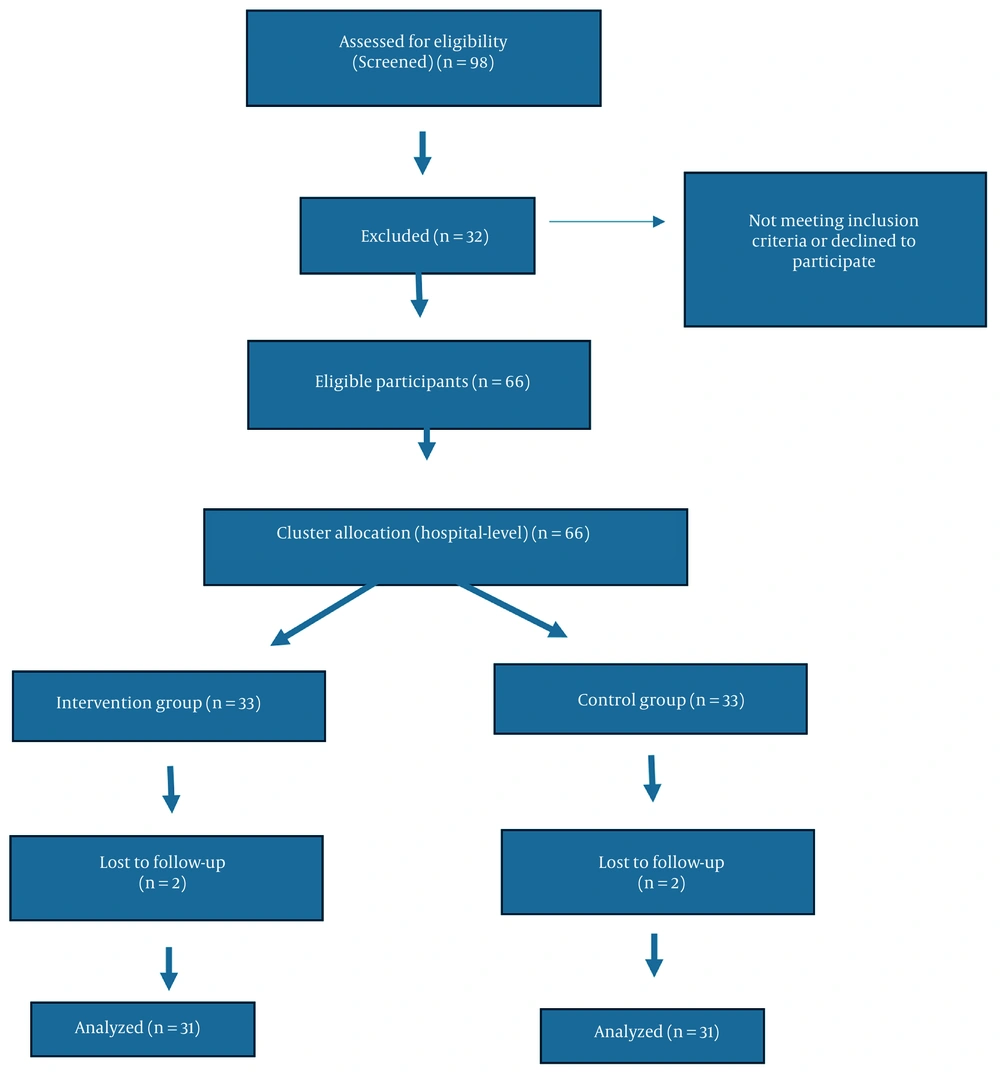
Figure 1.
Enrollment of participants in the study
Because ICU nurses within the same hospital frequently interact and exchange professional information, conducting the intervention and control conditions within a single setting could have led to unintentional sharing of intervention content. Therefore, to prevent the sharing of educational content between groups, nurses in the intervention and control groups were selected from two separate hospitals. Hospital A contained three ICUs (general, burn, and ICUOH), whereas Hospital B had four ICUs (two trauma and two general). Units with similar patient loads, nurse-to-patient ratios, and types of care provided were selected. Therefore, individual random assignment of participants was not performed. Instead, group allocation was conducted at the hospital (cluster) level. One of the two hospitals was selected as the intervention site using a simple random procedure (rolling a die), in which even numbers indicated the intervention hospital and odd numbers indicated the control hospital. Consequently, all eligible ICU nurses in the selected hospital comprised the intervention group, whereas nurses in the other hospital constituted the control group. Within each hospital, participants were recruited using convenience sampling.
In this study, Hospital A was allocated to the intervention arm and Hospital B to the control arm based on the die roll.
The inclusion criteria were as follows: (a) at least one year of work experience in ICUs to ensure experience in dealing with moral distress and (b) no participation in any professional ethics training course during the previous six months. The exclusion criteria were as follows: (a) unwillingness to continue participation, (b) transfer to another hospital or ward, and (c) absence from more than one intervention session.
Instruments
Data were collected using a two-part questionnaire. The first part collected demographic information, including age, gender, marital status, religion, education level, job position, total work experience, ICU experience, and employment status.
Moral distress was measured using the Moral Distress Scale-Revised (MDS-R), developed by Hamric et al. (2012). The MDS-R total score was the primary and only study outcome. The instrument consists of 21 items and 3 additional questions. The frequency and intensity of moral distress are assessed using the first 21 items on a 5-point Likert scale ranging from 0 (“never”) to 4 (“daily”) for frequency and from 0 (“none”) to 4 (“a great extent”) for intensity. For each item, the moral distress score is calculated by multiplying intensity by frequency. The total moral distress score is obtained by averaging all item scores, producing a possible range of 0 - 16 (24). Scores of 0 - 4 indicate low distress, 4.01 - 8 indicate moderate distress, 8.01 - 12 indicate high distress, and 12.01 - 16 indicate very high moral distress.
The final three questions (ethical-disturbance subscale) assess how often nurses tolerate moral distress and whether they have considered leaving or intend to leave their job because of such distress. In Hamric et al.’s study (24), Cronbach’s alpha was 0.88 for the 21 core items and 0.89 for the total instrument. The MDS-R was translated into Persian, and its psychometric properties were evaluated by Ghasemi et al. (2017). The Persian version demonstrated acceptable face and content validity (CVI = 0.96) and high internal consistency (Cronbach’s alpha = 0.946 for the total scale) (25). In the present study, internal consistency was also high (Cronbach’s alpha = 0.93).
Intervention
The ethical empowerment program used in this study was based on the Professional Empowerment Model developed by Salar et al. (26) and implemented through the grand rounds method. This indigenous Iranian model includes four main phases: needs assessment, sensitization, control and review, and evaluation.
2.2. Conceptual Framework and Mechanisms of Change
Empowerment is conceptualized as a psychosocial process that begins with awareness of the problem and progresses through skill building, confidence, and sustained self-regulation. In empowerment interventions developed in the Salar research line, the pathway typically moves from (i) increasing knowledge and perceived threat regarding the problem to (ii) enhancing self-efficacy through structured problem-solving and (iii) strengthening self-esteem and internal locus of control through active educational participation, with (iv) ongoing process and outcome evaluation to consolidate change.
In the present study, this logic was applied to ICU ethical practice. Needs assessment and case elicitation were used to identify nurses’ morally distressing situations and increase recognition of ethical threats to moral integrity; the grand rounds sessions used case-based discussion, critical thinking, communication, and coping exercises to build ethical self-efficacy and moral agency; repeated peer reflection was intended to reinforce professional identity, perceived control, and social support; and the control/review phase and follow-up assessments supported reinforcement and maintenance over time. Through these proximal determinants, the program was expected to reduce both the frequency and intensity components of moral distress measured by the MDS-R.
2.3. Needs Assessment
A needs assessment was conducted to identify ethical problems and educational needs. At baseline, both groups completed the MDS-R. Items with the highest intensity and frequency scores were prioritized as educational needs. To complement these findings, an open-ended question at the end of the MDS-R asked nurses to describe their most distressing ethical experiences in the ICU. Short qualitative interviews were also conducted to gain deeper insights. The results guided the preparation of the ethical empowerment content and the design of ethical case scenarios for the grand rounds sessions. These interviews were used only to refine the educational content and case scenarios and were not analyzed as study outcomes.
The main topics covered included orientation to the study objectives; professional values and ethical principles (ethical codes); patients’ rights; self-compassion; coping mechanisms for moral distress; stress, anger, and aggression management; empathy in patient care; spiritual care; truth-telling; confidentiality; interpersonal communication skills; end-of-life quality care; and euthanasia.
2.4. Sensitization Phase
The sensitization phase was conducted to actively engage participants with ethical challenges. The ethical empowerment program was delivered to the intervention group through grand rounds sessions consisting of six 30-minute sessions over three weeks. The intervention was implemented as face-to-face group sessions, enabling participants to engage directly in collaborative discussions. The sessions followed the four-stage framework of Ahmad et al. (2015): (1) a comprehensive literature review on the selected topic; (2) a short lecture to introduce the issue and encourage collaboration; (3) presentation of a case report emphasizing critical thinking, problem-solving, and clinical understanding; and (4) group discussion, reflection, and summary (20).
Each session included approximately four to five participants, including the head nurse, a registered nurse, a staff nurse, and, in some cases, a medical resident. To ensure that all nurses in the department received the training, the researcher delivered sessions across all three shifts. Sessions were held at the ICU nursing station and facilitated by the researcher. Training hours were determined in coordination with the educational and clinical supervisors and the nurses. Each session began with a brief lecture on an ethical dilemma, followed by the presentation of an ethical narrative and an open discussion among nurses to explore their reactions, experiences, and approaches. The researcher guided the discussion and corrected misconceptions when necessary, and each session concluded with a collective summary. The schedule and topic of each round were announced beforehand so that participants could prepare relevant cases or evidence. After each session, a handout summarizing the content was provided. In addition, social media groups were created to share supplementary materials and ethical case scenarios.
The control group received no educational intervention during the study but received the educational booklet developed from the grand rounds content after data collection to ensure ethical fairness.
2.5. Control and Review Phase
The control and review phase focused on monitoring training effectiveness, addressing previous challenges, and identifying new ethical issues to sustain nurses’ professional empowerment.
2.6. Evaluation Phase
The demographic questionnaire and MDS-R were administered to both groups at four time points: before the intervention, immediately after the intervention, two weeks after the intervention, and one month after the intervention. All questionnaires were self-administered by ICU nurses.
2.7. Data Analysis
Data were analyzed using SPSS version 25. Before the main analysis, the Shapiro-Wilk test was applied to assess the normality of quantitative variables. Descriptive statistics (frequency, percentage, mean, standard deviation, minimum, and maximum) were used to summarize the data.
Within-group comparisons of mean moral distress scores across time were performed using repeated-measures ANOVA, whereas between-group comparisons were conducted using independent t-tests. The chi-square or Fisher’s exact test was used to compare categorical variables. To minimize bias, data analysis was conducted by an independent outcome assessor who was blinded to group allocation. The significance level was set at P < 0.05.
2.8. Ethical Considerations
This study was approved by the Ethics Committee of Zahedan University of Medical Sciences, Iran (approval code: IR.ZAUMS.REC.1403.163). Participants received full information about the study objectives and procedures, their right to choose the time and place of participation, and their freedom to withdraw at any stage without penalty. Written informed consent was obtained. Confidentiality of all collected data was strictly maintained. To ensure ethical equity, the control group received the educational booklet derived from the grand rounds sessions after completion of posttest data collection.
3. Results
Of the 62 participating nurses, 75.80% were women and 83.87% were married. Participants’ ages ranged from 23 to 51 years (mean ± SD: 33.85 ± 5.60). The mean total work experience was 10.50 ± 5.71 years, and the mean ICU experience was 8.17 ± 4.99 years. Regarding educational level, 91.9% held a bachelor’s degree and 8.1% held a master’s degree. Overall, 79.0% were permanent employees, 16.1% were contractual employees, and 4.8% held plan/temporary positions. No significant between-group differences were observed in demographic characteristics (Table 1).
Table 1.
Baseline Demographic and Professional Characteristics of Participants a
| Variables | Intervention (n = 31) | Control (n = 31) | P-Value b |
|---|---|---|---|
| Sex | 0.76 | ||
| Male | 7 (22.6) | 8 (25.8) | |
| Female | 24 (77.4) | 23 (74.2) | |
| Marital status | 0.49 | ||
| Single | 4 (12.9) | 6 (19.4) | |
| Married | 27 (87.1) | 25 (80.6) | |
| Employment status | 0.83 | ||
| Plan/temporary | 1 (3.2) | 2 (6.5) | |
| Contractual | 5 (16.1) | 5 (16.1) | |
| Permanent | 25 (80.6) | 24 (77.4) | |
| Education | 0.23 | ||
| BSc | 27 (87.1) | 29 (93.5) | |
| MSc or higher | 4 (12.9) | 2 (6.5) | |
| Age (y) | 34.68 ± 4.16 | 33.03 ± 6.72 | 0.25 |
| Total work experience (y) | 11.06 ± 4.43 | 9.93 ± 6.80 | 0.44 |
| ICU work experience (y) | 8.16 ± 4.03 | 8.19 ± 5.86 | 0.98 |
Abbreviation: ICU, intensive care unit.
a Values are expressed as No. (%) or mean ± SD.
b P-values have calculated using independent t-test (continuous) and chi-square/Fisher’s exact test (categorical).
At baseline, there were no significant between-group differences in the total moral distress score (P = 0.89) or in the distribution of responses to the three terminal MDS-R items concerning tolerating moral distress, prior job leaving, thinking about leaving, or current intention to leave one’s job because of moral distress (P > 0.05;Table 2).
Table 2.
Baseline Distribution of Ethical-Disturbance Items (Hamric MDS-R) Before the Intervention a
| Items and Options | Intervention | Control | P-Value (Fisher’s Exact) |
|---|---|---|---|
| Q22. Have you ever left your job due to moral distress, or considered doing so? | 0.61 | ||
| No, I have never considered leaving. | 8 (25.8) | 12 (38.7) | |
| Yes, I have considered it but did not leave. | 20 (64.5) | 17 (54.8) | |
| Yes, I left my position. | 3 (9.7) | 2 (6.5) | |
| Q23. Are you currently considering leaving your job? | 0.16 | ||
| Yes | 28 (90.3) | 24 (77.4) | |
| No | 3 (9.7) | 7 (22.6) | |
| Q24. How do you tolerate moral distress? | 0.98 | ||
| I try to adapt to it. | 7 (22.6) | 6 (19.4) | |
| I have become accustomed to it. | 2 (6.5) | 2 (6.5) | |
| I try to remain indifferent to it. | 8 (25.8) | 9 (29.0) | |
| I am forced to endure it. | 14 (45.2) | 14 (45.2) |
a Values are expressed as No. (%).
In the intervention group, moral distress scores at pretest, immediately after the intervention, two weeks after the intervention, and one month after the intervention were 2.80 ± 1.92, 2.73 ± 1.90, 2.50 ± 1.55, and 2.28 ± 1.31, respectively, indicating an overall low level with a downward trend. However, comparisons of group means at each time point showed no statistically significant between-group differences (pretest: P = 0.89; immediately after the intervention: P = 0.84; two weeks after the intervention: P = 0.64; one month after the intervention: P = 0.23), with small effect sizes (ηp² ranging from 0.01 to 0.003) (Table 3).
Table 3.
| Time Point/Effect | Intervention Group | Control Group | P-value d | Effect Size (Cohen’s d) |
|---|---|---|---|---|
| Before intervention | 2.80 ± 1.92 | 2.87 ± 2.07 | 0.89 | -0.03 |
| Immediately after intervention | 2.73 ± 1.90 | 2.82 ± 1.98 | 0.84 | -0.05 |
| Two weeks after intervention | 2.50 ± 1.55 | 2.69 ± 1.67 | 0.64 | -0.12 |
| One month after intervention | 2.28 ± 1.31 | 2.77 ± 1.81 | 0.23 | -0.31 |
a Values are expressed as mean ± SD.
b Between-group comparisons at each time point: independent t-test.
c Repeated-measures ANOVA used for within- and between-group effects.
d Significance level was considered P < 0.05.
Despite the absence of significant between-group differences, within-group analyses using repeated-measures ANOVA revealed a decreasing trend in moral distress scores in the intervention group over time. Pairwise comparisons with Bonferroni adjustment indicated that the reduction in moral distress scores in the intervention group was statistically significant only between baseline and one month (P = 0.05) and between two weeks and one month (P = 0.03). However, because the time-by-group interaction was not significant (P = 0.54), the pattern of changes across the four measurements did not differ significantly between groups (Figure 2 presents the trend in moral distress over time using estimated marginal means derived from the repeated-measures analysis). In the control group, no significant within-group changes were observed at any time point (P > 0.05; Table 4). In the intervention group, the mean change from baseline to one month was -0.52 (95% CI: -1.03 to -0.01). At one month, the between-group mean difference was -0.49 (95% CI: -1.30 to 0.32).
Table 4.
Repeated-Measures ANOVA Results for Moral Distress Scores
| Effect | SS | Df | MS | F | P | Effect Size (ηp²) | Power |
|---|---|---|---|---|---|---|---|
| Group | 2.05 | 1 | 2.05 | 0.19 | 0.65 | 0.003 | 0.07 |
| Time | 4.12 | 2.03 | 2.02 | 1.55 | 0.21 | 0.02 | 0.32 |
| Group × time | 1.63 | 2.03 | 0.80 | 0.61 | 0.54 | 0.01 | 0.15 |
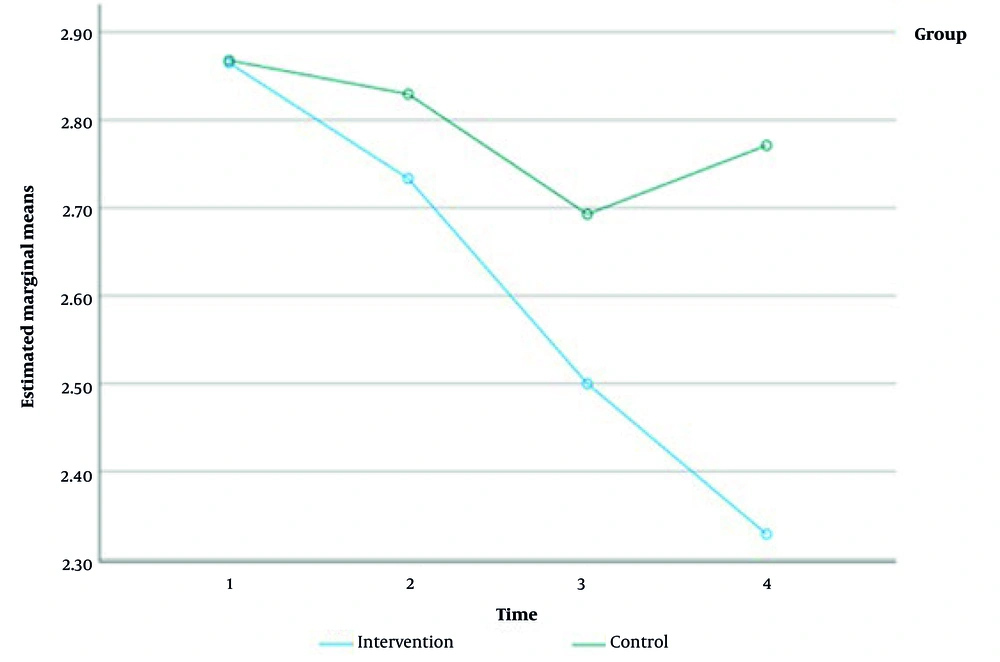
Figure 2.
Trends in moral distress over time in the intervention and control groups. Values represent estimated marginal means ± standard deviation.
4. Discussion
This study examined the effect of an empowerment program delivered through grand rounds on moral distress among ICU nurses. A notable finding was that baseline moral distress levels were relatively low in both groups, with no significant between-group differences. This finding is consistent with the results of Browning Emily and Cruz Jourdan (27), who also reported low moral distress among ICU nurses. In contrast, several studies have reported moderate levels (Arash et al. (5), Yeganeh et al. (28), and Altaker et al. (29)) or even severe levels (Asayesh et al. (30)). These discrepancies may be related to organizational, cultural, educational, geographic, and individual differences, including divergent knowledge bases and value systems among participants. Importantly, the relatively low baseline scores observed in this study may indicate a floor effect, whereby limited room for further reduction constrains the likelihood of detecting statistically significant intervention effects. When baseline moral distress is already low, even potentially beneficial interventions may yield changes that are difficult to capture quantitatively.
Importantly, a low distress score should not be interpreted simplistically as favorable. In some cases, low scores can reflect detachment or insufficient ethical awareness, whereby nurses fail to recognize or respond to ethically challenging situations (17). In our sample, responses to the item “How do you tolerate moral distress?” support this concern: 27.4% reported attempting to remain indifferent to moral distress. In fact, only 21% reported adapting constructively to moral distress, whereas the majority (79%) reported ineffective coping strategies such as indifference, normalization, and forced tolerance. Prior work shows that nurses often resort to avoidant strategies to blunt distress, which can directly degrade care quality (31).
Hakimi et al. (32) described the development of moral indifference through five stages: discouragement, normalization, resignation, becoming a justifier, and, ultimately, entrenched indifference. They argued that maintaining ethical practice in environments where colleagues are insensitive to ethical issues can be difficult and may contribute to stress and burnout. Overwork may normalize unethical practices, leading to resignation and post hoc justification to reduce cognitive dissonance; over time, ethical awareness may diminish (32). Esmaeili et al. (2024) similarly noted that maladaptive coping may stem from nurses’ perceived powerlessness within physician-centered hierarchies, expectations of deference, fear of repercussions, lack of managerial support, and poor interprofessional communication (33).
Despite the low baseline moral distress observed in this study, an alarmingly high proportion of nurses reported considering leaving the profession. Specifically, 59.7% had considered leaving but had not done so, 8.1% had previously left a job, and 83.9% currently expressed an intention to leave. This apparent discrepancy underscores the multifactorial nature of turnover intention, suggesting that moral distress alone does not fully account for nurses’ decisions to leave the profession. Structural and economic pressures, such as workload, burnout, job insecurity, and financial strain, may play a more prominent role. In Iran, economic instability and limited employment alternatives may further explain why nurses remain in their positions despite strong intentions to leave (34).
Comparable findings were reported by Abbasi et al. (14), who observed that while only a small proportion of nurses had actually left their jobs, a substantial majority had considered doing so, often attributing their intentions to moral and occupational stressors. Woods (35) similarly linked moral distress to physical and psychological exhaustion and subsequent turnover intention. National data from Iran further highlight the severity of this issue, with high rates of resignation and nurse migration reported in recent years (36). According to the Iranian Nursing Organization, approximately 1,000 nurses emigrated in 2018, increasing to 1,200 - 1,400 per year by 2021 (36). Thus, the item assessing intention to leave may indicate broader systemic workforce vulnerability rather than solely an ethical concern.
Regarding intervention effects, the present study found a gradual reduction in moral distress within the intervention group, reaching statistical significance only at one month after the intervention. This pattern aligns with findings by Abbasi et al. (14) and Sadeghi-Gandomani et al. (34), who also observed reductions in moral distress frequency/intensity one month after the intervention. Moral distress is unlikely to change abruptly; time and sustained intervention are often necessary. Wocial (37) argued that ethics is a fluid system that cannot be instilled in a single session; repeated education and memory refreshers are required for durable effects. Consistent with this view, Whitehead et al. (38) observed limited immediate effects following a single ethics round, and Browning and Cruz (27) reported no significant between-group differences after reflective dialogue sessions. Collectively, these findings reinforce the notion that moral distress is a complex, multifactorial phenomenon for which no single intervention is universally effective (39). This complexity may explain why, despite a downward trend over time, the grand rounds-based empowerment program did not produce significant between-group differences in the present study. Comparable quasi-experimental research among emergency department nurses reported improvements in moral sensitivity and caring behaviors following empowerment education, although between-group differences likewise failed to reach statistical significance (40).
Beyond quantitative reductions, grand rounds may influence how nurses learn and support each other. Despite abundant information sources, bedside nurses often prioritize human sources and tacit knowledge. Nursing grand rounds create space to recognize diverse expertise, strengthen intraprofessional networks, and elevate the value of nursing contributions to patient outcomes (41). The human connection forged during shared discussions of ethical challenges can reduce stress, enhance meaning-making, bolster resilience, and cultivate perceived social support (42). Through shared experiences, nurses may both learn more effectively and obtain psychological support, enabling more adaptive coping with ethical challenges without escalating moral distress.
A practical strength of our work was the delivery of grand rounds at the ICU nursing station. Prior research recommends that ethics education be conducted in real clinical settings and followed longitudinally (43). In-unit delivery enabled discussion of concrete, locally experienced cases, promoting shared understanding, experiential learning, and improved professional relationships.
Limitations
This study has several limitations. First, not all nurses were able to attend the grand rounds sessions because of heavy ICU workloads, although sessions were offered across all shifts and continuing-education credit was provided to encourage participation. Participants who missed more than one session were excluded; therefore, all analyzed participants attended at least five of the six sessions. Second, because of practical constraints and the need to minimize information exchange between groups, we used a quasi-experimental design with hospital-level allocation, which may limit causal inference; however, baseline characteristics were comparable between groups. Finally, moral distress was measured using self-administered questionnaires, which may be subject to self-report bias. These limitations suggest that the findings should be interpreted cautiously and underscore the need for randomized studies with longer follow-up periods and, where possible, objective measures.
Conclusion
The findings of this study indicate that the grand rounds-based empowerment program did not lead to statistically significant between-group differences in moral distress among ICU nurses over the study period. However, a significant within-group reduction in moral distress was observed in the intervention group over time, particularly between baseline and one month, suggesting a gradual and delayed response to the intervention. The low baseline levels of moral distress may have limited the magnitude of detectable between-group effects. From a clinical perspective, integrating ethics-focused grand rounds into routine ICU educational activities appears feasible and may support reflective practice, peer discussion, and ethical awareness among nurses without disrupting clinical workflows. Overall, these results suggest that empowerment interventions delivered through grand rounds may contribute to incremental improvements in nurses’ moral distress when sustained over time. Future studies with larger samples, longer follow-up periods, and integration with organizational-level strategies are warranted to more clearly delineate the effectiveness of such interventions in critical care settings.