
1. Background
The spread of new technologies and the Internet has transformed educational methods and increased the use of virtual education. Virtual education can facilitate access to educational resources, reduce spatial and temporal barriers, and create opportunities for active and independent learning (1).
Many studies have indicated that medical students may lack competency in diagnostic skills for heart disease, particularly in interpreting electrocardiograms (ECGs) and clinical cardiac data (2, 3). ECG interpretation is a critical skill in medical education and remains a major challenge for students (4, 5). Research suggests that virtual education can enhance medical skills, particularly ECG interpretation. Digital and online platforms may also offer advantages over traditional methods (2).
Today's students are highly familiar with technology and the Internet, which has increased interest in technology-supported learning approaches (6, 7). E-learning has the potential to expand access to medical education, particularly in resource-limited settings, and may improve educational quality (1). Curricula incorporating online ECG modules and other web-based systems have been effective in improving ECG understanding and interpretation (8). Studies have also shown that online education can be effective in health-professions education (9, 10). In nursing education, innovative ECG training methods have received increasing attention. An Iranian study showed that online gamification improved ECG interpretation skills and self-directed learning among nursing students (11). Evidence also suggests that virtual and augmented reality approaches can support learning in health sciences education (10). Qualitative studies have reported that nursing students may perceive virtual education as flexible and accessible; however, interaction and course design remain important determinants of the learning experience and satisfaction (12-14).
Given the challenges of face-to-face classes, including time constraints, distractions, and fatigue, as well as the accessibility of online platforms, virtual ECG interpretation classes may be useful. Student satisfaction with virtual education may be influenced by accessibility, interaction, and the quality of content delivery, highlighting the importance of well-designed online learning environments during and after the COVID-19 pandemic (15). Conventional classroom settings may also be associated with time demands and student fatigue (6). Despite these challenges, limited research has specifically examined the effectiveness of virtual ECG training among nursing students, as many existing studies have involved medical students or other healthcare trainees. Existing studies have also reported inconsistent findings regarding the effectiveness of virtual education compared with in-person methods, with some showing superiority (6, 11) and others showing no significant difference (3, 4). Evidence specifically focused on nursing students remains limited. Therefore, this study compared virtual and in-person instruction in nursing students to provide evidence for integrating virtual methods into nursing curricula.
2. Objectives
This study aimed to evaluate the impact of a virtual ECG training course on learning outcomes and satisfaction in nursing students.
3. Methods
3.1. Study Design and Participants
This quasi-experimental, two-group, before-and-after study was conducted in Mashhad, Iran, from March to June 2024. The study population comprised 64 undergraduate nursing students in semesters 1 to 5, who were recruited using a census method. Students who had not previously participated in an ECG interpretation course and were willing to participate were eligible. Exclusion criteria included prior participation in supplementary ECG courses, incomplete questionnaire responses, or withdrawal from the study. Participants were randomly assigned to two groups of 32 students using a random number generator (Random.org): the experimental group (virtual training) and the control group (in-person training).
3.2. Intervention
The course was developed using the ADDIE instructional design model, which comprises five stages: analysis, design, development, implementation, and evaluation (16).
Analysis: A preintervention test containing 20 validated multiple-choice questions (MCQs) was administered to both groups to assess baseline knowledge and skills in ECG interpretation.
Design: The educational intervention was delivered in two formats. The control group received traditional face-to-face lectures in classrooms at the Faculty of Nursing and Midwifery, whereas the experimental group received virtual instruction via the interactive Skyroom online platform. Both groups received identical educational content and objectives.
Development: The course content included basic ECG concepts, heart rate determination, rhythm and arrhythmia identification, and wave and segment abnormalities. The content was prepared using reliable scientific sources and reviewed by experts for accuracy.
Implementation: The experimental group participated in four 2-hour online sessions, and recorded videos were provided for review. Students were instructed not to share the recordings. The control group attended four 2-hour in-person sessions covering the same content. The instructor's competence was verified by the academic supervisor. The educational content was delivered over four weekly sessions. The first session covered cardiac anatomy and physiology, the cardiac electrical conduction system, basic ECG waveform components (P wave, QRS complex, T wave, PR interval, and ST segment), and standard lead placement. The second session focused on heart rate calculation, rhythm regularity, normal sinus rhythm, and sinus arrhythmias, including sinus bradycardia and sinus tachycardia. The third session addressed atrial fibrillation, atrial flutter, premature atrial contractions, junctional rhythms, premature ventricular contractions, ventricular tachycardia, and ventricular fibrillation. The fourth session covered atrioventricular blocks (first-degree, second-degree types I and II, and third-degree), bundle branch blocks, ischemic changes (ST-segment elevation and depression and T-wave inversion), and case-based ECG interpretation practice.
Evaluation: After completion of the course, a posttest identical to the preintervention test was administered to both groups. A validated satisfaction questionnaire was also administered to assess students' satisfaction with the course.
3.3. Data Collection
Data were collected using a demographic questionnaire and two validated instruments: a 20-item ECG knowledge test and the Student Satisfaction and Self-Confidence in Learning Scale (SCLS).
Demographic questionnaire: This questionnaire collected information on participants' age, gender, grade point average (GPA), and academic semester.
ECG knowledge test: The test comprised 20 MCQs adapted from the "Nursing Student Quizzes & Sample Tests" available on the Allnurses.com website. The test was translated into Persian using a forward-backward translation method and reviewed for cultural appropriateness by the faculty supervisor. The content validity of the translated version was confirmed by a panel of five faculty experts in nursing education and cardiology (content validity index > 0.94). Each correct answer was scored as 1 and each incorrect answer as 0, yielding a total score range of 0 - 20. Higher scores indicated greater ECG interpretation knowledge. Reliability was assessed using Cronbach alpha, which was 0.89 for the total test. Test-retest reliability was not assessed because the focus was on internal consistency.
Student Satisfaction Subscale: The satisfaction subscale of the SCLS was used in this study. The SCLS was originally developed by the National League for Nursing (NLN) (17), and the Persian version was adapted and validated by Tosun et al. The satisfaction subscale consists of 5 items rated on a 5-point Likert scale (1 = strongly disagree, 5 = strongly agree), with total scores ranging from 5 - 25. Higher scores indicate greater satisfaction with the educational method. The subscale demonstrated excellent psychometric properties, with a Cronbach alpha coefficient of 0.83.
3.4. Statistical Analysis
Data were analyzed using SPSS version 26.0 (IBM Corp., Armonk, NY, USA). Descriptive statistics, including frequency, mean, and standard deviation (SD), were reported for all variables. Normality was assessed using the Kolmogorov-Smirnov test. Paired t-tests were used to compare pre- and post-learning scores within each group for normally distributed data, and the Wilcoxon signed-rank test was used for nonnormally distributed data in the experimental group. Independent t-tests and Mann-Whitney U tests were used for between-group comparisons. The chi-square and Fisher exact tests were used to compare qualitative variables. The Kruskal-Wallis test was used to examine relationships between demographic factors (age, GPA, and academic semester) and outcomes. A significance level of P < 0.05 was considered statistically significant.
3.5. Ethical Considerations
Written informed consent was obtained from all participants, and confidentiality was maintained throughout the study. No fees were charged to participants. The study protocol was approved by the Ethics Committee of Mashhad University of Medical Sciences (IR.MUMS.MEDICAL.REC.1403.221).
4. Results
A total of 64 nursing students participated in this study, including 32 students in the experimental group and 32 in the control group. No participants withdrew. Normality was assessed using the Kolmogorov-Smirnov test. Age and GPA were not normally distributed (P < 0.05); therefore, the Mann-Whitney U test was used for between-group comparisons of these variables. Post-learning scores in the control group were also not normally distributed (P < 0.05), whereas pre-learning scores in both groups and post-learning scores in the experimental group were normally distributed. No significant demographic differences were observed between the groups, except for gender (Table 1).
Table 1.
Demographic and Baseline Characteristics of Nursing Students in the Virtual Training and Control Groups a
| Variables | Experimental Group (n = 32) | Control Group (n = 32) | P Value |
|---|---|---|---|
| Age (y) | 22.69 ± 4.00 | 21.59 ± 3.29 | 0.746 b |
| GPA | 17.12 ± 1.19 | 16.75 ± 1.24 | 0.098 b |
| Gender | < 0.001 c | ||
| Male | 6 (18.8) | 20 (62.5) | |
| Female | 26 (81.2) | 12 (37.5) | |
| Academic semester | 0.199 d | ||
| 1 | 3 (9.4) | 2 (6.3) | |
| 2 | 4 (12.5) | 5 (15.6) | |
| 3 | 6 (18.8) | 9 (28.1) | |
| 4 | 13 (40.6) | 5 (15.6) | |
| 5 | 6 (18.8) | 11 (34.4) |
a Values are expressed as mean ± SD or No. (%). Abbreviations: SD, standard deviation; GPA, grade point average; n, number of participants.
b Mann-Whitney U test.
c chi-square test.
d Fisher exact test.
There were no significant between-group differences in preintervention learning scores (independent t-test, P = 0.456) or postintervention learning scores (Mann-Whitney U test, P = 0.892) (Table 2). The independent t-test also showed no significant between-group difference in mean changes in learning scores (P = 0.209) (Table 2).
Table 2.
Learning Scores Before and After Virtual Education in the Experimental and Control Groups a
| Test Scores | Experimental Group (n = 32) | Control Group (n = 32) | P Value |
|---|---|---|---|
| Preintervention | 8.50 ± 3.57 | 7.91 ± 2.72 | 0.456 b |
| Postintervention | 13.13 ± 3.70 | 13.22 ± 2.54 | 0.892 c |
| Score change (post - pre) | 4.63 ± 4.07 | 5.31 ± 3.20 | 0.209 b |
| P value (within group) | < 0.001 d | < 0.001 e | - |
a Values are expressed as mean ± SD.
b Independent t-test.
c Mann-Whitney U test.
d Wilcoxon test.
e paired t-test.
Analysis of variance (ANOVA) showed a significant interaction between gender and intervention type for changes in learning scores (P = 0.030), whereas no other demographic or background variables showed significant independent or interaction effects on score changes. Specifically, the increase in learning scores among male students in the experimental group was greater than that among male students in the control group. Female students in the experimental group also improved, but the magnitude of improvement was lower than that observed among male students relative to the control group (Table 3).
Table 3.
Mean Differences in Learning Scores by Gender in the Virtual Learning and Control Groups a
| Gender | Experimental Group (n = 32) | Control Group (n = 32) | F | P Value |
|---|---|---|---|---|
| Male | 7.17 ± 3.66 | 3.08 ± 4.75 | 114.140 | 0.030 b |
| Female | 3.99 ± 4.04 | 3.31 ± 6.25 | - | - |
a Values are expressed as mean ± SD.
b ANOVA.
Students in the experimental group reported higher satisfaction than those in the control group for 8 of 12 main items (Figure 1).
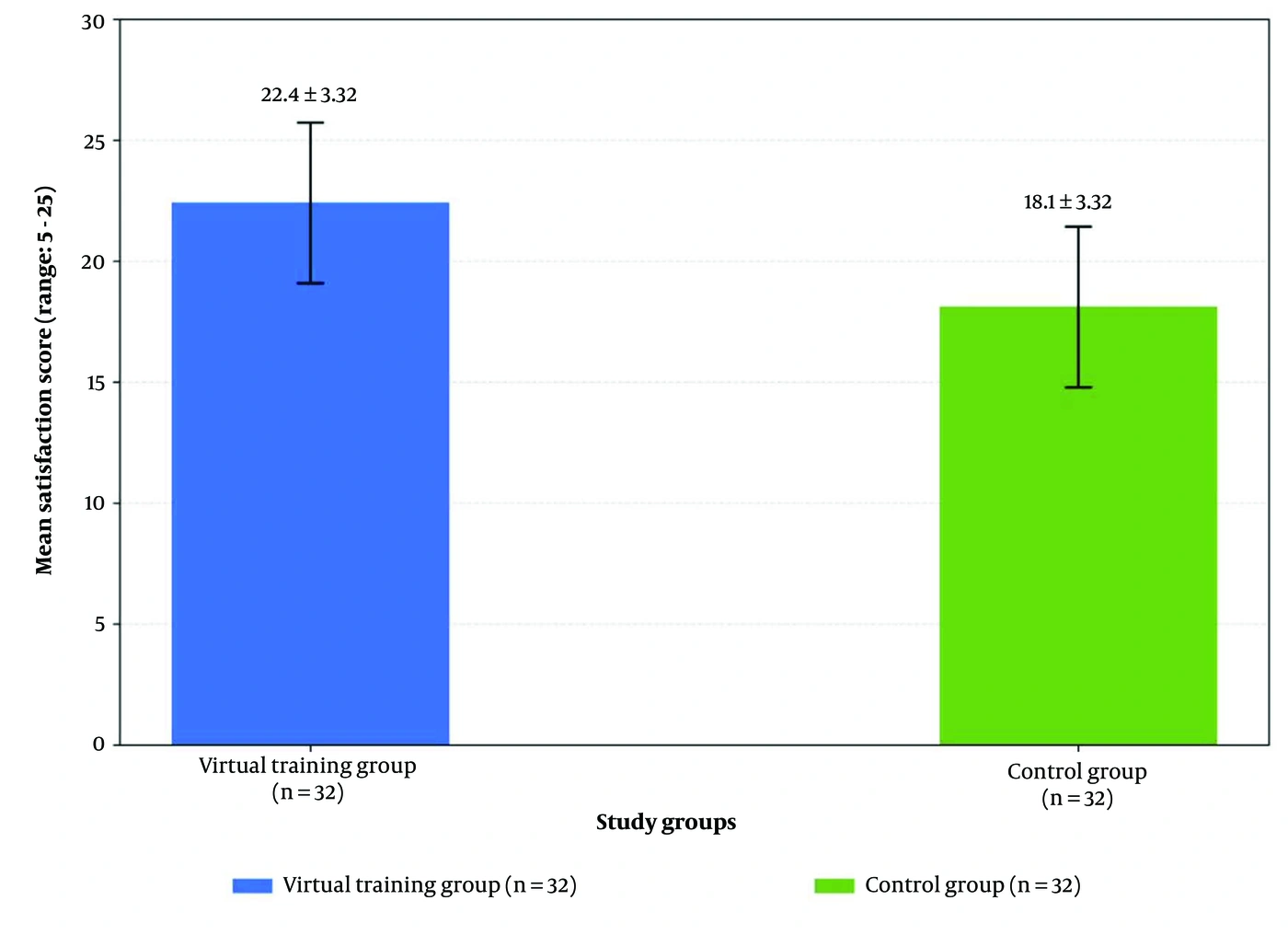
Figure 1.
Comparison of Satisfaction Scores Between the Virtual Training and Control Groups
5. Discussion
Following the virtual ECG educational intervention, learning scores increased significantly in both the virtual and in-person education groups, indicating improvement with both educational methods. However, no significant difference was observed between the groups, suggesting that virtual education did not outperform in-person education in improving learning scores. In Iran in 2020, Jebraeily et al. conducted a qualitative study of lecturers’ and students’ views on blended medical education in a developing-country setting (18). This study provides contextual evidence on blended medical education rather than a direct comparison of ECG learning outcomes (18). In Latin America in 2024, an online course improved diagnostic skills among medical and nonmedical personnel (19). Differences between our findings and those of other studies (3, 18) may be related to differences in study populations, because nursing students may have different prior knowledge and learning expectations than medical students. Differences in instructional design, including synchronous interactive sessions in the present study compared with less interactive modules in other settings, may also have influenced engagement and satisfaction. Cultural and educational contexts may further influence students’ familiarity with and attitudes toward virtual education. These factors may have contributed to differences among study findings.
Regarding gender and learning outcomes, this study showed a significant interaction between gender and the type of educational intervention. Specifically, male students in the virtual group showed greater improvement in learning scores than their counterparts in the control group, whereas female students performed better in the in-person setting. These findings suggest that the association between educational method and learning outcomes may vary by gender. Previous studies have reported differences in learning styles and preferences between male and female students. For example, a study in Turkey in 2023 found that male nursing students were more motivated by technology-based learning methods, whereas female students preferred traditional face-to-face instruction (6). A study in Iran in 2025 reported that virtual reality-based teaching was more effective for male students in anatomy education, whereas female students performed better with conventional methods (13). However, a study in Iran in 2024 found no significant gender differences in learning outcomes between virtual and in-person education (14). These inconsistent findings suggest that the effect of gender on learning outcomes may depend on context, educational content, instructional design, and learner characteristics. Educational planners may therefore consider gender as a potential factor when designing and implementing virtual or in-person training programs.
Students in the virtual group were more satisfied than those in the control group on 8 of 12 items. This finding is consistent with several recent studies. A study in Saudi Arabia in 2025 reported high satisfaction with blended learning among nursing students and identified flexibility and engagement as important factors (20). Similarly, a study in Iran in 2024 found that virtual problem-based learning increased nursing students’ satisfaction with cardiopulmonary resuscitation training compared with traditional methods (21). A study in Saudi Arabia in 2021 also reported high satisfaction with virtual education among nursing students, attributed to flexibility and accessibility (22). In contrast, an Iranian study reported that medical students were dissatisfied with virtual education during the COVID-19 pandemic; the authors associated this dissatisfaction with limited institutional and instructor experience with virtual education (15). Another Iranian study found that nursing students’ satisfaction with virtual education was directly correlated with information literacy, suggesting that satisfaction may also be influenced by students’ digital skills (23).
Overall, the findings indicate that both virtual and in-person education can improve student learning. In this study, learning outcomes were similar between the two methods, whereas satisfaction was higher with virtual education.
This study has several limitations. First, participation in the training course was not mandatory, which may have introduced selection bias and limited generalizability. Second, the sample was not homogeneous by gender because the distribution of male and female students differed between the groups. Although two-way ANOVA was used to account for the potential confounding effect of gender, this imbalance remains a limitation. Third, the study was conducted at a single university with a relatively small sample size, limiting generalizability to other populations and settings. Fourth, long-term retention of learning was not assessed. Fifth, self-reported satisfaction data may have been subject to social desirability bias. Despite these limitations, the study provides information on the use of virtual education among nursing students.
5.1. Conclusions
There was no difference in student learning between virtual and in-person education, indicating that these methods may be used interchangeably when necessary. Virtual education had a more positive effect on learning among male students, whereas in-person education was more effective among female students. Students also reported greater satisfaction with virtual education than with in-person education. Because gender distribution differed between groups and was associated with the results, these findings should be interpreted with caution. Further studies should compare synchronous and asynchronous online education and investigate the interaction between educational modality and gender in relation to student learning outcomes.