
1. Background
Stroke remains a major cause of long-term disability and the second leading cause of death worldwide, imposing a substantial socioeconomic burden on patients and health care systems (1-4). After the acute phase, sustained recovery depends substantially on patients’ self-management practices (5, 6). Self-management is an active process in which patients manage medication adherence, lifestyle changes, and psychosocial effects to reduce the risk of recurrent stroke and improve quality of life (7-9).
Achieving optimal self-management after hospital discharge remains challenging for many patients (10, 11). Current nursing models suggest that successful self-management depends on 2 fundamental pillars: the professional competence of nursing personnel and family collaborative care (12, 13). Nurses, as key members of the health care team, require clinical, educational, and communication competencies to initiate and support patient empowerment (14-17). McCarthy et al. emphasized that active family participation can facilitate the transition from clinical supervision to home-based independence (18-21).
Evidence regarding the combined associations of these factors with patient outcomes remains limited because many studies have examined them separately (22). Wang et al. (23) also highlighted the importance of family care in relation to self-management after stroke. In addition, predictive models of stroke self-management have emphasized multiple behavioral and contextual determinants (24). In the Iranian cultural and health care context, where family involvement is common, understanding these relationships may inform the development of more integrated rehabilitation programs (25).
2. Objectives
This study aimed to examine the associations of nursing competence and family participation with self-management behaviors among patients after stroke.
3. Methods
3.1. Study Design and Setting
This cross-sectional, descriptive-correlational study was conducted from April 2025 to April 2026 at Alavi Educational and Medical Center, a teaching hospital in Ardabil, Iran. The study setting included the Emergency Department, Intensive Care Unit (ICU), and Neurology Department. Participants included eligible nurses working in these units, discharged patients with stroke who had received care at the center, and their primary family caregivers.
3.2. Sample Size and Sampling
The sample size for patients and caregivers was determined using the correlation formula:
The calculation was based on a pilot correlation coefficient of r = 0.205 between family participation and self-management. The pilot study involved a small group of eligible stroke patient-caregiver dyads with characteristics similar to those of the main study population and was conducted to provide a preliminary estimate for sample size determination. To improve precision and reduce the risk of type I error in this clinically important population, a 99% confidence level and 80% statistical power were used. Based on these assumptions, the minimum required sample size was estimated at 278 participants. After allowing for 10% attrition, 306 participants were recruited.
Patients were selected from the Hospital Information System medical records using a random-number table. Because the study involved patient-caregiver dyads, each enrolled patient was paired with a primary family caregiver, yielding 306 matched patient-caregiver dyads. Nurses (n = 71) were recruited using a census approach.
3.3. Inclusion and Exclusion Criteria
Patients were eligible if they were aged 18 years or older, had a confirmed clinical diagnosis of stroke, had been discharged from Alavi Educational and Medical Center, and were available for follow-up exactly 1 month after discharge. Written informed consent was also required. Patients were excluded if they had preexisting psychiatric disorders, incomprehensible speech, or uncorrectable hearing loss.
Primary family caregivers, including spouses, children, siblings, or parents, were eligible if they were aged 18 years or older and directly involved in the patient’s care. Caregivers were excluded if they were simultaneously providing care for another patient.
Eligible nurses had at least 3 months of professional clinical experience in stroke care and provided written informed consent. Questionnaires with substantial missing data and cases in which participants withdrew from the study were excluded from the final analysis.
3.4. Data Collection and Instruments
The data collection instruments comprised 6 sections: 3 sociodemographic questionnaires designed separately for nurses (12 items), family caregivers (14 items), and patients (18 items), and 3 standardized study instruments. The nurse questionnaire included variables such as age, sex, marital status, education level, work experience, and ward of service. The caregiver questionnaire included age, sex, marital status, education level, relationship to the patient, and employment status. The patient questionnaire included age, sex, marital status, education level, type of stroke, and disease-related characteristics.
Data collection procedures differed by participant group. Nurses completed questionnaires in person at Alavi Educational and Medical Center. Data from patients with stroke and their primary family caregivers were collected through telephone interviews conducted at least 1 month after the patient’s discharge. A total of 306 patients and 306 primary family caregivers participated. Each interview lasted approximately 15 minutes and was conducted first with the primary caregiver and then with the patient.
The Stroke Care Competence Questionnaire (SCCQ) is a 41-item instrument developed by Kipinä et al. (26) to assess nurses’ competence in stroke care. Items are rated on a 5-point Likert scale from 1 (poor) to 5 (excellent), with higher scores indicating greater competence. The SCCQ comprises 4 domains: 1) counseling and interaction (19 items), 2) evidence-based practice (8 items), 3) self-management and development (8 items), and 4) interdisciplinary collaboration (6 items). In the original study, Cronbach α coefficients ranged from 0.89 to 0.96 across the 4 domains. In the present study, the SCCQ demonstrated excellent internal consistency (Cronbach α = 0.97). The Persian version was prepared using forward-backward translation, and its face and content validity were confirmed by 10 faculty members in nursing and public health using the Waltz and Bausell method (content validity index [CVI] = 0.96, content validity ratio [CVR] = 0.88). For interpretation, the midpoint score was calculated using the formula (maximum - minimum)/2 + minimum.
The Family Collaborative Care Questionnaire is a 10-item instrument developed by Suwanno et al. (2023). It uses a 5-point Likert scale from 1 (not sure) to 5 (completely sure), with higher scores indicating greater family participation in collaborative care. The instrument consists of 6 dimensions: care for stabilization, continuity of follow-up, monitoring, detecting health changes, persistence in finding solutions, and symptom-relief evaluation. In the original study, internal consistency was reported as McDonald’s ω = 0.87. In the present study, internal consistency was high (McDonald’s ω = 0.91). The Persian version was prepared using forward-backward translation, and its face and content validity were confirmed by 10 faculty members in nursing and public health using the Waltz and Bausell method (CVI = 0.94, CVR = 0.84). For interpretation, the midpoint score was calculated using the formula (maximum - minimum)/2 + minimum.
The Stroke Self-Management Behaviors Questionnaire, developed by Lo et al. (27), is a 9-item instrument scored on a 10-point scale from 0 (very dissatisfied) to 10 (very satisfied), with higher scores indicating better self-management behaviors. It includes 2 domains: medical management (3 items) and psychosocial management (6 items). In the original study, Cronbach α coefficients ranged from 0.65 to 0.88 across the subscales. In the present study, the instrument showed acceptable internal consistency (Cronbach α = 0.87). The Persian version was prepared using forward-backward translation, and its face and content validity were confirmed by 10 faculty members in nursing and public health using the Waltz and Bausell method (CVI = 0.96, CVR = 0.85). For interpretation, the midpoint score was calculated using the formula (maximum - minimum)/2 + minimum.
3.5. Statistical Analysis
Data were analyzed using SPSS version 27.0 (IBM Corp, Armonk, NY, USA). Descriptive statistics, including means and standard deviations (SDs), were used to summarize baseline clinical and demographic characteristics and the main study variables. Inferential analyses included one-sample t tests, independent-samples t tests, analysis of variance (ANOVA), and Pearson correlation coefficients.
Multiple linear regression analysis was used to evaluate the independent predictive capacity of family-participation subdimensions for self-management behaviors among post-stroke patients. Before conducting parametric tests and regression analyses, statistical assumptions were assessed. Normality was evaluated using the Kolmogorov-Smirnov test. Homoscedasticity and independence of residuals were assessed using residual plots and the Durbin-Watson statistic, respectively. Multicollinearity was assessed using the variance inflation factor (VIF), and all values were below the critical threshold of 10. Overall model effect size was evaluated using the coefficient of determination (R2), and 95% confidence intervals (CIs) were calculated for unstandardized regression coefficients (B). Statistical significance was set a priori at P < 0.05.
3.6. Ethical Considerations
The study was approved by the Ethics Committee of Ardabil University of Medical Sciences (IR.ARUMS.REC.1404.007). Participant anonymity and the right to withdraw were protected, and written informed consent was obtained from all participants.
4. Results
This study included 306 patients with stroke, 306 family caregivers, and 71 nurses. Findings are presented for participant characteristics, the primary study variables, and the predictive relationships among the variables.
4.1. Sociodemographic Characteristics of Participants
A total of 306 patients with stroke, 71 nurses, and 306 family caregivers participated. Table 1 summarizes the demographic characteristics of the three groups. Most patients were male (53.6%), whereas most nurses (81.7%) and caregivers (63.4%) were female. The mean ages of nurses, caregivers, and patients were 35.80 ± 7.77, 46.32 ± 13.16, and 63.62 ± 13.00 years, respectively. In all groups, most participants were married and lived in urban areas.
Table 1.
Sociodemographic Characteristics of Nurses, Discharged Patients with Stroke, and Family Caregivers a
| Variables | Nurses (n = 71) | Patients (n = 306) | Caregivers (n = 306) |
|---|---|---|---|
| Gender | |||
| Male | 13 (18.3) | 164 (53.6) | 112 (36.6) |
| Female | 58 (81.7) | 142 (46.4) | 194 (63.4) |
| Marital Status | |||
| Married | 44 (62.0) | 254 (83.0) | 244 (79.7) |
| Single/Other | 27 (38.0) | 52 (17.0) | 62 (20.3) |
| Residence | |||
| Urban | - | 281 (91.8) | 282 (92.2) |
| Rural | - | 25 (8.2) | 24 (7.8) |
| Education | |||
| University | 71 (100) | 82 (26.8) | 150 (49.0) |
| Non-university | - | 224 (73.2) | 156 (51.0) |
| Employment | |||
| Employed | 71 (100) | 107 (34.9) | 128 (41.8) |
| Retired/Homemaker | - | 199 (65.1) | 178 (58.2) |
| Comorbidity | |||
| Yes | - | 197 (64.4) | 97 (31.7) |
| No | - | 109 (35.6) | 209 (68.3) |
| Age (y) | 35.80 ± 7.77 | 63.62 ± 13.00 | 46.32 ± 13.16 |
a Values are expressed as No. (%) or mean ± SD.
Among caregivers, 96.7% had received training from medical staff, and 48% were the patients' children. Among patients, 64.4% had at least 1 comorbidity, and 94.4% were experiencing their first stroke. The most commonly reported functional impairment was maintaining body position (46.1%). Additional demographic and professional characteristics are presented in Table 1.
4.2. Status of the Main Study Variables
As shown in Table 2, nursing care competence and family collaborative care were at moderate levels, whereas patients with stroke reported a high level of self-management. Mean scores for all three variables were significantly higher than their theoretical midpoints (P < 0.001).
Table 2.
Descriptive Statistics and One-Sample T Test Results for the Main Variables
| Variables | Mean ± SD | Score Range | Test-Value | t-Value | P-Value | Status |
|---|---|---|---|---|---|---|
| Nursing competence | 142.21 ± 25.01 | 41 - 205 | 123 | 11.72 | < 0.001 | Moderate |
| Family participation | 39.34 ± 5.39 | 10 - 50 | 30 | 19.05 | < 0.001 | Moderate |
| Self-management | 65.68 ± 9.58 | 0 - 90 | 45 | 43.01 | < 0.001 | High |
4.3. Nursing Competence According to Professional Characteristics
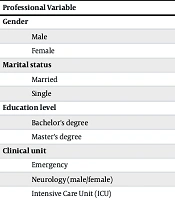
Nursing care competence differed significantly by education level (Table 3). The mean competence score was significantly higher among nurses with a Master's degree than among those with a Bachelor's degree (157.25 ± 17.26 vs 141.31 ± 25.21, P = 0.001).
Table 3.
Comparison of Nursing Care Competence According to Professional Characteristics (N = 71)
| Professional Variable | Mean ± SD | Test Value | P-Value |
|---|---|---|---|
| Gender | t = 0.34 | 0.73 | |
| Male | 144.38 ± 18.54 | ||
| Female | 141.72 ± 26.35 | ||
| Marital status | t = 0.20 | 0.84 | |
| Married | 142.65 ± 26.22 | ||
| Single | 141.48 ± 23.38 | ||
| Education level | t = -2.31 | 0.001 | |
| Bachelor's degree | 141.31 ± 25.21 | ||
| Master's degree | 157.25 ± 17.26 | ||
| Clinical unit | F = 8.12 | 0.001 | |
| Emergency | 128.72 ± 20.63 | ||
| Neurology (male/female) | 140.87 ± 20.78 | ||
| Intensive Care Unit (ICU) | 157.83 ± 26.75 | ||
| Employment status | F = 0.52 | 0.67 | |
| Permanent | 143.11 ± 24.54 | ||
| Contractual/Others | 139.42 ± 24.64 | ||
| Stroke workshop | t = 0.94 | 0.35 | |
| Attended | 144.26 ± 24.61 | ||
| Not attended | 138.44 ± 25.80 | ||
| Work experience (y) | r = 0.16 | - | 0.16 |
Clinical unit was also significantly associated with nursing competence. Nurses working in the ICU had the highest competence scores (157.83 ± 26.75) compared with those working in the Emergency Department (128.72 ± 20.63) and the Neurology Department (140.87 ± 20.78) (P = 0.001). Nurses who had attended stroke-specific workshops had higher competence scores than those who had not (144.26 ± 24.61 vs 138.44 ± 25.80), but the difference was not statistically significant (P = 0.35). Years of work experience were not significantly correlated with nursing competence (r = 0.16, P = 0.16).
4.4. Associations of Demographic and Clinical Characteristics with Study Variables
As shown in Table 4, patient self-management was significantly associated with educational attainment and marital status. Patients with higher educational attainment had significantly higher self-management scores than those with lower educational attainment (P < 0.01). Married participants also had higher self-management scores than single or otherwise unmarried participants (P < 0.01). Patients with recurrent stroke had lower self-management scores than those experiencing a first stroke (P < 0.01). These variables were examined in bivariate analyses and should not be interpreted as independent predictors.
Table 4.
Relationship of Demographic and Clinical Characteristics with the Main Variables (N = 306) a
| Variables | Family Participation | P-Value | Patient Self-Management | P-Value |
|---|---|---|---|---|
| Marital status | 0.34 | < 0.01 | ||
| Married | 39.20 ± 5.41 | 71.82 ± 10.22 | ||
| Single/Other | 39.91 ± 5.28 | 62.14 ± 9.08 | ||
| Education (patient) | 0.001 | < 0.01 | ||
| Illiterate/Elementary | 37.45 ± 4.90 | 64.45 ± 8.90 | ||
| Academic (higher education) | 41.50 ± 5.20 | 72.60 ± 5.06 | ||
| Stroke frequency | - | < 0.01 | ||
| First time | - | 71.10 ± 9.20 | ||
| Recurrent | - | 63.50 ± 10.15 | ||
| Self-rated health | 0.15 | < 0.01 | ||
| Good | 39.54 ± 5.51 | 73.15 ± 8.40 | ||
| Fair/Poor | 38.65 ± 5.43 | 62.40 ± 9.80 | ||
| Comorbidity | 0.001 | < 0.01 | ||
| No | 40.04 ± 5.17 | 72.90 ± 8.50 | ||
| Yes | 36.34 ± 5.30 | 65.50 ± 10.10 | ||
| Relationship | 0.001 | - | ||
| Spouse | 39.71 ± 4.99 | - | ||
| Others (child/etc) | 35.58 ± 6.45 | - |
a Values are expressed as mean ± SD.
4.5. Predictors of Patient Self-Management
To evaluate the extent to which family participation predicted post-stroke self-management, a multiple linear regression analysis was performed (Table 5). The overall model was statistically significant (F = 15.71, P = 0.001) and explained 8.0% of the variance in self-management behaviors (R2 = 0.08).
Table 5.
Multiple Linear Regression Analysis of Family-Participation Dimensions Predicting Post-Stroke Patient Self-Management Behaviors a
| Predictor Variables | B | SE | β | t | P-Value | 95% CI [Lower, Upper] |
|---|---|---|---|---|---|---|
| Family collaborative care (total) | 0.39 | 0.09 | 0.22 | 3.96 | 0.001 | [0.21, 0.57] |
| Care for stabilization | 1.90 | 0.76 | 0.14 | 2.50 | 0.01 | [0.41, 3.39] |
| Continuity of follow-up | 1.78 | 0.39 | 0.24 | 4.48 | 0.001 | [1.02, 2.54] |
| Monitoring health status | 1.72 | 0.38 | 0.25 | 4.52 | 0.001 | [0.98, 2.46] |
a Model summary: r = 0.22 (total care); R2 = 0.08; F = 15.71; P = 0.001.
Among the dimensions of family participation, monitoring health status was the strongest predictor of patient self-management (β = 0.25, P = 0.001; 95% CI, 0.98 - 2.46), followed by continuity of follow-up (β = 0.24, P = 0.001; 95% CI, 1.02 - 2.54). Care for stabilization also showed a significant positive association with self-management (β = 0.14, P = 0.01; 95% CI, 0.41 - 3.39). The overall family collaborative care score remained a significant predictor (β = 0.22, P = 0.001; 95% CI, 0.21 - 0.57). These findings indicate that greater family participation, particularly in monitoring health status and maintaining continuity of follow-up, was associated with better self-management after stroke.
A second multiple linear regression model examined the associations of nursing competence and family collaborative care with post-stroke self-management (Table 6). The model was statistically significant (F(2, 68) = 58.707, P < 0.001) and explained 63.3% of the variance in self-management (R2 = 0.633; adjusted R2 = 0.622). Family collaborative care had the largest standardized coefficient (β = 0.630, P < 0.001), and nursing competence was also independently and positively associated with self-management (β = 0.222, P = 0.027).
Table 6.
Multiple Linear Regression Model for Post-Stroke Self-Management Behaviors Including Nursing Competence a
| Predictor Variables | B | SE | β | t | P-Value | 95% CI [Lower, Upper] |
|---|---|---|---|---|---|---|
| Nursing competence | 0.102 | 0.045 | 0.222 | 2.262 | 0.027 | [0.012, 0.193] |
| Family collaborative care | 0.769 | 0.120 | 0.630 | 6.409 | < 0.001 | [0.530, 1.009] |
| Constant | 7.381 | 2.273 | — | 3.247 | 0.002 | [2.846, 11.917] |
a Model summary: r = 0.796; R2 = 0.633; adjusted R2 = 0.622; F(2, 68) = 58.707; P < 0.001.
5. Discussion
The present study examined the associations of nursing care competence and family collaborative care with self-management behaviors among patients after discharge for stroke. In the adjusted model, both family collaborative care and nursing competence were independently and positively associated with self-management, with family collaborative care showing a stronger association.
The stronger association between family collaborative care and self-management may reflect the transition from a structured inpatient environment to a less controlled home setting. Nursing competence is primarily expressed during hospital-based care, whereas post-stroke self-management is a sustained, context-sensitive behavioral process after discharge. Family members may therefore exert a more immediate influence on daily disease-management practices. Although nursing competence also showed an independent positive association, its contribution may be expressed partly through caregiver preparation, communication, discharge education, and the transfer of practical care-related knowledge. Because this study was cross-sectional and did not include mediation analysis, causal or mediated pathways cannot be inferred.
Post-stroke self-management is also likely to be influenced by determinants beyond family collaborative care and nursing competence, including baseline cognitive status, neurological impairment severity, socioeconomic conditions, and psychological resilience. Accordingly, family collaborative care should be regarded as an important supportive factor rather than the sole determinant of long-term self-management capacity.
5.1. Nursing Competence
Most nurses reported a moderate level of nursing competence, with the mean score significantly above the theoretical midpoint. This finding suggests that the nurses had basic competencies for stroke care but had not reached the highest level of competence. Ali and Khalifa (28) reported moderate professional competency among staff nurses. Hui et al. (29) likewise reported moderate nursing competence in the context of the COVID-19 outbreak. In contrast, Kolagari et al. (30) reported high clinical competence among ICU nurses, and Elhami et al. (31) reported a high mean level of clinical competence.
Nurses with a Master's degree and those working in specialized units, particularly ICUs, reported higher competence. This finding underscores the potential importance of advanced education and experience in complex clinical settings. Naga et al. (32) reported improved nurses' knowledge, skills, and attitudes following a competency-based stroke-care program. Kalani et al. (33) examined clinical competence among ICU nurses, and Osman et al. (34) reported an association between nurses' competencies and quality of care in ICUs.
5.2. Family Collaborative Care and Self-Management
Although nursing competence was independently associated with self-management, family collaborative care showed the stronger association. Wang et al. (23) reported a positive relationship between family care and self-management behavior among older adults hospitalized for stroke, supporting the importance of psychosocial support and health education.
Most caregivers in the present study had moderate levels of participation. This finding is consistent with McCarthy et al. (18), who described family members' experiences of supporting self-management after stroke. Moderate family participation in discharge planning has also been reported by Almborg et al. (35), whereas Haley et al. (36) documented substantial caregiver engagement in stroke care. Differences among studies may reflect variation in cultural context and definitions of participation.
Higher caregiver education, being a spouse, being retired, and the absence of comorbidities were associated with greater family participation. This finding highlights the importance of caregiver availability and health status and is partly consistent with Septianingrum et al. (37), who identified factors associated with family caregiver readiness after hospital discharge.
Specific domains of family collaborative care significantly predicted post-stroke self-management. Monitoring health status was the strongest predictor, followed by continuity of follow-up, while care for stabilization also showed a significant positive association. These findings indicate that families may support self-management through medication adherence, symptom monitoring, management of complications, and fall prevention. Systematic health monitoring and continuous caregiver follow-up may therefore be particularly important for sustaining self-management at home. These findings are conceptually consistent with reports by Wang et al. (23) and Risal et al. (38), which emphasized positive relationships between family engagement and patient outcomes.
Most patients with stroke demonstrated high levels of self-management. This may reflect family support and hospital-based education. Vemuri et al. (39) reported high self-management among a substantial proportion of stroke survivors, and Chen et al. (40) found that patient knowledge and family support were associated with self-management behaviors. Conversely, Wang et al. (23) reported more moderate self-management levels, which may reflect differences in timing and available resources. In the present study, higher education and being married were associated with better self-management. Similar associations between education, socioeconomic factors, marital support, and rehabilitation outcomes have been reported elsewhere (15, 39).
5.3. Study Limitations
Several limitations should be acknowledged. First, although both nursing competence and family collaborative care were independently associated with self-management in the adjusted model, the cross-sectional design does not establish temporal or causal relationships. Family collaborative care showed the stronger standardized association, but the relative contributions of these factors should be confirmed in longitudinal studies.
Second, the study did not use mediation analysis, such as structural equation modeling, to test whether nursing competence may influence patient outcomes indirectly through caregiver empowerment. Any discussion of indirect pathways therefore remains theoretical and requires empirical validation.
Third, data collection methods differed across participant groups: nurse data were collected in person, whereas patient and caregiver data were obtained through telephone interviews. This difference, together with reliance on self-report measures, may introduce response bias or social desirability bias. Finally, the cross-sectional design and recruitment from a single center limit causal inference and generalizability. Future longitudinal studies using robust mediation models are recommended.
5.4. Recommendations
Nursing managers should consider specialized family-centered care training to strengthen nurses' ability to empower family support systems. Future studies should examine the direct and indirect roles of both nursing competence and family participation in patient self-management using analytical approaches such as structural equation modeling or hierarchical regression. Longitudinal studies are also needed to assess the temporal stability of self-management practices, and qualitative research may help identify sociocultural factors that facilitate or hinder family participation in post-stroke care.
5.5. Conclusions
Post-stroke self-management was positively associated with both family collaborative care and nursing competence, although family collaborative care showed the stronger association in the adjusted model. Monitoring health status was the strongest family-participation dimension associated with self-management. Interventions should therefore emphasize caregiver training in health-status monitoring, continuity of follow-up, and stabilization-related care, while also strengthening nurses' education and communication competencies during the transition from hospital to home.
These findings should be interpreted in light of differences in data-collection methods. Face-to-face data collection for nurses and telephone interviews for patients and caregivers may have affected response depth or quality. Future studies should use more standardized data-collection procedures to reduce potential bias and further evaluate these associations.