
1. Background
Chronic renal failure (CRF) involves irreversible damage to renal cells and is characterized by a glomerular filtration rate of less than 60 mL/min per 1.73 m2 of body surface area for 3 months or more. The final stage of the disease is end-stage renal disease (ESRD), which involves irreversible loss of kidney function.
Worldwide, approximately 850 million people have CRF (1), of whom 3.9 million are dependent on hemodialysis (2). Because extensive efforts have been made to prevent and reduce mortality and morbidity among patients with ESRD, the number of these patients is increasing in the country (3).
The burden of CRF is higher in low- and middle-income countries, which account for approximately 80% of all CRF cases. In a 2016 meta-analysis of the global prevalence of chronic kidney disease, the prevalence in Iran was estimated at 11.6% (range, 4.51% - 18.84%) (4). According to Moazzeni et al. (5), approximately 8.4% of women and 9.3% of men in Iran develop CRF annually.
Most patients with ESRD depend on dialysis therapy to sustain life (6). Approximately 2.6 million people worldwide receive dialysis therapy (7). Although dialysis therapy is the first treatment option for most patients, it leads to changes in the physical, psychological, and social aspects of life because of dietary restrictions, lifestyle modifications, and strict medication and treatment regimens (8).
A growing body of evidence indicates that sleep disturbance is among the most prevalent symptoms experienced by patients receiving hemodialysis. Its main manifestations include easy awakening from sleep, poor sleep quality, insomnia, long-term dependence on hypnotic drugs, and sleep apnea. Poor sleep quality has become an important factor that threatens patients' lives and long-term survival, increases the risk of fatigue, anxiety, memory impairment, and behavioral disturbances, and increases mortality risk. A decline in sleep quality directly leads to a decline in the quality of life of patients receiving hemodialysis (9).
Sociodemographic variables, chronic illnesses, psychiatric and physical conditions, sleep quality, and sleep-related disorders may affect HRQoL. Chronic diseases are currently considered among the most common causes of physical dysfunction and can worsen HRQoL by imposing high economic burdens and functional limitations. Because patients with renal disease must receive treatments such as hemodialysis when they develop end-stage kidney failure, renal diseases have become a global public health problem. Research has shown that nearly 50% - 80% of patients on hemodialysis experience lower HRQoL (10).
Today, quality-of-life measurement is used to evaluate the services provided, assess the impact of therapeutic interventions, and obtain information for planning and delivering appropriate professional services for these patients (11). Because of ongoing dialysis, the family, occupational, and social status of many of these patients change involuntarily, and major problems arise in their daily activities and interests. These problems are significantly associated with patients' quality of life. Awareness of the quality of life of these individuals can play an effective role in clinical decision-making and in managing their problems.
2. Objectives
Given the importance of HRQoL, this study aimed to assess the associations of sleep duration and sleep quality with HRQoL among patients undergoing hemodialysis in Zahedan, Iran.
3. Methods
3.1. Study Design and Setting
This cross-sectional descriptive-analytical study was conducted at the dialysis center of Ali Ibn Abi Taleb Hospital in Zahedan, Iran, between January and December 2024.
3.2. Participants and Sampling
The target population comprised all hemodialysis patients referred to the center during 2024. Using consensus sampling, 86 patients who met the inclusion criteria were enrolled. The inclusion criteria were: 1) having an active medical record at the dialysis center, 2) being on a weekly hemodialysis schedule, 3) being fully alert and oriented to person, place, and time, 4) willingness to participate and provision of written informed consent, 5) a history of at least 6 months of hemodialysis, and 6) undergoing at least 2 dialysis sessions per week. The exclusion criteria were: 1) incomplete questionnaire completion, defined as answering fewer than 90% of the items, and 2) regular use of psychiatric medications, including antipsychotics, benzodiazepines, or antidepressants, within the past month.
3.3. Data Collection Tools
Data were collected using 3 instruments: a demographic questionnaire, the Pittsburgh Sleep Quality Index (PSQI), and the World Health Organization Quality of Life Questionnaire (WHOQOL-BREF).
3.3.1. Demographic Questionnaire
This questionnaire included items on age, gender, education level, marital status, and duration of illness, defined as years since diagnosis. The questionnaire was completed by the patients.
3.3.2. Pittsburgh Sleep Quality Index
The PSQI consists of 18 items grouped into 7 components: 1) subjective sleep quality, 2) sleep latency, 3) sleep duration, 4) habitual sleep efficiency, 5) sleep disturbances, 6) use of sleeping medications, and 7) daytime dysfunction over the previous month. Each component is scored from 0 to 3, and the sum of the 7 component scores yields a global PSQI score ranging from 0 to 21. Higher scores indicate poorer sleep quality; a global score > 5 indicates poor sleep quality. The validity and reliability of the Persian version of the PSQI have been established in Iran (Cronbach α = 0.689; test-retest correlation coefficient = 0.88).
3.3.3. Quality of Life Questionnaire
The 26-item WHOQOL-BREF was used. Each item is rated on a 5-point Likert scale, where 1 indicates a negative or low perception and 5 indicates a positive or high perception. Raw scores were converted to a percentage scale 0 - 100 using the following formula: (raw score - minimum possible raw score) / (maximum possible raw score - minimum possible raw score) × 100. Higher percentages reflect better quality of life. The validity and reliability of this questionnaire have been confirmed in previous research.
3.4. Data Collection Procedure
After the study objectives were explained to patients attending the hemodialysis unit, a trained research assistant invited eligible patients to participate. For patients who provided written informed consent, the questionnaires were administered face-to-face in a private room during routine dialysis sessions. Each questionnaire required approximately 20 - 25 minutes to complete.
3.5. Ethical Considerations
This study was derived from a student thesis and was approved by the Ethics Committee of Zahedan University of Medical Sciences (ethics code: IR.ZAUMS.REC.1403.323). Written informed consent was obtained from all participants before enrollment. Patients were assured of confidentiality, and all data were anonymized before analysis to protect privacy. Participation was voluntary, and participants had the right to withdraw at any time without affecting their care.
3.6. Statistical Analysis
Data were analyzed using SPSS version 22 for Windows (IBM Corp., Armonk, NY, USA). The normality of continuous variables was assessed using the Shapiro-Wilk test. Normally distributed data are presented as mean ± standard deviation (SD), whereas non-normally distributed data are presented as median (interquartile range [IQR]). Descriptive statistics, including the mean, SD, and median, were computed for demographic and clinical variables. The relationship between the global PSQI score and quality-of-life scores was examined using the Pearson correlation coefficient after the approximate normality of the relevant variables was confirmed. Statistical significance was set at P < 0.05.
4. Results
4.1. Study Population
A total of 86 hemodialysis patients from the dialysis center at Ali Ibn Abi Taleb Hospital, Zahedan, Iran, met the inclusion criteria and were enrolled in 2024. The mean age was 56.3 ± 8.6 years (range, 28 - 65 years), and the mean duration of dialysis was 37.1 ± 11.9 months. The sample included 36 females (41.9%) and 50 males (58.1%).
4.2. Quality of Life
Quality of life was assessed using the WHO quality-of-life questionnaire, with a possible range of 0 - 100, where higher scores indicate better QoL. The mean QoL score was 44.5 ± 8.5 (range, 7 - 66). In the frequency distribution, 35 patients (40.7%) had very poor QoL, 41 (47.7%) had poor QoL, and 10 (11.6%) had good QoL. No patients reported very good QoL.
4.3. Sleep Quality
Sleep quality was measured using the PSQI, with a possible range of 0 - 21, where higher scores indicate worse sleep quality. Poor sleep quality was defined as a score > 5. The mean PSQI score was 17.9 ± 7.2 (range, 5 - 19). Poor sleep quality was observed in 66 patients (76.7%).
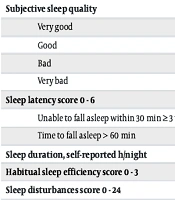
The subdimensions of sleep quality are summarized in Table 1.
Table 1.
Sleep Quality Subdimensions in Hemodialysis Patients (N = 86) a
| Subdimensions | Values |
|---|---|
| Subjective sleep quality | |
| Very good | 5 (5.8) |
| Good | 10 (11.6) |
| Bad | 49 (56.9) |
| Very bad | 22 (25.7) |
| Sleep latency score 0 - 6 | 4.8 ± 2.6 |
| Unable to fall asleep within 30 min ≥ 3 times/week | 51 (59.3) |
| Time to fall asleep > 60 min | 48 (55.8) |
| Sleep duration, self-reported h/night | 6.5 ± 1.3 |
| Habitual sleep efficiency score 0 - 3 | 2.9 ± 1.6 |
| Sleep disturbances score 0 - 24 | 22.8 ± 6.4 |
| Use of sleeping medications | |
| ≥ 2 times/week during the past 6 mo | 41 (47.6) |
| ≥ 1 time/week during the past 6 mo | 23 (26.7) |
| Daytime dysfunction score 0 - 6 | 4.9 ± 2.3 |
a Values are expressed as No. (%) or mean ± SD.
4.4. Association Between Sleep Quality and Quality of Life
Pearson correlation analysis revealed a significant inverse relationship between the global PSQI score and QoL (r = -0.249, P = 0.0039). Most subdimensions of sleep quality were also significantly correlated with QoL, except for sleep latency (r = -0.08, P = 0.46). Detailed correlations are presented in Table 2.
Table 2.
Pearson Correlation Coefficients Between Quality of Life and Sleep Quality Dimensions (N = 86)
| Variables | Correlation Coefficient (r) | P-Value |
|---|---|---|
| Overall sleep quality | -0.249 | 0.0039 |
| Subjective sleep quality | -0.361 | 0.021 |
| Sleep efficiency | -0.23 | 0.033 |
| Sleep latency | -0.08 | 0.46 |
| Sleep disturbance score | -0.291 | 0.0065 |
| Daytime dysfunction (functional disorder) | -0.355 | 0.0007 |
5. Discussion
In this cross-sectional study of 86 hemodialysis patients at Ali Ibn Abi Taleb Hospital, Zahedan, Iran, in 2024, we found a high prevalence of poor sleep quality (76.7%) and poor quality of life (88.4% with very poor or poor QoL). A significant inverse association was observed between the global PSQI score and QoL (r = -0.249, P = 0.0039), indicating that poorer sleep quality correlated with lower QoL. However, the correlation was weak, with sleep quality explaining only 6.2% (r2 = 0.062) of the variance in QoL, suggesting that other biomedical, psychological, and social factors play substantial roles.
Our findings align with previous Iranian studies. Hosseini et al. (10) in Neyshabur found that 78.2% of patients had poor sleep quality, with a mean HRQoL score of 57.6 ± 17.9, and that poor sleep quality was negatively associated with total HRQoL after adjustment. Internationally, Shen et al. (13) in China noted that poor sleep quality is common among hemodialysis patients and suggested that improvements in treatment quality and financial support could enhance both sleep and QoL. A systematic review by Calisanie and Gunadi (2021) also confirmed a relationship between sleep quality and QoL in this population (12).
When examining specific sleep dimensions, 59.3% of our patients could not fall asleep within 30 minutes 3 or more times per week, and 55.8% required more than 60 minutes to fall asleep. Subjective sleep quality was rated as bad or very bad by 82.6% of patients. The use of sleeping medications was common, with 47.6% reporting use at least twice weekly, and daytime dysfunction was reported by 75.5%. These figures are broadly consistent with Şahin et al. (14). However, a study by Al Naamani et al. (15) in the United States found no significant correlation between sleep quality and QoL. This discrepancy may reflect differences in healthcare systems, sample characteristics (e.g., dialysis adequacy and comorbidity burden), or cultural factors affecting sleep perception and reporting.
In our analysis, most sleep subdimensions were significantly correlated with QoL, except for sleep latency (r = -0.08, P = 0.46). The lack of association for sleep latency may indicate that the time to sleep onset is less directly linked to daytime functional status than subjective sleep quality or daytime dysfunction. Alternatively, the PSQI latency component may be less sensitive in hemodialysis patients, whose sleep is often fragmented by multiple causes, such as restless legs syndrome, nocturnal symptoms, and treatment schedules.
5.1. Study Limitations
Several limitations should be acknowledged. First, sleep quality and QoL were assessed by self-report, which may introduce recall and social desirability bias. Objective measures, such as actigraphy or polysomnography, were not used. Second, the cross-sectional design precludes causal inference; longitudinal studies are needed to assess bidirectionality. Third, the single-center convenience sample limits generalizability to other hemodialysis populations with different demographic characteristics or healthcare system contexts. Fourth, we did not collect data on potential confounders, such as dialysis adequacy, hemoglobin levels, depression, or socioeconomic status. Finally, the PSQI is inherently subjective, although it remains a widely used and validated screening tool.
5.2. Conclusions
Poor sleep quality is prevalent among hemodialysis patients and is significantly, although modestly, associated with lower HRQoL. These findings underscore the need for routine sleep assessment and targeted interventions by healthcare providers to improve sleep quality and, consequently, health-related quality of life in this population.