
1. Background
Heart failure (HF) is a complex clinical syndrome associated with substantial morbidity and an increasing global burden (1, 2). Effective long-term management requires patients to adhere to multifaceted treatment regimens; however, suboptimal treatment compliance remains a major challenge, contributing to disease progression, increased hospitalization, and poorer quality of life (3, 4). Treatment compliance, defined as the extent to which a patient’s behavior aligns with healthcare providers’ recommendations regarding medication use, diet, exercise, and follow-up care (5), is a critical component of HF self-care (6). It includes medication management, dietary sodium and fluid restriction, physical activity, and attendance at follow-up visits (7, 8). However, studies indicate that noncompliance is common. For example, Sen et al. (2020) reported that 45.5% of patients with HF had poor compliance (9).
Social support is a well-established psychosocial determinant of health behaviors in chronic illness (10). Among patients with cardiovascular disease, support from family and close social networks is often essential for initiating and sustaining self-care practices (11). Higher levels of perceived social support are associated with better treatment compliance (12), whereas inadequate support is linked to adverse outcomes, including higher rates of hospitalization and mortality (13-15). This relationship may be mediated by enhanced motivation, self-efficacy, and practical assistance (16, 17).
Although international evidence underscores the association between social support and compliance, important gaps remain in culturally specific contexts. In Iran, particularly in the Ardabil region, where family and community structures are central to daily life, the relationship between perceived social support and treatment compliance among patients with HF has not been examined. Understanding this relationship is important for developing tailored, family-centered nursing interventions that align with local sociocultural norms.
2. Objectives
This study aimed to evaluate the association between perceived social support and treatment compliance among patients with HF in Ardabil, Iran.
3. Methods
3.1. Study Design and Setting
A descriptive cross-sectional study was conducted in accordance with the STROBE reporting guidelines (18). The study was conducted at Imam Khomeini Educational and Therapeutic Center in Ardabil, Iran, the province’s principal tertiary cardiac care facility. Data were collected from May to November 2025.
3.2. Participants and Sampling
The target population comprised adults hospitalized with HF. Based on the previous year’s hospital registry, which indicated 590 eligible patients, the sample size was calculated using the finite population correction formula for a 95% confidence level. Assuming maximum variance (P = 0.5), a margin of error of 5%, and an anticipated nonresponse rate of 15%, the final target sample size was 268 participants.
A nonprobability convenience sampling method was used, and eligible inpatients were enrolled consecutively. Of the 274 patients approached, 14 were excluded because they did not meet the eligibility criteria, resulting in a final analytical sample of 260 participants. An a priori power analysis using G*Power 3.1 confirmed that a sample of 260 provided adequate power (> 0.80) to detect medium effect sizes (Cohen f2 = 0.15) at a two-tailed alpha level of 0.05.
Inclusion criteria were age ≥ 18 years, a confirmed HF diagnosis for ≥ 6 months, left ventricular ejection fraction < 40% (19), New York Heart Association class II or III, a prescription for diuretics (20), and literacy in Persian. Exclusion criteria were an unstable medical condition, a recent acute cardiovascular event, significant cognitive or psychiatric impairment, and inability or unwillingness to provide informed consent.
3.3. Data Collection and Instruments
Data were collected between the second and fifth days of hospitalization, when patients were clinically stable. A trained researcher administered a paper-based questionnaire packet and provided standardized instructions, offering clarification only upon request to minimize bias (21).
The questionnaire consisted of three parts:
(1) Demographic and clinical characteristics: A researcher-designed form was used to collect data on age, sex, marital status, education, occupation, residence, living arrangement, number of children, disease duration, and comorbidities.
(2) Perceived social support: Perceived social support (PSS) was measured using the Persian version of the 12-item Multidimensional Scale of Perceived Social Support (MSPSS) (22). Items across three subscales (family, friends, and significant others) are rated on a 7-point Likert scale from 1, very strongly disagree, to 7, very strongly agree; higher total scores (12 - 84) indicate greater perceived support. The Persian version was developed through forward-backward translation according to Beaton et al. (23). Face and content validity were established by an expert panel (CVR = 0.90, I-CVI = 0.96). Confirmatory factor analysis confirmed the three-factor structure with excellent fit indices (χ2/df = 1.026, RMSEA = 0.010, IFI = 0.986, TLI = 0.981, GFI = 0.984). Internal consistency in this study was good (Cronbach α = 0.84).
(3) Treatment compliance: Treatment compliance was measured using the validated Persian Revised Heart Failure Compliance Questionnaire (RHFCQ) (24). This 20-item tool assesses compliance across six domains: follow-up appointments, medications, diet, exercise, smoking, and alcohol cessation. Responses are converted to a standardized score of 0 - 100, with higher scores indicating better compliance. The Persian RHFCQ has established content validity (I-CVI = 0.833 - 1.000) and moderate test-retest reliability (ICC = 0.576) (24). In this study, internal consistency was good (Cronbach α = 0.87).
3.4. Statistical Analysis
Data were analyzed using SPSS version 26.0 and AMOS version 24.0. Descriptive statistics were used to summarize sample characteristics and key variables. The Kolmogorov-Smirnov test was used to assess normality. Pearson correlation coefficients were used to examine relationships between PSS total and subscale scores and treatment compliance total and domain scores. Group differences in compliance across categorical demographic variables were tested using independent t tests and one-way analysis of variance.
To identify predictors of compliance, a two-step hierarchical linear regression analysis was performed. Demographic and clinical variables were entered in block 1, and the total MSPSS score was added in block 2 to assess its incremental predictive value. The assumptions of linearity, homoscedasticity, and absence of multicollinearity (VIF < 10) were met. Statistical significance was set at P < 0.05 using two-tailed tests.
3.5. Ethical Considerations
The study received ethical approval from Ardabil University of Medical Sciences (IR.ARUMS.REC.1404.085). All participants provided written informed consent after receiving a thorough explanation of the study. All procedures followed the Declaration of Helsinki and ensured confidentiality, anonymity, and the right to withdraw without consequence.
4. Results
4.1. Sample Characteristics and Demographic Associations
A total of 260 patients with HF participated in the study. The mean age was 65.93 ± 9.32 years, and the mean disease duration was 32.40 ± 9.66 months. Most participants were male (58.5%), married (74.2%), lived with family (81.2%), and resided in urban areas (70.8%). Additional demographic details are presented in Table 1.
Table 1.
Participant Characteristics and Associations with Treatment Compliance (n = 260)
| Variables | Values a | Statistics | P-Value |
|---|---|---|---|
| Age (y) | 65.93 ± 9.32 | r = -0.07 | 0.29 |
| Disease duration (mo) | 32.40 ± 9.66 | r = -0.24 | < 0.001 |
| Gender | t = 1.84 | 0.06 | |
| Male | 152 (58.5) | ||
| Female | 108 (41.5) | ||
| Marital status | F = 25.42 | < 0.001 | |
| Married | 193 (74.2) | ||
| Single | 57 (21.9) | ||
| Other | 10 (3.8) | ||
| Living arrangement | t = -6.99 | < 0.001 | |
| With family | 211 (81.2) | ||
| Alone | 49 (18.8) | ||
| Education level | F = 23.61 | < 0.001 | |
| Illiterate | 42 (16.2) | ||
| Lower secondary | 65 (25.0) | ||
| Upper secondary | 98 (37.7) | ||
| Higher | 55 (21.2) |
a Values are expressed as No. (%) or mean ± SD.
Demographic factors showed differential associations with treatment compliance (Table 1). Longer disease duration was significantly correlated with lower compliance (r = -0.24, P < 0.001). Compliance scores were significantly higher among married participants (F = 25.42, P < 0.001), those with higher education (F = 23.61, P < 0.001), and those living with family compared with those living alone (t = -6.99, P < 0.001). No significant associations were observed between compliance and age, gender, occupation, comorbidity status, or residence (all P > 0.05).
4.2. Levels of Perceived Social Support and Treatment Compliance
Participants reported moderate levels of PSS, with a mean total score of 4.92 ± 0.48 on a 1 - 7 scale. Family support was rated highest (4.99 ± 0.66), followed by support from friends (4.90 ± 0.66) and significant others (4.88 ± 0.67). Overall treatment compliance was moderate (53.38 ± 15.76 on a 0 - 100 scale). Compliance was highest for follow-up appointments (60.21 ± 23.64) and lowest for dietary sodium and fluid restriction (49.91 ± 20.48). Complete descriptive statistics are presented in Table 2.
Table 2.
Descriptive Statistics for Perceived Social Support and Treatment Compliance (n = 260)
| Construct and Dimension | Possible Range | Mean | SD |
|---|---|---|---|
| Perceived social support | |||
| Family | 1 - 7 | 4.99 | 0.66 |
| Friends | 1 - 7 | 4.90 | 0.66 |
| Significant others | 1 - 7 | 4.88 | 0.67 |
| Total | 1 - 7 | 4.92 | 0.48 |
| Treatment compliance | |||
| Follow-up appointments | 0 - 100 | 60.21 | 23.64 |
| Medication | 0 - 100 | 57.28 | 20.16 |
| Diet | 0 - 100 | 49.91 | 20.48 |
| Exercise | 0 - 100 | 52.09 | 19.59 |
| Smoking | 0 - 100 | 50.28 | 18.94 |
| Alcohol cessation | 0 - 100 | 50.57 | 19.76 |
| Total | 0 - 100 | 53.38 | 15.76 |
4.3. Correlations Between Social Support and Compliance
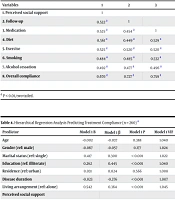
Pearson correlation analysis showed a strong, significant positive correlation between total PSS and overall treatment compliance (r = 0.670, P < 0.001). PSS was also significantly correlated with all individual compliance domains, with coefficients ranging from r = 0.492 for smoking/alcohol cessation to r = 0.561 for diet/fluid restriction, all P < 0.001. Strong intercorrelations were also observed among the compliance domains (Table 3).
Table 3.
Correlations Between Perceived Social Support and Treatment Compliance Domains (n = 260)
| Variables | 1 | 2 | 3 | 4 | 5 | 6 | 7 | 8 |
|---|---|---|---|---|---|---|---|---|
| 1. Perceived social support | 1 | |||||||
| 2. Follow-up | 0.522 a | 1 | ||||||
| 3. Medication | 0.525 a | 0.454 a | 1 | |||||
| 4. Diet | 0.561 a | 0.449 a | 0.529 a | 1 | ||||
| 5. Exercise | 0.525 a | 0.520 a | 0.520 a | 0.453 a | 1 | |||
| 6. Smoking | 0.484 a | 0.485 a | 0.532 a | 0.432 a | 0.536 a | 1 | ||
| 7. Alcohol cessation | 0.492 a | 0.477 a | 0.496 a | 0.415 a | 0.518 a | 0.535 a | 1 | |
| 8. Overall compliance | 0.670 a | 0.727 a | 0.759 a | 0.710 a | 0.759 a | 0.848 a | 0.832 a | 1 |
a P < 0.01, two-tailed.
4.4. Predictors of Treatment Compliance: Hierarchical Regression
Hierarchical regression analysis was performed to identify predictors of treatment compliance (Table 4). Model 1, which included only demographic and clinical variables, explained 56.9% of the variance (R2 = 0.569, F = 32.92, P < 0.001). Significant predictors in this model were marital status (β = 0.300), education (β = 0.445), disease duration (β = -0.376), and living arrangement (β = 0.364).
Table 4.
Hierarchical Regression Analysis Predicting Treatment Compliance (n = 260) a
| Predictor | Model 1 B | Model 1 β | Model 1 P | Model 1 VIF | Model 2 B | Model 2 β | Model 2 P | Model 2 VIF |
|---|---|---|---|---|---|---|---|---|
| Age | -0.002 | -0.037 | 0.388 | 1.040 | -0.001 | -0.018 | 0.528 | 1.041 |
| Gender (ref: male) | -0.067 | -0.057 | 0.177 | 1.024 | 0.000 | 0.000 | 0.994 | 1.037 |
| Marital status (ref: single) | 0.417 | 0.300 | < 0.001 | 1.022 | 0.237 | 0.171 | < 0.001 | 1.089 |
| Education (ref: illiterate) | 0.262 | 0.445 | < 0.001 | 1.040 | 0.282 | 0.478 | < 0.001 | 1.045 |
| Residence (ref: urban) | 0.031 | 0.024 | 0.566 | 1.008 | -0.043 | -0.034 | 0.216 | 1.021 |
| Disease duration | -0.023 | -0.376 | < 0.001 | 1.007 | -0.020 | -0.338 | < 0.001 | 1.013 |
| Living arrangement (ref: alone) | 0.542 | 0.364 | < 0.001 | 1.045 | 0.203 | 0.136 | < 0.001 | 1.251 |
| Perceived social support | 0.703 | 0.578 | < 0.001 | 1.324 |
a Model summary: Model 1: R2 = 0.569; Adjusted R2 = 0.552; F = 32.92; P < 0.001; Model 2: R2 = 0.820; Adjusted R2 = 0.812; ΔR2 = 0.250; P < 0.001.
When PSS was added in model 2, it emerged as the strongest predictor (β = 0.578, P < 0.001). The inclusion of PSS increased the explained variance by 25.0% (ΔR2 = 0.250, F-change = 344.19, P < 0.001), and the full model explained 82.0% of the variance in treatment compliance (R2 = 0.820). In the final model, the standardized coefficients for marital status, disease duration, and living arrangement were attenuated, whereas education and PSS remained the most robust predictors.
5. Discussion
This study provides a comprehensive examination of the association between PSS and treatment compliance across multiple behavioral domains in patients with HF. The findings demonstrate a strong positive relationship, underscoring the critical role of psychosocial resources in chronic disease management.
The results confirm that higher PSS is significantly associated with better overall treatment compliance. This finding is consistent with existing evidence linking robust social support to improved self-care and compliance in cardiovascular populations (12, 25). The mechanisms underlying this relationship are well documented. Social support is theorized to enhance chronic disease management by improving motivation and self-efficacy and by providing practical assistance (26, 27). Specifically, emotional, informational, and instrumental support from one’s network can increase the likelihood of adhering to medical advice and sustaining long-term lifestyle changes (11, 28).
Notably, social support showed particularly strong associations with medication compliance, physical activity, and smoking/alcohol cessation, which are behaviors that require consistent daily motivation. This finding is consistent with previous research. For example, Wu et al. identified social support as a key predictor of successful medication management in HF (13), while other studies have shown that supportive relationships facilitate consistent medication-taking and engagement in health-promoting activities (29, 30). These findings reinforce the view that social support is a vital component of effective self-care in broader cardiovascular populations (31).
The predominance of family support in this sample reflects the Iranian cultural context, in which the family unit is central to caregiving and health-related decision-making. This finding aligns with sociological frameworks that identify family and close ties as primary sources of emotional and instrumental support in illness management (32). The findings are also consistent with studies highlighting the role of the family in facilitating HF self-care (25, 33), suggesting that family-centered interventions may be especially effective in similar cultural settings.
The hierarchical regression analysis further contextualizes this relationship. Demographic and clinical factors, including marital status, education, disease duration, and living arrangement, initially explained a substantial proportion of the variance in compliance. This underscores the multifactorial nature of treatment compliance, in which social determinants and clinical realities intersect (34). However, the subsequent introduction of PSS into the model markedly increased its explanatory power, establishing PSS as the strongest independent predictor. This suggests that social support may be a key mechanism through which demographic advantages, such as being married or living with family, translate into better compliance.
The inverse relationship between disease duration and compliance is noteworthy and may indicate treatment fatigue or declining self-management vigilance over time, a challenge previously documented in long-term chronic illness (35). This finding highlights the need for sustained support strategies rather than only initial education or counseling.
For nursing practice, these findings underscore the need to assess and integrate patients’ social support systems into HF management plans. Interventions should move beyond individual patient education to actively engage family members and strengthen community-based support networks. As suggested by previous research, developing family-centered care protocols and connecting patients with peer support groups could be effective strategies for improving long-term compliance and outcomes (31, 36). Nurses are uniquely positioned to facilitate these strategies by counseling families, providing resources for community support, and advocating for healthcare policies that recognize the vital role of the social environment in patient health.
5.1. Study Limitations
This study had several limitations. The cross-sectional design precludes causal inference. Reliance on self-reported measures may have introduced social desirability or recall bias. In addition, the use of convenience sampling from a single center may limit the generalizability of the findings to other settings or cultural contexts. Future longitudinal and intervention-based studies are needed to confirm causal pathways and to explore the role of other psychosocial variables, such as health literacy and depression.
5.2. Conclusions
This study demonstrates that PSS, particularly family support, is a robust correlate and predictor of treatment compliance in patients with HF. The findings emphasize that effective HF management extends beyond pharmacological treatment to include the patient’s social ecology. Nursing and healthcare interventions should therefore prioritize strategies that assess, activate, and strengthen family-centered and community-based support systems to promote sustained self-care and improve clinical outcomes.