
1. Background
Peripheral vascular malformations are congenital abnormalities of vascular development characterized by structural vessel defects that cause deformities of the skin surface of the head and neck, trunk, and extremities. Within this group of disorders, venous malformations (VMs) account for approximately 38.6%, and arteriovenous malformations (AVMs) account for approximately 10% - 15%, representing the two most common simple forms of vascular malformations (1). Although these lesions do not involve abnormal endothelial cell proliferation, they tend to progress and persist, leading to soft tissue swelling, pain, skin discoloration, and cosmetic deformity, and they do not resolve spontaneously over time (2, 3).
Physical impairment in patients with vascular malformations represents a multidimensional burden. Patients often experience chronic pain, limited mobility, body image distress, and social stigma, all of which negatively affect mental functioning and markedly reduce quality of life (QoL) compared with that of the general population (4-6). Although absolute ethanol embolization-sclerotherapy has been used to reduce symptoms, control lesion progression, and improve local clinical findings in peripheral vascular malformations, treatment success should not be assessed solely on the basis of technical or imaging-based responses (7, 8). Patients may continue to experience pain, functional limitation, cosmetic concerns, and psychological distress even when the lesion appears clinically improved (9-13). Therefore, patient-reported QoL is an important complementary outcome that reflects the broader effect of treatment on daily functioning and well-being.
Recommendations also emphasize that the assessment of treatment outcomes in vascular diseases should extend beyond clinical indicators alone. Combining objective measures with patient-reported outcomes is necessary to comprehensively evaluate treatment effectiveness, particularly in terms of functional status and QoL (14). Nevertheless, evidence on posttreatment outcomes of peripheral vascular malformations in Vietnam has largely focused on clinical evaluation, including lesion characteristics, procedural outcomes, and complications, whereas prospective data tracking changes in QoL remain scarce. This research gap limits the ability to counsel patients regarding posttreatment recovery from the patient perspective.
2. Objectives
This study aimed to evaluate QoL before and after absolute ethanol embolization-sclerotherapy in patients with peripheral vascular malformations and to assess treatment responses and complications after the intervention. Accordingly, the study sought to answer two research questions: 1) Does absolute ethanol embolization-sclerotherapy improve QoL in patients with peripheral vascular malformations? 2) What treatment responses and complications are associated with this intervention?
3. Methods
3.1. Study Design and Patient Selection
This longitudinal prospective study was part of a larger research project on the treatment of peripheral vascular malformations and was conducted at the University Medical Center Ho Chi Minh City, Vietnam, from July 2020 to June 2021. In the present study, we used data from patients aged 18 years or older in the parent project database who had simple peripheral vascular malformations classified as VM or AVM, were treated with absolute ethanol embolization-sclerotherapy, and had complete SF-36 assessments at two time points: before treatment and 6 months after the intervention. The study followed the Strengthening the Reporting of Observational Studies in Epidemiology (STROBE) guidelines.
The sample size was calculated using the formula for estimating a mean, with a 95% confidence level, an estimated standard deviation of 39.3 points from a previous meta-analysis of SF-36 scores in patients with vascular malformations (6), and an acceptable margin of error of 10 points. The minimum required sample size was 60 patients. A total sampling method was applied, whereby all patients in the parent project database were screened and included if they met the eligibility criteria.
After screening, 71 patients met these criteria and were included in the analysis. The inclusion criteria were lesions visible on the skin surface of the head and neck, chest, abdomen, or limbs, accompanied by clinical symptoms or complications (pain, swelling, ulceration, skin necrosis, secondary infection, or bleeding) and/or psychological and cosmetic impacts due to vascular malformations. Patients with capillary malformations, lymphatic malformations, acquired arteriovenous fistulas, combined vascular malformations (capillary-arterial-venous-lymphatic), specific syndromes such as Klippel-Trenaunay, Sturge-Weber, or Bannayan-Riley-Ruvalcaba syndrome, or contraindications to endovascular embolization-sclerotherapy, including allergy or contraindication to contrast agents due to comorbidities, were excluded.
3.2. Outcomes and Measurements
In this analysis, demographic and clinical characteristics, lesion features, intervention-related information, and complications were abstracted from medical records and cross-checked with the parent project database when available. Variables collected included age, sex, clinical symptoms (psychological impact; swelling and enlargement; pain; and skin discoloration), duration from symptom onset to hospital admission (months), and duration from detection to treatment (months). Lesion characteristics included the type of malformation (VM or AVM), digital subtraction angiography (DSA) morphology (localized or diffuse), draining veins (very slow flow or high flow with dilatation), number of arterial feeding branches (< 3 branches or ≥ 3 branches), lesion site (head and neck, chest, abdomen, upper limbs, or lower limbs), lesion size (cm), largest diameter (cm), lesion volume (mL), and tissue involvement (skin and subcutaneous tissue, muscle, or bone involvement). Intervention characteristics included the number of interventions and the mean ethanol volume per intervention (mL).
Overall treatment outcomes were defined according to predefined clinical and MRI-based criteria. Clinical response was evaluated by changes in symptom severity on the 11-point Numeric Rating Scale (15). MRI response was evaluated 6 months after the final treatment session based on changes in lesion diameter, lesion volume, and lesion characteristics, including flow signal and thrombosis. Based on these criteria, responses were categorized as very good, good, fair, or poor and were subsequently grouped as very good to good and fair to poor for analysis and reporting (15, 16).
The primary outcome was improvement in QoL, assessed using the RAND 36-Item Health Survey. The SF-36, version 1.0, consists of 36 items divided into eight domains: physical functioning (10 items), role physical (4 items), bodily pain (2 items), general health (5 items), role emotional (3 items), vitality (4 items), mental health (5 items), and social functioning (2 items). These domains are aggregated into two main components: physical health and mental health. Each item is scored and converted to a scale ranging from 0 to 100, with higher scores indicating better QoL. Overall QoL was calculated as the average of all eight domains. Cutoff values were defined as follows: ≤ 25 points indicated low QoL, 25 - 75 points indicated moderate QoL, and ≥ 75 points indicated high QoL (17, 18). Previous psychometric testing of the Vietnamese SF-36 showed good discriminant validity across all eight domains; however, internal consistency varied by domain, with Cronbach alpha values ranging from 0.55 to 0.86 (17).
Before absolute ethanol embolization-sclerotherapy, patients were interviewed face to face by the principal investigator for the first QoL assessment. Six months after the procedure, patients returned for follow-up at the study site and completed a second QoL assessment using the same SF-36 instrument. Patients included in the present analysis had complete SF-36 data at both time points.
3.3. Study Procedure
A total sampling approach was applied to the parent project database for the present analysis. All 71 cases available in the database were reviewed against the study criteria, and those with complete SF-36 assessments at baseline and 6 months were retained for the final analysis. Before the intervention, each patient underwent a comprehensive clinical and paraclinical assessment and QoL evaluation. After absolute ethanol embolization-sclerotherapy, patients were followed for 6 months, during which QoL, complications, and treatment outcomes were recorded.
3.4. Statistical Analysis
Data were analyzed using R software version 3.4.4. Continuous variables with a normal distribution were presented as mean ± standard deviation, whereas skewed variables were presented as median (interquartile range); categorical variables were reported as numbers and percentages. Comparisons between VMs and AVMs for secondary outcomes were presented descriptively using proportions. The Wilcoxon signed-rank test was applied for paired comparisons of SF-36 scores before treatment and 6 months after intervention within each lesion type. Statistical significance was defined as P < 0.05.
3.5. Ethical Considerations
Ethics approval was obtained from the Ethics Committee in Biomedical Research of the University of Medicine and Pharmacy at Ho Chi Minh City (approval number 20312-DHYD, dated July 24, 2020). The study followed the Declaration of Helsinki and relevant institutional ethics regulations (19).
4. Results
A total of 71 patients with peripheral vascular malformations were included in the analysis, comprising 48 cases of VM and 23 cases of AVM that met the inclusion criteria. The mean age of the study population was 30.3 ± 9.0 years, and females predominated (67.6%). Most patients resided in the Mekong Delta (33.8%), Ho Chi Minh City (22.5%), and the Southeast region (18.3%). The flowchart of patient selection is presented in Figure 1.
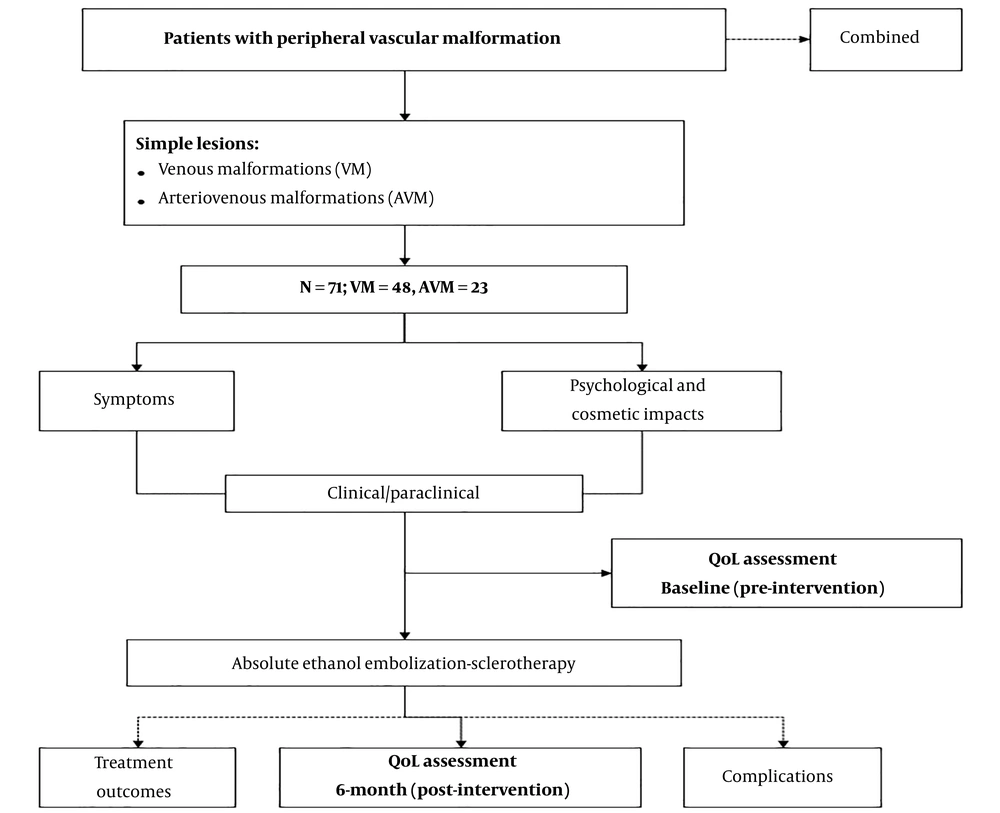
Figure 1.
Flowchart of patient selection for the study
4.1. Baseline Demographics and Clinical Presentation
Table 1 presents the baseline characteristics of the patients. Psychological impact was the most common manifestation (98.6%), followed by pain (95.8%), swelling and enlargement (94.4%), and skin discoloration (56.3%). The mean duration from symptom onset to hospital admission was 129.4 ± 110.9 months. The mean number of interventions was 2.0 ± 1.4 (range, 1 - 8). Lesions were mainly located in the head and neck (36.6%), lower limbs (35.2%), and upper limbs (19.7%). Most patients had skin and subcutaneous tissue involvement (98.6%), 66.2% had muscle involvement, and 4.2% had bone involvement. Digital subtraction angiography findings indicated that VMs were predominantly localized (58.3%), whereas AVMs were more often diffuse (56.5%).
Table 1.
Baseline Characteristics of Patients with Vascular Malformations (N = 71) a
| Characteristics | All (n = 71) | VM (n = 48) | AVM (n = 23) |
|---|---|---|---|
| Psychological impact | 70 (98.6) | 47 (97.9) | 23 (100.0) |
| Swelling, enlargement | 67 (94.4) | 45 (93.8) | 22 (95.7) |
| Pain | 68 (95.8) | 45 (93.8) | 23 (100.0) |
| Skin discoloration | 40 (56.3) | 27 (56.2) | 13 (56.5) |
| Duration from onset of symptoms to hospital admission (mo) | |||
| Mean ± SD | 129.4 ± 110.9 | 151.1 ± 118.8 | 84.0 ± 75.9 |
| Min - Max | 2 - 480 | 2 - 480 | 6 - 240 |
| Number of interventions | |||
| Mean ± SD | 2.0 ± 1.4 | 1.9 ± 1.3 | 2.3 ± 1.7 |
| Min - Max | 1 - 8 | 1 - 7 | 1 - 8 |
| Lesion site | |||
| Head and neck | 26 (36.6) | 17 (35.4) | 9 (39.1) |
| Chest | 5 (7.0) | 4 (8.3) | 1 (4.3) |
| Abdomen | 2 (2.8) | 1 (2.1) | 1 (4.3) |
| Upper limbs | 14 (19.7) | 8 (16.7) | 6 (26.1) |
| Lower limbs | 25 (35.2) | 19 (39.6) | 6 (26.1) |
| Skin and subcutaneous tissue involvement | 70 (98.6) | 47 (97.9) | 23 (100.0) |
| Muscle involvement | 47 (66.2) | 31 (64.6) | 16 (69.6) |
| Bone involvement | 3 (4.2) | 1 (2.1) | 2 (8.7) |
| DSA morphology | |||
| Localized | 28 (58.3) | 10 (43.5) | |
| Diffuse | 20 (41.7) | 13 (56.5) |
a Values are expressed as No. (%) unless indicated. Abbreviations: AVM, arteriovenous malformations; DSA, digital subtraction angiography; SD, standard deviation; VM, venous malformations.
4.2. Primary Outcome
Table 2 describes all eight domains and the overall QoL score, which improved significantly at 6 months after the intervention (P < 0.001). In the VM group, the largest mean score improvements were observed in vitality (52.4 points), bodily pain (51.7 points), and role physical (51.6 points), followed by social functioning (49.7 points), general health (48.5 points), role emotional (46.5 points), and mental health (42.8 points), whereas physical functioning showed a smaller improvement (26.2 points). Overall QoL increased by a mean of 46.2 points. Similarly, in the AVM group, QoL improved across most domains, with the greatest gains in role physical (59.8 points), bodily pain (55.9 points), general health (54.3 points), role emotional (53.6 points), vitality (50.0 points), mental health (46.4 points), and social functioning (46.2 points); physical functioning improved by 32.0 points. Overall QoL increased by a mean of 49.8 points.
Table 2.
| SF-36 Domain | VM Before Treatment (n = 48) | VM After Treatment (n = 48) | P-Value | AVM Before Treatment (n = 23) | AVM After Treatment (n = 23) | P-Value |
|---|---|---|---|---|---|---|
| Physical functioning | 71.1 ± 25.5 | 97.3 ± 6.0 | < 0.001 | 63.7 ± 35.5 | 95.7 ± 7.7 | < 0.001 |
| Role physical | 45.3 ± 36.0 | 96.9 ± 9.8 | < 0.001 | 34.8 ± 26.9 | 94.6 ± 10.5 | < 0.001 |
| Bodily pain | 30.8 ± 16.6 | 82.4 ± 10.4 | < 0.001 | 25.5 ± 13.1 | 81.4 ± 11.5 | < 0.001 |
| General health | 27.5 ± 5.6 | 76.0 ± 8.3 | < 0.001 | 22.6 ± 10.6 | 77.0 ± 7.2 | < 0.001 |
| Vitality | 23.0 ± 6.9 | 75.4 ± 33.7 | < 0.001 | 20.7 ± 7.6 | 70.7 ± 10.5 | < 0.001 |
| Social functioning | 28.1 ± 9.5 | 77.9 ± 15.5 | < 0.001 | 24.5 ± 15.8 | 70.7 ± 13.9 | < 0.001 |
| Role emotional | 50.0 ± 22.8 | 96.5 ± 12.4 | < 0.001 | 37.7 ± 27.2 | 91.3 ± 15.0 | < 0.001 |
| Mental health | 33.5 ± 9.4 | 76.3 ± 19.3 | < 0.001 | 28.7 ± 10.5 | 75.1 ± 11.2 | < 0.001 |
| Overall QoL | 38.7 ± 10.8 | 84.8 ± 9.3 | < 0.001 | 32.3 ± 12.9 | 82.0 ± 7.5 | < 0.001 |
a Values are expressed as mean ± SD. Abbreviations: AVM, arteriovenous malformations; QoL, quality of life; VM, venous malformations.
b Wilcoxon signed-rank test.
4.3. Secondary Outcomes
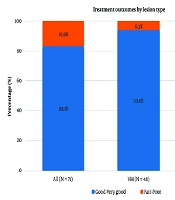
Most treatment outcomes were classified as good to very good (Figure 2). Specifically, the VM group had a higher proportion of good to very good outcomes, with 93.8% achieving good to very good outcomes, whereas this proportion was 60.9% in the AVM group. Conversely, the AVM group had a higher proportion of fair to poor outcomes (39.1%) compared with the VM group (6.2%).
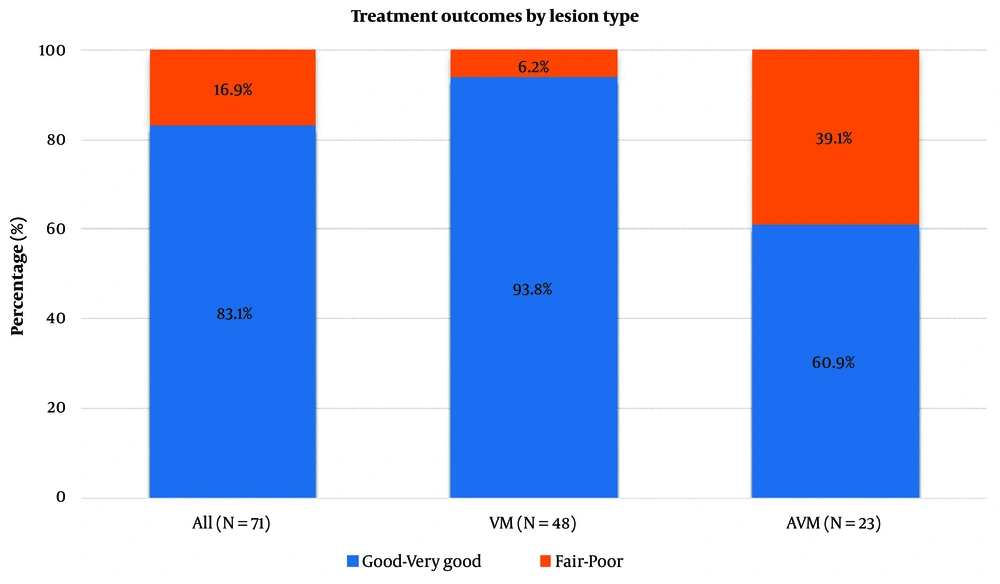
Figure 2.
Overall treatment effectiveness among patients with peripheral vascular malformations (N = 71)
All patients (100% in both the VM and AVM groups) experienced swelling as a complication (Figure 3). Skin ulcers occurred in 25.0% of VM cases and 30.4% of AVM cases. Deep vein thrombosis was recorded in 6.2% of VM patients but not in AVM patients. Temporary nerve injury was reported in 12.5% of VM patients and 8.7% of AVM patients, whereas permanent nerve injury was observed only in the AVM group (4.3%).
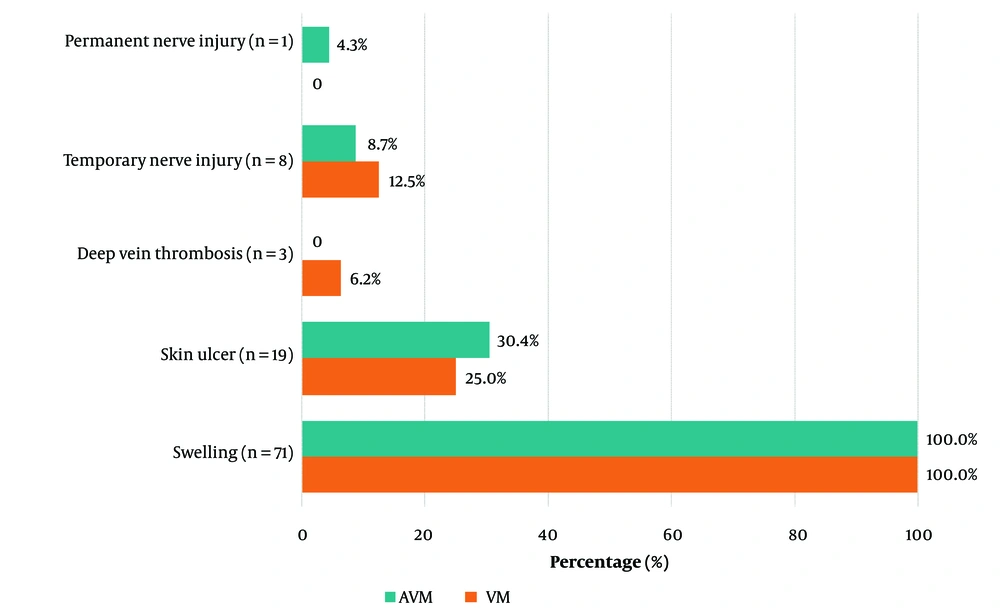
Figure 3.
Complications According to Lesion Type in VM and AVM (N = 71)
5. Discussion
Quality of life reflects the interaction of multiple factors, including disease burden and the patient’s ability to adapt while living with the condition and after treatment. Therefore, changes in QoL are important for evaluating treatment effectiveness from the patient perspective, rather than relying solely on imaging findings or lesion size (20, 21). After 6 months of follow-up, QoL in 71 patients with peripheral vascular malformations treated with ethanol sclerotherapy improved across all eight SF-36 domains and in overall QoL, with all changes reaching statistical significance (P < 0.001). Notably, bodily pain was among the domains with the greatest improvement in both patient groups, with postintervention scores increasing by a mean of 51.7 points in the VM group and 55.9 points in the AVM group compared with baseline. This finding aligns with clinical reality, as pain has a profound effect on QoL across multiple aspects (6, 22, 23).
In the present study, most patients were admitted to the hospital because of pain. Previous studies have also reported that pain is a common reason for patients to seek interventional treatment (24, 25). Effective pain reduction after treatment helps restore mobility, improve daily activities, and lessen psychological burden. Nguyen et al. (6) also concluded that pain and the psychological impact caused by vascular malformations are factors that severely reduce patients’ QoL. A possible explanation for why role physical was also among the domains with the greatest improvement is that it reflects the recovery of physical role, mobility, and participation in physical activities that had previously been severely impaired by prolonged pain, swelling, and enlargement before intervention (22, 24). This is particularly meaningful because impairment of physical functioning often leads to subsequent effects on mental health and overall QoL. England et al. (26) also emphasized that addressing pain and physical functioning should be among the key indicators assessed in patients.
Compared with the other SF-36 domains, physical functioning showed the smallest improvement in QoL, with an average increase of 26.2 points in the VM group and 32.0 points in the AVM group. However, these results do not necessarily indicate that the intervention was ineffective. A plausible explanation is that the baseline value for this domain was already close to the good-to-very-good level (71.1 points in the VM group and 63.7 points in the AVM group). Therefore, this finding remains clinically valuable because the intervention helped patients maintain physical mobility, which may have facilitated greater improvements in heavily affected domains such as pain, mental health, and social functioning. This finding indicates that treatment effectiveness should not focus solely on a single aspect; a multidisciplinary approach is needed for optimal management (9).
The improvement in QoL across all domains demonstrates the effectiveness of absolute ethanol embolization-sclerotherapy in treating these patients. The results showed that 93.8% of patients in the VM group achieved good-to-very-good treatment outcomes. In contrast, the AVM group achieved a success rate of only 60.9%. This discrepancy may stem from the challenges of managing and treating AVMs. The 2013 Consensus Document of the International Union of Angiology also states that an AVM is one of the most dangerous and difficult vascular malformations to treat and requires more complex interventions, leading to a lower success rate. However, the authors affirmed that absolute ethanol embolization-sclerotherapy still provides optimal long-term results with minimal recurrence rates (9). Therefore, evaluating QoL after treatment is essential because it reflects not only the effect of the disease process on the patient’s life but also the effectiveness of the treatment method (23).
This study preliminarily demonstrated the effectiveness of the treatment method through analysis of outcomes across various QoL domains. Absolute ethanol sclerotherapy was assessed across different QoL domains using the SF-36 scale, which comprehensively measures both physical and psychological factors. Furthermore, the study followed patients for 6 months, allowing evaluation of the short-term effect of the treatment.
5.1. Study Limitations
Because the number of patients with AVMs in this study was small, further research is needed to revalidate our hypothesis. Future studies should involve larger sample sizes to ensure more accurate results regarding improvements in QoL. Another limitation of our study is the absence of a control group to compare the effectiveness of ethanol sclerotherapy with other treatment methods. In addition, greater attention should be given to mental health to implement effective psychological support measures, not only surgical or sclerotherapy interventions (27).
5.2. Conclusions
Quality of life improved significantly at 6 months after absolute ethanol embolization-sclerotherapy in patients with peripheral vascular malformations, with improvement observed across all SF-36 domains. The greatest improvements in bodily pain and role physical suggest that the intervention may reduce symptom burden and help patients recover their physical role after treatment. Patients with VMs showed a higher proportion of good-to-very-good treatment outcomes than patients with AVMs, reflecting the greater complexity of AVM treatment. These findings support incorporating patient-reported QoL into posttreatment evaluation alongside clinical and imaging outcomes. However, important gaps remain regarding the temporal persistence of QoL gains; thus, future investigations should focus on longitudinal monitoring and the identification of at-risk subgroups predisposed to poor clinical outcomes.