
1. Introduction
Ostomy formation is a common surgical intervention for colorectal cancer, inflammatory bowel disease, and bladder cancer (1, 2). Effective postoperative management is essential to prevent complications such as peristomal dermatitis, infection, leakage, and psychosocial distress (3-5). Nurses play a central role in patient education, stoma assessment, appliance management, and long-term follow-up. Therefore, nurses’ competence directly influences patient safety and quality of life (6).
Despite notable advancements in nursing education, practical, structured training in ostomy care remains limited in many undergraduate curricula (7, 8). Newly graduated nurses frequently report insufficient knowledge, psychomotor skills, and confidence to provide effective ostomy care (9, 10). In several contexts, educational exposure is limited to fewer than 5 hours of theoretical instruction and minimal supervised clinical practice (11, 12). These deficiencies highlight a substantial gap between theoretical education and the demands of real-world clinical environments.
Globally, 50% to 80% of patients with ostomies experience at least 1 complication within the first postoperative year (3, 4). These complication rates underscore the clinical consequences of inadequate nursing preparation, thereby directly linking educational gaps to patient outcomes. Furthermore, limited preparedness among nurses is associated with poor patient outcomes, increased healthcare costs, and psychosocial burdens for patients (5-7). Collectively, these findings emphasize the urgent need to strengthen undergraduate nursing training in ostomy care.
To address these gaps, innovative educational approaches, such as simulation-based learning, problem-based learning (PBL), blended learning, and e-learning, have been introduced (8-11, 12). Simulation enables students to practice technical skills, such as stoma assessment and pouch changing, in a controlled and safe environment (10-12). Blended learning models that integrate simulation, theory, and longitudinal supervised practice demonstrate enhanced knowledge acquisition, skill retention, and self-confidence among students (12). The evolution of nursing education requires frameworks that not only impart knowledge but also foster critical reflection and professional growth. For example, a randomized controlled trial of multi-source feedback in nurse anesthesia education underscored the efficacy of integrating structured feedback mechanisms (13). This approach can enhance professionalism by encouraging trainees to engage with diverse perspectives on their performance, thereby promoting continuous self-assessment and skill refinement that are crucial for advanced nursing competencies.
Although individual studies have demonstrated the effectiveness of these strategies, the existing evidence remains fragmented, and a comprehensive synthesis integrating methodological quality, implementation barriers, and curricular implications is lacking (10, 14-18). No prior systematic review has consolidated global evidence specifically on ostomy care education in undergraduate nursing programs. Therefore, this systematic review aimed to synthesize existing evidence on educational strategies for ostomy care, evaluate their effectiveness, identify barriers and facilitators, and provide guidance for curriculum integration in undergraduate nursing programs.
2. Methods
This study was conducted as a systematic review in strict accordance with the Preferred Reporting Items for Systematic Reviews and Meta-Analyses (PRISMA) 2020 guidelines. The PRISMA checklist, comprising 27 essential items, guided all stages of the review process, ensured transparent reporting, and aimed to minimize bias. The process included: 1) a comprehensive search of electronic databases using predefined keywords; 2) systematic screening and selection of studies based on explicit inclusion and exclusion criteria; 3) independent data extraction and quality assessment; and 4) data synthesis, with the entire selection process visualized in a PRISMA flow diagram.
The primary objective of this review was to synthesize existing evidence on educational approaches to ostomy care in undergraduate nursing programs, focusing on their effectiveness, associated barriers and facilitators, and aspects of curriculum integration.
2.1. Research Question
The research question was developed using the PICO framework:
P (Population): Undergraduate nursing students
I (Intervention): Educational strategies for ostomy care, including simulation, blended learning, PBL, and e-learning
C (Comparison): Traditional lecture-based education or other strategies
O (Outcomes): Knowledge, psychomotor skills, self-confidence, and curriculum integration
The research question was as follows: What educational strategies are most effective in improving ostomy care competence among undergraduate nursing students?
2.2. Search Strategy and Data Sources
A comprehensive search was conducted across international and national electronic databases, including PubMed, Scopus, Web of Science, CINAHL, and relevant national scientific databases. The search period covered publications from 2000 to 2026. The year 2000 was selected as the starting point because structured simulation-based nursing education began expanding globally in the early 2000s, aligning with major curricular reforms.
The search strategy used combinations of the following keywords: "ostomy care," "nursing education," "undergraduate curriculum," "simulation," "blended learning," "problem-based learning," "e-learning," and related terms, with Boolean operators such as "AND" and "OR" to refine the search. The reference lists of all included articles were also manually screened using snowballing to identify additional relevant studies that might have been missed in the initial database search.
("ostomy care" OR "stoma care") AND ("nursing education" OR "undergraduate curriculum") AND ("simulation" OR "blended learning" OR "problem-based learning" OR "e-learning")
2.3. Eligibility Criteria
Studies were included in this systematic review if they met the following criteria:
1) Focused specifically on undergraduate nursing education;
2) Addressed ostomy care education;
3) Reported measurable educational outcomes related to ostomy care, such as knowledge, skills, or self-confidence;
4) Were available in full-text format;
5) Were published in English or Persian, if national databases were used for Persian content;
6) Evaluated ostomy care education interventions in nursing education settings; and
7) Had an interventional or quasi-experimental study design.
Studies were excluded if they met any of the following criteria:
1) Focused solely on continuing professional education or postgraduate nursing programs;
2) Did not report specific ostomy-related educational outcomes;
3) Were review articles, editorials, conference abstracts without full methodological detail, or book chapters, unless they met specific criteria for unique data; or
4) Had qualitative or non-interventional designs. These designs were excluded because the review aimed to achieve greater homogeneity of findings and to focus specifically on intervention-based educational studies.
2.4. Study Selection and Screening Process
All records were imported into Rayyan (Qatar Computing Research Institute), and duplicates were removed. Screening and selection were conducted independently by 2 reviewers in 2 phases.
Phase 1, title and abstract screening: Titles and abstracts of all unique records were reviewed against the predefined inclusion and exclusion criteria. Articles that were clearly outside the scope of this review were excluded.
Phase 2, full-text review: The full texts of the remaining articles were assessed to determine their final eligibility for inclusion. Particular attention was paid to ensuring that each study met all specified inclusion criteria.
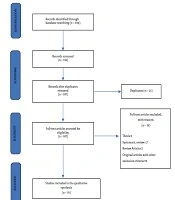
Discrepancies between the 2 reviewers at either screening stage were resolved through discussion and consensus. If agreement could not be reached, a third reviewer, who was a senior researcher or supervisor, was consulted for the final decision. The entire study selection process is illustrated in the PRISMA 2020 flow diagram (Figure 1).
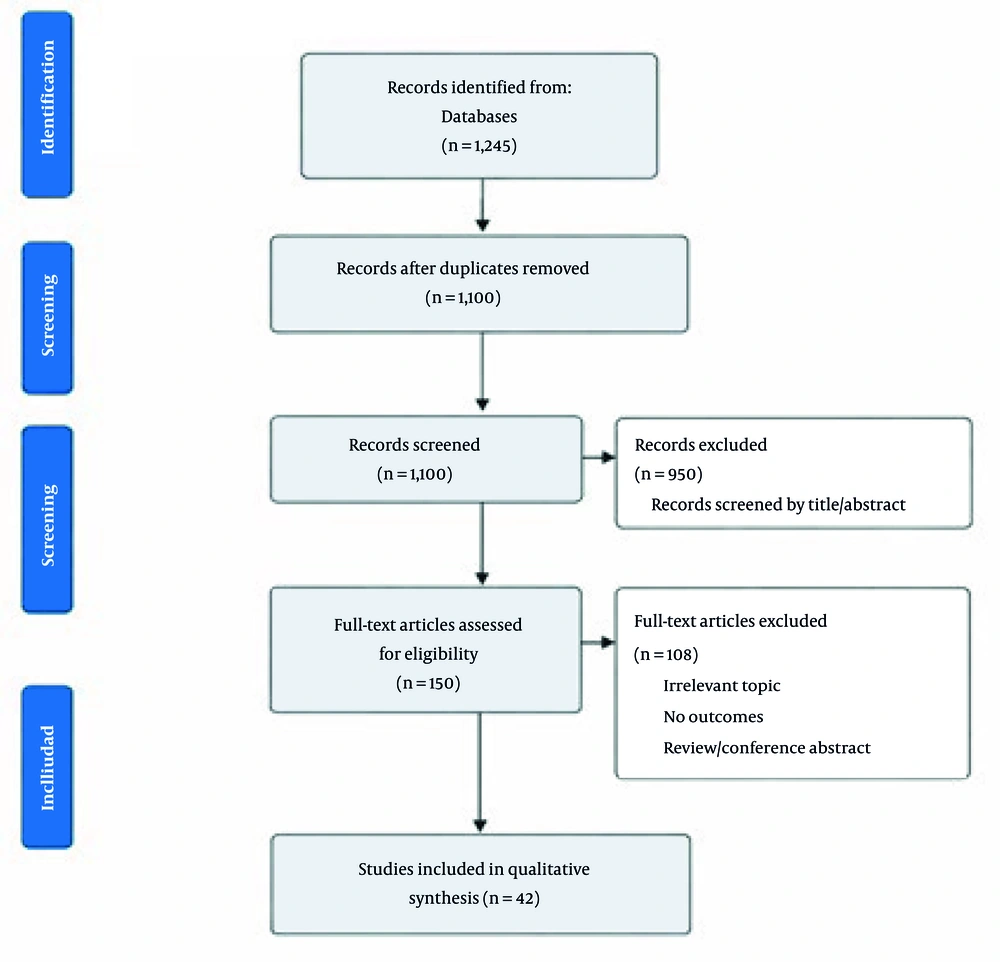
Figure 1.
PRISMA flow diagram of study selection
2.5. Data Extraction
A standardized, researcher-developed data extraction form was used to systematically collect relevant information from the final set of included studies. The form captured key details, including the first author's name, publication year, country of study, study design, sample size and characteristics, educational intervention, specific educational outcomes reported, and any reported barriers or facilitators to implementation of the educational strategy. Data extraction was performed independently by 2 reviewers to ensure accuracy and consistency, and disagreements were resolved through discussion.
2.6. Quality Assessment
The methodological quality, or risk of bias, of the selected studies was independently appraised by 2 reviewers. The Joanna Briggs Institute (JBI) Critical Appraisal Tools were used because they provide specific checklists tailored to various study designs, such as randomized controlled trials, quasi-experimental studies, and qualitative studies (19). Each included study was evaluated against the criteria in the relevant JBI checklist and categorized as having a low, moderate, or high risk of bias. Disagreements between the 2 reviewers were resolved through discussion and, if necessary, consultation with a third reviewer.
Of the 42 included studies, 21 were rated as having a low risk of bias, 15 as having a moderate risk, and 6 as having a high risk. Common methodological limitations included the lack of allocation concealment in quasi-experimental studies and reliance on self-reported outcomes. The results of these appraisals are provided in a supplementary file titled "Supplementary Risk-of-Bias Table."
2.7. Data Synthesis
Given the anticipated heterogeneity in study designs, interventions, and outcome measures, a narrative synthesis approach was primarily used. This method allowed for the systematic description and interpretation of findings without formal statistical aggregation. The synthesis was structured around key themes aligned with the review objectives, including the effectiveness of different educational strategies on learning outcomes, barriers to implementing effective ostomy care education, facilitators that promote successful ostomy care education, and integration of ostomy care education into undergraduate nursing curricula.
Findings were summarized and discussed qualitatively, highlighting patterns, commonalities, and discrepancies across studies to provide a comprehensive understanding of the current state of ostomy care education.
3. Results
Simulation-based education was consistently reported as the most effective method for improving knowledge, skills, and confidence outcomes in the majority of included studies (1-18).
3.1. Characteristics of Included Studies
Table 1 summarizes the main characteristics of the 42 studies included in this systematic review. As shown in Table 1, most studies (50.0%) were published between 2020 and 2026, indicating increasing research interest in this field in recent years. Regarding study design, quasi-experimental studies (45.2%) and randomized controlled trials (RCTs) (33.3%) were the most common. The studies were conducted in various countries, with Iran (21.4%) and the United States (16.7%) contributing the most. Furthermore, most studies (79.8%) focused on education for intestinal ostomy care, including colostomy and ileostomy care.
Table 1.
Characteristics of Included Studies (N = 42)
| Variables | No. (%) |
|---|---|
| Publication year | |
| 2000 - 2009 | 6 (14.3) |
| 2010 - 2019 | 15 (35.7) |
| 2020 - 2026 | 21 (50.0) |
| Study design | |
| RCT | 14 (33.3) |
| Quasi-experimental | 19 (45.2) |
| Qualitative | 7 (16.7) |
| Country | |
| Iran | 9 (21.4) |
| USA | 7 (16.7) |
| Australia | 4 (9.5) |
| Brazil | 3 (7.1) |
| Other countries | 19 (45.3) |
| Type of ostomy | |
| Colostomy/ileostomy | 31 (73.8) |
| Tracheostomy | 11 (26.2) |
3.2. Educational Interventions and Outcomes
The characteristics of the included studies are summarized in Table 2. The studies varied in design, educational interventions, and reported outcomes, with simulation-based education being the most frequently investigated strategy.
Table 2.
Summary of Educational Interventions and Outcomes in Included Studies a
| Author (y) | Study Design | Country | Type of Ostomy | Educational Intervention | Main Outcomes Evaluated | Key Findings |
|---|---|---|---|---|---|---|
| Sung et al. (2008) (1) | Quasi-experimental | South Korea | Clinical nursing skills (simulation-based) | Blended learning (theory + practice) | Clinical competence, confidence | Improved clinical competence after blended instruction |
| Cant and Cooper (2017) (18) | Umbrella review | Australia | Nursing education (simulation) | Simulation-based learning | Learning outcomes | Strong evidence supporting simulation effectiveness |
| Alenezi et al. (2023) (5) | Mixed-methods | Saudi Arabia | Ostomy patients | Clinical experience + education | Quality of life, care outcomes | Gaps in education affect patient outcomes |
| Abselam-Ali et al. (2025) (6) | Quasi-experimental | Spain | Stoma care education | Active learning methods | Self-efficacy, satisfaction, confidence | Significant improvement in student outcomes |
| Yeo and Park (2023) (7) | RCT | Korea | Ostomy surgery patients | Preoperative education program | Knowledge, recovery readiness | Structured education improved preparedness |
| McCutcheon et al. (2015) (12) | Systematic review | UK | Nursing skills education | Online vs face-to-face learning | Skill acquisition, performance | Blended/online learning comparable to traditional learning |
| Ala et al. (2020) (9) | RCT | Iran | Ileostomy care | Pharmacologic + nursing care education | Symptom relief | Improved symptom control after intervention |
| Alvandipour et al. (2025) (10) | RCT | Iran | Post-surgical ostomy patients | Surgical + nursing management | Postoperative outcomes | Improved recovery outcomes |
| Compton et al. (2020) (11) | Comparative study | USA | Nursing education | Problem-based learning | Critical thinking | Enhanced engagement and learning |
| Kim et al. (2016) (15) | Meta-analysis | Korea | Nursing simulation | Fidelity-based simulation | Learning outcomes | Higher fidelity improves outcomes |
| Foronda et al. (2020) (16) | Systematic review | USA | Nursing simulation | Virtual simulation | Engagement, knowledge | Increased engagement and learning |
a Abbreviations: RCT, randomized controlled trial.
3.3. Effectiveness of Educational Strategies on Learning Outcomes
The effectiveness of different educational strategies for knowledge, skills, and confidence outcomes is summarized in Table 3. As shown in this table, simulation-based education was identified as the most effective method, achieving the highest levels of effectiveness across all 3 domains, particularly for practical skills and confidence building. Blended learning approaches also showed high effectiveness, especially for knowledge acquisition. In contrast, lecture-based instruction alone demonstrated the lowest effectiveness across all domains.
Table 3.
Effectiveness of Educational Strategies on Learning Outcomes
3.4. Barriers and Facilitators
Table 4 presents the key barriers and facilitators identified for the effective integration of ostomy care education into the curriculum. The most frequently reported barriers were limited time within a crowded curriculum and a lack of adequate simulation facilities and equipment. In contrast, structured integration of content into the curriculum and strong institutional support emerged as the strongest facilitators.
Table 4.
Barriers and Facilitators to Ostomy Care Education
| Domain and Factor | Frequency (Number of Studies Reporting Factor) |
|---|---|
| Barriers | |
| Limited curriculum time | 14 |
| Lack of simulation facilities | 15 |
| Faculty shortage | 12 |
| Facilitators | |
| Curriculum integration | 19 |
| Institutional support | 17 |
| Trained educators | 11 |
This systematic review identified simulation-based education and blended learning as the most effective strategies for ostomy care education in undergraduate nursing, whereas lecture-based methods were the least effective. Key barriers included limited time, a lack of simulation resources, and faculty shortages, whereas successful implementation depended on curricular integration and institutional support.
The conceptual model (Figure 2) synthesizes the key findings from the included studies into a framework illustrating how structural barriers, active educational strategies, and contextual facilitators interact to produce outcomes in student competence and confidence. Each element of the model is directly supported by evidence from the reviewed literature (1 - 40), ensuring that the framework is grounded in empirical data rather than theoretical assumptions.
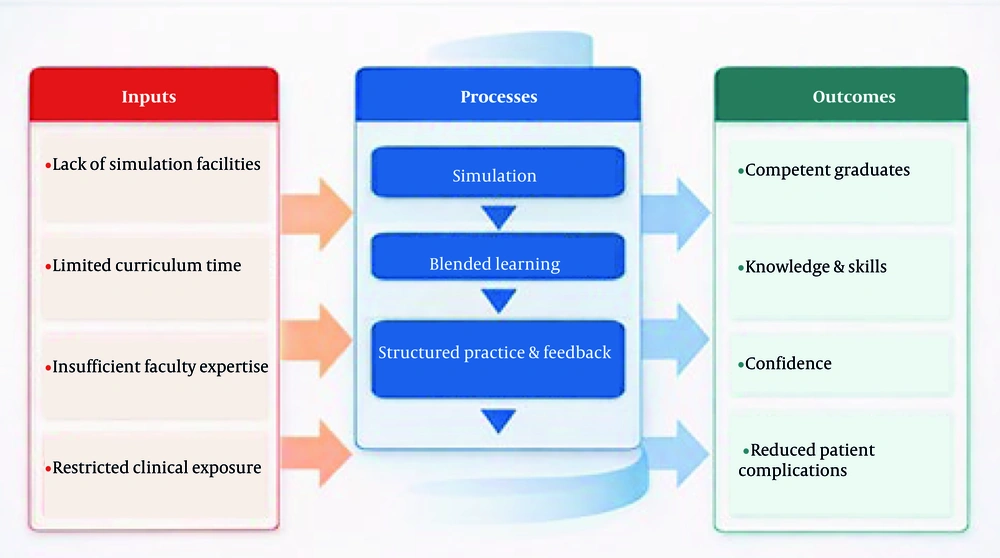
Figure 2.
Conceptual framework for integrated ostomy care
4. Discussion
Although 42 studies were included in this review, there was considerable heterogeneity in study designs, outcome measures, and educational contexts. The included studies comprised randomized controlled trials, quasi-experimental studies, and qualitative research, with varying sample sizes and assessment tools. The methodological quality ranged from low to high risk of bias, particularly in quasi-experimental studies relying on self-reported outcomes. Consequently, although consistent patterns were observed, such as the relative effectiveness of simulation-based and blended learning, the magnitude of effects and their generalizability may vary according to context, resource availability, and curricular structure. These findings underscore the need to interpret the results cautiously, with attention to methodological differences and implementation factors. This systematic review provides a comprehensive, evidence-based analysis of educational approaches to ostomy care within undergraduate nursing curricula. By synthesizing findings from 42 studies, this review offers robust insights into the effectiveness, limitations, and practical implications of current educational strategies.
A prominent finding of this review is the consistent superiority of simulation-based education over traditional lecture-based methods across all primary learning outcomes, including knowledge acquisition, psychomotor skill performance, and self-confidence (1-5). This finding is neither incidental nor context-specific; rather, it reflects a repeated pattern observed across diverse educational systems and cultural contexts. Simulation enables students to actively engage in realistic clinical scenarios, practice technical skills such as pouch changing and stoma assessment, and receive structured feedback in a safe learning environment (6, 7).
Blended learning approaches have demonstrated significant effectiveness in enhancing theoretical knowledge and learner satisfaction (8-10); however, evidence suggests that they may be insufficient for developing complex psychomotor competencies unless supplemented with hands-on practice and simulation (11).
In contrast, lecture-based education, which remains the dominant instructional method in many nursing programs, showed consistently poor outcomes. Studies reported low knowledge retention, inadequate skill performance, and reduced self-confidence among students trained exclusively through lectures (12-14). These findings highlight a fundamental misalignment between traditional pedagogical approaches and the experiential nature of ostomy care.
One of the most important contributions of this review is its detailed analysis of psychomotor skill development. Simulation-based interventions led to higher scores on objective structured clinical examinations and higher self-reported confidence levels (15 - 18). Self-confidence emerged as a critical mediating factor between education and clinical performance (19, 20).
Students who reported higher confidence levels were more likely to engage actively in patient care and demonstrate autonomy in clinical decision-making (21). This finding is particularly relevant because lack of confidence has been identified as a major barrier to effective ostomy care among newly graduated nurses (22).
Despite the clear benefits of innovative educational strategies, the review identified several persistent barriers. The most frequently reported challenges included limited curriculum time, inadequate simulation infrastructure, and insufficient faculty expertise (23-25). In many nursing programs, ostomy care is treated as a marginal topic and allocated minimal instructional time, often fragmented across different courses.
Faculty-related barriers were particularly prominent. Several studies reported that nursing educators themselves lacked formal training in ostomy care or simulation-based teaching methodologies (3, 5, 7, 26). This limitation undermines the quality and consistency of educational delivery and highlights the need for targeted faculty development programs. However, not all studies demonstrated the superiority of simulation; several reported comparable outcomes between blended and traditional methods (9, 10, 12).
Conversely, institutional support and curriculum integration emerged as strong facilitators of effective ostomy education. Programs that embedded ostomy care content longitudinally across multiple semesters demonstrated better learning outcomes and higher student satisfaction (27, 28). The critical role of robust infection control education in ostomy care cannot be overstated, given the inherent risks associated with wound management. A comprehensive review of Staphylococcus aureus complex infections, for instance, highlights persistent challenges and evolving strategies for preventing healthcare-associated infections within clinical settings. Applying these insights to ostomy care training indicates that educational programs must cover theoretical aspects of infection prevention and equip nurses with practical, evidence-based skills to mitigate risks effectively. This includes reinforcing sterile techniques, understanding antimicrobial stewardship, and recognizing early signs of infection, thereby directly contributing to patient safety and reducing complications.
The presence of trained clinical champions, standardized teaching packages, and collaboration with wound and ostomy care specialists further enhanced educational quality (29).
From a practical standpoint, the findings suggest that, even in resource-limited settings, meaningful improvements can be achieved through low-fidelity simulation, structured skills laboratories, and case-based discussions, provided these approaches are pedagogically sound and systematically integrated (30, 31).
The results of this review are consistent with broader nursing education literature emphasizing the effectiveness of experiential learning and simulation-based pedagogy (32, 33). However, this review extends existing knowledge by focusing specifically on ostomy care and undergraduate curricula, thereby addressing a critical gap in the literature. Moreover, the effectiveness of any educational framework, particularly in specialized areas such as ostomy care, is significantly influenced by the competence and commitment of nursing faculty. Research exploring the relationship between safe nursing care and professional commitment indicates that dedicated and well-equipped educators are pivotal in translating complex knowledge into practical skills and fostering a culture of safety (34). Therefore, investing in faculty development programs, providing educators with updated knowledge and resources, and supporting their professional growth are essential prerequisites for enhancing the quality and impact of ostomy care education. This commitment from educators directly translates into better-trained nurses who are more likely to provide safe, high-quality care, ultimately benefiting patient outcomes.
These findings also highlight how confidence and competence may translate into safer, more autonomous nursing practice and improved patient quality of life. The reference on professional commitment supports this argument (35). By making these connections explicit, the manuscript provides a clearer bridge between educational methodology and its broader clinical implications.
Notably, few studies evaluated long-term patient-related outcomes or cost-effectiveness, representing an important area for future research (36-40). Additionally, the lack of standardized outcome measures across studies limited the feasibility of meta-analysis.
From the researchers' perspective, the evidence strongly suggests that current undergraduate nursing curricula are insufficiently aligned with the clinical realities of ostomy care. Continuing to rely solely on lecture-based instruction for such a complex and skill-intensive area may not adequately prepare students for clinical demands.
The findings of this review support the need for a shift toward structured, simulation-enhanced, and curriculum-integrated ostomy care education. Such reforms should be supported by faculty development initiatives, institutional investment, and national curriculum standards. Ultimately, improving ostomy care education is not merely an academic concern but a critical determinant of patient safety, quality of life, and healthcare system efficiency.
4.1. Limitations
Although comprehensive, this review has limitations. Variability in study designs, intervention durations, and assessment tools precluded a formal meta-analysis, limiting quantitative synthesis. Furthermore, most studies measured short-term outcomes; long-term retention of skills and the ultimate impact of these skills on patient care in clinical practice remain underexplored. Finally, the review focuses on educational outcomes and does not systematically evaluate the cost-effectiveness of implementing different strategies, a crucial consideration for resource allocation.
4.2. Conclusions
This review demonstrates that simulation-based and blended learning strategies enhance knowledge, skills, and confidence among undergraduate nursing students. Curricular integration and institutional support are key facilitators. These findings provide guidance for evidence-based curriculum reforms in ostomy care education.
Availability of Data and Materials: The data set is available upon request from the corresponding author.
Ethics Approval and Consent to Participate: This systematic review was conducted in accordance with internationally recognized ethical standards for secondary research, including the avoidance of plagiarism, data fabrication or falsification, and redundant publication. Because this research synthesized existing published literature, individual participant consent was not required. However, all original studies included in this review were screened to ensure that they explicitly reported ethical compliance, such as local institutional approvals and participant consent procedures. The conduct of this systematic review adhered to the PRISMA 2020 guidelines and the principles of the Declaration of Helsinki concerning secondary data analysis.