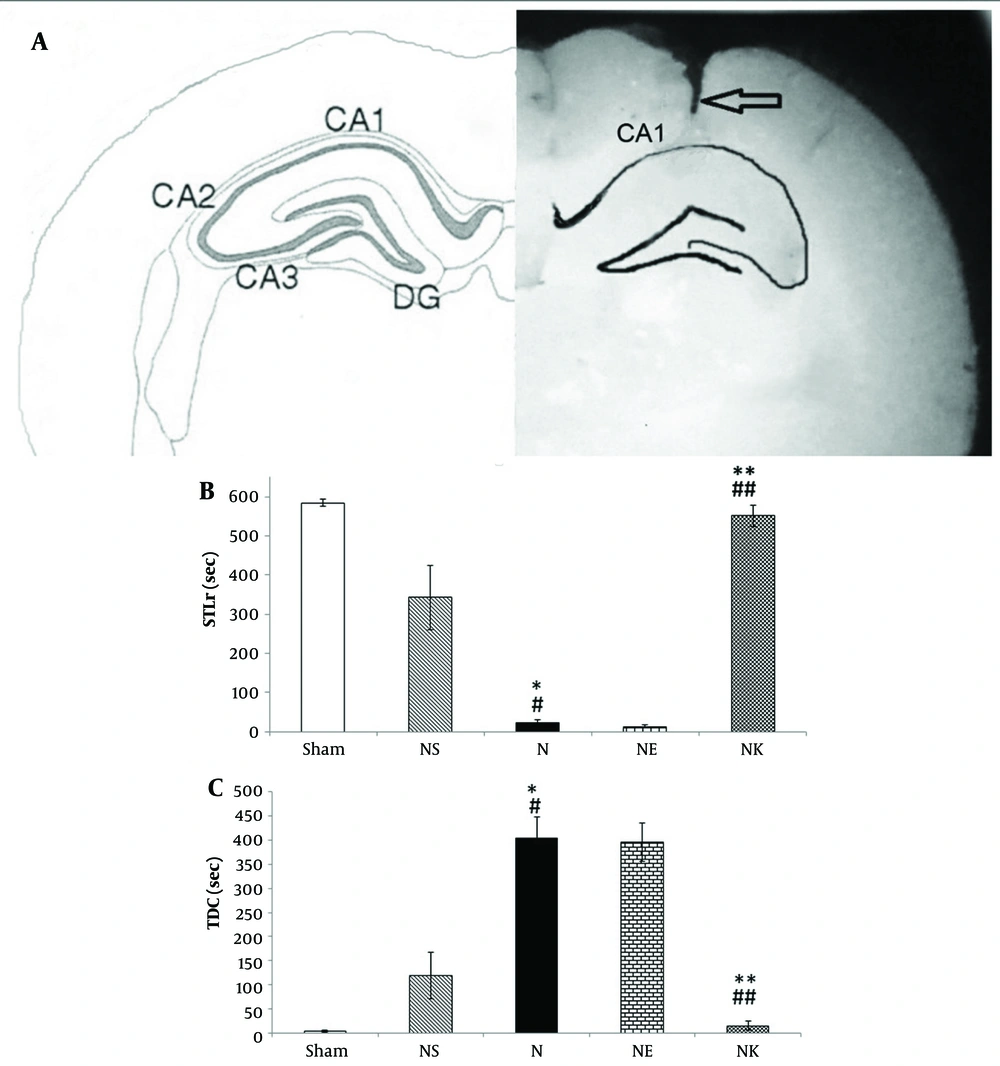
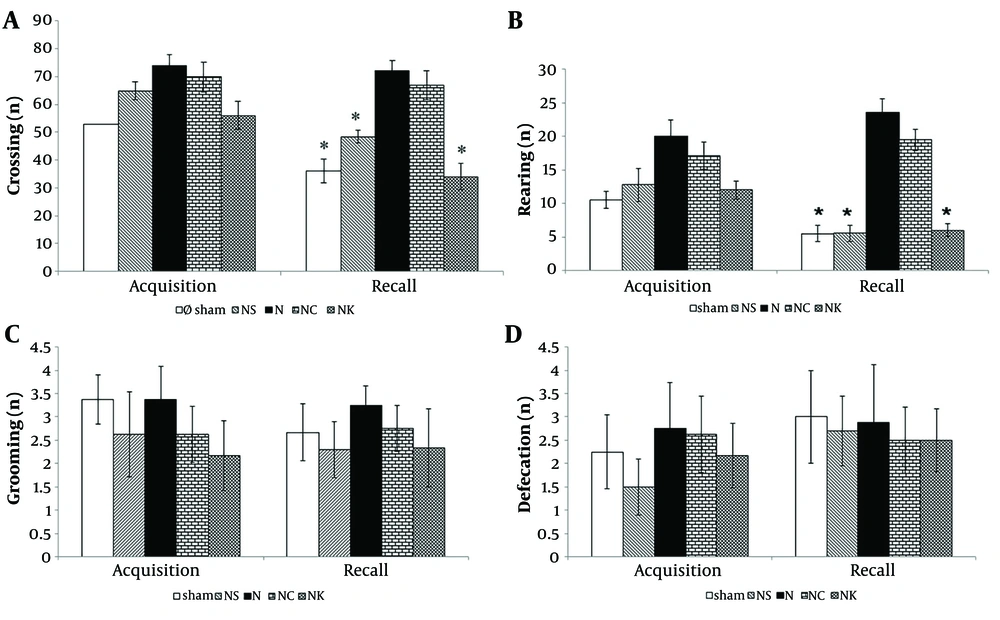
This study evaluated the effect of subcutaneous Vit K injection on rats with NMDA-induced damage in the hippocampal CA1 area using passive avoidance and open-field tests. The results showed that 30 days of Vit K administration significantly increased entrance latency and decreased the time spent in TDC compared to the control group. Additionally, Vit K reduced locomotion activity and the number of rearings in the open-field test.
Learning and memory impairment are key characteristics of neurodegenerative disorders such as Alzheimer’s disease (AD). Glutamate and its action at NMDA receptors play a crucial role in memory (
15). Neuronal cell death is induced by NMDA receptor agonists, while antagonists appear to protect neurons (
16). Previous studies have confirmed that NMDA injection into the hippocampal CA1 area leads to cell death in this region (
1,
16). The toxicity of NMDA is linked to an influx of extracellular Ca
2+ through its receptors, directly or indirectly. It is well established that transient changes in intracellular Ca
2+ levels can trigger several cellular responses, including apoptosis (
17,
18). Furthermore, glutamate activates nuclear factor-κB (NF-κB) through ionotropic glutamate receptors. Nuclear factor-κB activation is associated with neurodegeneration (
19) and may contribute to memory impairment (
20).
Our results demonstrated that destruction of the hippocampal CA1 area did not affect acquisition but impaired memory retrieval in the passive avoidance test. The lack of memory recall in the acquisition trial during the open-field test suggests that NMDA significantly impaired recognition memory. The observed decrease in rearing numbers and locomotor activity during the recall sessions in the open-field test further indicated impaired recognition memory (
21). Although emotional event information may be stored in both the amygdala and hippocampus, these two structures likely encode different aspects of the experience. It has been shown that the amygdala and hippocampus have reciprocal connections, allowing them to modify each other’s responses (
22,
23). A study on the roles of hippocampal areas CA1 and CA3 suggested that both regions contribute to acquisition, although only the CA1 region is essential for contextual memory retrieval (
1).
In this study, we observed that 30 days of Vit K administration increased the STL and decreased time spent in TDC in the passive avoidance test, indicating an improvement in memory impairment. The ability of Vit K to decrease locomotor activity and rearing behavior in the recall session of the open-field test also reflects enhanced recognition memory. Consistent with our findings, rats on a low-Vit K diet took longer to find the platform in the Morris water maze test compared to those on adequate or Vit K-rich diets (
5). In a study on healthy older adults, participants with higher serum Vit K1 levels demonstrated better cognitive function than those with lower levels (
24). Furthermore, post-mortem analysis of MK-4 levels in brain tissue indicated that higher MK-4 levels were associated with a reduced likelihood of mild cognitive impairment and fewer neurofibrillary tangles in neuronal cells. This suggests that MK-4 might have a neuroprotective mechanism directly linked to the preservation of cognitive processes and protection against neurofibrillary tangles (
25).
Menaquinone-4, the primary form of Vit K in the brains of both young and older rats, plays a role in sphingolipid synthesis (
6). Increased MK-4 levels in the brain have shown a positive correlation with sulfatides, cerebrosides, and sphingomyelin but a negative correlation with gangliosides (
7). A similar correlation between sulfatide concentrations and MK-4 in the hippocampus has also been observed (
8). In contrast, one study indicated that higher lifetime intake of Vit K was associated with lower concentrations of sulfatides and cerebrosides in the brain (
7). Cerebrosides, one of the most abundant glycolipids in the myelin sheath and axons, are crucial for nerve function (
26,
27). Additionally, sulfatides and cerebrosides regulate myelination and the differentiation of oligodendrocytes (
28), with reduced myelin integrity recognized as a key contributor to cognitive deficits (
29-
31).
Gangliosides, on the other hand, play a role in the protection and repair of nervous tissue (
32) and may influence neural cell signaling (
33). Meanwhile, Vit K appears to reduce ceramide levels in the hippocampus (
7). Ceramide can interfere with neuronal survival pathways (
34), and elevated ceramide levels have been associated with AD (
35,
36). This suggests that Vit K, through its effects on sphingolipid metabolism, may offer neuroprotective benefits and influence cognitive health.
Vitamin K is known for its neuroprotective effects, particularly through Vit K–dependent proteins (VKDPs) like proteins C and S, and Gas6, which have potent cytoprotective properties. In adult rats, Gas6 is expressed in the brain, including the hippocampus [specifically in areas CA1, CA3, and the dentate gyrus (DG)] (
4). Gas6 has shown pro-survival effects on hippocampal neurons by activating MAPK and downstream PI3-K signaling pathways. The Tyro3 receptor, a Gas6 ligand abundant in the hippocampus, appears to play a role in memory consolidation (
37,
38) and the maturation of glutamatergic synapses (
39). Additionally, Protein S, activated by Vit K, is expressed in the hippocampus and protects neurons from excitotoxic injury (
6). The endothelial protein C receptor (EPCR), present on endothelial cells, converts protein C into activated protein C (APC) (
4). In hypoxic-ischemic brain injury models, APC treatment has been shown to reduce the number of apoptotic cells in the CA1, CA2, CA3, and DG regions of the hippocampus in both hemispheres, while increasing the number of preserved neurons in CA1 and CA3 (
40).
The antioxidant (
9) and anti-inflammatory properties of Vit K, as well as its inhibition of the NF-kB signaling pathway (
40), may also contribute to preventing neurodegeneration and memory impairment. Recent studies suggest that Vit K supplementation modulates pathways involving NLRP3, caspase-1, and Nrf-2, which are crucial in managing inflammation and oxidative stress. Additionally, Vit K may enhance the expression of tyrosine hydroxylase that contribut in maintaining cognitive functions (
41).
A limitation of the present study is the lack of assessment of inflammatory cytokines and oxidative stress biomarkers, which would offer deeper insights into the effect of Vit K on memory impairment.
5.1. Conclusions
Our results demonstrated that a single-dose injection of NMDA into the hippocampal CA1 area increased time spent in TDC and decreased STL in the passive avoidance test, indicating memory impairment. Additionally, NMDA significantly disrupted recognition memory in the open-field test. However, chronic administration of Vit K ameliorated these NMDA-induced memory deficits in rats. Our findings suggest that Vit K may help mitigate excitotoxic neuronal damage and improve memory impairments. Based on these results, we recommend future studies to investigate the mechanisms underlying the therapeutic effects of Vit K on memory improvement, particularly focusing on the role of the CA1 region.