
1. Background
The skin is the body’s first protective barrier against external threats such as bacteria, temperature fluctuations, and chemicals. Disruption of its integrity can lead to serious health risks. A wound is an injury to the skin caused by mechanical trauma, thermal damage, or underlying physiological conditions that compromise its structure (1). Once the skin is injured, it becomes vulnerable to microbial invasion and external pathogens, often resulting in wound infections (2). Wound healing naturally proceeds through four regulated phases: Hemostasis, inflammation, proliferation, and remodeling. Disruption of this process, especially by persistent infection, can result in chronic wounds and delayed healing (3, 4). Wound dressings have traditionally been used to control bleeding and protect the wound site. Conventional products such as gauze, bandages, and cotton wool are mainly suitable for dry wounds with minimal exudate (5). However, these dressings often fail to maintain the moist environment essential for optimal healing and lack inherent antimicrobial activity (6). An ideal wound dressing should protect the wound, prevent infection, maintain homeostasis, and provide thermal insulation (7). Natural polymer-based dressings, especially those composed of chitosan and gelatin, have gained increasing attention in recent years due to their multifunctionality, biodegradability, and ability to deliver bioactive compounds for wound repair (8, 9). Chitosan, a natural polysaccharide, is particularly attractive because of its antimicrobial activity, biodegradability, oxygen permeability, and ability to accelerate clot formation (10). Gelatin, derived from partial hydrolysis of collagen, provides high water absorption, gel formation at room temperature, and wound-healing effects mediated by amino acids such as glycine (11). In parallel, medicinal plants and their polyphenolic compounds have increasingly been explored for their roles in infection control and tissue regeneration. Among them, cardamom (Elettaria cardamom Maton) has shown potent antioxidant and antimicrobial activities (12), attributed to its phenolic constituents including catechin, epicatechin, gallic acid, and kaempferol (13, 14). These compounds neutralize reactive oxygen species (ROS) and inhibit lipid peroxidation, thereby reducing oxidative stress at the wound site (15). Additionally, cardamom disrupts bacterial membranes, interferes with protein synthesis, and impairs quorum sensing in pathogens such as Staphylococcus aureus and Escherichia coli (16). Previous studies have investigated chitosan-gelatin dressings loaded with antibiotics like gentamicin or ampicillin, demonstrating significant antibacterial efficacy and good cytocompatibility (17). Additionally, various polyphenol-rich plant extracts — such as curcumin, quercetin, and gallic acid — have been incorporated into biopolymer-based wound dressings to enhance antioxidant and antimicrobial properties (18). Recent reviews have further highlighted the growing interest in integrating plant-derived polyphenols with biopolymers to develop multifunctional, bioactive wound dressings with controlled drug release and enhanced regenerative potential (19, 20).
2. Objectives
However, there is limited evidence for formulations that co-deliver both an antibiotic and a plant-based polyphenol within a single biopolymer scaffold. To address this gap, herein the present study introduces a novel wound dressing based on chitosan-gelatin film co-loaded with erythromycin and black cardamom extract. This dual-loaded system is designed to provide synergistic antimicrobial and antioxidant effects, while maintaining structural integrity and biocompatibility. The formulation was comprehensively characterized and its antibacterial, antioxidant, and cytocompatibility properties were systematically evaluated.
3. Methods
3.1. Cardamom Extraction
Cardamom extraction was obtained using the maceration method (13). Briefly, 10 g of dried and ground cardamom seeds were soaked in 50 mL of 53% (v/v) aqueous ethanol and stirred in the dark for 48 h. The solvent was then removed using a rotary evaporator operated for 3 h at 40°C in a water bath. Finally, the extract was dried in an oven at 40°C for 24 h.
3.2. Film Preparation
For film preparation, 0.1 g of gelatin was dissolved in 20 mL of 1% acetic acid at 50°C using an oil bath, followed by the addition of 0.4 g of chitosan to obtain the chitosan-gelatin base film. For the chitosan-gelatin-cardamom film, 0.8 g of cardamom extract was added, based on preliminary studies that optimized antioxidant and antibacterial activity without compromising film properties. In the final step, 0.1 g of erythromycin was incorporated into the solution to prepare the chitosan-gelatin-cardamom-erythromycin film. This concentration was selected to provide effective antimicrobial activity while maintaining cell compatibility and mechanical integrity. The resulting solution was cast onto a flat mold (area of approximately 50.24 cm²) and cross-linked with a solution of 2% sodium tripolyphosphate (TPP) and 3 M NaCl mixed in a 1:1 ratio (v/v). The cast films were kept at 4°C for 48 h to ensure complete film formation. After solidification, the films were gently removed and washed three times with 0.1 M NaOH followed by distilled water to remove residual reagents and impurities. Based on the total materials used and the final casting area, the dry loading of black cardamom extract and erythromycin in the film were approximately 15.92 mg/cm² and 2 mg/cm², respectively.
3.3. Film Characterization
3.3.1. Scanning Electron Microscope
To examine the morphology of chitosan-gelatin and chitosan-gelatin-cardamom groups, samples were freeze-dried, coated with gold, and observed using a scanning electron microscope (SEM).
3.3.2. Fourier-Transform Infrared
The prepared films were first dried in an oven at 40°C and then analyzed using potassium bromide (KBr) pellets over a range of 450 - 4000 cm⁻¹.
3.3.3. Degree of Swelling
The swelling degree was measured according to the method of Darwis et al. (21). Briefly, the films were dried and weighed (Wd), then immersed in 50 mL of distilled water for 48 h until fully swollen. The swollen samples were weighed (Ws), and the swelling degree (DS) was calculated using the following equation:
3.3.4. Equilibrium Water Content
Samples were immersed in double-distilled water at a ratio of 1:500, including films with different cardamom concentrations (3, 6, and 9%). This process continued until the samples reached a constant weight after water absorption. The samples were then weighed (Ws), dried in an oven at 60°C (Wd), and the Equilibrium water content (EWC) was calculated using the following equation:
3.3.5. Tensile Testing
The mechanical properties of the chitosan–gelatin films were assessed using a universal testing machine (STM, Santam, Iran) equipped with a 50 N load cell. Rectangular specimens (10 mm × 50 mm) were prepared and conditioned at room temperature (25 ± 2°C) for 24 h before testing. Tensile tests were carried out at a constant crosshead speed of 10 mm/min. Film thickness was measured with a digital micrometer at three different points and averaged. From the resulting stress–strain curves, tensile strength, elongation at break (% strain), and Young’s modulus were calculated.
3.4. Erythromycin Release of Film
To evaluate the in vitro release profile of erythromycin, circular dried film discs (1.2 cm diameter) were prepared using a sterile punch and subsequently vacuum-dried. Each disc was immersed in 3 mL of phosphate-buffered saline (PBS, pH 7.4) and incubated in a shaker incubator at 25°C and 50 rpm. At predetermined time points (1, 2, 3, 4, 5, 6, 7, and 8 h), 2 mL of the medium was withdrawn and replaced with an equal volume of fresh PBS to maintain sink conditions. The concentration of released erythromycin was determined using a UV-Vis spectrophotometer at 285 nm, and cumulative release (%) was calculated based on a standard calibration curve. All experiments were performed in triplicate, and mean values were reported. No dialysis membrane was used, as erythromycin diffusion was measured directly from the film surface into the surrounding medium.
3.5. in vitro Antibacterial Activity Evaluation of Hydrogels
For microbial tests, E. coli (PTCC-25922) and S. aureus (PTCC-112) were used as representative Gram-negative and Gram-positive bacterial strains, respectively. Both strains were obtained from the Iranian Research Organization for Science and Technology (IROST). The antibacterial activity of the film groups contained (1) chitosan-gelatin (J1, as negative control), (2) chitosan-gelatin-cardamom (J2), (3) chitosan-gelatin-cardamom-erythromycin (J3) was evaluated using both disk and well diffusion methods. Bacteria were pre-cultivated overnight in their respective selective media at 37°C, and a 0.5 McFarland standard suspension was then inoculated onto agar plates. Film samples (1 × 1 cm²) were incubated with 500 µL of PBS in a shaker-incubator (37°C, 50 rpm) for 24 h. For the disk diffusion assay, 25 µL of the extract was applied onto sterile discs, whereas for the well diffusion assay, 100 µL of the extract was added to each well. Plates were incubated at 37°C for 24 h. Each film piece weighed 0.12 ± 0.03 mg, corresponding to approximately 0.022 mg of cardamom in J2 films and 0.0028 g of erythromycin in J3 films. Equivalent amounts of erythromycin and cardamom (H) were dissolved in 500 µL of PBS and used as positive controls. The diameters of the inhibition zones were measured with a caliper and reported in millimeters (mm).
3.6. Film Antioxidant Properties Assays
3.6.1. 2,2-Diphenyl-1-Picryl-Hydrazyl-Hydrate (DPPH) Assay
For the antioxidant assay, film samples (1 × 1 cm²) were incubated with 950 µL of 0.4% DPPH solution in the dark at room temperature for 45 min. Absorbance of both the samples and control was measured at 517 nm using a UV-Vis spectrophotometer. Antioxidant activity (%) was calculated using the following equation:
Where Acontrol represents the absorbance of the DPPH solution without film, and Asample represents the absorbance in the presence of the film. IC₅₀ values were not determined, as only a single concentration of each sample was tested.
3.6.2. Ferric Reducing Ability of Plasma
Ferric reducing ability of plasma (FRAP) reagent was freshly prepared by mixing 25 mL of 300 mM acetate buffer (pH = 3.6), 2.5 mL of 20 mM ferric chloride, and 2.5 mL of 10 mM TPTZ in hydrochloric acid. Film samples of equal weight and size were incubated with 1 mL of FRAP reagent at 37°C for 30 min, after which absorbance was measured at 595 nm. A Trolox standard curve (0 - 500 µM) was used to calculate antioxidant activity, and results were expressed as Trolox equivalents.
3.7. Film Cytotoxicity Assay
Human fibroblast cells were employed for the cytotoxicity assay of the prepared films. The cells were obtained from the Iranian Biological Resource Center. The cell line was authenticated and routinely tested for mycoplasma contamination by the supplier to ensure quality and purity. First, 1 × 10⁴ cells were seeded into each well of a 96-well plate. At the same time, 1 cm² film pieces were cut and pre-incubated with 500 µL of PBS at 37°C for 24 h. Subsequently, 5, 10, and 20 µL of each film extract were added to the cell cultures. After 24 h, the medium was replaced with 100 µL of fresh medium containing methylthiazolyldiphenyl-tetrazolium bromide (MTT) (0.5 mg/mL), and the cells were incubated for 3 h. The resulting formazan crystals were dissolved in 100 µL of DMSO, and after 10 min of incubation, absorbance was measured at 570 nm using a microplate reader. Cell viability was calculated using the following formula:
3.8. Statistical Analysis
All experiments were performed in triplicate (n = 3). Data are presented as mean ± standard deviation (SD). Statistical differences among multiple groups were analyzed using one-way analysis of variance (ANOVA), followed by Tukey’s post hoc test. A P-value ≤ 0.05 was regarded as statistically significant. All statistical analyses were performed using GraphPad Prism version 10 (GraphPad Software, USA). Significance levels are indicated as follows: P ≤ 0.05 (*), P ≤ 0.01 (**), and P ≤ 0.001 (***).
4. Results
4.1. Film Characterization
4.1.1. Scanning Electron Microscopy
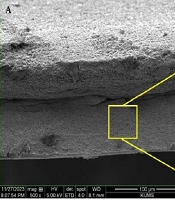
Scanning electron microscopy analysis showed that while the chitosan–gelatin base film had a relatively uniform morphology, incorporation of cardamom extract and erythromycin resulted in a more heterogeneous and porous surface (Figure 1). Such morphological features are highly relevant, as surface roughness and porosity can significantly affect fluid absorption, drug release behavior, and cell–material interactions during the wound healing process (22, 23).
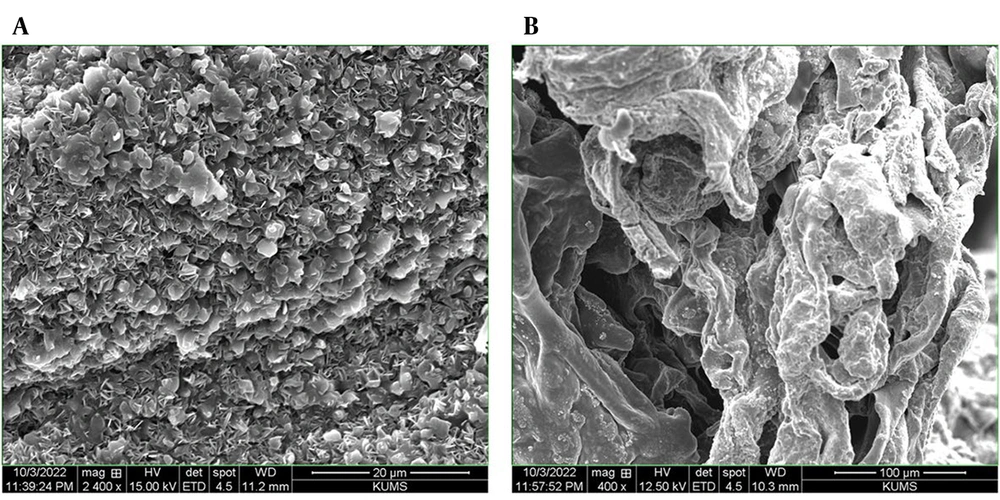
Figure 1.
Scanning electron microscopy (SEM) images of A, chitosan–gelatin film; and B, chitosan–gelatin–cardamom–erythromycin film, showing surface morphology and composite network structure.
4.1.2. Fourier-Transform Infrared Spectroscopy
The Fourier-transform infrared (FTIR) spectra of erythromycin, cardamom extract, chitosan–gelatin, chitosan–gelatin–cardamom, and chitosan–gelatin–cardamom–erythromycin films are shown in Figure 2. In the spectrum of erythromycin (Figure 2, Ery), a broad band at 3464 cm⁻¹ corresponds to O–H stretching vibrations, while ester carbonyl stretching is observed at 1734 and 1169 cm⁻¹. Peaks between 3000 - 2800 cm⁻¹ represent C–H stretching of alkanes, and bending vibrations of CH₃ and CH₂ groups appear at 1380 and 1460 cm⁻¹, respectively. The C–O–C asymmetric stretching of ether bonds is also evident at 1011 and 1053 cm⁻¹. The spectrum of cardamom extract (Figure 2, CEO) exhibited an O–H stretching band at 3385 cm⁻¹, C–H stretching between 3000–2800 cm⁻¹, a C=O ester peak at 1713 cm⁻¹, and CH₃/CH₂ bending vibrations at 1333 cm⁻¹. In the chitosan–gelatin spectrum (Figure 2, Ch-Gel), the O–H stretching band appeared at 3439 cm⁻¹, N–H stretching of secondary amines was observed at 3364 cm⁻¹, with bending at 1578 cm⁻¹. CH₃ and CH₂ bending vibrations were noted at 1339 and 1414 cm⁻¹, while peaks around 1078 and 1153 cm⁻¹ corresponded to C–O groups in both gelatin and chitosan. In the combined films (Ch-Gel-CEO and Ch-Gel-CEO-Ery), slight shifts in peak positions and intensity were detected, suggesting the formation of hydrogen bonds and other non-covalent interactions between the functional groups of the components. These slight shifts in the FTIR peaks are attributed to hydrogen bonding and intermolecular interactions between chitosan, gelatin, and cardamom extract, which is consistent with previous findings on chitosan–gelatin-based films (5).
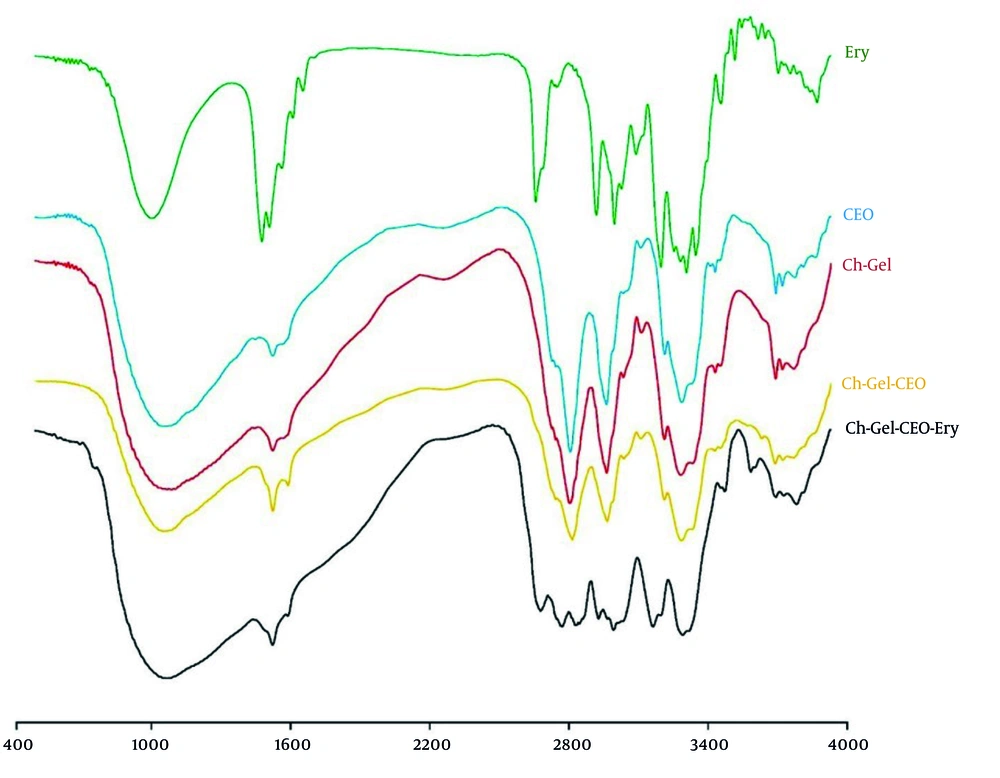
Figure 2.
Fourier-transform infrared (FTIR) spectra of erythromycin (Ery), cardamom extract (CEO), chitosan–gelatin film (Ch-Gel), chitosan–gelatin–cardamom film (Ch-Gel-CEO), and chitosan–gelatin–cardamom–erythromycin (Ch-Gel-CEO-Ery) film
4.1.3. Swelling Degree and Equilibrium Water Content
Swelling degree and equilibrium water content (EWC) are critical parameters for wound dressings, as they determine the ability of the material to absorb exudates and maintain a moist healing environment. As summarized in Table 1, the chitosan–gelatin–cardamom (9%) film showed the highest swelling capacity (15.25 ± 0.36, *** P < 0.001) and EWC (93.84 ± 2.1, *** P < 0.001), while the lowest values were recorded in the chitosan–cardamom (9%) group. The superior swelling behavior of gelatin-containing formulations reflects their enhanced hydrophilicity, which is advantageous for managing wound exudates. These results are consistent with findings by Koc & Altıncekic, who observed that cross-linked gelatin/chitosan films show greater swelling with increasing gelatin proportion, and are also in line with reviews highlighting the importance of polymer composition and crosslinking density on water uptake in chitosan/cellulose-based hydrogels (24).
Table 1.
| Groups | Swelling Degree | EWC (%) |
|---|---|---|
| Chitosan | 2.14 ± 0.33 | 68.15 ± 2.5 |
| Chitosan-cardamom 3% | 6.68 ± 0.42 ** | 86.99 ± 1.8 * |
| Chitosan-cardamom 6% | 14.35 ± 0.51 *** | 36.43 ± 2.2 ** |
| Chitosan-cardamom 9% | 0.77 ± 0.21 | 48.93 ± 1.7 |
| Chitosan-gelatin-cardamom 9% | 15.25 ± 0.36 *** | 93.84 ± 2.1 *** |
a Data are presented as mean ± standard deviation (n = 3).
b Statistical analysis was performed using one-way ANOVA followed by Tukey’s post hoc test.
c Significance levels: * P ≤ 0.05, ** P ≤ 0.01, *** P ≤ 0.001 compared to chitosan group.
4.1.4. Tensile Testing
The chitosan–gelatin–cardamom–erythromycin film exhibited a tensile strength of 0.12 ± 0.02 MPa, elongation at break of 32.5 ± 2.3 %, and a Young’s modulus of 0.50 ± 0.07 MPa (Figure 3 and Table 2). These values indicate favorable flexibility and elasticity appropriate for wound dressing applications. For comparison, previous studies on chitosan–gelatin composite films have reported Young’s modulus values in the range of approximately 0.3 to 1.2 MPa, tensile strength between 0.1 and 0.2 MPa, and elongation at break between 20 % and 40 %, depending on film composition, type and amount of plasticizer (e.g., glycerol or sorbitol), and processing conditions (25-27). More recently, Gürler reported that incorporation of pineapple peel extract and aloe vera gel into chitosan/gelatin/starch films reduced tensile strength but increased elongation at break, reflecting trends similar to our findings, where bioactive incorporation slightly shifts the mechanical balance while preserving overall integrity (28).
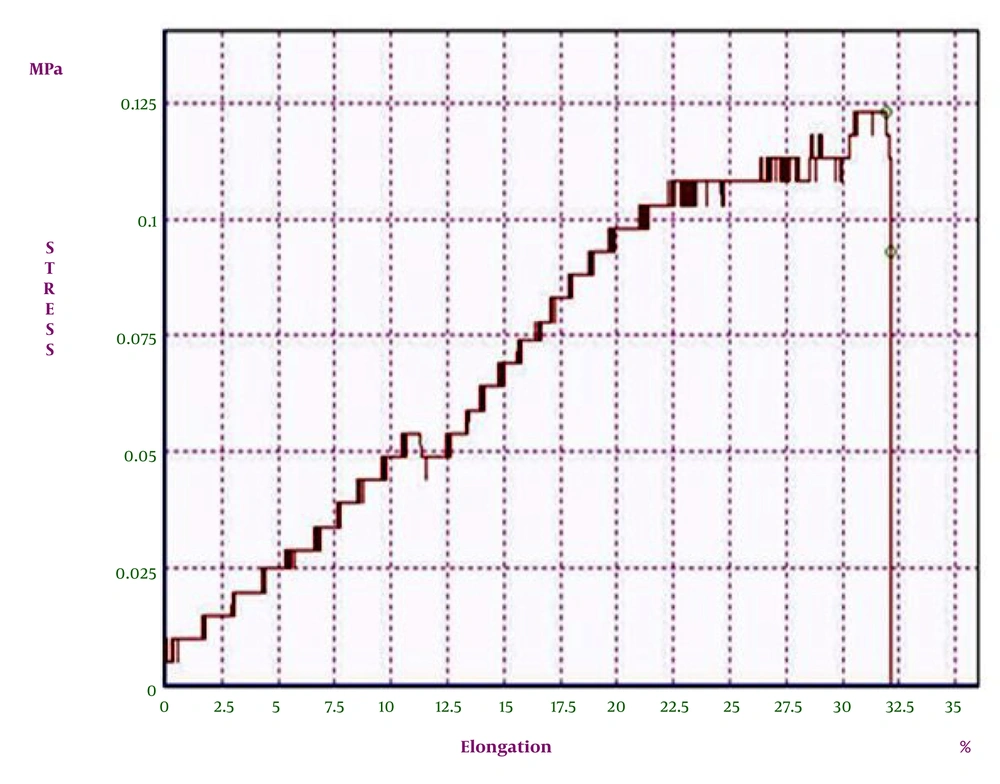
Figure 3.
Representative stress–strain curve of the chitosan–gelatin film. The film exhibited a maximum tensile strength of approximately 0.12 MPa and an elongation at break of 32.5%, indicating favorable flexibility for wound dressing applications.
Table 2.
Mechanical Properties of Chitosan–Gelatin–Cardamom Film a
| Parameter | Value |
|---|---|
| Tensile strength (MPa) | 0.12 ± 0.02 |
| Strain at break (%) | 32.5 ± 2.3 |
| Young’s modulus (MPa) | 0.50 ± 0.07 |
a Values represent the average of three independent measurements (mean ± SD).
4.2. Erythromycin Release of Film
The cumulative release profile of erythromycin from the chitosan–gelatin film is illustrated in Figure 4. The data indicate a sustained release pattern, with the drug gradually diffusing over time and reaching a plateau after 7 - 8 hours. The total cumulative release reached approximately 32.5% by 8 hours, suggesting that a portion of erythromycin remained entrapped within the hydrogel matrix, likely due to electrostatic interactions or diffusion barriers. Controlled-release hydrogel systems formulated with chitosan and gelatin have demonstrated similar sustained release characteristics. For instance, Mirjalili and Mahmoodi observed a linear, gradual protein release over 24 h from gelatin–chitosan hydrogels containing platelet-rich fibrin nanoparticles (29). Likewise, Andrade Del Olmo et al. reported a biphasic drug release profile from chitosan–genipin hydrogels, with approximately 30 - 40% release in the first 6 hours, followed by sustained release up to 24 h (30). These observations are consistent with the notion that matrix properties — particularly crosslinking density, mesh size, and gelatin content — govern drug diffusion and release dynamics. Earlier foundational work by Li & Mooney highlighted that polymer–drug interactions and hydrogel network parameters are key determinants in tuning release kinetics (31). Collectively, these findings reinforce the potential of our chitosan–gelatin hydrogel as a localized and sustained delivery system for infected wounds.
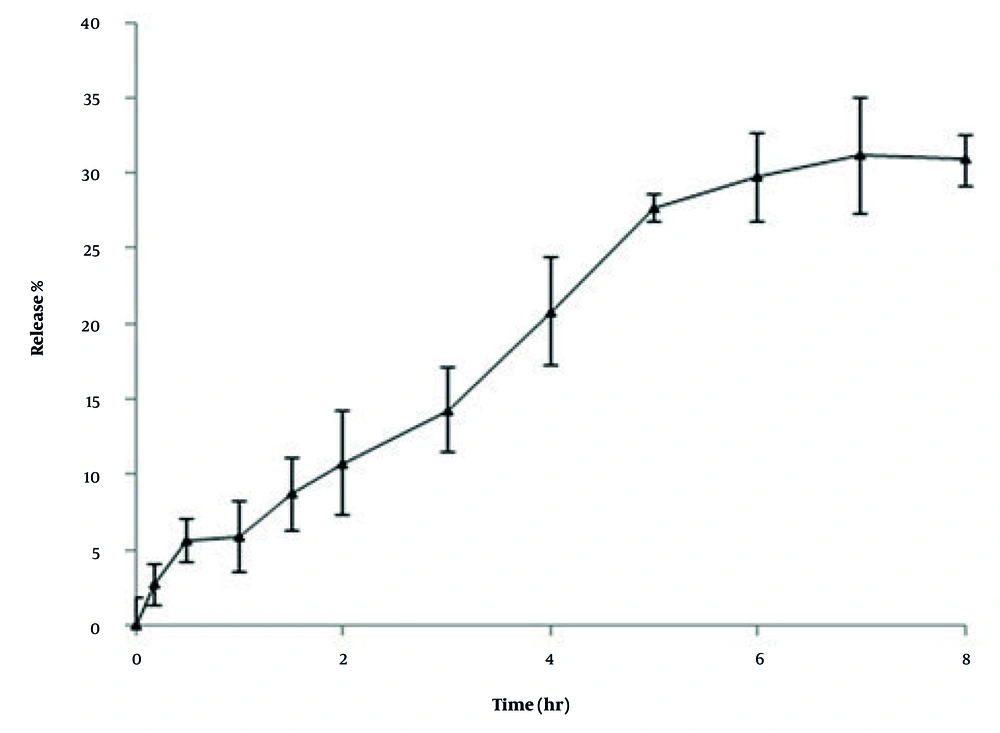
Figure 4.
Cumulative release profile of erythromycin from the chitosan–gelatin–cardamom–erythromycin film over an 8-hour period.
4.3. in vitro Antibacterial Effect
Figure 5 illustrates the inhibition zones of different film formulations and controls. Statistically significant differences were observed among the groups (P < 0.001, one-way ANOVA). For S. aureus, the mean ± SD inhibition zones were: J1 (no inhibition), J2: 12 ± 2.2 mm, J3: 28 ± 3.4 mm, cardamom control (H): 20 ± 2.8 mm, and erythromycin: 24 ± 1.9 mm. Tukey’s post hoc analysis revealed that J3 significantly outperformed J1, J2, and erythromycin (P < 0.05), suggesting a synergistic antibacterial effect between erythromycin and cardamom extract. Against E. coli, only J3 and erythromycin displayed inhibition, with zones of 25 ± 2.9 mm and 22 ± 1.6 mm, respectively. J2 and H exhibited no inhibitory activity. Although J3 showed a slightly larger inhibition zone than erythromycin, the difference was not statistically significant (P > 0.05), indicating that erythromycin was the main contributor to antibacterial activity against E. coli. These findings highlight the selective antibacterial action of cardamom extract against S. aureus, while erythromycin exhibited a broader spectrum consistent with its established pharmacology (32). The enhanced activity of J3 may stem from improved bacterial membrane permeability induced by cardamom phytochemicals such as 1,8-cineole and α-terpinyl acetate, which facilitate erythromycin uptake. Similar synergistic interactions between essential oils and macrolide antibiotics have been reported in prior studies (33). In addition, the chitosan–gelatin base likely contributed to the antibacterial activity. Chitosan is known to interact with phospholipid membranes, disrupting permeability and facilitating antimicrobial penetration (34). Chitosan increases the production of extracellular matrix due to its hydrophilic property and greater degradation. Furthermore, its degradation releases N-acetyl-D-glucosamine, which promotes fibroblast proliferation, collagen deposition, and hyaluronic acid synthesis, thereby accelerating wound healing (35). These biological activities of chitosan have been associated with enhanced wound healing responses in prior in vivo studies, including infection control, debridement, and angiogenesis stimulation (35, 36). Our findings are in agreement with these reports, further validating chitosan’s dual role as both a structural matrix and a bioactive agent. Comparable studies have also demonstrated that incorporating natural additives into chitosan–gelatin matrices can enhance antibacterial performance. For example, a composite dressing containing potato starch, sesame oil, and banana peel powder significantly improved mechanical strength and antibacterial efficacy against S. aureus and E. coli (5). Similarly, a chitosan–gelatin–honey hydrogel exhibited nearly 100% inhibition against both bacteria, surpassing the effects of chitosan or honey alone.
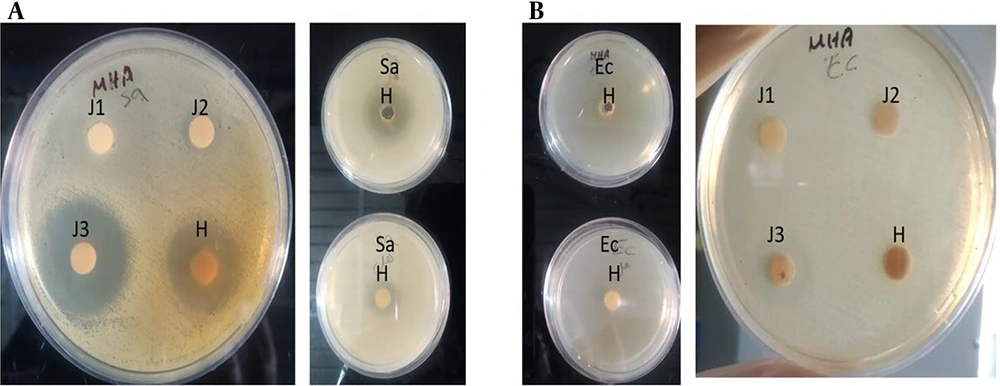
Figure 5.
Antibacterial activity of different films against A, Staphylococcus. aureus; and B, Escherichia coli using disc and well diffusion assays. Zone of inhibition was measured after 24 h. Data represent the mean ± SD (n = 3). J1; chitosan–gelatin, J2; chitosan–gelatin–cardamom; J3, chitosan–gelatin–cardamom–erythromycin; H, pure cardamom extract.
4.4. Antioxidant Activities
The antioxidant properties of the films were evaluated using two complementary assays: 2,2-diphenyl-1-picrylhydrazyl (DPPH) radical scavenging and FRAP reducing power (Figure 6). One-way ANOVA followed by Tukey’s post hoc test confirmed highly significant differences among the formulations (P < 0.001 for both assays). In the DPPH assay, J1 (chitosan–gelatin) showed the minimal scavenging activity (18 ± 1.2%), which was significantly lower than that of J2 (93 ± 1.7%), J3 (95 ± 1.1%), and H (93.5 ± 1.6%) (P < 0.001). No significant difference was observed among J2, J3, and H, indicating that incorporation of erythromycin did not reduce the antioxidant potential imparted by cardamom. In the FRAP assay, antioxidant capacity, expressed as Trolox equivalents, followed the same pattern observed in the DPPH test. J1 had significantly lower activity than the other groups (P < 0.001), while no significant differences were found among J2, J3, and H. Collectively, these results suggest that the antioxidant activity of the films is primarily attributable to cardamom extract, while chitosan and gelatin contributed minimally. The pronounced antioxidant activity can be attributed to phenolic compounds naturally present in cardamom, including catechin, epicatechin, gallic acid, and kaempferol (37). In agreement, Noshad and Alizadeh identified 73 antioxidant constituents in green cardamom and reported 43 ± 0.67% DPPH inhibition. They also noted that the minimum inhibitory concentrations of cardamom extracts ranged from 4 - 32 mg/mL, with Streptococcus pyogenes and Enterobacter aerogenes showing the greatest and least susceptibility, respectively (37).
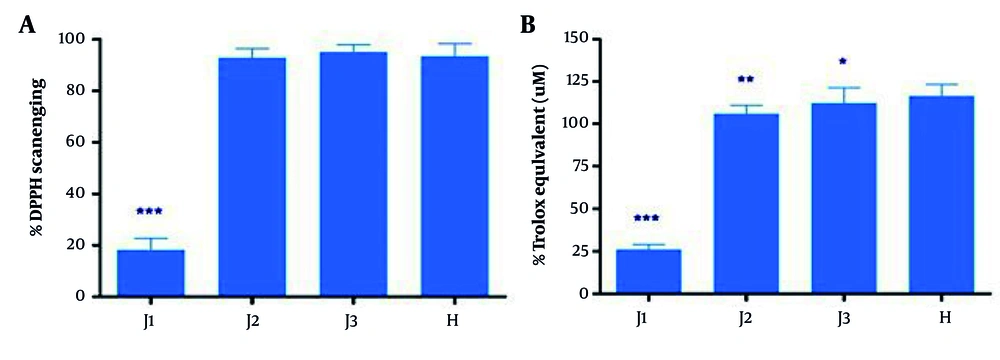
Figure 6.
Antioxidant activities of different film formulations measured using A, DPPH radical scavenging; and B, FRAP assay. J1, chitosan–gelatin; J2, chitosan–gelatin–cardamom; J3, chitosan–gelatin–cardamom–erythromycin; H, pure cardamom extract. Data are presented as mean ± SD (n = 3). One-way ANOVA with Tukey’s post hoc test was used. . * P ≤ 0.05, ** P ≤ 0.01, *** P ≤ 0.001.
4.5. Film Biocompatibility
Methylthiazolyldiphenyl-tetrazolium bromide (MTT) assay results (Figure 7B) demonstrated that all film formulations supported high cell viability (> 90%) at all tested concentrations (5, 10, and 20 µL), with no statistically significant differences compared to the untreated control (P > 0.05). Microscopic observations (Figure 7A) further confirmed normal fibroblast morphology, with no evidence of cytotoxic changes such as cell shrinkage, membrane blebbing, or detachment. These findings collectively affirm the biocompatibility of the formulations with human fibroblasts. Gelatin is known to promote cell adhesion, proliferation, and migration (38), while chitosan provides structural stability and bioactivity (39). Their combination thus creates a favorable microenvironment for soft tissue repair. The gelatin content (20% w/w) contributed to stable hydrogel formation at room temperature, yielding a compact and uniform structure indicative of strong component compatibility and mechanical integrity. No dose-dependent cytotoxicity was observed, and all samples complied with ISO 10993-5 criteria for non-toxicity. However, the lack of a positive toxic control (e.g., DMSO-treated cells) limits the robustness of the assay, and future studies should include such controls to strengthen the interpretation of cytocompatibility.
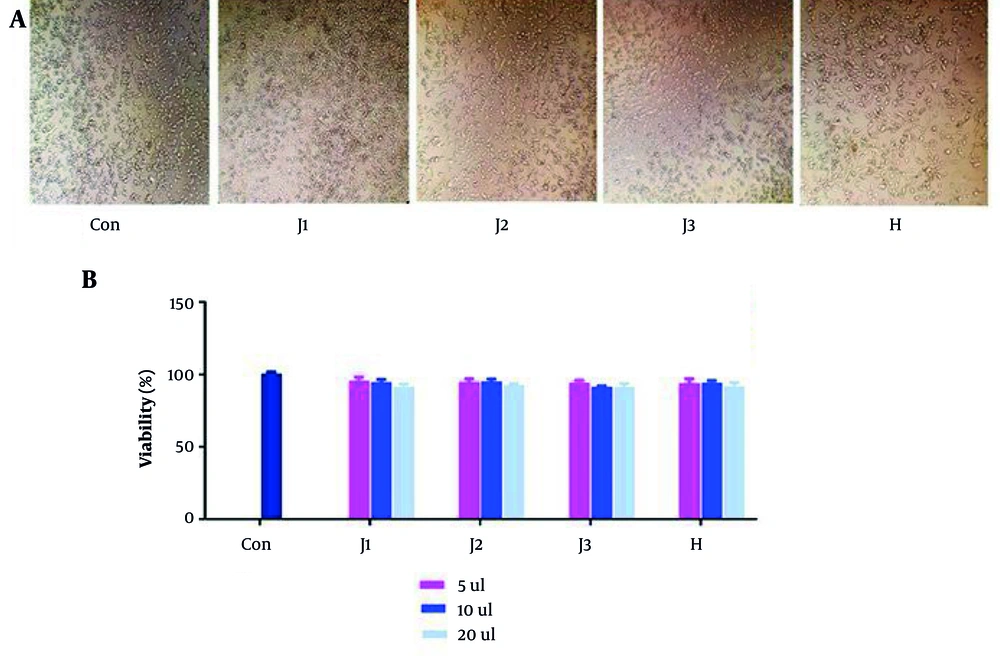
Figure 7.
Cell viability assay. A, light microscopy images of human fibroblast cells treated with 10 µl of extraction from each film group after 24 h; B, cell viability measured by MTT assay for 5, 10, and 20 µL film extract. J1, chitosan–gelatin; J2, chitosan–gelatin–cardamom; J3, chitosan–gelatin–cardamom–erythromycin; H, pure cardamom extract; Con, untreated control. Data are shown as mean ± SD (n = 3). One-way ANOVA with Tukey’s post hoc test was used. ns: Not significant (P > 0.05).
5. Discussion
In summary, we developed a chitosan–gelatin-based film containing 9% cardamom extract and erythromycin with multifunctional properties relevant to wound healing applications. The optimized formulation showed strong antibacterial activity, particularly against S. aureus, along with marked antioxidant capacity and excellent cytocompatibility with human fibroblast cells. Its favorable mechanical strength and swelling behavior further highlight its potential as an effective wound dressing capable of providing structural support, maintaining moisture balance, and sustaining therapeutic delivery. Nevertheless, this study has certain limitations, including the lack of in vivo validation and the absence of detailed chemical profiling of the bioactive components. Future research should therefore focus on in vivo wound healing assessments, comprehensive quantification of phytochemicals (e.g., via HPLC or LC-MS), and long-term stability evaluations to strengthen the translational potential of this formulation for clinical use.