


1. Background
2. Objectives
3. Methods
3.1. Preparation of Heracleum persicum Essential Oil
3.2. Gas Chromatography-Mass Spectrometry (GC-MS)
3.3. Drugs or Chemicals
3.4. Animals
3.5. Forced Swim Test
3.6. Open Field Test
3.7. Grouping
3.8. Possible Mechanisms
3.8.1. The Role of the Dopaminergic System
3.8.2. The Role of the Noradrenergic System
3.8.3. The Role of the Serotonergic System
3.9. Measurement of Antioxidant Activity
3.10. Data Analysis
4. Results
4.1. Chemical Components of Heracleum persicum Essential Oil
| No. | Components | RT (min) | KI | Percentage (%) |
|---|---|---|---|---|
| 1 | Propanoic acid, 2-methyl-, 1-methylethyl ester | 5.45 | 794 | 0.93 |
| 2 | Hexanol < n- > | 8.47 | 870 | 0.28 |
| 3 | Isopropyl 2-methylbutyrate | 9.02 | 885 | 1.05 |
| 4 | Isopropyl 3-methylbutanoate | 9.42 | 904 | 1.33 |
| 5 | Isobutyl isobutyrate | 12.33 | 911 | 0.25 |
| 6 | Butyl butanoate | 14.61 | 994 | 0.61 |
| 7 | Octanal < n- > | 15.14 | 998 | 0.65 |
| 8 | Hexyl acetate | 15.48 | 1009 | 0.44 |
| 9 | Cymene | 16.12 | 1029 | 0.69 |
| 10 | Butyl 2-methylbutanoate | 16.89 | 1038 | 0.37 |
| 11 | Butanoic acid, 3-methyl-, butyl ester | 17.23 | 1054 | 0.29 |
| 12 | γ-Terpinene | 17.81 | 1060 | 0.93 |
| 13 | Octanol < n- > | 18.61 | 1068 | 1.19 |
| 14 | Terpinolene | 20.03 | 1088 | 0.58 |
| 15 | Propanoic acid, 2-methyl-, hexyl ester | 22.30 | 1150 | 1.63 |
| 16 | Hexyl butanoate | 24.57 | 1192 | 33.96 |
| 17 | Cyclohexane, ethenyl- | 24.81 | 1197 | 3.26 |
| 18 | Acetic acid, octyl ester | 25.48 | 1213 | 23.48 |
| 19 | Hexyl 2-methyl butanoate < n- > | 26.58 | 1236 | 2.76 |
| 20 | Hexyl isovalerate | 26.90 | 1244 | 0.40 |
| 21 | Anethole < (E)- > | 29.43 | 1284 | 0.84 |
| 22 | Propanoic acid, 2-methyl-, octyl ester | 31.53 | 1348 | 2.95 |
| 23 | Hexyl hexanoate | 33.41 | 1383 | 3.15 |
| 24 | Butanoic acid, octyl ester | 33.57 | 1394 | 8.18 |
| 25 | Butanoic acid, 2-methyl-, octyl ester | 35.37 | 1436 | 5.30 |
| 26 | Butanoic acid, 3-methyl-, octyl ester | 35.64 | 1442 | 0.58 |
| Total identified | 96.08 | |||
Abbreviations: RT, retention time; KI, Kovats Index.
4.2. Behavioral Responses
4.2.1. Effects of Heracleum persicum Essential Oil on Immobility Time in Forced Swim Test
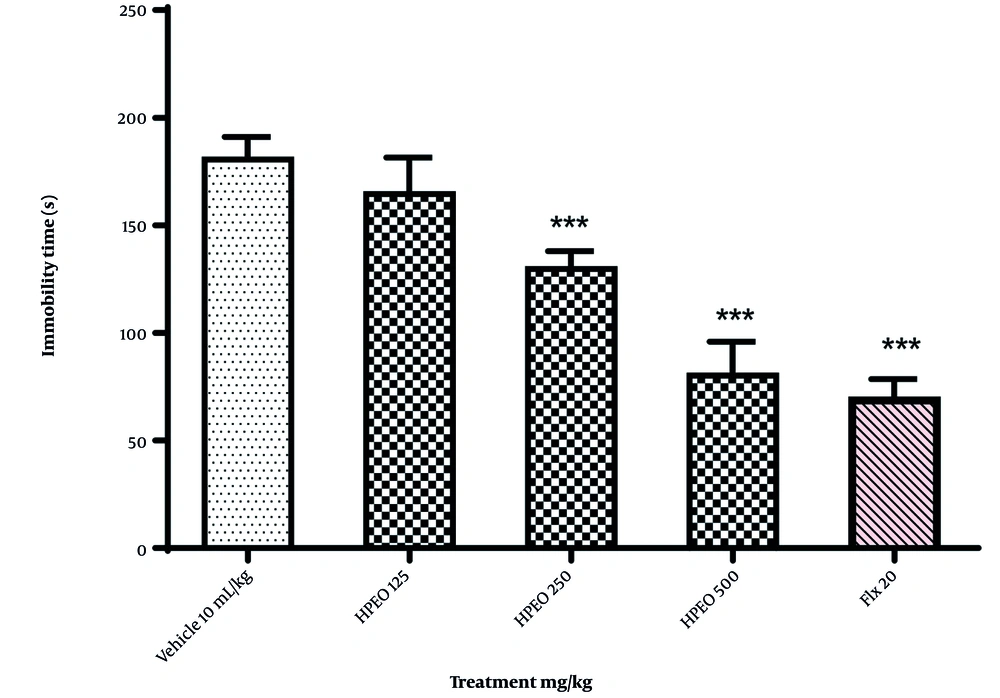
Effects of Heracleum persicum essential oil (HPEO) on immobility time in the forced swim test (FST). The data are presented as mean ± SEM (n = 6). *** P < 0.001 versus the vehicle (control) group
4.2.2. Effects of Heracleum persicum Essential Oil on Animal Locomotion in Open Field Test
| Groups | Dose | Number of Square Crossings | Number of Rearing |
|---|---|---|---|
| Vehicle (control); mL/kg | 10 | 56.0 ± 1.98 | 17.00 ± 1.24 |
| HPEO; mg/kg | 125 | 60.00 ± 3.07 | 15.70 ± 1.36 |
| HPEO; mg/kg | 250 | 61.50 ± 2.23 | 18.70 ± 0.76 |
| HPEO; mg/kg | 500 | 65.30 ± 4.18 | 20.00 ± 0.57 |
Abbreviation: HEPO, Heracleum persicum essential oil.
a Results are expressed as mean ± SEM (n = 6).
4.3. Role of the Dopaminergic System in the Antidepressant Mechanism of Heracleum persicum Essential Oil in the Forced Swim Test
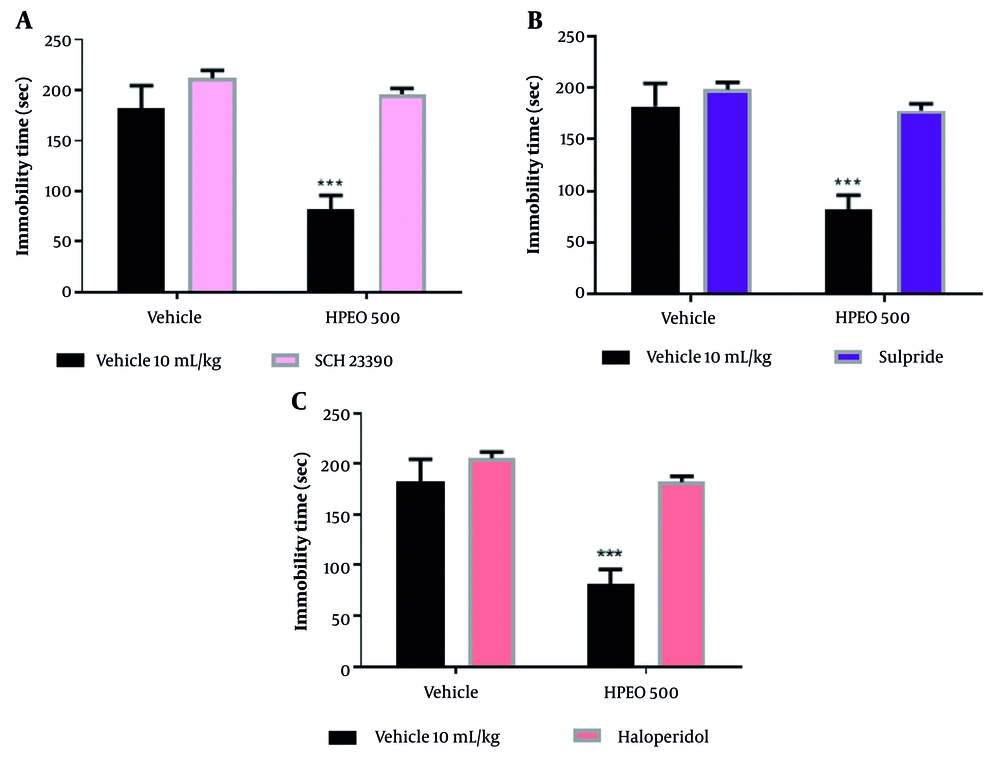
Pretreatment with SCH23390 (0.05 mg/kg; D1 receptor antagonist), sulpiride (50 mg/kg; D2 receptor antagonist), and haloperidol (0.2 mg/kg; non-selective dopamine (DA) receptor antagonist) on the antidepressant potential Heracleum persicum essential oil (HPEO) in the forced swim test (FST). The data are presented as mean ± SEM (n = 6). *** P < 0.001 versus the vehicle group
4.4. Role of the Noradrenergic System in the Antidepressant Mechanism of Heracleum persicum Essential Oil in Forced Swim Test
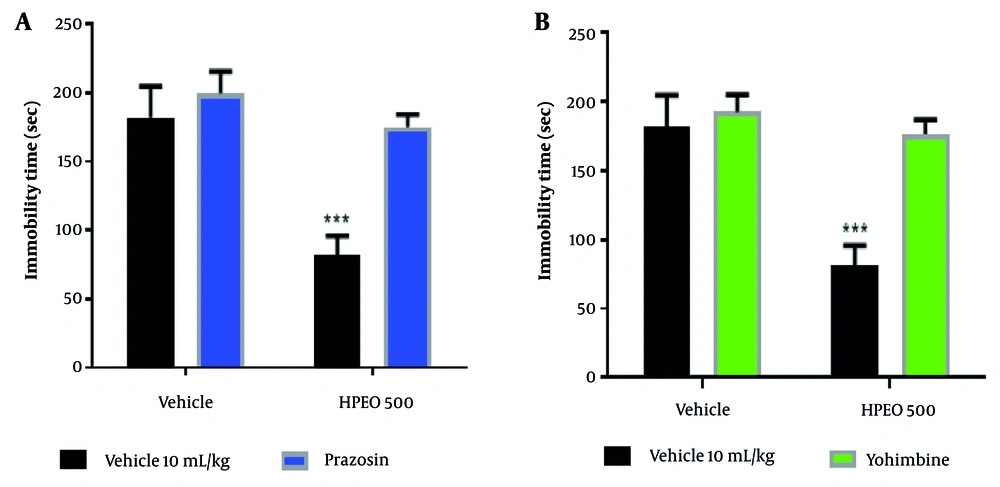
The pre-treatment with prazosin (1 mg/kg; α1 receptor antagonist), yohimbine (1 mg/kg; α2 receptor antagonist) on the antidepressant potential Heracleum persicum essential oil (HPEO) in the forced swim test (FST). The data are presented as mean ± SEM (n = 6). *** P < 0.001 versus the vehicle group.
4.5. Role of the Serotonergic System in the Antidepressant Mechanism of Heracleum persicum Essential Oil in Forced Swim Test
![Pretreatment with WAY100135 (5-HT1A/1B receptor antagonist, 10 mg/kg), ketanserin (5-HT2A serotonergic receptor antagonist, 5 mg/kg), and p-chlorophenylalanine (pCPA) [serotonin (5-HT) synthesis inhibitor, 150 mg/kg] on the antidepressant potential of <i>Heracleum persicum</i> essential oil (HPEO) in the forced swim test (FST). Results are presented as mean ± SEM (n = 6). + p < 0.05 versus the HPEO group (500 mg/kg). *** P < 0.001 versus the vehicle group.](https://brieflands.com/journals/jrps/articles/161974/figures/jrps-161974-i004-F4-preview.webp "Pretreatment with WAY100135 (5-HT1A/1B receptor antagonist, 10 mg/kg), ketanserin (5-HT2A serotonergic receptor antagonist, 5 mg/kg), and p-chlorophenylalanine (pCPA) [serotonin (5-HT) synthesis inhibitor, 150 mg/kg] on the antidepressant potential of <i>Heracleum persicum</i> essential oil (HPEO) in the forced swim test (FST). Results are presented as mean ± SEM (n = 6). + p < 0.05 versus the HPEO group (500 mg/kg). *** P < 0.001 versus the vehicle group.")
Pretreatment with WAY100135 (5-HT1A/1B receptor antagonist, 10 mg/kg), ketanserin (5-HT2A serotonergic receptor antagonist, 5 mg/kg), and p-chlorophenylalanine (pCPA) [serotonin (5-HT) synthesis inhibitor, 150 mg/kg] on the antidepressant potential of Heracleum persicum essential oil (HPEO) in the forced swim test (FST). Results are presented as mean ± SEM (n = 6). + p < 0.05 versus the HPEO group (500 mg/kg). *** P < 0.001 versus the vehicle group.
4.6. Pretreatment with Reserpine in Forced Swim Test
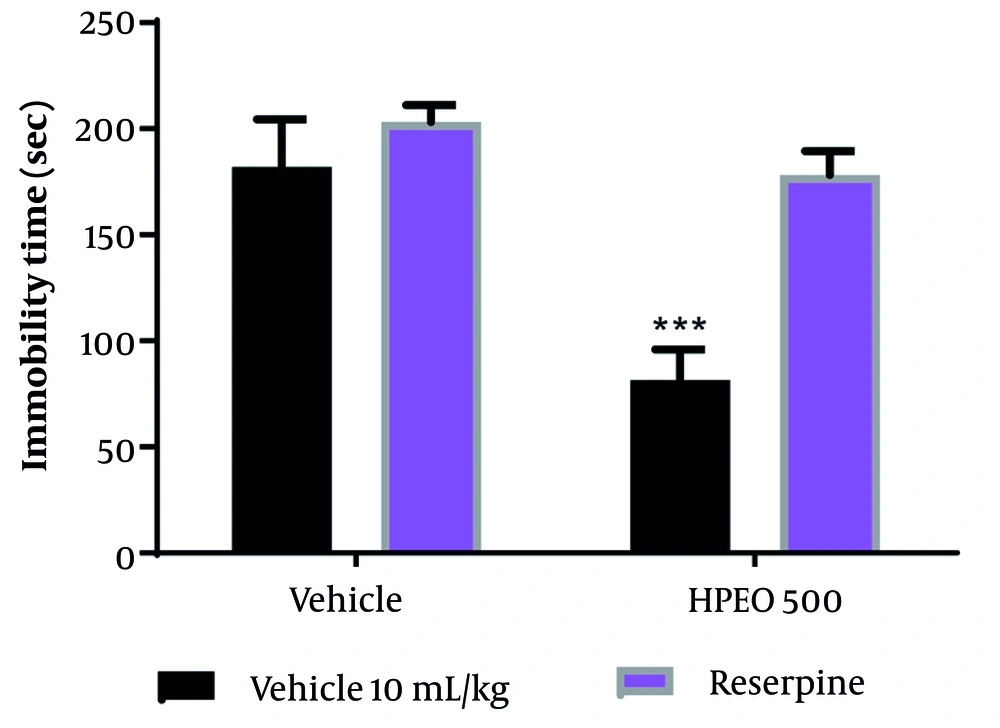
Pretreatment with reserpine (2 mg/kg; brain monoamine depleter) on the antidepressant potential of Heracleum persicum essential oil (HPEO) in the forced swim test (FST). The data are presented as mean ± SEM (n = 6). *** P < 0.001 versus the vehicle group
4.7. Antioxidant Activity
![Effects of <i>Heracleum persicum</i> essential oil (HPEO) on the serum antioxidant enzyme levels [glutathione (GSH), catalase (CAT) and nitric oxide (NO)]. The data are presented as mean ± SEM (n = 6). * P < 0.05, ** P < 0.01 and *** P < 0.001 versus the vehicle group; # P < 0.05 and ## P < 0.01 versus the fluoxetine (Flx) group](https://brieflands.com/journals/jrps/articles/161974/figures/jrps-161974-i006-F6-preview.webp "Effects of <i>Heracleum persicum</i> essential oil (HPEO) on the serum antioxidant enzyme levels [glutathione (GSH), catalase (CAT) and nitric oxide (NO)]. The data are presented as mean ± SEM (n = 6). * P < 0.05, ** P < 0.01 and *** P < 0.001 versus the vehicle group; # P < 0.05 and ## P < 0.01 versus the fluoxetine (Flx) group")
Effects of Heracleum persicum essential oil (HPEO) on the serum antioxidant enzyme levels [glutathione (GSH), catalase (CAT) and nitric oxide (NO)]. The data are presented as mean ± SEM (n = 6). * P < 0.05, ** P < 0.01 and *** P < 0.001 versus the vehicle group; # P < 0.05 and ## P < 0.01 versus the fluoxetine (Flx) group

