Journal of Semnan University of Medical Sciences
The incidence of complications of vaccination in children and infants of Semnan, Iran
Authors

Abstract
Introduction: Vaccination has achieved significant and cost effective success in prevention of infectious disease. Although the current vaccines used are very effective and their side effects are minimal, generally no vaccine is not free from side effects. Incidence of adverse reactions after immunization may discourage people for further immunization of their children. The aim of this work was to determine the incidence of complications of vaccination in children and infants of Semnan, Iran . Materials and methods: In a longitudinal study (prospective), all vaccinated children between September 2006 and March 2007 in 11 vaccination centers were studied. A specific questionnaire, including vaccine recipient profile, type of vaccine, birth weight, feeding and 46 adverse reactions were completed immediately after and 2,4,6,12,18 months later . Results: 5776 children were studied. 29% of the children showed at least one adverse reaction of vaccination. The most common adverse reactions were: fever (24%), pain at injection site (3.8%), swelling (2.5%), erythema (2.5%), induration (2.1%), and ulceration at injection site (2.1%). Incidence of other complications was below 1%. The most dangerous complication of the vaccine was encephalitis (one case) and two cases had febrile seizures. The most cause of hospitalization was adverse reaction of MMR vaccine. Finally, of every four children, one child showed at least one complication that fever was the most common. Conclusion: In general, routine immunization program of Iran country against nine common infectious diseases has lower complications. This complication is mainly mild and transient and do not need any intervention by drugs. However, among these may be rare and dangerous complications such as seizures and encephalitis occur. Hence, a careful follow-up program is required to report complications of immunization
Highlights
Copyright
© 2010, Author(s). This open-access article is available under the Creative Commons Attribution 4.0 (CC BY 4.0) International License (https://creativecommons.org/licenses/by/4.0/), which allows for unrestricted use, distribution, and reproduction in any medium, provided that the original work is properly cited.
Similar Articles
Survey of Complications of Triple Vaccine in Yazd in 2005
Ayatollahi J, Zare A, Kheirandish M. Survey of Complications of Triple Vaccine in Yazd in 2005. Shiraz E-Med J. 2008;9(4):e93753. doi:
A Survey on Measles and Rubella Supplementary Immunization Activities (SIAs) in Iran
Zahraei SM, Gouya MM, Mohammadi M, Tabatabaei SM, Zanganeh M, et al. A Survey on Measles and Rubella Supplementary Immunization Activities (SIAs) in Iran. Health Scope. 2017;6(4):e64184. doi: https://doi.org/10.5812/jhealthscope.64184
Seroprevalence of measles, mumps and rubella Antibodies in 18 months and 6.5 years old children: 6 months after measles-mumps-rubella (MMR) vaccination
Shamsizadeh A, Nikfar R, Makvandi M, Hakimzadeh M, Alisamir M, et al. Seroprevalence of measles, mumps and rubella Antibodies in 18 months and 6.5 years old children: 6 months after measles-mumps-rubella (MMR) vaccination. Jundishapur J Microbiol. 2012;5(4):578-581. doi: https://doi.org/10.5812/jjm.4563
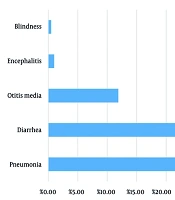
Evaluation of Demographic, Clinical, and Paraclinical Profile of Hospitalized Children with Measles
Soleimani G, Miri A, Soleimanzadeh Mousavi SH, Nabatzehi M, Yaghoubi S. Evaluation of Demographic, Clinical, and Paraclinical Profile of Hospitalized Children with Measles. Arch Pediatr Infect Dis. 2026;14(4):e168921. doi: https://doi.org/10.5812/apid-168921
Complications of Bacillus Calmette-Guérin Vaccination at a University Hospital in Iranian Neonates
Siroosbakht S, Rezakhaniha B. Complications of Bacillus Calmette-Guérin Vaccination at a University Hospital in Iranian Neonates. J Compr Ped. 2019;10(1):e67098. doi: https://doi.org/10.5812/compreped.67098
More by these authors
- Scopus by DOI: 0
Last Update: 3 weeks ago
- Scopus by Title: 5
Last Update: 3 weeks ago
- Scopus by Title (Ref): 0
Last Update: 3 weeks ago
- CrossRef: 0
Last Update: 6 hours ago
- OpenAlex: 0
Last Update: 1 day ago
- OpenCitations: 0
Last Update: 4 days ago