Fulltext
Full Text Available is PDF
Image Credit:Multidiscip Cardio Annal
Authors
Long QT syndrome (LQTS) results from
structural abnormalities in the potassium
channels of the heart, which predispose
affected persons to an accelerated
heart rhythm (arrhythmia). Nifekalant,
a new class III antiarrhythmic agent
developed in US, blocks selectively a
rapidly-activating component of the
delayed rectifier potassium channel
(IKr) in cardiac myocytes, and causes
dose-dependent increase in artrial
and ventricular refractory periods and
repolarization. We report a case of
congenital long QT syndrome (LQTS)
with recurrent ventricular fibrillation
inadvertently treated with intravenous
nifekalant. Treatment neither modified
the rate-corrected QT interval nor
induced torsades de points. Subsequent
genotyping of the patient revealed a
missense mutation in the extracellular
loop between S5 and the pore region of
HERG (K595E). Since HERG encodes
the IKr channel, LQT2 patient may be
more tolerant of pure IKr blockers than
other LQTS genotypes.
© 2010, Multidisciplinary Cardiovascular Annals. This open-access article is available under the Creative Commons Attribution-NonCommercial 4.0 (CC BY-NC 4.0) International License (https://creativecommons.org/licenses/by-nc/4.0/), which allows for the copying and redistribution of the material only for noncommercial purposes, provided that the original work is properly cited.
Hajsheikholeslami F, Yazdani S. Sudden Cardiac Death As a Result of Neglected Hypopituitarism. Int J Endocrinol Metab. 2013;11(2):. doi: https://doi.org/10.5812/ijem.5374
Senja Agusta L, P. Riswati H, R. Akbar R, Rizal A. Bradycardia-Induced Recurrent Torsade de Pointes: When Serenity Turns into Chaosity. Int J Cardiovasc Pract. 2018;3(4):e130274. doi: https://doi.org/10.21859/ijcp-03045
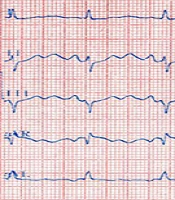
Tabaghi S, Akbarzadeh MA. Methadone-Induced QT Interval Prolongation and Torsades de Pointes. Int J Cardiovasc Pract. 2021;6(2):e130693. doi: https://doi.org/10.5812/intjcardiovascpract-130693
Yan Y, Wu J, He D, Sun K, Li L. Epilepsies Associated with KCNQ2 Complicated by Supraventricular Tachycardia Due to a De Novo Mutation in KCNQ2. Inn J Pediatr. 2018;28(6):e74214. doi: https://doi.org/10.5812/ijp.74214
Eftekhari SS, Hashemizadeh SM, Nokhbe Zaeim H, Feizi Barnaji L. The Effects of Flecainide on QT Interval and Dispersion in Brugada Syndrome: Insights from a Retrospective Analysis. Int J Cardiovasc Pract. 2025;10(1):e160642. doi: https://doi.org/10.5812/intjcardiovascpract-160642
Last Update: 4 days ago
Last Update: 4 days ago
Last Update: 4 days ago
Last Update: 8 hours ago
Last Update: 11 hours ago
Last Update: 5 days ago