


1. Background
Sexual education is one of the most important subjects in the field of education, with a great impact on the formation of human personality, thoughts, emotions, and behaviors (1). Sexuality education is a lifelong process that requires family as the first source of life skills and children's upbringing to provide the necessary information and to prepare their children for upcoming challenges related to sexuality and relationship issues (2). However, researchers reported that many parents are challenged to answer their children's sexual questions and have little information in this field (3, 4). Also, it is obvious that in order to realize sexual education based on Iranian culture and the Islamic society of Iran, a meaningful, harmonious, and coherent set of attitudes, knowledge, and skills should be combined. In other words, education should be presented in the form of a model (5). According to national research on specialized training programs for various groups, as well as the use of virtual platforms to interact with institutions, groups, and experts from different fields, an initial model called Family-oriented and Developmental-based Sexuality Education (F&DSE) has been developed. This model can be further refined to meet cultural, sociological, and psychological needs (6).
The F&DSE model assigns the main responsibility of sexual education to the family while also recognizing the importance of other institutions, such as educational institutions and the media. It emphasizes Iranian and Islamic culture and views sexual education as a continuous process of development. This model can serve as a suitable and unique native approach to sexual education for Iranian families. Its preliminary effectiveness has been confirmed in increasing participants' knowledge, attitudes, and sexual skills (6). Also, the concepts of this model can make sexual education tools suitable for Iranian society. In order to evaluate parents' competence and ability to provide the sexuality-based guide and information, an evaluation instrument that can present criteria for an effective education process was essentially and urgently needed (7). Although there are many tools related to sex and sexuality issues (8, 9), there are very few scales related to parents and the assessment of the family's overall abilities regarding sexuality education. In Iran, F&DSE programs are few (10), and relevant measuring tools that can be utilized to evaluate its effect are scant. Existing measures and scales include a psychometric for parent-perceived sexuality education exigency that reported the effect of sexuality education, principle, content, and source of sexuality education as essential topics to be covered in the Iranian context (4). The research suggested notable findings, but a holistic viewpoint suggests that feeling about exigency does not translate into skillful effort toward sexuality-based parenting. In addition to understanding how parents perceive the significance of sexuality education and its importance, there is also a need for another tool to evaluate their knowledge and attitude and understand where to start further intervention or modification. Another questionnaire was developed to be used as a measure of parents' knowledge and behavior about sexuality, which was derived from Islamic teaching (11). However, it may not apply to religious minorities living in the country. Parent comfort is another aspect of family-oriented intervention. In this regard, Youzbashi et al. (12) already adopted and readjusted a questionnaire that measures parent comfort in providing sexual education to their children according to the Iranian cultural context. Therefore, skills are necessary for someone to be comfortable in the process of sexuality discussion.
The mentioned questionnaires were limited to a single aspect of sexuality education and did not measure the core attitudes and skills necessary for enhancing children's abilities related to sexuality issues. Abdollahzadeh and Keykhosravi (13) developed a questionnaire for parent sexuality education style, which explains how strict, permissive, or authoritative the parents are in terms of sexuality education. The questionnaire is helpful in identifying the present state of Iranian society, but it does not indicate the potential they have in nurturing the necessary skills in their children.
Overall, the review of sexual education questionnaires shows that there is a need for a sexual education questionnaire that addresses the native and Islamic culture of Iran, measures various knowledge, attitudes, and skills of sexual education, and has an educational aspect. Therefore, it was decided to carry out this study.
2. Objectives
The study was conducted on the construction and psychometric characterization of a Family-oriented and Developmental-based Sexuality Education Questionnaire for Iranian families (online national research).
3. Methods
3.1. Design
This descriptive research involved developing an instrument for validation and assessing its reliability.
3.2. Participants
The statistical population of this study included all Iranian families in 2021 - 2022 (the online distribution of questionnaires was done on 11/18/2021, and the end date was 3/19/2022). Considering the multi-ethnicity in Iran and the exigency of observing health protocols during the coronavirus epidemic, the survey was conducted virtually. Notices and questionnaires were distributed on family-related virtual platforms. In this way, first, the online link of the questionnaire was provided to university colleagues and teachers as well as students living in all provinces of Iran who had previous cooperation with the researchers. Then, these people put the link of the questionnaires in the family groups of the province where they lived. Individuals voluntarily logged into the webpage (Google form) and responded to the items. Finally, 1024 completed questionnaires were used for analysis in this research. The inclusion criteria were being married and having at least one child. The exclusion criterion was an incomplete questionnaire.
3.3. Data Collection
The procedure of developing the questionnaire was done by reviewing 41 sexuality education books, several articles, and measures related to the current topic as well as the knowledge of researchers in the field. Keywords and variables applicable to the questionnaire were extracted, and three dimensions of sexuality education, including sexuality awareness, sexual attitude, and sexuality education skills, emerged. In order to evaluate the item validity and content relevance, 120 items were specified and presented to six faculty members at the departments of psychology and educational sciences who were recognized to be experts in the subject matter. Finally, 96 out of 120 items were confirmed. The scale was preliminarily administered to 30 people selected using a convenience sampling method. The questions were reduced to 74 due to the responses and administered to the main sample. The responses were analyzed using statistical software SPSS 26 and AMOS 24. Incomplete questionnaires were removed, and the analysis was performed on questionnaires that were completed. In this research, ethical considerations were observed, including free and voluntary participation in the research, compliance with the principle of trustworthiness and confidentiality of the participants' information, compliance with the privacy of the participants, and selection of the sample without bias. In addition, this research has been approved by the Ethics Committee of the Ferdowsi University of Mashhad with code IR.UM.REC.1401.003. The parent self-efficacy questionnaire and sexuality education style questionnaire were used to assess the criterion validity of the actual questionnaire. An explanation of each is mentioned below.
3.4. Tools
Personal Information Form: The form included 11 items on the students' sociodemographic characteristics (e.g., age, gender, education level).
3.4.1. F&DSEQ
The F&DSEQ was designed by Asgharinekah and Samimi to measure knowledge, attitude, and skills related to sexuality education. The initial version consisted of 76 items. After analysis of responses and removal of unnecessary items, 58 remained to constitute the final questionnaire. They included questions related to the perceived significance and exigency of sexuality education, breastfeeding skills, diaper replacement skills, skills related to bathing and toileting, sleeping independence skills, privacy internalization skills, prevention of abuse, sexual identity education, media and sexuality education, peer relationship, pre-pubertal and pubertal skills, and heterosexual relationship. The items were assessed using a Likert scale ranging from 1 (completely disagree) to 6 (completely agree). Items 2, 7, 10, 12, 13, 19, 48, 50, 51, 52, 53, 55, and 56 had reverse scoring. The minimum score was 58, and the maximum score was 348. The higher score indicated higher knowledge, attitude, and skills in sexuality education. Construct validity of the questionnaire was also evaluated using the factor analysis method with a sample of 1024 parents from the provinces throughout Iran (northern provinces 71, southern provinces 147, eastern provinces 274, western provinces 88, and central provinces 444). Factor analysis results indicated that 11 factors explained 58.319% of the variance in 58 questions; these 11 factors fell into three components: Knowledge, attitude, and sexual education skills, supporting the construct validity of the questionnaire. The results of the Pearson correlation coefficient indicated a significant relationship between the total score of the F&DSEQ and other scales (i.e., sexuality education style questionnaire and parent self-efficacy questionnaire) at the level of 0.001. The correlation was -0.39 with the permissive sexual education style, -0.25 with the strict sexual education style, 0.47 with the authoritative sexual education style, and 0.37 with the Parental Self-efficacy Scale. The Cronbach's alpha reliability of the questionnaire was 0.92. A preliminary study to assess the reliability of this item using the test-retest method showed a 0.96 score in the first stage and 0.94 in the next four weeks (6).
3.4.2. Parental Sexual Education Style Questionnaire
This scale was designed by Abdollahzadeh and Keykhosravi in 2019. This scale has 33 items regarding 3 strict sexual education styles (questions 28, 25, 23, 22, 20, 18, 15, 12, 10, 6 f. 3, 1), permissive sexual education (questions: 32, 31 measures 30, 29, 26, 24, 16, 13, 9, 8, 2), and authoritative sexual education style (questions 32, 27, 21, 19, 17, 14, 11, 7, 5, 4). The questionnaire is scored based on a 5-point Likert scale from zero (completely disagree) to five (completely agree). The higher score in each of the sexual education styles indicates having the same style, and the total score in this questionnaire has no meaning. The factor analysis of this version indicated that these three factors could explain 20.32% of the variance in 33 items of the questionnaire. Cronbach's alpha coefficients were 0.75, 0.73, 0.76, and 0.75 for the whole questionnaire and the strict, liberating, and authoritative sexual education styles, respectively. Varimax's rotated matrix showed that all items related to the styles could be utilized (13).
3.4.3. Parental Self-efficacy Scale
This scale was developed by Dumka et al. in 1996. The tool was designed to assess parental self-efficacy, with ten questions including five positive phrases and five negative phrases, and a general parental sense of confidence in the parenting process (14). Its scoring is based on the Likert scale from 1 (rarely) to 7 (always), in which the minimum and maximum scores are 10 and 70, respectively. A high score on this scale indicates high self-efficacy. Taylor (15) reported a 0.54 reliability coefficient for the scale using Cronbach's alpha method. Hamdi Khosroshahi and Merç (16) also obtained a 0.76 reliability coefficient for the same scale in Iran.
3.4.4. Statistical Analysis
The statistical analysis was conducted using the Pearson correlation and EFA analysis in SPSS-26 and AMOS-24.
4. Results
The sociodemographic data showed that the study sample consisted of 1024 participants (145 males and 879 females, mean age 37.73 ± 7.54 years old). Also, 181 participants had a diploma degree, 448 had a bachelor's degree, 311 had a master's degree, and 84 had a Ph.D. More information is mentioned in Table 1.
Table 1.Sample (Family) Characteristics (N = 1024)
| No. (%) or Mean ± Standard Deviation | |
|---|---|
| Gender | |
| Male | 145 (14.2) |
| Female | 879 (85.8) |
| Patient's age | 37.73 ± 7.54 |
| Patient's education | |
| Diploma | 181 (17.7) |
| Bachelor's degree | 448 (43.8) |
| Master's degree | 311 (30.4) |
| Ph.D. | 84 (8.2) |
| Province of residence | |
| Northern provinces | 71 (6.9) |
| Southern provinces | 147 (14.4) |
| Central provinces | 444 (43.4) |
| Eastern provinces | 274 (26.8) |
| Western provinces | 88 (8.6) |
4.1. Item Validity
The content validity of F&DSEQ has been confirmed by professors and experts in this field. Experts were 6faculty members in the departments of psychology and educational sciences who were recognized to be experts in the subject matter. Three of them were well-known psychologists and researchers in the field of sex education, two were associate professors in the field of clinical psychology, and one was a professor of educational psychology. The items that were not suitable, according to experts, were removed. Also, the Pearson correlation between the F&DSEQ and the parent sexuality education style questionnaire and parent self-efficacy scale was used to obtain criterion validity. Accordingly, the correlation of the F&DSEQ was -0.39 with permissive sexual education style, -0.25 with strict sexual education style, 0.47 with authoritative sexual education style, and 0.37 with parental self-efficacy, all of which were significant at the 0.001 level.
4.2. Exploratory Factor Analysis
The F&DSEQ with 76 items was validated using exploratory factor analysis preceded by the Kaiser-Meyer-Olkin sample size adequacy test and Bartlett's spherical test, which indicated the suitability of the correlation matrix and sample size for exploratory factor analysis. As the necessary assumptions were met, factor analysis was employed using the principal component analysis and varimax rotation method. By examining the factor loading of the rotating variables, it was determined that:
(1) Some factors have less than 3 items
(2) Some items have a factor load on two factors at the same time
(3) Some also have poor factor load and have coefficients less than 0.40
(4) Some items are placed next to irrelevant ones
Considering the mentioned observation, 16 items (3, 7, 19, 31, 40, 42, 45, 46, 48, 53, 54, 55, 56, 59, 66, and 73) were excluded. After deleting these items, factor analysis (second-order factor analysis) was performed using principal component analysis and varimax rotation. Table 1 shows the results of KMO and Bartlett's spherical test. The KMO value is above 90, and Bartlett's spherical test is significant (0.0001), indicating the suitability of the data for a factor analysis.
The scree plot diagram extracted from the factor analysis also shows that eleven factors or components can be selected for the final analysis (Figure 1).
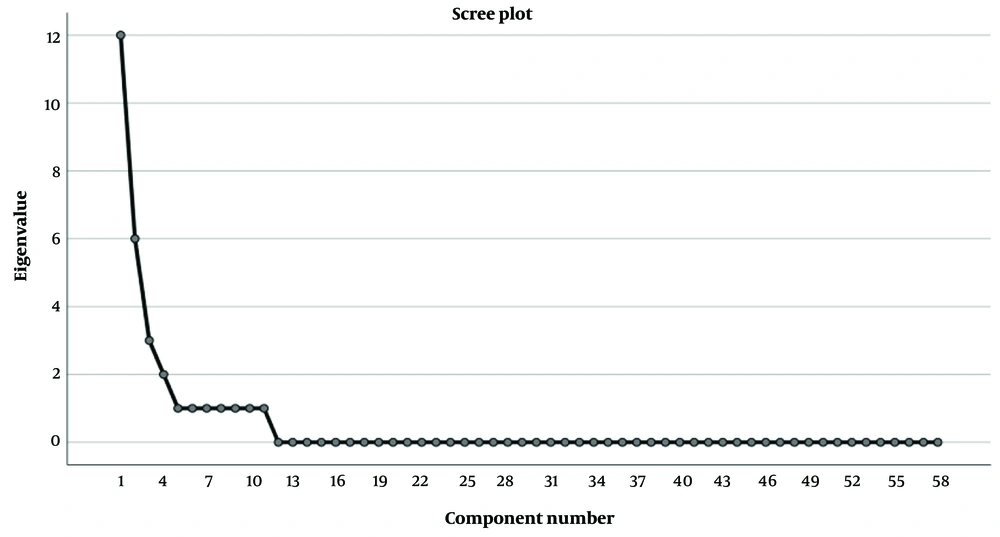
Figure 1.
Scree plot
Table 2 shows the extracted factors, the specific value, and the percentage of variances explained by each factor. The table shows that each of these factors has a specific value higher than 1, which is a good figure. As specified in Table 2, the final factor analysis resulted in the extraction of 11 factors, which explained 58% of the total variance of the questionnaire.
Table 2.Results of Principal Component Factor Extraction
| Component | Initial Eigenvalues | Rotation Sums of Squared Loadings | ||||
|---|---|---|---|---|---|---|
| Total | % of Variance | Cumulative (%) | Total | % of Variance | Cumulative (%) | |
| 1 | 12.492 | 21.538 | 21.538 | 6.367 | 10.978 | 10.978 |
| 2 | 6.201 | 10.692 | 32.230 | 5.605 | 9.664 | 20.642 |
| 3 | 3.334 | 5.749 | 37.979 | 3.772 | 6.504 | 27.146 |
| 4 | 2.350 | 4.052 | 42.031 | 2.781 | 4.795 | 31.942 |
| 5 | 1.923 | 3.315 | 45.346 | 2.755 | 4.750 | 36.692 |
| 6 | 1.470 | 2.535 | 47.881 | 2.543 | 4.384 | 41.076 |
| 7 | 1.420 | 2.449 | 50.330 | 2.300 | 3.965 | 45.041 |
| 8 | 1.336 | 2.303 | 52.633 | 2.278 | 3.928 | 48.969 |
| 9 | 1.163 | 2.004 | 54.638 | 2.257 | 3.892 | 52.860 |
| 10 | 1.090 | 1.880 | 56.518 | 1.593 | 2.747 | 55.607 |
| 11 | 1.045 | 1.802 | 58.319 | 1.573 | 2.712 | 58.319 |
Table 3 provides the rotated factor matrix and factor loading of each item, as well as Cronbach's alpha values. To calculate Cronbach's alpha, the information of all 1024 people was evaluated. Based on Table 3, the Cronbach's alpha of the components was between 0.65 and 0.92.
Table 3.Rotated Factor Matrix and Factor Loading of Each Item and Cronbach Alpha
| Factors | Related Questions | Cronbach Alpha |
|---|---|---|
| 1 | 1, 2, 4 | 0.65 |
| 2 | 5, 6, 8, 9, 10, 11, 12, 13 | 0.79 |
| 3 | 14, 15, 16, 17, 18, 19 | 0.78 |
| 4 | 20, 21, 22, 24 | 0.66 |
| 5 | 23, 25, 26, 27 | 0.78 |
| 6 | 28, 29, 30 | 0.79 |
| 7 | 34, 35, 36, 37, 38, 39, 41, 43, 44, 47, 31 | 0.88 |
| 8 | 50, 51, 52 | 0.93 |
| 9 | 60, 61, 62 | 0.65 |
| 10 | 57, 58, 63, 64, 65 | 0.85 |
| 11 | 33, 49, 67, 68, 69, 70, 71, 72, 74 | 0.92 |
| Total | 0.92 | |
5. Discussion
The present study was conducted to construct and determine the psychometric properties of the family-oriented and developmental-based sexuality education questionnaire for Iranian families. This research was done in two stages: construction and standardization. In the construction phase, a preliminary questionnaire with 58 questions was prepared, while the standardization phase finalized the structure of the instrument, assessed psychometric properties, and extracted normative tables. In the standardization phase, the results of the exploratory factor analysis indicated the existence of eleven factors that had the necessary compatibility with the theoretical foundation of the questionnaire. The results of exploratory factor analysis showed that the indicators are in a suitable range and consistent with the results obtained from previous theoretical tools (7). The indicators of exploratory factor analysis showed that the factors in the research data can be separated from each other to a suitable extent, and they can be extracted from the analyzed matrix. In other words, although the concepts and structures in the questionnaire are conceptually and statistically related, the existing questions for measuring them have been designed in a way that allows for their distinction and separation from one another. At the same time, answering the questions by the sample group has been done in such a way that each of them has a unique amount of variance, differentiating them from other questions. In other words, the questions used do not repeat the same concept as different expressions.
The results of exploratory factor analysis showed that the extracted factors explained 58.319% of the total variance of the questionnaire, according to the researchers (17). The minimum acceptable value for this index is 50%. This amount of variance is considered reasonable in the first step of creating a new questionnaire, and it has also been reported in similar studies of creating a questionnaire and implementing it on parents (14). Cronbach's alpha value of the extracted factors in the eleven factors of parents' sexual education styles is in the medium and high range. It indicates the acceptable internal consistency of the designed questionnaire. Since each of these coefficients represents the clean index of the questions (18), this index can be considered the power and sensitivity of each question in recognizing the differences between people. The vast majority of the resulting indices in this range are more than 0.3. Correlation coefficients between sex education styles and the Parental Self-efficacy Scale of Dumka et al. (14) and the Parental Sexual Education Style Questionnaire of Abdollahzadeh and Keykhosravi (13) confirm the convergent and divergent validity of this questionnaire and the compatibility of the factors with the theoretical and research background.
The F&DSEQ is made up of 58 items grouped into eleven factors classified into three general factors (sexuality education knowledge, attitude, and skills) to have adequate internal consistency and validity. The essential indicators of knowledge and attitude include the perceived importance and urgency of sexuality education, understanding the role of the family in sexuality education, comprehension of children's natural curiosity about sexuality, parents' knowledge and attitude towards respecting children's privacy in various situations such as breastfeeding and toileting, attitude towards age-appropriate sexual exploration, knowledge of how to address it, understanding the biological and logical basis of gender differences, development of a healthy gender identity, parents' knowledge and attitude towards creating a supportive family environment that promotes sexual morality, knowledge of how to address sexual assault and abuse, dispelling misconceptions about sexual issues, providing puberty education, understanding the pathology and management of masturbation, and recognizing its impact on family life. The skill dimension of the questionnaire also includes skills related to providing sexuality education during breastfeeding, bathing, and toileting. It also includes the development of independent sleeping habits, respect for privacy, the ability to address children's sexual self-stimulation activities, and the skill of answering children's questions and discussing issues related to sexuality with them. The following criteria were derived from research studies that identified Iranian context-appropriate topics to be covered in sexuality education, most of which emphasize implementing sexuality education in a natural context (13).
Creating a standard questionnaire using F&DSE can create new ways to expand and conduct research in the field of sexual education in Iranian society. Considering that the main purpose of this questionnaire was to measure the parents' sexual education style in the non-clinical population, this tool is helpful for surveying and developing educational and preventive sexual education programs. Despite the practical results obtained, the current research has some limitations. This research was only conducted on parents and was not validated for other groups, such as students and professionals. In addition, due to the collection of questionnaires during the COVID-19 epidemic, the results may be different from normal times. Also, considering that this questionnaire has been validated for the first time in Iran using online sampling, it is suggested to conduct other research using face-to-face sampling and compare the results of this research with it. In addition, considering the acceptable psychometric properties of this questionnaire, it is suggested that experts in the field of sexual education use this questionnaire in their research.
5.1. Conclusions and Recommendations
After carrying out further analyses, we estimated the measuring tool with adequate psychometric properties that give it validity for the assessment of parents' and professionals' sexuality education knowledge, attitudes, and skills. The three dimensions evaluated show good internal consistency, which guarantees the instrument's reliability. However, there might be a need for an additional instrument that would measure children's response to parental interventions.
